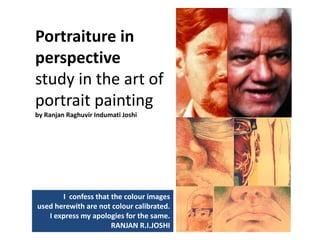
Portraiture in 
perspective              
study in the art of 
portrait painting
by Ranjan Raghuvir Indumati Joshi  
I  confess that the colour images                   
used herewith are not colour calibrated. 
I express my apologies for the same. 
RANJAN R.I.JOSHI  
History :  Portrait painting
The oldest known portrait in the world comes from Czech Republic.          
It shows a woman face and was made from mammoth ivory and                
is about 26,000 years old. Some of the earliest surviving painted    
portraits of people, who were not kings or emperors, are the funeral 
portraits that survived in the dry climate of Egypt's Fayum district.              
These are almost the only paintings from the classical world that have  
survived, apart from frescos, though many   sculptures survive, and 
portraits on coins.
The art of the portrait flourished in Ancient Greek   and     
especially Roman sculpture, where sitters demanded                
individualized and realistic portraits, even unflattering ones.              
During the 4th century, the portrait began to retreat in favor of an 
idealized symbol of what that person looked like.                             
(Compare the portraits of  Roman Emperors Constantine 
I and  Theodosius I at their entries.)  In the Europe of the Early Middle 
Ages representations of individuals are mostly    generalized. True 
portraits of the outward appearance of individuals re‐emerged                  
in the late Middle Ages, in tomb monuments, donor portraits, miniatures 
in illuminated manuscripts and then panel paintings.
Moche culture of Peru was one of the few ancient civilizations which 
produced portraits. These works accurately represent anatomical 
features in great detail. The individuals portrayed would have been 
recognizable without the need for other symbols or a written reference 
to their names. The individuals portrayed were members of the ruling 
elite, priests, warriors and even distinguished artisans.[1]
They were represented during several stages of their lives. The faces of 
gods were also depicted. To date, no portraits of women have been 
found. There is particular emphasis on the representation of the details of 
headdresses, hairstyles, body adornment and face painting.
One of the best‐known portraits in the Western world is Leonardo da 
Vinci's painting titled Mona Lisa, which is a painting of Lisa del Giocondo. 
The world's oldest known portrait was found in 2006 in 
the Vilhonneur grotto near Angoulême and is thought to be 27,000 years 
old.[2][3]
THE DEFINITION ON THE INTERNET
Portrait ˈpɔːtrɪt/ noun
1. a painting, drawing,
photograph, or engraving of a
person, especially one depicting
only the face or head and
shoulders.
2. denoting a format of printed
matter which is higher than
it is wide.
You can print landscape and
portrait pages in the same
document
A portrait is
a painting, photograph, sculpture,
or other artistic representation of a
person, in which the face and its
expression is predominant. The
intent is to display the
likeness, personality, and even the
mood of the person. For this
reason, in photography a portrait
is generally not a snapshot, but a
composed image of a person in a
still position. A portrait often shows
a person looking directly at the
painter or photographer, in order
to most successfully engage the
subject with the viewer
THEDEFINITIONONTHEINTERNET
Portrait photography[edit]
Main article: Portrait photography
Portrait photography is a popular commercial industry all over the world. Many people enjoy having professionally 
made family portraits to hang in their homes, or special portraits to commemorate certain events, such as graduations 
or weddings. Since the dawn of photography, people have made portraits. The popularity of the daguerreotype in the 
middle of the 19th century was due in large part to the demand for inexpensive portraiture. Studios sprang up in cities 
around the world, some cranking out more than 500 plates a day. The style of these early works reflected the technical 
challenges associated with 30‐second exposure times and the painterly aesthetic of the time. Subjects were generally 
seated against plain backgrounds and lit with the soft light of an overhead window and whatever else could be 
reflected with mirrors.  As photographic techniques developed, an intrepid group of photographers took their talents 
out of the studio and onto battlefields, across oceans and into remote wilderness.William Shew's Daguerreotype 
Saloon, Roger Fenton's Photographic Van and Mathew Brady's What‐is‐it? wagon set the standards for making 
portraits and other photographs in the field.
Sharaku: Actor Ichikawa Ebozo as Takemura Sadanoshin, 1794… P1
Roman‐Egyptian funeral portraitof a young boy
Self-portraiture[edit]
Main article: self-portrait
When the artist creates a portrait of him- or herself, it is
called a self-portrait. Identifiable examples become
numerous in the late Middle Ages, but if the definition is
extended the first was by
the EgyptianPharaoh Akhenaten's sculptor Bak, who
carved a representation of himself and his wife Taheri c.
1365 BC. However, it seems likely that self-portraits go
back to the cave paintings, the earliest representational
art, and literature records several classical examples
that are now lost.
Personality type
From Wikipedia, the free encyclopedia
This article is about the generic aspects of type theory.
For the book by Jung, see Psychological Types.
Personality type refers to the psychological classification
of different types of individuals. Personality types are
sometimes distinguished from personality traits, with the
latter embodying a smaller grouping of behavioral
tendencies. Types are sometimes said to
involve qualitative differences between people, whereas
traits might be construed
asquantitative differences.[1] According to type theories,
for example, introverts and extraverts are two
fundamentally different categories of people. According to
trait theories, introversion and extraversion are part of
a continuous dimension, with many people in the middle.
Definitions
Perspective is the art of drawing so as to give the          
effect of solidity and relative distance and size.
Perspective is a word, but also a concept, describing how 
things look depending on where things are. Things         
that are closer to us always look bigger than they         
would if they were far away; a beetle can look               
bigger than a bus if the beetle is close enough,                     
or the bus is far enough away.
Things also appear to change shape depending on      
where they are in relation to you (or where you are in         
relation to them). A table will look  very different                 
if you are standing on top of it, or sitting on a chair    
looking at it, or hiding underneath it. This applies to most 
other things.
Try looking at different things from different angles and 
distances in order to see how much they appear to change.
We know where things are because of their shape and size. 
We don't need to be able to draw, to be good at using our 
understanding of space. The only reason anyone can catch 
a ball, or kick it, or even   find it, is because we are able to 
judge where it is, because of how it looks, and how it 
seems to change shape and size as it moves.                    
Even animals are good at perspective, otherwise dogs 
couldn't catch sticks.
The problem with perspective is not using it, but using it so 
that drawn pictures of things look right ‐ drawing things "in 
perspective".
Artists learnt to use perspective a few hundred years 
ago. If you look at old paintings ‐ before the                  
15th century ‐ you will see that most of them are 
pictures of things on a flat background. There doesn't 
seem to be much space in them. You can see examples  
of paintings which have bigger and smaller things in 
them before the 15th century, but nothing that    
suggests depth or the use of "perspective" as an            
art tool. In Italy during the Renaissance,                    
people started to wonder why things looked the way 
they looked, and to wonder how you could make 
pictures look more like the world we see around us. 
Some artists invented the system that we 
call perspective for describing things visually.
We use the same system today, in computer programs 
and design, this is because it still looks "right". But it is 
only a system for making things seem to look "right". You 
can make a drawing look like anything you want, you can 
take a picture of anything you want, but every time you 
do these things you are telling a sort of lie, because you 
are creating an illusion. We know that all drawings, 
paintings and photos are really just flat surfaces with 
marks on them. Perspective is only a system and some of 
the things about it aren't quite "right".
Stanislaw  Masłowski 
(1853‐1926), Portrait 
of Artist‘s Wife,      
dry point, ca_1905, 
11.5x7.7_cm
Sharaku: Actor Ichikawa Ebozo 
as Takemura Sadanoshin, 1794
The portrait on 
the left is nearly 
thousand years 
old and on the 
right two 
hundred years. 
The realistic 
approach of 
Greek and 
Roman whereas 
emotional 
aspect of Orient 
or Asia.
Some of the earliest 
surviving painted    
portraits of people, 
who were 
not kings or                
emperors, are the 
funeral portraits that 
survived in the dry 
climate of 
Egypt's Fayum district.
Schuffenecker’s “Emile Bernard”
Look at these  two images  and observe the details in the background of main portrait…
Émile Schuffenecker (8 December 1851 – 31 July 1934) 
was a French Post‐Impressionist artist, painter, art 
teacher and art collector. A friend of Paul 
Gauguin and Odilon Redon, and one of the first 
collectors of works by Vincent van Gogh, Schuffenecker 
was instrumental in establishing the Volpini exhibition, 
in 1889. His own work, however, tends to have been 
neglected since his death—and even worse, recent 
season campaigns in the media have reactivated 
resentments virulent since the late 1920s, when 
Schuffenecker was suspected to have imitated the work 
of other contemporary artists, among them, Van 
Gogh.[citation needed] Still a contentious issue, it has not 
been established whether he produced forgeries. 
Meanwhile, serious scholarly research at least has 
provided the base for a sober art historical approach to 
Schuffenecker's life and work.
220px‐Schuffenecker_self_portrait
This is the self portrait of the artist himself…
250px‐Reproduction‐of‐the‐1805‐Rembrandt‐Peale‐
painting‐of‐Thomas‐Jefferson‐New‐York‐Historical‐
Society 1
800px‐VanGogh_1887_Selbstbildnis
Look at these versions…
What is Patterned drawing ?  A pattern is meant to copy the defined visual form.
I have been studying  head study since my art school days (now four decades in this visual art) 
lead me into the world of  PORTRAIT  PAINTING study. Let me correct if I am wrong I found that 
by copying famous artist works or by following some conservative rules in the art academics 
without any insights such as we are blindly asked to take ¾ angle, eye level and top spot light 
(natural sun light or room light) mostly facing to the left to be arranged for any model. Is not 
Patterned drawing ?  A pattern is meant to copy the defined visual form. Mostly  when many 
demonstrations of  PORTRAIT PAINTING when viewed  one can notice my said observations. Do 
we have to strictly follow the definition of PORTRAIT PAINTING ? I am trying to curiously 
investigate these  myths in next pages. Viewers are  welcome to contribute their point of views.     
Late Prof.R.P.Joshi 
my father always 
use to teach me to 
study eyes its 
highlights and iris 
whenever we 
discusses about 
HEAD‐STUDY or 
PORTRAIT 
PAINTING. These 
are 11 examples of 
his work in 
plaster,oil,pastel or 
water colours.
Unknown Artist
Unknown Artist
On the left 
two pictures 
are studio 
shoot and 
on the right 
is actual 
painting by 
hand.       
We can 
observe the 
difference 
between 
these 
images. 
Look at         
these examples which 
has redefined the art of 
Portrait Painting.
Artist is unknown but the portrait is 
extremely expressive. The above eye level 
perspective composition creates 
immediate dialogue  
This skin tone is a challenge to 
demonstrate in portrait painting 
or photography.
It’s difficult to find crest shadow, cast 
shadow, reflected light and highlight  in such 
portrait painting or photography.
Devdatta  D. Padekar 
Devdatta  D. Padekar  Unknown Artist
Artist  
Devdatta is 
exploring 
different eye 
levels with 
result 
portraits 
became  
animated and 
interactive. 
The portrait  
on the right is 
bellow eye 
level  more 
like an 
illustration 
saying 
something to 
the viewer.  
Artist D.T. PADEKAR by Prafull Sawant who has captured the essence of  model’s personality in a painterly manner. 
Frans Hals the Elder (/hɑːls/;[1] Dutch: [ɦɑls];        
c. 1582 – 26 August 1666) was a Dutch Golden 
Age portrait painter who lived and worked 
in Haarlem. He is notable for his 
loose painterly brushwork, and he helped 
introduce this lively style of painting  into 
Dutch art. Hals played an important role in the 
evolution of 17th‐century group portraiture.
This artist not only 
captures the mood 
but the perfect 
placement of 
highlight on the iris 
and the skin tone. 
Unknown Artist
Unknown Artist
Interesting to compare these two visuals.
Jan Van Eyck
Mexican artist‐Diego Rivera self portrait
Mexican artist‐Diego Rivera painted  this portrait  painting as 
tribute of  forgotten Indian revolutionary patriot  Dr. Khankhoje 
who  became god like figure in Mexico due to his conurbation of 
making Mexico self sufficient in Agriculture .                                    
(Ref. “Dr. Khankhoje –nahi chira” by Veena Gavankar in Marathi.)
Mark model looking to the left but eyes gazing to the right. 
Unknown Artist
Speed portrait painting by Carol Louis Smith
Interesting to 
compare these two 
visuals.
Mark model looking         
to the left. 
Mark model looking to the right. 
This is the portrait of 
J.WALTER THOMSON    
the founder of the     
world famous    
advertising agency          
by the same name.     
Artist unknown to me.
Mark model looking to the left but 
eyes gazing right.
This is the photograph of 
India’s famous  portrait painter 
Suhas Bahulkar while 
demonstrating the portrait 
from life. On the top right is his 
one of the commissioned 
portrait painting works of the 
famous Indian Industrialist     
JRD TATA. 
On the right top is the Internationally acclaimed India’s portrait artist Vasudev Kamath 
seen in his own self‐portrait painting. On the extreme left  his world famous portrait from 
life. In the middle one of his demonstrations with unusual angle. 
Mark model looking    
to the left but gazing to 
the right
Ranjan joshi by ARTIST D.T. PADEKAR 
Unknown 
photographers
Timeless 
art of 
Greek 
sculpture: 
observe 
the play of 
light and 
shadow.
Ranjan Raghuvir Indumati Joshi  who 
tried to interpret the art of 
Portraiture in perspective the study in 
art of portrait painting in this small 
presentation. This does not preach any 
theory  but trying to curiously  know the 
subject  from different angles.  The 
formal definitions to out of box 
interpretations.  ARE YOU INTERESTED 
TO JOIN THIS VISUAL QUEST?   
Please see next POWER POINT 
PRESENTATION PORTRAIT  IN 
PERSPECTIVE‐RANJAN’S VIEW

Portrait in perspective