BRINGING
TOGETHER
A Visual Treatise on EAST, WEST & 
MODERN visual communication thinking. 
Is it …Revelation, Reconciliation, Renaissances, Research…all this in one…?
This is an attempt to learn and understand 
though the revolutionary method 
conceived by the master Indian painter                
Late M. R. Acharekar in 1949.
By Ranjan R.I. Joshi
Kindly note: All the copy rights are with the respective 
artist and institutions. This is an academic exercise 
PLEASE SEE PART TWO AFTER THIS PART ONE…
“RUPADARSINI” The  Indian approach to Human Form           
a book written in 1949 by  the famous Indian master painter Mr. M. R. ACHAREKAR
• FORWARD – By M. R. Acharekar 
• Assumed… Traditional  Indian Art does not 
inspire the modern art students, and it is often 
unnatural, crude and lifeless.
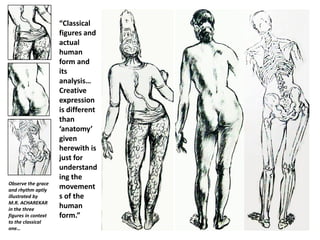
• Classical figures and actual human form and its 
analysis… 
• Creative expression is different than ‘anatomy’ given 
herewith is just for understanding the movements of 
the human form.  
INTRODUCTION by  G. VENKATACHALM 
2nd April 1949. 
Is Art  universal and does it transcend natural frontiers ?
Art – Matter of ‘Latitude’ and ‘ Longitude ?’ 
Elemental impulses are universal and art is as old as mankind and varied – ‘ Nationalistic’ in the world. All great works of art a
heritage. They have a past, tradition and character. Only the so‐called Modern Art seems to be without a background or parentage
and certainty no FUTURE. What is Indian Art ? In what way does it differ from the art of the West ? What are its aesthetical ideals and
artistic merits ? Is there not an undue emphasis on the so‐called natural aspect of it ? M. R. ACHAREKAR who has delightfully
conceived and produced book of drawings under the fascinating title “RUPADARSINI”. This illustrated monograph is a simple
straightforward albeit a practical, answer to the questions raised at the beginning of this text. Comparative study and the underlying
structural strength of human form as conceived and created by the ancient artist of India. Endless Expression of beauty… Plastic quality
and linear grace but feeling for abstraction… Indian Art is A Mental Summery of Visual perception rather than a faithful reproduction of
an object or a person from a certain point of in space. The perceptive is psychological and freer and unfettered in INDIAN ART. The tree is
never mistaken for forest. Artistic Anatomy, Rhythmic Form, and Symmetry is the ideal in INDIAN ART. Breakaway from the shackles of
the ACADEMY ART AND REDISCOVER THE HIDDEN BEAUTY in the traditional art. M. R. ACHAREKAR who has delightfully conceived and
produced book of drawings under the fascinating title “RUPADARSINI”. This illustrated monograph is a simple straightforward albeit a
practical, answer to the questions raised at the beginning of this text.
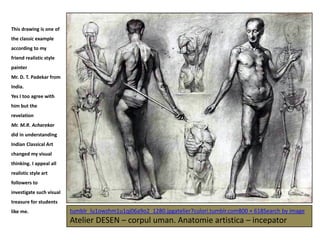
tumblr_lu1owzhm1u1qj06a9o2_1280.jpgatelier7culori.tumblr.com800 × 618Search by image
Atelier DESEN – corpul uman. Anatomie artistica – incepator
This drawing is one of 
the classic example 
according to my 
friend realistic style 
painter                       
Mr. D. T. Padekar from 
India. 
Yes I too agree with 
him but the 
revelation                  
Mr. M.R. Acharekar
did in understanding 
Indian Classical Art 
changed my visual 
thinking. I appeal all 
realistic style art 
followers to 
investigate such visual 
treasure for students 
like me.    
These two example illustrates the idea of human body’s anatomical proportions from 
the WESTERN viewpoint presented by M.R. Acharekar. 
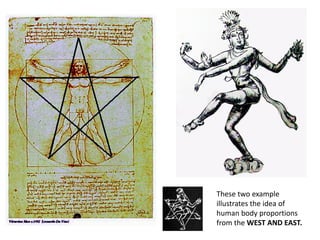
These two example 
illustrates the idea of 
human body proportions 
from the WEST AND EAST.
Simplifying 
forms to 
understand 
the rhythmic 
visual force.
This drawing is one of the classic example
M.R. ACHAREKAR created to investigate Indian classical
figure through the lens of western ideas of human
proportions. This according to my study one of the few
steps ever taken by any Indian artist to rationalized the
same in today‘s age of sciencetific thinking.
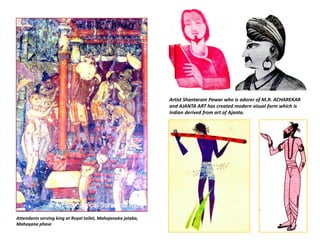
Attendants serving king at Royal toilet, Mahajanaka jataka, 
Mahayana phase
Artist Shantaram Pawar who is adorer of M.R. ACHAREKAR 
and AJANTA ART has created modern visual form which is 
Indian derived from art of Ajanta.    
Look at this metamorphic visualization in the  work of famous applied artist          
Shantaram Pawar who is adorer of M.R. ACHAREKAR and AJANTA ART. One can see the 
modern interpretive influence of both that aptly demonstrates  as the Traditional 
"Indian Art does inspire the modern art students.                      
Elemental impulses are universal and art is as old as mankind and varied –
‘ Nationalistic’ in the world. INTRODUCTION by  G. VENKATACHALM 
This is the work of famous applied artist Shantaram Pawar who is adorer of M.R. ACHAREKAR and 
AJANTA ART. One can see the modern interpretive strong INDIAN art form                                
derived from AJANTA ART.    
“Classical 
figures and 
actual 
human 
form and 
its 
analysis… 
Creative 
expression 
is different 
than 
‘anatomy’ 
given 
herewith is 
just for 
understand
ing the 
movement
s of the 
human 
form.”
Observe the grace 
and rhythm aptly 
illustrated by   
M.R. ACHAREKAR  
in the three 
figures in context 
to the classical 
one… 
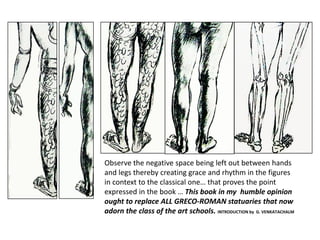
Observe the negative space being left out between hands 
and legs thereby creating grace and rhythm in the figures 
in context to the classical one… that proves the point 
expressed in the book … This book in my  humble opinion 
ought to replace ALL GRECO‐ROMAN statuaries that now 
adorn the class of the art schools. INTRODUCTION by  G. VENKATACHALM
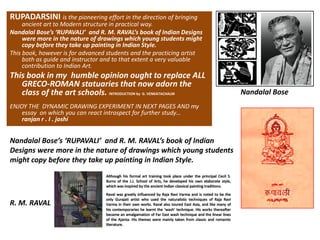
Nandalal Bose’s ‘RUPAVALI’  and R. M. RAVAL’s book of Indian 
Designs were more in the nature of drawings which young students 
might copy before they take up painting in Indian Style. 
R. M. RAVAL
RUPADARSINI is the pioneering effort in the direction of bringing 
ancient art to Modern structure in practical way. 
Nandalal Bose’s ‘RUPAVALI’  and R. M. RAVAL’s book of Indian Designs 
were more in the nature of drawings which young students might 
copy before they take up painting in Indian Style. 
This book, however is for advanced students and the practicing artist 
both as guide and instructor and to that extent a very valuable 
contribution to Indian Art. 
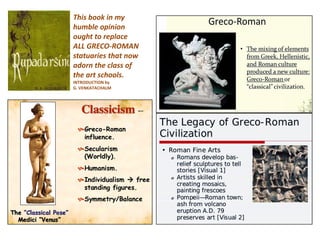
This book in my  humble opinion ought to replace ALL 
GRECO‐ROMAN statuaries that now adorn the 
class of the art schools. INTRODUCTION by  G. VENKATACHALM
ENJOY THE  DYNAMIC DRAWING EXPERIMENT IN NEXT PAGES AND my 
essay  on which you can react introspect for further study…        
ranjan r . I . joshi
Nandalal Bose
This book in my  
humble opinion 
ought to replace                             
ALL GRECO‐ROMAN 
statuaries that now 
adorn the class of 
the art schools. 
INTRODUCTION by                           
G. VENKATACHALM
JAGANNATH AHIVASI
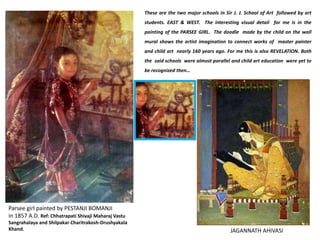
Parsee girl painted by PESTANJI BOMANJI              
in 1857 A.D. Ref: Chhatrapati Shivaji Maharaj Vastu 
Sangrahalaya and Shilpakar Charitrakosh‐Drushyakala 
Khand. 
These are the two major schools in Sir J. J. School of Art followed by art
students. EAST & WEST. The interesting visual detail for me is in the
painting of the PARSEE GIRL. The doodle made by the child on the wall
mural shows the artist imagination to connect works of master painter
and child art nearly 160 years ago. For me this is also REVELATION. Both
the said schools were almost parallel and child art education were yet to
be recognized then…
“RUPADARSINI is the 
pioneering effort in the 
direction of bringing 
ancient art to Modern 
structure in practical 
way. “ 
This book is the eye 
opener for students,  
scholars and practioners 
of Indian visual art who 
are following realistic 
approach. 
Perspective blended 
science and art.          
This experiment by    
M.R. ACHAREKAR 
blended 
EAST with WEST  
culturally through this 
scientific modern 
method. 
Courtesy: PHADNIS GALLERY journey of his cartoons : JYOTSNA PRAKASHAN‐ Pune, first edition 2014. Page 11.
This is PARADOXICAL where the 
artist creates realistic painting 
from the abstract model.             
My most favorite cartoonist                       
Mr. S. D. PHADNIS captures the 
essence of this contrasting human 
perception. I have never seen 
such visual parodist.  This essay is  
trying to understand such 
nuancenses of visual art.  See the 
next page abstract painting 
appears different to me.           
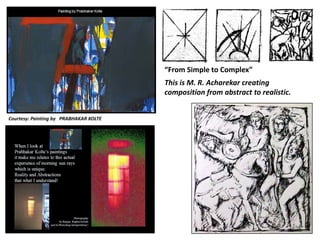
Courtesy: Painting by   PRABHAKAR KOLTE
“From Simple to Complex” 
This is M. R. Acharekar creating 
composition from abstract to realistic.
Motifs from the Ajanta‐Ellora‐Cave‐paintings
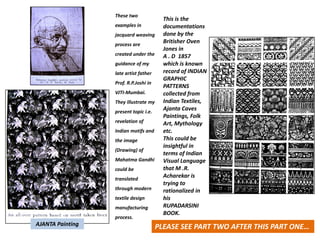
These two 
examples in 
jacquard weaving 
process are 
created under the 
guidance of my 
late artist father 
Prof. R.P.Joshi in 
VJTI‐Mumbai.
They illustrate my 
present topic i.e. 
revelation of 
Indian motifs and 
the image 
(Drawing) of 
Mahatma Gandhi 
could be 
translated 
through modern 
textile design   
manufacturing 
process.    
AJANTA Painting
This is the 
documentations 
done by the 
Britisher Oven 
Jones in                
A . D  1857 
which is known 
record of INDIAN 
GRAPHIC  
PATTERNS 
collected from 
Indian Textiles, 
Ajanta Caves 
Paintings, Folk 
Art, Mythology 
etc. 
This could be 
insightful in 
terms of Indian 
Visual Language 
that M .R. 
Acharekar is 
trying to 
rationalized in 
his 
RUPADARSINI 
BOOK.           
PLEASE SEE PART TWO AFTER THIS PART ONE…

Bringing together 1