PRECEDENTANALYSIS
S C H O O L o f A R C H I T E C T U R E
U N I V E R S I T Y o f I L L I N O I S
SCRE
T h o m a s M c C o r m i c k
E HOME
CREEK PATH
COLLABORATIVESPACE
CABIN VILLAGE
N
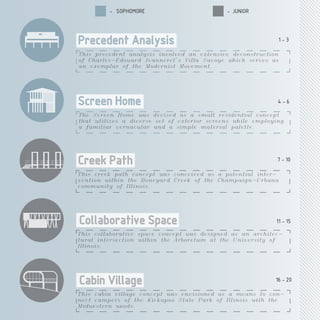
This precedent analysis involved an extensive deconstruction
of Charles-Edouard Jeanneret's Villa Savoye which serves as
an exemplar of the Modernist Movement.
The Screen Home was devised as a small residential concept
that utilizes a diverse set of exterior screens while employing
a familiar vernacular and a simple material palette.
This creek path concept was conceived as a potential inter-
vention within the Boneyard Creek of the Champaign-Urbana
community of Illinois.
- SOPHOMORE - JUNIOR
This collaborative space concept was designed as an architec-
tural intersection within the Arboretum at the University of
Illinois.
This cabin village concept was envisioned as a means to con-
nect campers of the Kickapoo State Park of Illinois with the
Midwestern woods.
1 - 3
4 - 6
7 - 10
11 - 15
16 - 20
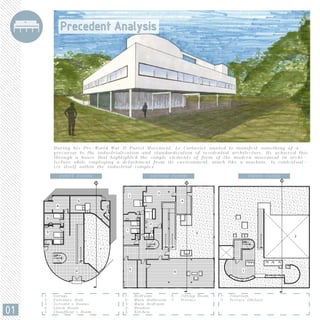
During his Pre-World War II Purist Movement, Le Corbusier wanted to manifest something of a
precursor to the industrialization and standardization of residential architecture. He achieved this
through a house that highlighted the simple elements of form of the modern movement in archi-
tecture while employing a detachment from its environment, much like a machine, to contextual-
ize itself within the industrial complex.
FIRST FLOOR SECOND FLOOR THIRD FLOOR
1: Garage
2: Entrance Hall
3: Servant's Rooms
4: Linen Room
5: Chauffeur's Room
1: Bedroom
2: Main Bathroom
3: Main Bedroom
4: Boudoir
5: Kitchen
6: Sitting Room
7: Terrace
1: Solarium
2: Terrace (Below)
01
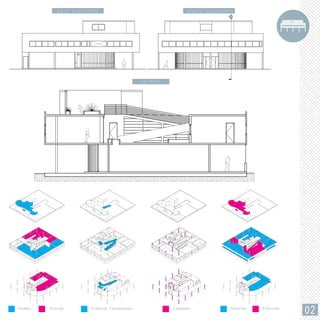
EAST ELEVATION NORTH ELEVATION
SECTION
Public Private Vertical Circulation Columns Interior Exterior
02
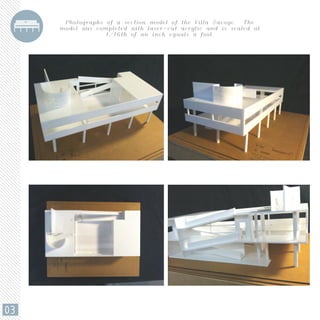
Photographs of a section model of the Villa Savoye. The
model was completed with laser-cut acrylic and is scaled at
1/16th of an inch equals a foot.
03
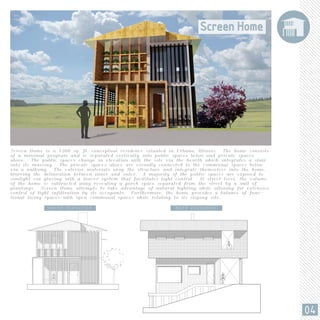
Screen Home is a 1200 sq. ft. conceptual residence situated in Urbana, Illinois. The home consists
of a minimal program and is separated vertically into public spaces below and private spaces
above. The public spaces change in elevation with the site via the hearth which integrates a stair
into its massing. The private spaces above are visually connected to the communal spaces below
via a walkway. The exterior materials wrap the structure and integrate themselves into the home,
blurring the delineation between inner and outer. A majority of the public spaces are exposed to
sunlight via glazing with a louver system that facilitates light control. At street level, the volume
of the home is subtracted away revealing a porch space separated from the street by a wall of
plantings. Screen Home attempts to take advantage of natural lighting while allowing for extensive
control of light infiltration by its occupants. Furthermore, the home provides a balance of func-
tional living spaces with open communal spaces while relating to its sloping site.
SOUTH ELEVATION WEST ELEVATION
04
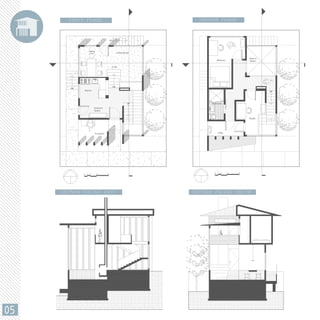
FIRST FLOOR SECOND FLOOR
SECTION FACING EAST SECTION FACING SOUTH
05
06
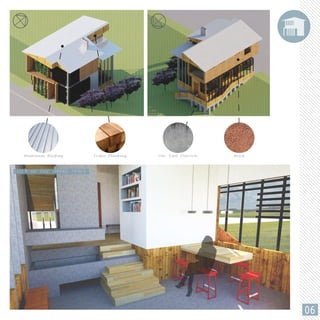
VIEW OF THE LIVING SPACE
Aluminum Roofing Cedar Planking Site-Cast Concrete Brick
07
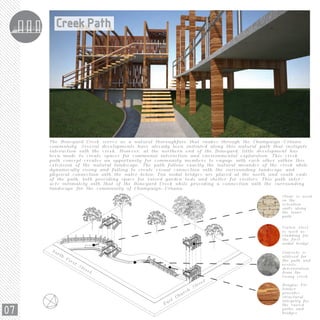
Stone is used
in the
retention
walls along
the lower
path.
Corten Steel
is used as
cladding for
the first
nodal bridge.
Concrete is
utilized for
the path and
resists
deterioration
from the
rising creek.
Douglas Fir
timber
provides
structural
integrity for
the raised
paths and
bridges.
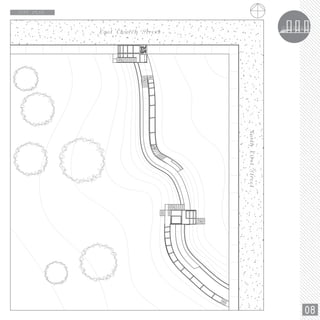
The Boneyard Creek serves as a natural thoroughfare that snakes through the Champaign-Urbana
community. Several developments have already been initiated along this natural path that instigate
interaction with the creek. However, at the northern end of the Boneyard, little development has
been made to create spaces for communal interaction and environmental exploration. This creek
path concept creates an opportunity for community members to engage with each other within this
extension of the natural landscape. The path follows exactly the natural meander of the creek while
dynamically rising and falling to create visual connection with the surrounding landscape and
physical connection with the water below. Two nodal bridges are placed at the north and south ends
of the path, both providing space for raised garden beds and shelter for visitors. This path inter-
acts intimately with that of the Boneyard Creek while providing a connection with the surrounding
landscape for the community of Champaign-Urbana.
East
Church
Street
North
First
Street
08
SITE PLAN
East Church Street
NorthFirstStreet
09
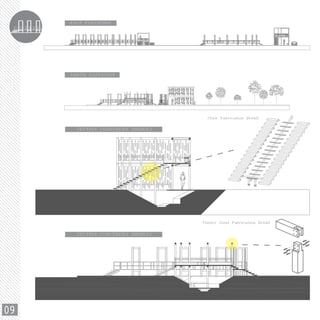
EAST ELEVATION
NORTH ELEVATION
SECTION (NORTHERN BRIDGE)
SECTION (SOUTHERN BRIDGE)
Stair Fabrication Detail
Timber Joint Fabrication Detail
10
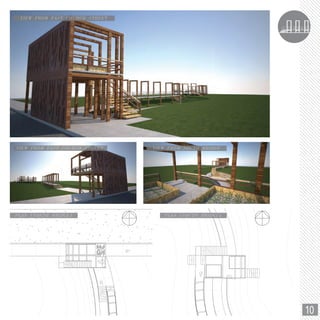
PLAN (NORTH BRIDGE) PLAN (SOUTH BRIDGE)
VIEW FROM EAST CHURCH STREET
VIEW FROM SOUTH BRIDGEVIEW FROM EAST CHURCH STREET
11
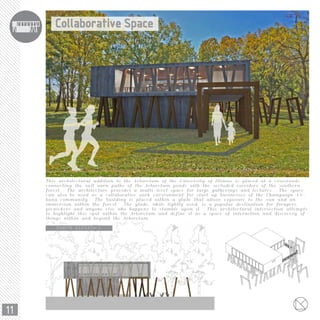
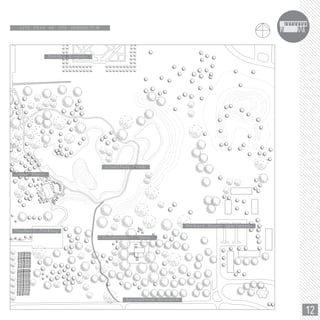
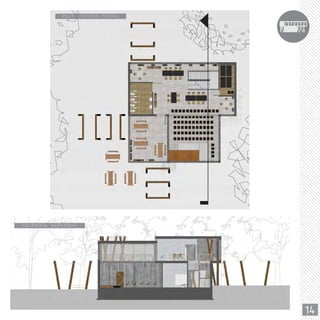
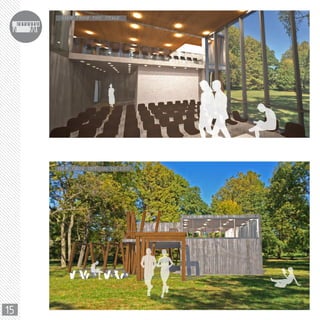
This architectural addition to the Arboretum of the University of Illinois is placed at a crossroads
connecting the well worn paths of the Arboretum ponds with the secluded corridors of the southern
forest. The architecture provides a multi-level space for large gatherings and lectures. The space
can also be used as a collaborative work environment for start up businesses of the Champaign-Ur-
bana community. The building is placed within a glade that allows exposure to the sun and an
immersion within the forest. The glade, while lightly used, is a popular destination for foragers,
picnickers and anyone else who happens to stumble upon it. This architectural intersection attempts
to highlight this spot within the Arboretum and define it as a space of interaction and discovery of
things within and beyond the Arboretum.
NORTH ELEVATION
12
Japan House
SITE PLAN OF THE ARBORETUM
Southern Parking
Agricultural Research
Orchard Downs Apartments
Collaborative Space
Hartley Gardens
Arboretum Ponds
13
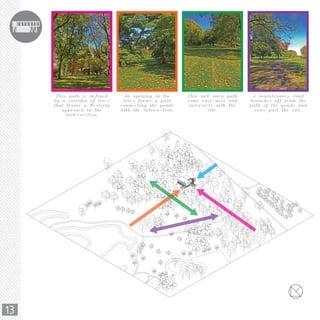
This path is defined
by a corridor of trees
that frame a Westerly
approach to the
instersection.
An opening in the
trees forms a path
connecting the ponds
with the intersection.
This well worn path
runs east-west and
intersects with the
site.
A maintenance road
branches off from the
path of the ponds and
runs past the site.
14
PLAN (SECOND FLOOR)
SECTIONAL ELEVATION
15
VIEW FROM THE STAGE
VIEW FROM THE SOUTH END
16
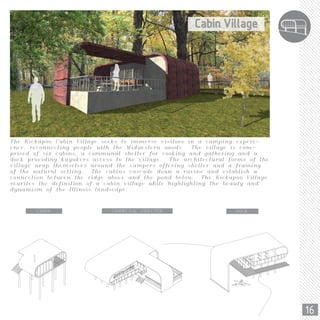
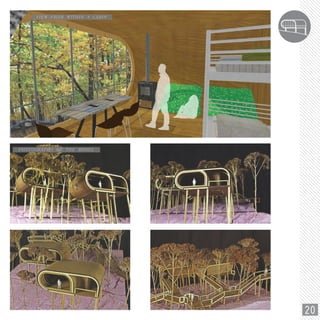
The Kickapoo Cabin Village seeks to immerse visitors in a camping experi-
ence, reconnecting people with the Midwestern woods. The village is com-
prised of six cabins, a communal shelter for cooking and gathering and a
dock providing kayakers access to the village. The architectural forms of the
village wrap themselves around the campers offering shelter and a framing
of the natural setting. The cabins cascade down a ravine and establish a
connection between the ridge above and the pond below. The Kickapoo Village
rewrites the definition of a cabin village while highlighting the beauty and
dynamism of the Illinois landscape.
CABIN COMMUNAL SHELTER DOCK
17
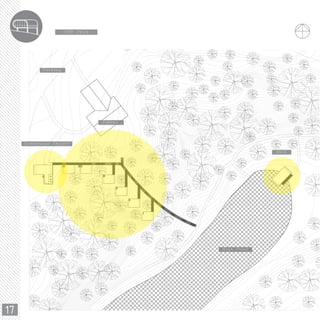
SITE PLAN
Communal Shelter
Cabins
Dock
High Pond
Parking
18
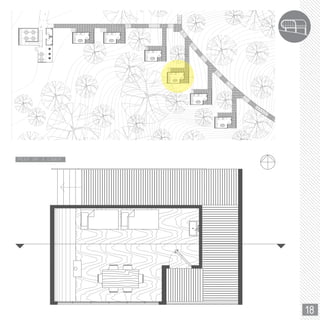
PLAN OF A CABIN
19
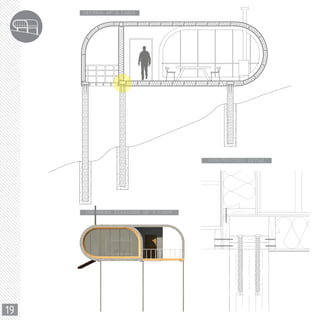
SECTION OF A CABIN
CONSTRUCTION DETAIL
SOUTHERN ELEVATION OF A CABIN
20
VIEW FROM WITHIN A CABIN
PHOTOGRAPHS OF THE MODEL
Portfolio 01 (Compressed)

Portfolio 01 (Compressed)

  • 1.
    PRECEDENTANALYSIS S C HO O L o f A R C H I T E C T U R E U N I V E R S I T Y o f I L L I N O I S SCRE T h o m a s M c C o r m i c k E HOME CREEK PATH COLLABORATIVESPACE CABIN VILLAGE N
  • 2.
    This precedent analysisinvolved an extensive deconstruction of Charles-Edouard Jeanneret's Villa Savoye which serves as an exemplar of the Modernist Movement. The Screen Home was devised as a small residential concept that utilizes a diverse set of exterior screens while employing a familiar vernacular and a simple material palette. This creek path concept was conceived as a potential inter- vention within the Boneyard Creek of the Champaign-Urbana community of Illinois. - SOPHOMORE - JUNIOR This collaborative space concept was designed as an architec- tural intersection within the Arboretum at the University of Illinois. This cabin village concept was envisioned as a means to con- nect campers of the Kickapoo State Park of Illinois with the Midwestern woods. 1 - 3 4 - 6 7 - 10 11 - 15 16 - 20
  • 3.
    During his Pre-WorldWar II Purist Movement, Le Corbusier wanted to manifest something of a precursor to the industrialization and standardization of residential architecture. He achieved this through a house that highlighted the simple elements of form of the modern movement in archi- tecture while employing a detachment from its environment, much like a machine, to contextual- ize itself within the industrial complex. FIRST FLOOR SECOND FLOOR THIRD FLOOR 1: Garage 2: Entrance Hall 3: Servant's Rooms 4: Linen Room 5: Chauffeur's Room 1: Bedroom 2: Main Bathroom 3: Main Bedroom 4: Boudoir 5: Kitchen 6: Sitting Room 7: Terrace 1: Solarium 2: Terrace (Below) 01
  • 4.
    EAST ELEVATION NORTHELEVATION SECTION Public Private Vertical Circulation Columns Interior Exterior 02
  • 5.
    Photographs of asection model of the Villa Savoye. The model was completed with laser-cut acrylic and is scaled at 1/16th of an inch equals a foot. 03
  • 6.
    Screen Home isa 1200 sq. ft. conceptual residence situated in Urbana, Illinois. The home consists of a minimal program and is separated vertically into public spaces below and private spaces above. The public spaces change in elevation with the site via the hearth which integrates a stair into its massing. The private spaces above are visually connected to the communal spaces below via a walkway. The exterior materials wrap the structure and integrate themselves into the home, blurring the delineation between inner and outer. A majority of the public spaces are exposed to sunlight via glazing with a louver system that facilitates light control. At street level, the volume of the home is subtracted away revealing a porch space separated from the street by a wall of plantings. Screen Home attempts to take advantage of natural lighting while allowing for extensive control of light infiltration by its occupants. Furthermore, the home provides a balance of func- tional living spaces with open communal spaces while relating to its sloping site. SOUTH ELEVATION WEST ELEVATION 04
  • 7.
    FIRST FLOOR SECONDFLOOR SECTION FACING EAST SECTION FACING SOUTH 05
  • 8.
    06 VIEW OF THELIVING SPACE Aluminum Roofing Cedar Planking Site-Cast Concrete Brick
  • 9.
    07 Stone is used inthe retention walls along the lower path. Corten Steel is used as cladding for the first nodal bridge. Concrete is utilized for the path and resists deterioration from the rising creek. Douglas Fir timber provides structural integrity for the raised paths and bridges. The Boneyard Creek serves as a natural thoroughfare that snakes through the Champaign-Urbana community. Several developments have already been initiated along this natural path that instigate interaction with the creek. However, at the northern end of the Boneyard, little development has been made to create spaces for communal interaction and environmental exploration. This creek path concept creates an opportunity for community members to engage with each other within this extension of the natural landscape. The path follows exactly the natural meander of the creek while dynamically rising and falling to create visual connection with the surrounding landscape and physical connection with the water below. Two nodal bridges are placed at the north and south ends of the path, both providing space for raised garden beds and shelter for visitors. This path inter- acts intimately with that of the Boneyard Creek while providing a connection with the surrounding landscape for the community of Champaign-Urbana. East Church Street North First Street
  • 10.
    08 SITE PLAN East ChurchStreet NorthFirstStreet
  • 11.
    09 EAST ELEVATION NORTH ELEVATION SECTION(NORTHERN BRIDGE) SECTION (SOUTHERN BRIDGE) Stair Fabrication Detail Timber Joint Fabrication Detail
  • 12.
    10 PLAN (NORTH BRIDGE)PLAN (SOUTH BRIDGE) VIEW FROM EAST CHURCH STREET VIEW FROM SOUTH BRIDGEVIEW FROM EAST CHURCH STREET
  • 13.
    11 This architectural additionto the Arboretum of the University of Illinois is placed at a crossroads connecting the well worn paths of the Arboretum ponds with the secluded corridors of the southern forest. The architecture provides a multi-level space for large gatherings and lectures. The space can also be used as a collaborative work environment for start up businesses of the Champaign-Ur- bana community. The building is placed within a glade that allows exposure to the sun and an immersion within the forest. The glade, while lightly used, is a popular destination for foragers, picnickers and anyone else who happens to stumble upon it. This architectural intersection attempts to highlight this spot within the Arboretum and define it as a space of interaction and discovery of things within and beyond the Arboretum. NORTH ELEVATION
  • 14.
    12 Japan House SITE PLANOF THE ARBORETUM Southern Parking Agricultural Research Orchard Downs Apartments Collaborative Space Hartley Gardens Arboretum Ponds
  • 15.
    13 This path isdefined by a corridor of trees that frame a Westerly approach to the instersection. An opening in the trees forms a path connecting the ponds with the intersection. This well worn path runs east-west and intersects with the site. A maintenance road branches off from the path of the ponds and runs past the site.
  • 16.
  • 17.
    15 VIEW FROM THESTAGE VIEW FROM THE SOUTH END
  • 18.
    16 The Kickapoo CabinVillage seeks to immerse visitors in a camping experi- ence, reconnecting people with the Midwestern woods. The village is com- prised of six cabins, a communal shelter for cooking and gathering and a dock providing kayakers access to the village. The architectural forms of the village wrap themselves around the campers offering shelter and a framing of the natural setting. The cabins cascade down a ravine and establish a connection between the ridge above and the pond below. The Kickapoo Village rewrites the definition of a cabin village while highlighting the beauty and dynamism of the Illinois landscape. CABIN COMMUNAL SHELTER DOCK
  • 19.
  • 20.
  • 21.
    19 SECTION OF ACABIN CONSTRUCTION DETAIL SOUTHERN ELEVATION OF A CABIN
  • 22.
    20 VIEW FROM WITHINA CABIN PHOTOGRAPHS OF THE MODEL