All of the people inhabiting a specified area.
OR
A group of individuals or items that share one or
more characteristics living in the same area.
EXAMPLE
A colony of ants
A crowd of people
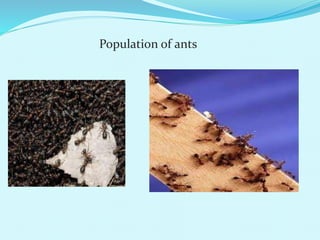
Population of ants
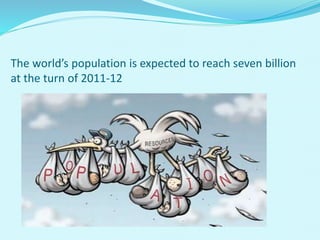
The world’s population is expected to reach seven billion
at the turn of 2011-12
The term:
Population size
The Actual counting of a total
population, the census method, is
not often possible in large animal
populations.
Census
method
collection of data
from the whole
population
rather than just a
sample.
The population
size is
expressed as
the population
present at a
particular
instant.
Population is of
two types
1. Absolute
population size (N)
2. Effective
population size (Ne)
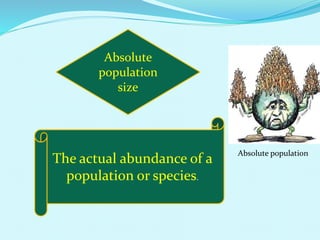
The actual abundance of a
population or species.
Absolute
population
size
Absolute population
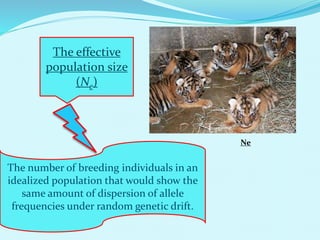
The effective
population size
(Ne)
The number of breeding individuals in an
idealized population that would show the
same amount of dispersion of allele
frequencies under random genetic drift.
Ne
There are four
Factors affecting
the population size
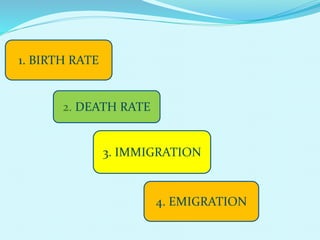
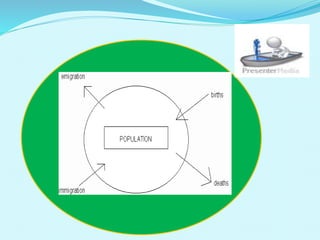
1. BIRTH RATE
2. DEATH RATE
3. IMMIGRATION
4. EMIGRATION
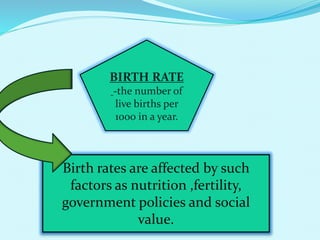
BIRTH RATE
-the number of
live births per
1000 in a year.
Birth rates are affected by such
factors as nutrition ,fertility,
government policies and social
value.
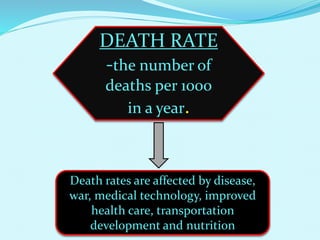
DEATH RATE
-the number of
deaths per 1000
in a year.
Death rates are affected by disease,
war, medical technology, improved
health care, transportation
development and nutrition
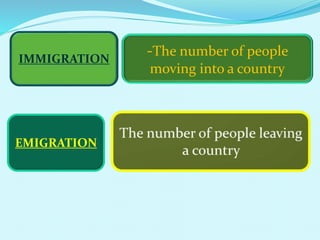
-The number of people
moving into a country
IMMIGRATION
EMIGRATION
Determining
population size
Four steps
1. Direct observation 2. Indirect observation
3. Sampling 4. Mark- and –recapture
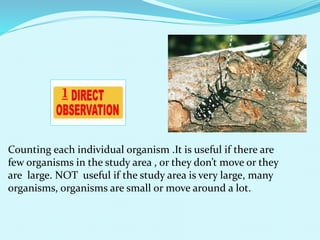
Counting each individual organism .It is useful if there are
few organisms in the study area , or they don’t move or they
are large. NOT useful if the study area is very large, many
organisms, organisms are small or move around a lot.
1
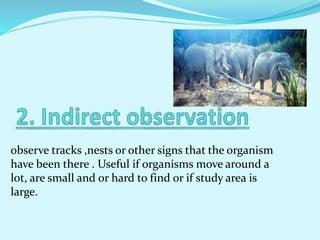
observe tracks ,nests or other signs that the organism
have been there . Useful if organisms move around a
lot, are small and or hard to find or if study area is
large.
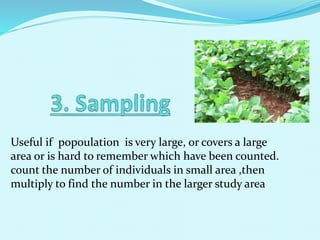
Useful if popoulation is very large, or covers a large
area or is hard to remember which have been counted.
count the number of individuals in small area ,then
multiply to find the number in the larger study area
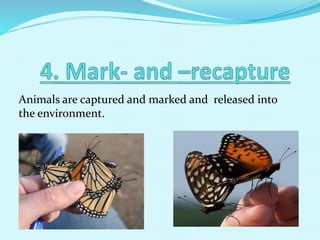
Animals are captured and marked and released into
the environment.
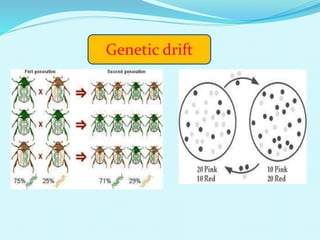
Genetic drift
Genetic drift is the random change in the
genetic composition of a population due
to chance events causing unequal
participation of individuals in producing
succeeding generations
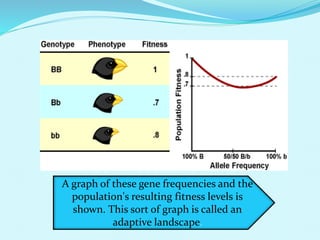
BB individuals have big beaks , Bb individuals
have medium-sized beak and bb individuals have
small beaks. These birds live in a place where large
and small seeds are abundant, but no medium-
sized seeds are available . Populations of all big-
beaked individuals have a very high average fitness
they can crack open big seeds.
Populations of all small-beaked individuals do
well— but not quite as well as the big-beaked
individual. Medium-beaked individuals have the
lowest fitness .and no medium sized beaks
available.
A graph of these gene frequencies and the
population's resulting fitness levels is
shown. This sort of graph is called an
adaptive landscape
A graph of these gene frequencies and the
population's resulting fitness levels is
shown. This sort of graph is called an
adaptive landscape.
Genetic drift
Founder effect
Bottlenecks effect
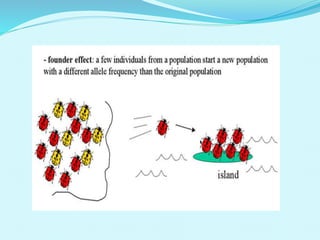
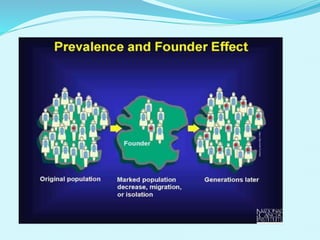
Founder effects
A founder effect occurs when
a new colony is started by a
few members of the original
population
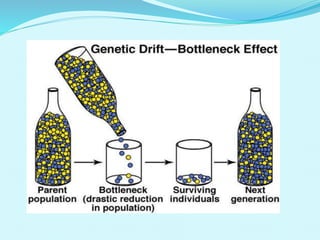
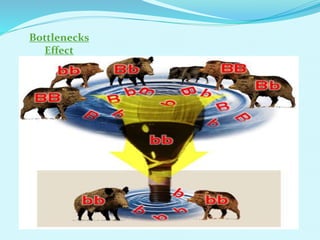
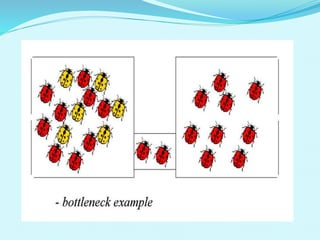
Bottlenecks Effect
Population bottlenecks occur
when large numbers of a
population are removed by
disease, overhunting, overfishing
or natural disasters.
Bottlenecks
Effect
Population size and genetic drift

Population size and genetic drift

  • 5.
    All of thepeople inhabiting a specified area. OR A group of individuals or items that share one or more characteristics living in the same area.
  • 6.
    EXAMPLE A colony ofants A crowd of people
  • 7.
  • 8.
    The world’s populationis expected to reach seven billion at the turn of 2011-12
  • 9.
    The term: Population size TheActual counting of a total population, the census method, is not often possible in large animal populations. Census method collection of data from the whole population rather than just a sample. The population size is expressed as the population present at a particular instant.
  • 10.
    Population is of twotypes 1. Absolute population size (N) 2. Effective population size (Ne)
  • 11.
    The actual abundanceof a population or species. Absolute population size Absolute population
  • 12.
    The effective population size (Ne) Thenumber of breeding individuals in an idealized population that would show the same amount of dispersion of allele frequencies under random genetic drift. Ne
  • 13.
    There are four Factorsaffecting the population size
  • 14.
    1. BIRTH RATE 2.DEATH RATE 3. IMMIGRATION 4. EMIGRATION
  • 15.
    BIRTH RATE -the numberof live births per 1000 in a year. Birth rates are affected by such factors as nutrition ,fertility, government policies and social value.
  • 16.
    DEATH RATE -the numberof deaths per 1000 in a year. Death rates are affected by disease, war, medical technology, improved health care, transportation development and nutrition
  • 17.
    -The number ofpeople moving into a country IMMIGRATION EMIGRATION
  • 19.
    Determining population size Four steps 1.Direct observation 2. Indirect observation 3. Sampling 4. Mark- and –recapture
  • 20.
    Counting each individualorganism .It is useful if there are few organisms in the study area , or they don’t move or they are large. NOT useful if the study area is very large, many organisms, organisms are small or move around a lot. 1
  • 21.
    observe tracks ,nestsor other signs that the organism have been there . Useful if organisms move around a lot, are small and or hard to find or if study area is large.
  • 22.
    Useful if popoulationis very large, or covers a large area or is hard to remember which have been counted. count the number of individuals in small area ,then multiply to find the number in the larger study area
  • 23.
    Animals are capturedand marked and released into the environment.
  • 24.
    Genetic drift Genetic driftis the random change in the genetic composition of a population due to chance events causing unequal participation of individuals in producing succeeding generations
  • 25.
    BB individuals havebig beaks , Bb individuals have medium-sized beak and bb individuals have small beaks. These birds live in a place where large and small seeds are abundant, but no medium- sized seeds are available . Populations of all big- beaked individuals have a very high average fitness they can crack open big seeds. Populations of all small-beaked individuals do well— but not quite as well as the big-beaked individual. Medium-beaked individuals have the lowest fitness .and no medium sized beaks available.
  • 26.
    A graph ofthese gene frequencies and the population's resulting fitness levels is shown. This sort of graph is called an adaptive landscape A graph of these gene frequencies and the population's resulting fitness levels is shown. This sort of graph is called an adaptive landscape.
  • 27.
  • 28.
  • 29.
    Founder effects A foundereffect occurs when a new colony is started by a few members of the original population
  • 32.
    Bottlenecks Effect Population bottlenecksoccur when large numbers of a population are removed by disease, overhunting, overfishing or natural disasters.
  • 34.

Editor's Notes

  • #25  due to chance event occur