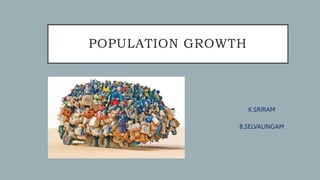
POPULATION GROWTH
K.SRIRAM
B.SELVALINGAM
WHAT IS POPULATION ?
• Population is defined as a group of individuals belonging to the same
species , which live in a area of given time.
POPULATION DENSITY :
• It is expressed as the number of individuals of the population per unit area or
per unit volume . This varies in response to changes in the environment and
introduction with other living organism.
POPULATION GROWTH
• The rapid growth of the global’s population for the past 100 years
results from the difference between the rate of birth and death.
• In 1880, the global population was about 1 billion people . It took about 130
years(in 1930) to reach 2 billion. But the population reached to 4 billion within
45 years (in 1975). Now we have already crossed 6 billion and may have to
reach about 10 billion by 2050 as per the World Bank calculations.
• Increase in population = population growth
• CAUSES OF RAPID POPULATION GROWTH :
1) Population growth is due to decrease of death rate and increase in birth rate.
2) Availability of antibiotics, immunisation , increased food production, clean
water and air decreases the famine-related deaths and infant mortality.
3) Agricultural based countries, children’s are required to help parents in the
fields that is why population increases in the developing countries.
PROBLEMS ( ENVIRONMENTAL ISSUSES )
OF POPULATION GROWTH
1) Increasing demands for food and natural resources.
2) Inadequate housing and health services.
3) Loss of agricultural lands.
4) Unemployment and socio-political unrest.
5) Environmental pollution.
• Causes of population growth :
1) Fertility rates.
2) International migration.
3) Increase in climate change.
4) Impact on biodiversity loss.
5) Overexploitation of resources.
•
POPULATION GROWTH
METHODS OF POPULATION CONTROL
• The different methods of population control in human beings are
1) Child Tax,
2) One-Child Policy,
3) Sterilization,
4) Medical Abortion,
5) Family Planning, etc.
POPULATION GROWTH-1.pptx

POPULATION GROWTH-1.pptx

  • 1.
  • 2.
    WHAT IS POPULATION? • Population is defined as a group of individuals belonging to the same species , which live in a area of given time. POPULATION DENSITY : • It is expressed as the number of individuals of the population per unit area or per unit volume . This varies in response to changes in the environment and introduction with other living organism.
  • 3.
    POPULATION GROWTH • Therapid growth of the global’s population for the past 100 years results from the difference between the rate of birth and death. • In 1880, the global population was about 1 billion people . It took about 130 years(in 1930) to reach 2 billion. But the population reached to 4 billion within 45 years (in 1975). Now we have already crossed 6 billion and may have to reach about 10 billion by 2050 as per the World Bank calculations. • Increase in population = population growth • CAUSES OF RAPID POPULATION GROWTH : 1) Population growth is due to decrease of death rate and increase in birth rate. 2) Availability of antibiotics, immunisation , increased food production, clean water and air decreases the famine-related deaths and infant mortality. 3) Agricultural based countries, children’s are required to help parents in the fields that is why population increases in the developing countries.
  • 4.
    PROBLEMS ( ENVIRONMENTALISSUSES ) OF POPULATION GROWTH 1) Increasing demands for food and natural resources. 2) Inadequate housing and health services. 3) Loss of agricultural lands. 4) Unemployment and socio-political unrest. 5) Environmental pollution. • Causes of population growth : 1) Fertility rates. 2) International migration. 3) Increase in climate change. 4) Impact on biodiversity loss. 5) Overexploitation of resources. •
  • 5.
  • 6.
    METHODS OF POPULATIONCONTROL • The different methods of population control in human beings are 1) Child Tax, 2) One-Child Policy, 3) Sterilization, 4) Medical Abortion, 5) Family Planning, etc.