Deception/ Lie Detection
• Even the earliest legal systems had techniques for detecting
lies.
• in an ancient form of trial by ordeal, a suspect who denied
committing a crime was required to plunge his arm into a pot
of boiling water and pull out a stone. The arm was then
bandaged. If, after 3 days, the burns were not infected, the
person was judged to be telling the truth.
• God would intervene on behalf of an innocent person and
reveal the truth by preventing infection.
The Complexity & Pervasiveness of Deception
• The world is full of lies…..
• think about the novels you have read or the movies you have
seen, chances are that one of the key plot elements is a lie
told by one of the main characters.
• From evolutionary perspective, lying is adaptive — it
promotes survival.
• When chimpanzees want access to more food, they
sometimes falsely call out an alarm signaling that a predator
is near.
• When the other members of the troop run away in response
to the false alarm, the deceptive chimp is temporarily left
alone with the food (Hall & Brosnan, 2017).
• Machiavellian intelligence hypothesis” — which holds that a
great leap forward in human intelligence was triggered by
the need for humans to develop the essential social skills of
manipulation, pretense, and deception (Bereczkei, 2018).
• Our capacity to deceive is a fundamental part of human
nature, and it makes the detection of lies less straightforward
than is commonly supposed.
Lying is universal and multifaceted.
• Lie, mislead, misinform,
• trick, fake, betray, fool,
• cheat, con, confabulate, delude, deceive,
• distort, fabricate, exaggerate, pretend,
• falsify, or misrepresent.
All convey slightly different shade of meaning, though all imply a
bending or violation of the truth.
• lies of commission: saying something that is not true
• lies of omission: leaving out crucial details that might reveal
the truth
Can We Tell When Others are Lying?
• Courts in the United States have expressed great confidence
in the ability of jurors to detect lies by carefully observing
each witness’s “manner of testifying” and “demeanor on
the witness stand”
• A part of a police interrogator’s job is to act as a sort of
human lie detector
• to scrutinize the suspect’s nonverbal behavior, to look for
inconsistencies in the suspect’s story, and to decide
whether the suspect is telling the truth.
• The behavioral cues interrogators are taught to focus on
(crossing legs, shifting and fidgeting, grooming gestures,
avoiding eye contact) are flawed indicators of deception
(DePaulo et al., 2003; Masip & Herrero, 2015).
• these cues are consistent with a prevalent but mistaken liar’s
stereotype.
• In a survey of more than 2,500 people in 63 countries, about
70% of respondents believed that, when lying, people tend
to avert their gaze, squirm, touch themselves more, and
stutter (Bond & DePaulo, 2008).
• Flawed interpretation of a suspect’s verbal and nonverbal
behavior is likely to fuel a phenomenon called confirmation
bias (Kassin et al., 2013; Meissner & Kassin, 2004).
• Confirmation bias: Once we form a strong belief, we tend to
seek out evidence that confirms that belief and to dismiss
evidence that contradicts that belief.
The Polygraph
Development of the Polygraph
• Lie-detection devices monitor physiological changes.
• People hooked up to a polygraph usually have a blood
pressure cuff around the upper arm, a pneumatic tube
stretched across the chest, and electrodes on the fingers of
one hand.
Theory behind the polygraph
• Lying causes physiological arousal.
• the act of lying causes a rise in blood pressure, an increase in
skin moisture, and changes in heart rate and breathing
patterns.
• The polygraph reveals physiological responses to questions
asked by an examiner.
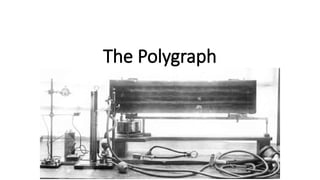
• Older machines tracked changes in physiological reactions
with multiple pens that wrote on a moving strip of graph
paper
• (the word polygraph comes from the Greek poly, meaning “many,”
and grapho, meaning “write”).
Physiological detection of deception (PDD)
• Use physiological measurements as an index of deception
• Not behavioral
• Directly measure arousal or other cognitive processes
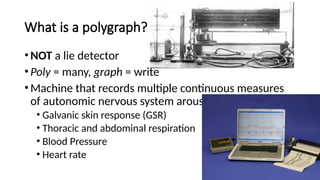
What is a polygraph?
•NOT a lie detector
•Poly = many, graph = write
•Machine that records multiple continuous measures
of autonomic nervous system arousal
• Galvanic skin response (GSR)
• Thoracic and abdominal respiration
• Blood Pressure
• Heart rate
Polygraph- History
• William Moulton Marston
(1893 – 1947)
• Student of Hugo Münsterberg
at Harvard
• Discovered correlation
between blood pressure and
arousal during lying
Polygraph- History
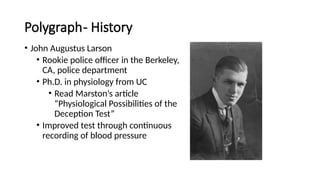
• John Augustus Larson
• Rookie police officer in the Berkeley,
CA, police department
• Ph.D. in physiology from UC
• Read Marston’s article
“Physiological Possibilities of the
Deception Test”
• Improved test through continuous
recording of blood pressure
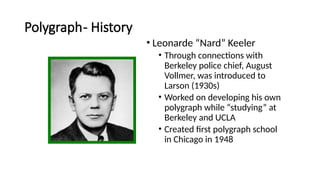
Polygraph- History
• Leonarde “Nard” Keeler
• Through connections with
Berkeley police chief, August
Vollmer, was introduced to
Larson (1930s)
• Worked on developing his own
polygraph while “studying” at
Berkeley and UCLA
• Created first polygraph school
in Chicago in 1948
Autonomic nervous system (ANS)
• Part of the peripheral nervous system controlling visceral or
automatic functions
• Sympathetic and parasympathetic nervous systems
• General theory behind polygraph
• Arousal  Increased ANS activity
• Sweating
• Respiration changes
• Pulse rate
• Blood pressure
• Specific patterns of arousal during questioning could indicate guilt
or lying
Polygraph – Modern version
• Modern polygraphs are now computerized
• Allow for more accurate and automatic (unbiased) analysis
• Main Measures
• Galvanic skin response (sweating)
• Respiration
• Thoracic and Abdominal
• Blood pressure
• Pulse oximeter
• Measures percentage of oxygenated hemoglobin
• Pad(s) to measure subject movement
The Process of Polygraphing
• To be used as a lie detector, the polygraph machine must be
combined with a systematic questioning procedure.
The “lie detector” refers more to the test used
• Comparison Question Test
• Relevant/Irrelevant test
• Rising Peak of Tension
• Directed Lie Test
• Concealed Information Test
Polygraph – Comparison Question Test
• Most common method of polygraph interrogation
• Developed by John Reid
• Begins with extensive pre-test interview
• Three kinds of questions:
• 1. Relevant
• E.g. “Did you kill Nicole Brown Simpson”
• 2. Comparison (aka probable lie)
• E.g. “Have you ever physically harmed someone”
• 3. Irrelevant
• Is your name Orenthal James Simpson?
• The CQT relies on the measurement of relative arousal.
• it is assumed that some physiological reactions will be
elevated while lying but will not be elevated while telling the
truth.
• The name given to the CQT highlights the importance of
comparison questions.
• These questions involve behaviors that are uncomfortable for
suspects but are not directly related to the crime under
investigation.
• Reactions to comparison questions are compared to reactions to
questions about the specific crime being investigated
• (e.g., “Did you stab David?” or “Did you steal the money from the
bank safe?”).
• The basic proposition is that innocent suspects will respond
more strongly to the comparison questions, whereas guilty
suspects will respond more strongly to the crime-relevant
questions.
• Examiners who use the CQT want suspects to answer “no” to
the comparison questions, but they also want suspects to
feel uncomfortable about their denials.
• Because of the importance of comparison questions, the CQT
relies on the examiner’s skill and stage managing ability.
• The examiner must persuade the suspect that the polygraph
can detect lies so that the suspect will be nervous about
lying.
• Scoring of the polygraph charts is done numerically.
• One commonly used scale runs from –3 to +3.
• If the suspect’s response to a relevant question is stronger
than the response to the paired comparison question, a
negative number is assigned.
• The opposite pattern leads to a positive number.
• Negative scores are thought to indicate deception, and
positive scores to indicate truthfulness.
Weaknesses
• Although the CQT is an improvement over earlier
questioning procedures, it places a heavy burden on the
skills of examiners.
• Examiners must be able to formulate a delicately calibrated
series of comparison questions that elicit stronger reactions
than crime-relevant questions from innocent suspects, but
weaker reactions from guilty suspects.
positive comparison test (PCT),
• An alternative form of the CQT, called the positive comparison test
(PCT), uses the crime-relevant question as its own comparison.
• Crime-relevant question (e.g., in a rape case,
• “Did you use physical force to make Jennifer have sex with you?”) is
asked twice.
• The alleged rapist is instructed to tell the truth once and to tell a lie
once.
• This method allows for a direct comparison of responses to the same
question.
Weaknesses in the Process
• First Some people are so controlled or so nonreactive emotionally
that lying produces little physiological response.
• Second, there is no guarantee that innocent people will not react
strongly to questions about whether they committed a crime.
• Indeed, a tired criminal may be less likely to react to lying than an
innocent person being accused of a terrible crime.
• Third, if the person being tested does not have faith in the validity of
the polygraph, he or she may not respond in the way examiners
suppose.
• Guilty people who have no faith in the test may not be concerned
about lying because they have no fear of detection.
• Some examiners — because of their appearance or
demeanor — induce great anxiety in the person being
tested.
• Some examiners let their suspicions about a suspect’s guilt
influence their interpretation of the polygraph charts.
• Moreover, there is considerable subjectivity in the scoring.
• Finally, suspects may attempt to fool the polygraph through a variety
of “self stimulation”
• strategies. Lie detection depends on the measurement of relative
• arousal — a comparison between the amount of arousal following
relevant
• questions and the amount of arousal following comparison questions.
Lack of standardization
• The content of questions, the number of questions, the
demeanor of the examiner, and the scoring all vary from one
polygraph test to another.
• Relevant questions must vary depending on the nature of the
crime being investigated, and even comparison questions
can vary.
• It is extremely difficult to standardize the behavior of all
polygraphers.
Polygraph – Relevant/Irrelevant Test
• Earliest method of polygraph testing
• Two kinds of questions
• Relevant
• Deal with issue at hand
• Irrelevant
• Deal with outside facts or details
• Assumption:
• A liar or guilty person will be more aroused by relevant questions
than Irrelevant ones, while an innocent person will show no
difference
• So, if arousal(relevant) > arousal(irrelevant) = lying
Polygraph – Searching Peak of Tension (POT)
• Can be used when specific details of a crime are unknown to the investigator
• Suspect is presented serially with potential relevant clues
• Areas in which a body may be located
• Amounts of money that may have been stolen
• Assumption:
• A guilty person will react strongest when the correct alternative is
chosen
• An innocent person may simply become more aroused as the test
goes on, but will not show a significant sudden increase in arousal
to one alternative
Polygraph – Concealed Information Test (CIT)
• Rather than trying to detect arousal caused by lying, tries to detect arousal from
recognition of “guilty knowledge” from the response
• Multiple-choice (serially presented) questions where the investigator knows the correct
answer
• “What was the weapon used to kill Mr. Boddy?”
• Candlestick
• Rope
• Revolver
• Lead Pipe
• Knife
• Wrench
• Assumption:
• A guilty person’s arousal will increase upon recognizing the correct alternative due to
involuntary orienting response
• Innocent person will not be able to discern the correct alternative from the others
Research on the Polygraph
Polygraph- Accuracy
• R/I
• Extremely poor
• CQT
• 83 - 89% for guilty subjects
• 53 – 75% for innocent subjects
• 12 – 47% incorrectly classified (falsely accused of guilt)
• GKT
• 76 – 88% of guilty subjects
• 12 – 24% false-negatives
• 94 – 99% for innocent subjects
• 1 – 6% false-positives
Polygraph – So why is it still used?
• Effective at soliciting confessions
• General belief of the infallibility of the machine
Polygraph – Famous misses
• Julius and Ethel Rosenberg
• Passed nuclear secrets to Soviet
Union
 Aldrich Ames
 CIA officer
 Convicted of spying for
Soviet Union
An actual CIT polygraph record

Polygraph tests forensic psychology.pptx

  • 1.
  • 3.
    • Even theearliest legal systems had techniques for detecting lies. • in an ancient form of trial by ordeal, a suspect who denied committing a crime was required to plunge his arm into a pot of boiling water and pull out a stone. The arm was then bandaged. If, after 3 days, the burns were not infected, the person was judged to be telling the truth. • God would intervene on behalf of an innocent person and reveal the truth by preventing infection.
  • 4.
    The Complexity &Pervasiveness of Deception • The world is full of lies….. • think about the novels you have read or the movies you have seen, chances are that one of the key plot elements is a lie told by one of the main characters.
  • 5.
    • From evolutionaryperspective, lying is adaptive — it promotes survival. • When chimpanzees want access to more food, they sometimes falsely call out an alarm signaling that a predator is near. • When the other members of the troop run away in response to the false alarm, the deceptive chimp is temporarily left alone with the food (Hall & Brosnan, 2017).
  • 6.
    • Machiavellian intelligencehypothesis” — which holds that a great leap forward in human intelligence was triggered by the need for humans to develop the essential social skills of manipulation, pretense, and deception (Bereczkei, 2018). • Our capacity to deceive is a fundamental part of human nature, and it makes the detection of lies less straightforward than is commonly supposed.
  • 7.
    Lying is universaland multifaceted. • Lie, mislead, misinform, • trick, fake, betray, fool, • cheat, con, confabulate, delude, deceive, • distort, fabricate, exaggerate, pretend, • falsify, or misrepresent. All convey slightly different shade of meaning, though all imply a bending or violation of the truth.
  • 8.
    • lies ofcommission: saying something that is not true • lies of omission: leaving out crucial details that might reveal the truth
  • 9.
    Can We TellWhen Others are Lying? • Courts in the United States have expressed great confidence in the ability of jurors to detect lies by carefully observing each witness’s “manner of testifying” and “demeanor on the witness stand” • A part of a police interrogator’s job is to act as a sort of human lie detector • to scrutinize the suspect’s nonverbal behavior, to look for inconsistencies in the suspect’s story, and to decide whether the suspect is telling the truth.
  • 10.
    • The behavioralcues interrogators are taught to focus on (crossing legs, shifting and fidgeting, grooming gestures, avoiding eye contact) are flawed indicators of deception (DePaulo et al., 2003; Masip & Herrero, 2015). • these cues are consistent with a prevalent but mistaken liar’s stereotype. • In a survey of more than 2,500 people in 63 countries, about 70% of respondents believed that, when lying, people tend to avert their gaze, squirm, touch themselves more, and stutter (Bond & DePaulo, 2008).
  • 11.
    • Flawed interpretationof a suspect’s verbal and nonverbal behavior is likely to fuel a phenomenon called confirmation bias (Kassin et al., 2013; Meissner & Kassin, 2004). • Confirmation bias: Once we form a strong belief, we tend to seek out evidence that confirms that belief and to dismiss evidence that contradicts that belief.
  • 12.
  • 13.
    Development of thePolygraph • Lie-detection devices monitor physiological changes. • People hooked up to a polygraph usually have a blood pressure cuff around the upper arm, a pneumatic tube stretched across the chest, and electrodes on the fingers of one hand.
  • 14.
    Theory behind thepolygraph • Lying causes physiological arousal. • the act of lying causes a rise in blood pressure, an increase in skin moisture, and changes in heart rate and breathing patterns. • The polygraph reveals physiological responses to questions asked by an examiner.
  • 15.
    • Older machinestracked changes in physiological reactions with multiple pens that wrote on a moving strip of graph paper • (the word polygraph comes from the Greek poly, meaning “many,” and grapho, meaning “write”).
  • 16.
    Physiological detection ofdeception (PDD) • Use physiological measurements as an index of deception • Not behavioral • Directly measure arousal or other cognitive processes
  • 17.
    What is apolygraph? •NOT a lie detector •Poly = many, graph = write •Machine that records multiple continuous measures of autonomic nervous system arousal • Galvanic skin response (GSR) • Thoracic and abdominal respiration • Blood Pressure • Heart rate
  • 18.
    Polygraph- History • WilliamMoulton Marston (1893 – 1947) • Student of Hugo Münsterberg at Harvard • Discovered correlation between blood pressure and arousal during lying
  • 19.
    Polygraph- History • JohnAugustus Larson • Rookie police officer in the Berkeley, CA, police department • Ph.D. in physiology from UC • Read Marston’s article “Physiological Possibilities of the Deception Test” • Improved test through continuous recording of blood pressure
  • 20.
    Polygraph- History • Leonarde“Nard” Keeler • Through connections with Berkeley police chief, August Vollmer, was introduced to Larson (1930s) • Worked on developing his own polygraph while “studying” at Berkeley and UCLA • Created first polygraph school in Chicago in 1948
  • 21.
    Autonomic nervous system(ANS) • Part of the peripheral nervous system controlling visceral or automatic functions • Sympathetic and parasympathetic nervous systems • General theory behind polygraph • Arousal  Increased ANS activity • Sweating • Respiration changes • Pulse rate • Blood pressure • Specific patterns of arousal during questioning could indicate guilt or lying
  • 22.
    Polygraph – Modernversion • Modern polygraphs are now computerized • Allow for more accurate and automatic (unbiased) analysis • Main Measures • Galvanic skin response (sweating) • Respiration • Thoracic and Abdominal • Blood pressure • Pulse oximeter • Measures percentage of oxygenated hemoglobin • Pad(s) to measure subject movement
  • 23.
    The Process ofPolygraphing • To be used as a lie detector, the polygraph machine must be combined with a systematic questioning procedure.
  • 24.
    The “lie detector”refers more to the test used • Comparison Question Test • Relevant/Irrelevant test • Rising Peak of Tension • Directed Lie Test • Concealed Information Test
  • 25.
    Polygraph – ComparisonQuestion Test • Most common method of polygraph interrogation • Developed by John Reid • Begins with extensive pre-test interview • Three kinds of questions: • 1. Relevant • E.g. “Did you kill Nicole Brown Simpson” • 2. Comparison (aka probable lie) • E.g. “Have you ever physically harmed someone” • 3. Irrelevant • Is your name Orenthal James Simpson?
  • 26.
    • The CQTrelies on the measurement of relative arousal. • it is assumed that some physiological reactions will be elevated while lying but will not be elevated while telling the truth. • The name given to the CQT highlights the importance of comparison questions. • These questions involve behaviors that are uncomfortable for suspects but are not directly related to the crime under investigation.
  • 27.
    • Reactions tocomparison questions are compared to reactions to questions about the specific crime being investigated • (e.g., “Did you stab David?” or “Did you steal the money from the bank safe?”). • The basic proposition is that innocent suspects will respond more strongly to the comparison questions, whereas guilty suspects will respond more strongly to the crime-relevant questions.
  • 28.
    • Examiners whouse the CQT want suspects to answer “no” to the comparison questions, but they also want suspects to feel uncomfortable about their denials. • Because of the importance of comparison questions, the CQT relies on the examiner’s skill and stage managing ability. • The examiner must persuade the suspect that the polygraph can detect lies so that the suspect will be nervous about lying.
  • 29.
    • Scoring ofthe polygraph charts is done numerically. • One commonly used scale runs from –3 to +3. • If the suspect’s response to a relevant question is stronger than the response to the paired comparison question, a negative number is assigned. • The opposite pattern leads to a positive number. • Negative scores are thought to indicate deception, and positive scores to indicate truthfulness.
  • 30.
    Weaknesses • Although theCQT is an improvement over earlier questioning procedures, it places a heavy burden on the skills of examiners. • Examiners must be able to formulate a delicately calibrated series of comparison questions that elicit stronger reactions than crime-relevant questions from innocent suspects, but weaker reactions from guilty suspects.
  • 31.
    positive comparison test(PCT), • An alternative form of the CQT, called the positive comparison test (PCT), uses the crime-relevant question as its own comparison. • Crime-relevant question (e.g., in a rape case, • “Did you use physical force to make Jennifer have sex with you?”) is asked twice. • The alleged rapist is instructed to tell the truth once and to tell a lie once. • This method allows for a direct comparison of responses to the same question.
  • 32.
    Weaknesses in theProcess • First Some people are so controlled or so nonreactive emotionally that lying produces little physiological response. • Second, there is no guarantee that innocent people will not react strongly to questions about whether they committed a crime. • Indeed, a tired criminal may be less likely to react to lying than an innocent person being accused of a terrible crime. • Third, if the person being tested does not have faith in the validity of the polygraph, he or she may not respond in the way examiners suppose. • Guilty people who have no faith in the test may not be concerned about lying because they have no fear of detection.
  • 33.
    • Some examiners— because of their appearance or demeanor — induce great anxiety in the person being tested. • Some examiners let their suspicions about a suspect’s guilt influence their interpretation of the polygraph charts. • Moreover, there is considerable subjectivity in the scoring.
  • 34.
    • Finally, suspectsmay attempt to fool the polygraph through a variety of “self stimulation” • strategies. Lie detection depends on the measurement of relative • arousal — a comparison between the amount of arousal following relevant • questions and the amount of arousal following comparison questions.
  • 35.
    Lack of standardization •The content of questions, the number of questions, the demeanor of the examiner, and the scoring all vary from one polygraph test to another. • Relevant questions must vary depending on the nature of the crime being investigated, and even comparison questions can vary. • It is extremely difficult to standardize the behavior of all polygraphers.
  • 36.
    Polygraph – Relevant/IrrelevantTest • Earliest method of polygraph testing • Two kinds of questions • Relevant • Deal with issue at hand • Irrelevant • Deal with outside facts or details • Assumption: • A liar or guilty person will be more aroused by relevant questions than Irrelevant ones, while an innocent person will show no difference • So, if arousal(relevant) > arousal(irrelevant) = lying
  • 37.
    Polygraph – SearchingPeak of Tension (POT) • Can be used when specific details of a crime are unknown to the investigator • Suspect is presented serially with potential relevant clues • Areas in which a body may be located • Amounts of money that may have been stolen • Assumption: • A guilty person will react strongest when the correct alternative is chosen • An innocent person may simply become more aroused as the test goes on, but will not show a significant sudden increase in arousal to one alternative
  • 38.
    Polygraph – ConcealedInformation Test (CIT) • Rather than trying to detect arousal caused by lying, tries to detect arousal from recognition of “guilty knowledge” from the response • Multiple-choice (serially presented) questions where the investigator knows the correct answer • “What was the weapon used to kill Mr. Boddy?” • Candlestick • Rope • Revolver • Lead Pipe • Knife • Wrench • Assumption: • A guilty person’s arousal will increase upon recognizing the correct alternative due to involuntary orienting response • Innocent person will not be able to discern the correct alternative from the others
  • 39.
    Research on thePolygraph
  • 40.
    Polygraph- Accuracy • R/I •Extremely poor • CQT • 83 - 89% for guilty subjects • 53 – 75% for innocent subjects • 12 – 47% incorrectly classified (falsely accused of guilt) • GKT • 76 – 88% of guilty subjects • 12 – 24% false-negatives • 94 – 99% for innocent subjects • 1 – 6% false-positives
  • 41.
    Polygraph – Sowhy is it still used? • Effective at soliciting confessions • General belief of the infallibility of the machine
  • 42.
    Polygraph – Famousmisses • Julius and Ethel Rosenberg • Passed nuclear secrets to Soviet Union  Aldrich Ames  CIA officer  Convicted of spying for Soviet Union
  • 43.
    An actual CITpolygraph record