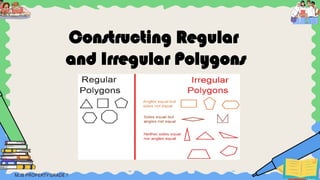
Constructing Regular
and Irregular Polygons
2
● This lesson serves as a prerequisite lesson for the following DepEd
competencies:
Learning Competencies
○ Draw and describe regular and irregular polygons with 5, 6, 8, or 10
sides based on measurements of sides and angles using a ruler and
protractor.
○ Draw triangles, quadrilaterals, and regular polygons (5, 6, 8, or 10 sides)
with given angle measures.
3
Learning Targets
● At the end of this lesson, the learner should be able to do the following:
○ Define regular and irregular polygons and determine the characteristics
of polygons with 5, 6, 8, or 10 sides.
○ Utilize a ruler and protractor to measure sides and angles accurately for
constructing regular and irregular polygons.
○ Draw and describe triangles, quadrilaterals, and regular polygons (5, 6,
8, or 10 sides) with given angle measures.
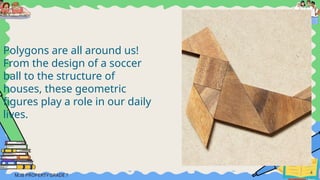
Polygons are all around us!
From the design of a soccer
ball to the structure of
houses, these geometric
figures play a role in our daily
lives.
4
This lesson will delve into understanding the difference
between regular and irregular polygons and how to
construct them using simple tools like a ruler and
protractor.
Let’s jump into this interesting world of shapes and
angles!
6
1. What makes a polygon
regular?
7
2. How do you draw a regular
polygon using a ruler and a
protractor?
Prerequisite Skills
● Ability to recognize basic shapes such as triangles, squares, rectangles, etc.
● Familiarity with the basic use of a ruler and protractor.
● Knowledge of basic angle measures and properties.
Virtual Geometry
Suggested Time Frame: 10 minutes
Materials: computer or tablet, internet access
Instructions:
1. Open the Google Drawing app.
2. Use the tool to draw regular and irregular hexagons and decagons.
3. Adjust the angles and side lengths to explore different variations.
9
Warm up!
Guide Questions:
1. How did using a digital tool compare to drawing polygons manually?
2. Were there any challenges using the digital tool?
10
Warm up!
Learn about It
● polygons – closed two-dimensional shapes made up of line segments
Did You Know?
The word polygon comes from the Greek words poly meaning "many"
and gonia meaning "angle." A polygon essentially means "many angles."
Learn about It
● The following are examples of polygons. Note that polygons have vertices,
angles, and sides.
Learn about It
● The following figures are not polygons.
Learn about It
Parts of a polygon:
● side – line segments that enclose the polygon
● vertex (plural: vertices) – a point of intersection of the sides of a polygon
● angle – an opening that the two sides of a polygon form
Learn about It
● regular polygons – polygons that have all sides of equal length and all
angles of equal measure
● irregular polygons – polygons that do not have sides of equal length or
angles of equal measure
Learn about It
● Examples of Regular and Irregular Polygons
Learn about It
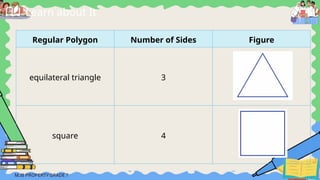
Regular Polygon Number of Sides Figure
equilateral triangle 3
square 4
Learn about It
Regular Polygon Number of Sides Figure
regular pentagon 5
regular hexagon 6
Learn about It
Regular Polygon Number of Sides Figure
regular octagon 8
regular decagon 10
Tip
Note that in this lesson, we will only be covering triangles, squares,
pentagons, hexagons, octagons, and decagons. A more in-depth
discussion of the different types of polygons will be covered in Lesson 3:
Types of Polygons.
Tip
In constructing regular polygons, you have to know the measure of its
interior angles by using a ruler and a protractor.
● The angles of a regular triangle measure 60o
.
● The angles of a square measure 90o
.
● The angles of a regular pentagon measure 108o
.
● The angles of a regular hexagon measure 120o
.
● The angles of a regular octagon measure 135o
.
● The angles of a regular decagon measure 144o
.
Tip
Note that there is a formula for solving the interior angles of a polygon,
but this will be discussed in detail in Lesson 4: Interior and Exterior Angles
of a Convex Polygon.
24
Let’s Practice
Example 1:
A plane figure with five sides that all measure 3 cm each and five angles all
measuring 108° each. Is the given figure a regular polygon?
25
Solution to Let’s Practice
Solution:
Step 1: Determine if the figure is a polygon.
The figure is a closed two-dimensional shape, and it is made up of
line segments. Thus, the figure is a polygon.
26
Solution to Let’s Practice
Solution:
Step 2: Determine if the polygon is a regular polygon.
The sides of the polygon have the same length, which is 3 cm.
The angles of the polygon have the same measure, which is 108°.
27
Solution to Let’s Practice
Answer:
The figure is a regular polygon.
28
Let’s Practice
Example 2:
Construct an equilateral triangle.
29
Solution to Let’s Practice
Solution:
An equilateral triangle has three sides with equal measures. Each angle
measures 60°.
Step 1: Draw a line of any length.
30
Solution to Let’s Practice
Solution:
Step 2: At one end of the line, use a protractor to measure an angle of
60°.
Draw the next line from that point and at the given angle. Make sure
that the new line has the same length as the previous line.
31
Solution to Let’s Practice
Solution:
Step 3: Repeat Step 2 until you complete the triangle.
Practical Applications
The concept of regular and irregular polygons can be found in different
disciplines.
Science:
The structure of crystals can resemble certain regular polygons.
Art and Design:
Polygons are used in various designs and patterns to create visually
appealing structures.
Practical Applications
Architecture:
Polygons, especially triangles and quadrilaterals, form the basis of
structural designs for many buildings.
To be done individually
The sides of a triangle have the following lengths: 7 cm, 7 cm, and 5 cm.
Is the figure a regular polygon?
To be done individually
Construct a square.
To be done in groups of two to five
Patricia plans to create a pentagonal pen for her child’s playground. Each
side of the pentagon should have a length of 3 meters. She also would
like to make sure that the pen is symmetric. Draw a possible pen and
identify its line of symmetry.
●A polygon is a closed figure made up of line segments.
○ The side of a polygon refers to the line segments that
enclose the polygon.
○ The vertex of a polygon refers to the point of intersection
of the sides of a polygon.
○ The angles of a polygon refers to the opening that the two
sides form.
●Regular polygons are polygons that have all sides of equal
length and all angles of equal measure.
38
Synthesis
Wrap-Up
1. What distinguishes a regular polygon from an irregular one?
2. How are a ruler and a protractor essential in constructing accurate
polygons?
39
Synthesis
Application and Values Integration
1. How might the skill of constructing polygons be useful in real-life
situations?
2. What values were practiced during the group activity?
40
Synthesis
Bridge to the Next Topic
1. How important are angles in constructing regular polygons?
2. What do you think is the importance of studying relationships between
angles?

contructing polygons and irregular polygons.pptx

  • 1.
  • 2.
    2 ● This lessonserves as a prerequisite lesson for the following DepEd competencies: Learning Competencies ○ Draw and describe regular and irregular polygons with 5, 6, 8, or 10 sides based on measurements of sides and angles using a ruler and protractor. ○ Draw triangles, quadrilaterals, and regular polygons (5, 6, 8, or 10 sides) with given angle measures.
  • 3.
    3 Learning Targets ● Atthe end of this lesson, the learner should be able to do the following: ○ Define regular and irregular polygons and determine the characteristics of polygons with 5, 6, 8, or 10 sides. ○ Utilize a ruler and protractor to measure sides and angles accurately for constructing regular and irregular polygons. ○ Draw and describe triangles, quadrilaterals, and regular polygons (5, 6, 8, or 10 sides) with given angle measures.
  • 4.
    Polygons are allaround us! From the design of a soccer ball to the structure of houses, these geometric figures play a role in our daily lives. 4
  • 5.
    This lesson willdelve into understanding the difference between regular and irregular polygons and how to construct them using simple tools like a ruler and protractor. Let’s jump into this interesting world of shapes and angles!
  • 6.
    6 1. What makesa polygon regular?
  • 7.
    7 2. How doyou draw a regular polygon using a ruler and a protractor?
  • 8.
    Prerequisite Skills ● Abilityto recognize basic shapes such as triangles, squares, rectangles, etc. ● Familiarity with the basic use of a ruler and protractor. ● Knowledge of basic angle measures and properties.
  • 9.
    Virtual Geometry Suggested TimeFrame: 10 minutes Materials: computer or tablet, internet access Instructions: 1. Open the Google Drawing app. 2. Use the tool to draw regular and irregular hexagons and decagons. 3. Adjust the angles and side lengths to explore different variations. 9 Warm up!
  • 10.
    Guide Questions: 1. Howdid using a digital tool compare to drawing polygons manually? 2. Were there any challenges using the digital tool? 10 Warm up!
  • 11.
    Learn about It ●polygons – closed two-dimensional shapes made up of line segments
  • 12.
    Did You Know? Theword polygon comes from the Greek words poly meaning "many" and gonia meaning "angle." A polygon essentially means "many angles."
  • 13.
    Learn about It ●The following are examples of polygons. Note that polygons have vertices, angles, and sides.
  • 14.
    Learn about It ●The following figures are not polygons.
  • 15.
    Learn about It Partsof a polygon: ● side – line segments that enclose the polygon ● vertex (plural: vertices) – a point of intersection of the sides of a polygon ● angle – an opening that the two sides of a polygon form
  • 16.
    Learn about It ●regular polygons – polygons that have all sides of equal length and all angles of equal measure ● irregular polygons – polygons that do not have sides of equal length or angles of equal measure
  • 17.
    Learn about It ●Examples of Regular and Irregular Polygons
  • 18.
    Learn about It RegularPolygon Number of Sides Figure equilateral triangle 3 square 4
  • 19.
    Learn about It RegularPolygon Number of Sides Figure regular pentagon 5 regular hexagon 6
  • 20.
    Learn about It RegularPolygon Number of Sides Figure regular octagon 8 regular decagon 10
  • 21.
    Tip Note that inthis lesson, we will only be covering triangles, squares, pentagons, hexagons, octagons, and decagons. A more in-depth discussion of the different types of polygons will be covered in Lesson 3: Types of Polygons.
  • 22.
    Tip In constructing regularpolygons, you have to know the measure of its interior angles by using a ruler and a protractor. ● The angles of a regular triangle measure 60o . ● The angles of a square measure 90o . ● The angles of a regular pentagon measure 108o . ● The angles of a regular hexagon measure 120o . ● The angles of a regular octagon measure 135o . ● The angles of a regular decagon measure 144o .
  • 23.
    Tip Note that thereis a formula for solving the interior angles of a polygon, but this will be discussed in detail in Lesson 4: Interior and Exterior Angles of a Convex Polygon.
  • 24.
    24 Let’s Practice Example 1: Aplane figure with five sides that all measure 3 cm each and five angles all measuring 108° each. Is the given figure a regular polygon?
  • 25.
    25 Solution to Let’sPractice Solution: Step 1: Determine if the figure is a polygon. The figure is a closed two-dimensional shape, and it is made up of line segments. Thus, the figure is a polygon.
  • 26.
    26 Solution to Let’sPractice Solution: Step 2: Determine if the polygon is a regular polygon. The sides of the polygon have the same length, which is 3 cm. The angles of the polygon have the same measure, which is 108°.
  • 27.
    27 Solution to Let’sPractice Answer: The figure is a regular polygon.
  • 28.
  • 29.
    29 Solution to Let’sPractice Solution: An equilateral triangle has three sides with equal measures. Each angle measures 60°. Step 1: Draw a line of any length.
  • 30.
    30 Solution to Let’sPractice Solution: Step 2: At one end of the line, use a protractor to measure an angle of 60°. Draw the next line from that point and at the given angle. Make sure that the new line has the same length as the previous line.
  • 31.
    31 Solution to Let’sPractice Solution: Step 3: Repeat Step 2 until you complete the triangle.
  • 32.
    Practical Applications The conceptof regular and irregular polygons can be found in different disciplines. Science: The structure of crystals can resemble certain regular polygons. Art and Design: Polygons are used in various designs and patterns to create visually appealing structures.
  • 33.
    Practical Applications Architecture: Polygons, especiallytriangles and quadrilaterals, form the basis of structural designs for many buildings.
  • 34.
    To be doneindividually The sides of a triangle have the following lengths: 7 cm, 7 cm, and 5 cm. Is the figure a regular polygon?
  • 35.
    To be doneindividually Construct a square.
  • 36.
    To be donein groups of two to five Patricia plans to create a pentagonal pen for her child’s playground. Each side of the pentagon should have a length of 3 meters. She also would like to make sure that the pen is symmetric. Draw a possible pen and identify its line of symmetry.
  • 37.
    ●A polygon isa closed figure made up of line segments. ○ The side of a polygon refers to the line segments that enclose the polygon. ○ The vertex of a polygon refers to the point of intersection of the sides of a polygon. ○ The angles of a polygon refers to the opening that the two sides form. ●Regular polygons are polygons that have all sides of equal length and all angles of equal measure.
  • 38.
    38 Synthesis Wrap-Up 1. What distinguishesa regular polygon from an irregular one? 2. How are a ruler and a protractor essential in constructing accurate polygons?
  • 39.
    39 Synthesis Application and ValuesIntegration 1. How might the skill of constructing polygons be useful in real-life situations? 2. What values were practiced during the group activity?
  • 40.
    40 Synthesis Bridge to theNext Topic 1. How important are angles in constructing regular polygons? 2. What do you think is the importance of studying relationships between angles?