NATIONAL MATHEMATICS PROGRAM QUARTER 1
CLASSIFICATION OF
POLYGONS ACCORDING TO
THE NUMBER OF SIDES
WHETHER REGULAR OR
IRREGULAR
(Polygon)
(Not a Polygon)
(Not a Polygon)
(Polygon)
(Polygon)
(Polygon)
(Not a Polygon)
(Not a Polygon)
THINGS TO REMEMBER
Non-collinear- points that do not lie on the same straight line
Polygon- literally means “many angles” in Greek
Interior Angle- angle inside the polygon
Edges – sides of the polygon
Irregular polygon – does not have all sides and angles of equal
measure
Regular polygon – has equal sides and equal angles
N-gon – has n-sides
Dodecagon - has 12 sides
Undecagon – has 11 sides
3 TRIANGLE REGULAR
6 HEXAGON IRREGULAR
QUADRILATERAL
4 IRREGULAR
6 HEXAGON IRREGULAR
4 QUADRILATERAL REGULAR
REGULAR
POLYGON
When can you say that a polygon is regular or irregular?
A polygon is regular if the measurements of its sides
and angles are congruent. If not, then it is
irregular.
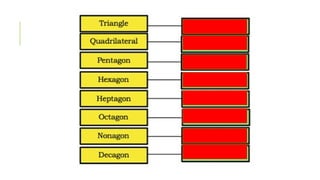
1. Penta comes from the Greek word "pente,” which means
"five."
2. Hexa comes from the Greek word "hex," which means
"six."
3. Octa comes from the Greek word "okto," which means
"eight."
4. Deca comes from the Greek word "deka," which means
"ten.”
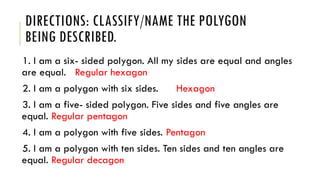
DIRECTIONS: CLASSIFY/NAME THE POLYGON
BEING DESCRIBED.
1. I am a six- sided polygon. All my sides are equal and angles
are equal. Regular hexagon
2. I am a polygon with six sides. Hexagon
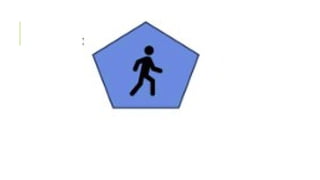
3. I am a five- sided polygon. Five sides and five angles are
equal. Regular pentagon
4. I am a polygon with five sides. Pentagon
5. I am a polygon with ten sides. Ten sides and ten angles are
equal. Regular decagon
PROPERTIES OF REGULAR AND IRREGULAR
POLYGONS
To measure an object using a ruler, line up the end of an
object to the zero of the ruler then look at the other end
of an object and get the length measure.
To measure an angle using a protractor, line up the vertex of
the angle with the dot at the center of the protractor. Line up
one side of the angle with 0 degrees on the protractor. Read
the protractor to see where the other side of the angle crosses
the number scale.
Compass - It is an instrument, usually metal, that you
can use to draw circles or arcs, and to measure distances
for constructions in geometry.
Protractor - It is an instrument for measuring angles.
Interior angles - These are angles formed by two
consecutive sides inside a polygon.
Degree - It is a unit of angular measurement used to
quantify the size or magnitude of an angle.
Vertex- It is a point where two straight lines or rays
meet.

National mathematics program WEEK2.slide

  • 1.
  • 2.
    CLASSIFICATION OF POLYGONS ACCORDINGTO THE NUMBER OF SIDES WHETHER REGULAR OR IRREGULAR
  • 12.
  • 13.
  • 14.
  • 15.
  • 16.
  • 17.
  • 18.
  • 19.
  • 20.
    THINGS TO REMEMBER Non-collinear-points that do not lie on the same straight line Polygon- literally means “many angles” in Greek Interior Angle- angle inside the polygon Edges – sides of the polygon Irregular polygon – does not have all sides and angles of equal measure Regular polygon – has equal sides and equal angles N-gon – has n-sides Dodecagon - has 12 sides Undecagon – has 11 sides
  • 21.
    3 TRIANGLE REGULAR 6HEXAGON IRREGULAR QUADRILATERAL 4 IRREGULAR 6 HEXAGON IRREGULAR 4 QUADRILATERAL REGULAR
  • 22.
    REGULAR POLYGON When can yousay that a polygon is regular or irregular? A polygon is regular if the measurements of its sides and angles are congruent. If not, then it is irregular.
  • 23.
    1. Penta comesfrom the Greek word "pente,” which means "five." 2. Hexa comes from the Greek word "hex," which means "six." 3. Octa comes from the Greek word "okto," which means "eight." 4. Deca comes from the Greek word "deka," which means "ten.”
  • 24.
    DIRECTIONS: CLASSIFY/NAME THEPOLYGON BEING DESCRIBED. 1. I am a six- sided polygon. All my sides are equal and angles are equal. Regular hexagon 2. I am a polygon with six sides. Hexagon 3. I am a five- sided polygon. Five sides and five angles are equal. Regular pentagon 4. I am a polygon with five sides. Pentagon 5. I am a polygon with ten sides. Ten sides and ten angles are equal. Regular decagon
  • 25.
    PROPERTIES OF REGULARAND IRREGULAR POLYGONS To measure an object using a ruler, line up the end of an object to the zero of the ruler then look at the other end of an object and get the length measure.
  • 26.
    To measure anangle using a protractor, line up the vertex of the angle with the dot at the center of the protractor. Line up one side of the angle with 0 degrees on the protractor. Read the protractor to see where the other side of the angle crosses the number scale.
  • 27.
    Compass - Itis an instrument, usually metal, that you can use to draw circles or arcs, and to measure distances for constructions in geometry. Protractor - It is an instrument for measuring angles. Interior angles - These are angles formed by two consecutive sides inside a polygon. Degree - It is a unit of angular measurement used to quantify the size or magnitude of an angle. Vertex- It is a point where two straight lines or rays meet.