Polygon is an ordered list of vertices as
shown in the above figure. For filling
polygons with particular colors, you need to
determine the pixels falling on the border of
polygon and those which fall inside the
polygon.
Now, we will see how we can fill
polygons using different techniques.
 ScanLineAlgorithm
This algorithm works by intersecting scanline with
polygon edges and fills the polygon between pairs of
intersections. The following steps depict how this
algorithm works.
ScanLine
 Step 1: Find out the Ymin and Ymax from the given
polygon.
 Step 2: ScanLine intersects with each edge of the
polygon from Ymin to Ymax. Name each intersection
point of the polygon. As per the figure shown above,
they are named as p0, p1, p2, p3.
 Step 3: Sort the intersection point in the increasing
order of X coordinate i.e. (p0, p1), (p1, p2), and (p2,
p3).
 Step 4: Fill all those pair of coordinates that are
inside polygons and ignore the alternate pairs.
 Sometimes we want to fill the area of
polygon and its boundary with different
colors.
 it relies on the fill color. In other words, it
replaces the interior color of the object with
the fill color. When no more pixels of the
original interior color exist, the algorithm is
completed.
 This algorithm relies on the Four-connect or
Eight-connect method of filling in the
pixels. But instead of looking for the
boundary color, it is looking for all adjacent
pixels that are a part of the interior.
 In this algorithm, we assume that color of
the boundary is same for the entire object.
The boundary fill algorithm can be
implemented by 4-connetected pixels or 8-
connected pixels.
 In this technique 4-
connected pixels are
used as shown in the
figure. We are putting
the pixels above, below,
to the right, and to the
left side of the current
pixels and this process
will continue until we find
a boundary with different
color.
Algorithm
Step 1: Initialize the value of seed point (seedx, seedy),
newcolor and ololdcol.
Step 2: Define the boundary values of the polygon.
Step 3: Check if the current seed point is of old color, then
repeat the steps 4 and 5 till the boundary pixels reached.
If getpixel(x, y) = ololdcol then repeat step
4 and 5
Step 4: Change the old color with the fill color at the seed
point.
setPixel(seedx, seedy, newcol)
step 5: Recursively follow the procedure with
four neighborhood points.
FloodFill (seedx – 1, seedy, newcol, oldcol)
FloodFill (seedx + 1, seedy, newcol, oldcol)
FloodFill (seedx, seedy - 1, newcol, oldcol)
FloodFill (seedx – 1, seedy + 1, newcol,
oldcol)
Step 6: Exit
There is a problem with
this technique.
Consider the case as
shown below where we
tried to fill the entire
region. Here, the image
is filled only partially. In
such cases, 4-
connected pixels
technique cannot be
used.
In this technique, 8-connected pixels are
used as shown in the figure. We are putting
pixels above, below, right and left side of the
current pixels as we were doing in 4-
connected technique.
 In addition to this, we are
also putting pixels in
diagonals so that entire
area of the current pixel
is covered. This process
will continue until we find
a boundary with different
color.
Recursively follow the procedure with eight
neighborhood points.
FloodFill (seedx – 1, seedy, newcol, oldcol)
FloodFill (seedx + 1, seedy, newcol, oldcol)
FloodFill (seedx, seedy - 1, newcol, oldcol)
FloodFill (seedx, seedy + 1, newcol, oldcol)
FloodFill (seedx – 1, seedy + 1, newcol, oldcol)
FloodFill (seedx + 1, seedy + 1, newcol, oldcol)
FloodFill (seedx + 1, seedy - 1, newcol, oldcol)
FloodFill (seedx – 1, seedy - 1, newcol, oldcol)
 This method is also known as counting
number method.
 While filling an object, we often need to
identify whether particular point is inside the
object or outside it.
 Odd-Even Rule method is used by which we
can identify whether particular point is inside
an object or outside.
 In this technique, we will count the edge
crossing along the line from any point (x,y) .
 If the number of interactions is odd, then the
point (x,y) is an interior point; and if the
number of interactions is even, then the point
(x,y) is an exterior point. The following
example depicts this concept.
(x, y)
20
Rotating About An Arbitrary Point
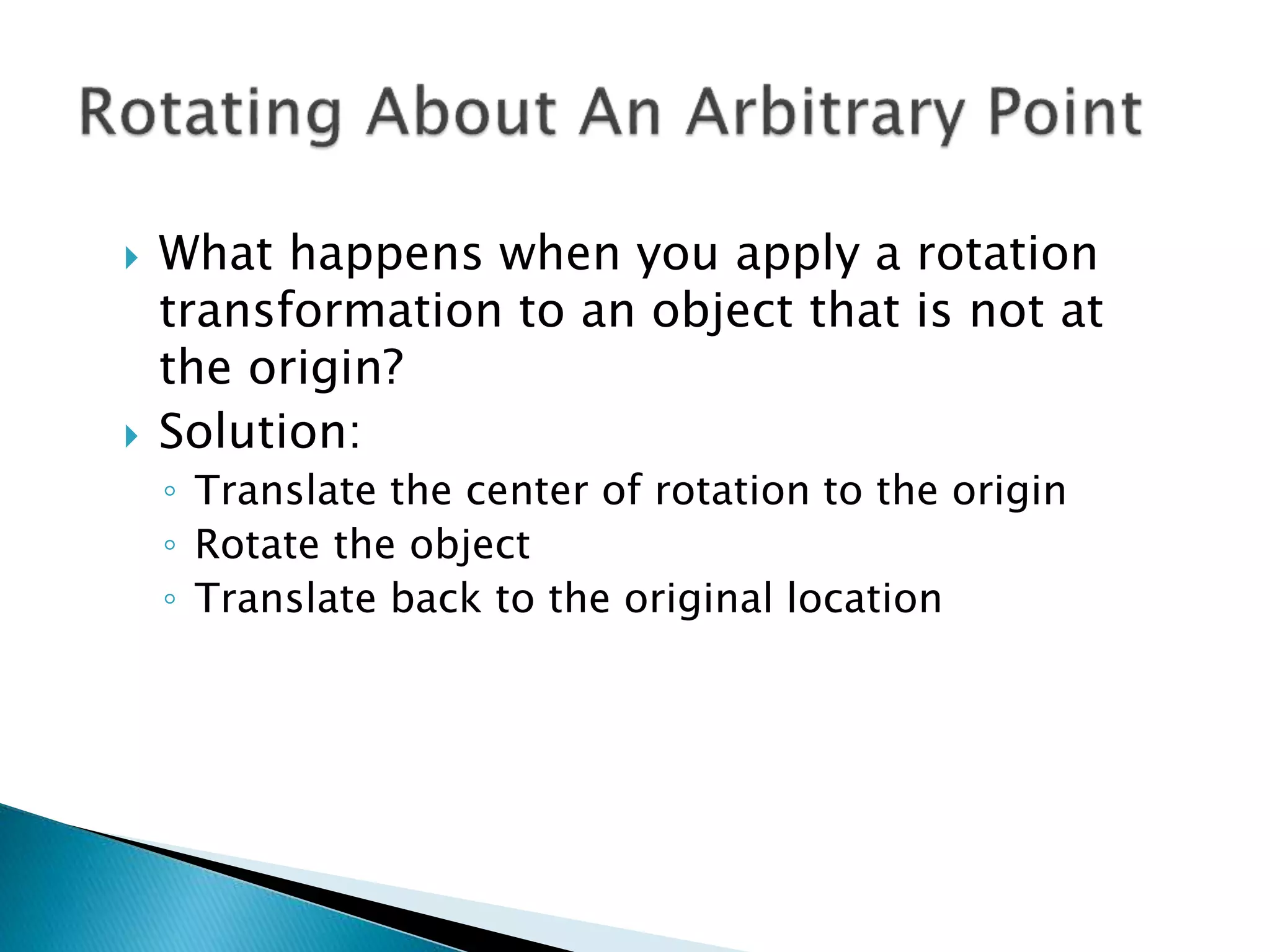
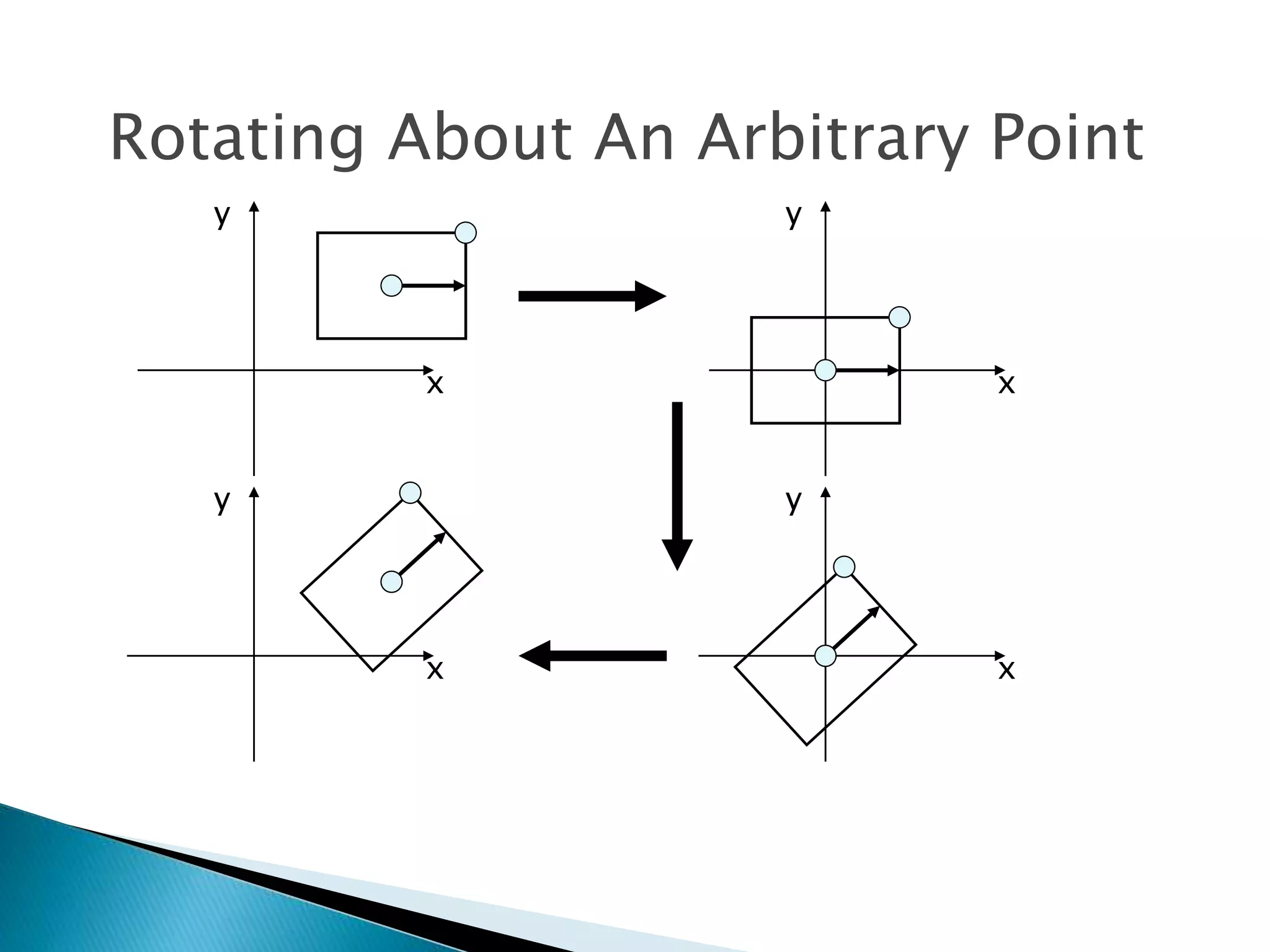
 What happens when you apply a rotation
transformation to an object that is not at
the origin?
 Solution:
◦ Translate the center of rotation to the origin
◦ Rotate the object
◦ Translate back to the original location
Rotating About An Arbitrary Point
x
y
x
y
x
y
x
y
 Thank you….
Polygon
Polygon
Polygon
Polygon
Polygon
Polygon
Polygon
Polygon
Polygon
Polygon
Polygon
Polygon
Polygon

Polygon

  • 3.
    Polygon is anordered list of vertices as shown in the above figure. For filling polygons with particular colors, you need to determine the pixels falling on the border of polygon and those which fall inside the polygon. Now, we will see how we can fill polygons using different techniques.
  • 4.
     ScanLineAlgorithm This algorithmworks by intersecting scanline with polygon edges and fills the polygon between pairs of intersections. The following steps depict how this algorithm works. ScanLine
  • 5.
     Step 1:Find out the Ymin and Ymax from the given polygon.  Step 2: ScanLine intersects with each edge of the polygon from Ymin to Ymax. Name each intersection point of the polygon. As per the figure shown above, they are named as p0, p1, p2, p3.  Step 3: Sort the intersection point in the increasing order of X coordinate i.e. (p0, p1), (p1, p2), and (p2, p3).  Step 4: Fill all those pair of coordinates that are inside polygons and ignore the alternate pairs.
  • 6.
     Sometimes wewant to fill the area of polygon and its boundary with different colors.  it relies on the fill color. In other words, it replaces the interior color of the object with the fill color. When no more pixels of the original interior color exist, the algorithm is completed.
  • 7.
     This algorithmrelies on the Four-connect or Eight-connect method of filling in the pixels. But instead of looking for the boundary color, it is looking for all adjacent pixels that are a part of the interior.

  • 9.
     In thisalgorithm, we assume that color of the boundary is same for the entire object. The boundary fill algorithm can be implemented by 4-connetected pixels or 8- connected pixels.
  • 10.
     In thistechnique 4- connected pixels are used as shown in the figure. We are putting the pixels above, below, to the right, and to the left side of the current pixels and this process will continue until we find a boundary with different color.
  • 11.
    Algorithm Step 1: Initializethe value of seed point (seedx, seedy), newcolor and ololdcol. Step 2: Define the boundary values of the polygon. Step 3: Check if the current seed point is of old color, then repeat the steps 4 and 5 till the boundary pixels reached. If getpixel(x, y) = ololdcol then repeat step 4 and 5 Step 4: Change the old color with the fill color at the seed point. setPixel(seedx, seedy, newcol)
  • 12.
    step 5: Recursivelyfollow the procedure with four neighborhood points. FloodFill (seedx – 1, seedy, newcol, oldcol) FloodFill (seedx + 1, seedy, newcol, oldcol) FloodFill (seedx, seedy - 1, newcol, oldcol) FloodFill (seedx – 1, seedy + 1, newcol, oldcol) Step 6: Exit
  • 13.
    There is aproblem with this technique. Consider the case as shown below where we tried to fill the entire region. Here, the image is filled only partially. In such cases, 4- connected pixels technique cannot be used.
  • 14.
    In this technique,8-connected pixels are used as shown in the figure. We are putting pixels above, below, right and left side of the current pixels as we were doing in 4- connected technique.
  • 15.
     In additionto this, we are also putting pixels in diagonals so that entire area of the current pixel is covered. This process will continue until we find a boundary with different color.
  • 16.
    Recursively follow theprocedure with eight neighborhood points. FloodFill (seedx – 1, seedy, newcol, oldcol) FloodFill (seedx + 1, seedy, newcol, oldcol) FloodFill (seedx, seedy - 1, newcol, oldcol) FloodFill (seedx, seedy + 1, newcol, oldcol) FloodFill (seedx – 1, seedy + 1, newcol, oldcol) FloodFill (seedx + 1, seedy + 1, newcol, oldcol) FloodFill (seedx + 1, seedy - 1, newcol, oldcol) FloodFill (seedx – 1, seedy - 1, newcol, oldcol)
  • 17.
     This methodis also known as counting number method.  While filling an object, we often need to identify whether particular point is inside the object or outside it.  Odd-Even Rule method is used by which we can identify whether particular point is inside an object or outside.
  • 18.
     In thistechnique, we will count the edge crossing along the line from any point (x,y) .  If the number of interactions is odd, then the point (x,y) is an interior point; and if the number of interactions is even, then the point (x,y) is an exterior point. The following example depicts this concept.
  • 19.
  • 20.
    20 Rotating About AnArbitrary Point
  • 21.
     What happenswhen you apply a rotation transformation to an object that is not at the origin?  Solution: ◦ Translate the center of rotation to the origin ◦ Rotate the object ◦ Translate back to the original location
  • 22.
    Rotating About AnArbitrary Point x y x y x y x y
  • 23.