Grojec, Poland 4.-8. 11.2013.
 Latvian state was proclaimed on the 18th November,1918.
 By the World War II, Latvia was an independent parliamentary republic
 At the beginning of the second World War on the 17th June ,1940
,Latvia was occupied by the USSR. Till 1991 Latvia was a part of the
USSR.
 On the fourth May,1991 is accepted the declaration of independence
and in Latvia is slowly restored the country's independence.
 From 1991 Latvia again is an independent parliamentary state.
 From 2004 Latvia EU member.
 From 2014. Latvia joins the euro.
 On the 18th November,2018, Latvia will celebrate its 100th birthday.
1. Latvia is an independent democratic republic.
2. The sovereign power of the State of Latvia is voted by
the people of Latvia.
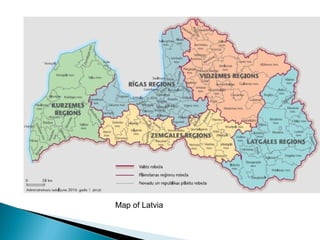
3. The territory of the State of Latvia, within the borders
established by international agreements, consists of
Vidzeme, Latgale, Kurzeme and Zemgale.
4. The Latvian language is the official language in the
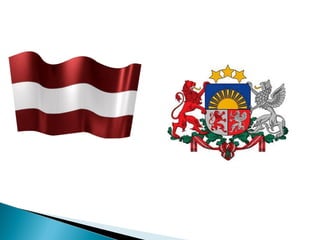
Republic of Latvia. The carmine-white-carmine flag of
Latvia is one of the oldest in the world
Map of Latvia
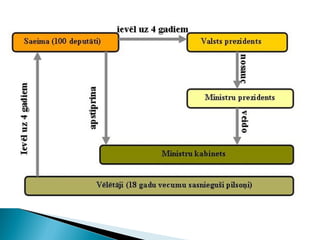
According to the Satversme (Constitution),
Latvia is a parliamentary republic in which the
sovereign power belongs to the people, who are
represented by a unicameral parliament
(Saeima), with 100 members elected in general,
equal, direct, secret and proportional elections
for a four-year period.
The Saeima, and also the people, have the right to
legislate, in accordance with the procedures, and to
the extent, provided for by the Constitution.
The Saeima elects President for a term of four
years. The same person must not hold office as
President for more than eight consecutive years.
The President signs laws, chooses the Prime
Minister (who heads the government) and performs
representative functions
 The elections for Parliament (Saeima) in Latvia are held every four
years on the first Saturday in October.
 All citizens of Latvia who have reached the age of 18 by election
day have the right to vote unless any of the restrictions apply.
 Any legally registered political party or association of political parties
may submit a list of candidates for Saeima.
 Any citizen of Latvia who has reached the age of 21 by election day
may be nominated as a candidate, unless any of the restrictions
apply.
 Only those list of candidates which have received at least 5% of the
total number of votes cast in all five election constituencies will be
elected to the Saeima.
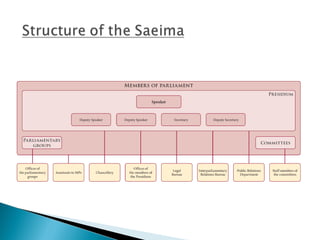
 The work of the Saeima is administered by the
Presidium, which is elected by the Saeima at the
beginning of its mandate.
The Presidium is composed of five members of
parliament: the Speaker of the Saeima, two Deputy
Speakers and a Deputy Secretary.
 The Speaker of the Saeima is the official of the Saeima
who
-Represents the Saeima,
-Conduct the Saeima sittings,
-In special cases temporarily assumes the duties of the
President of the State
 Committees
Currently, there are 15 standing committees in the
Saeima:
- Foreign AffairsCommittee
- Budget and Finance Committee
- Legal Affairs Commitee
- Human Rights and Public Affairs Committee
- Education, Culture and Science Committee
- Defence, Internal Affairs and Corruption Provention
Committee
- Public Administration and Local Government
Committee
- Economic, Agricultural, Environmental and Regional
Policy Committee
- Social and Environmental Matters Committee
- Mandate, Ethics and Submissions Comittee
- Government Review Committee
- Public Expenditure and Audit Commettee
- National Security Committee
- Social Cohesion Committee
- European Affairs Committee
The committees prepare for consideration all matters that
are discussed by the Saeima.
Broader discussions about laws take place within the
committees
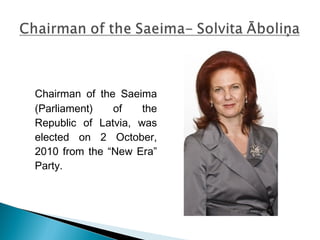
Chairman of the Saeima
(Parliament) of the
Republic of Latvia, was
elected on 2 October,
2010 from the “New Era”
Party.
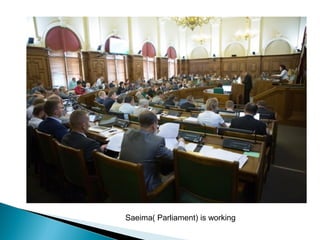
Saeima( Parliament) is working
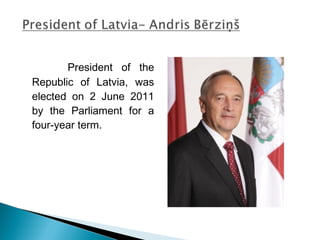
President of the
Republic of Latvia, was
elected on 2 June 2011
by the Parliament for a
four-year term.
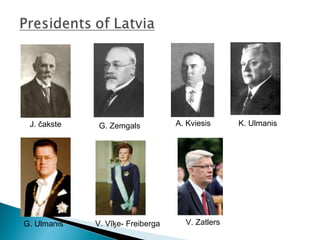
J. čakste G. Zemgals A. Kviesis K. Ulmanis
G. Ulmanis V. Vīķe- Freiberga V. Zatlers
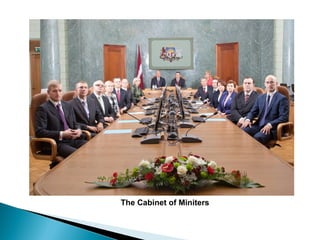
The Cabinet of Ministers is the highest
executive body of the country. The role
and functions of the executive power are
stipulated in the Satversme
(Constitution) of the Republic of Latvia
and in the Law on the Structure of
Cabinet Law. The Cabinet of Ministers is
formed by a person invited by the State
President.
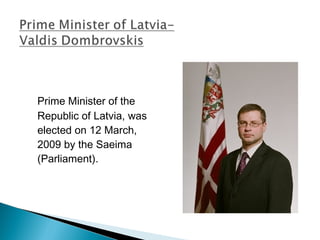
Prime Minister of the
Republic of Latvia, was
elected on 12 March,
2009 by the Saeima
(Parliament).
The Cabinet of Miniters
The President represents the State in international
relations, appoints the diplomatic representatives of
Latvia, and also receives diplomatic representatives of
other states.
The President implements the decisions of the Saeima
concerning the ratification of international agreements.
The President is the Commander-in-Chief of the Armed
Forces of Latvia. During wartime, the President appoints
a Supreme Commander.
The President has the right to initiate legislation.
The President proclaims laws passed by the Saeima not
earlier than the seventh day and not later than the
twenty-first day after the law has been adopted. A law
comes into force fourteen days after its proclamation
unless a different term has been specified in the law.
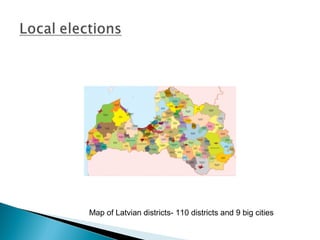
Map of Latvian districts- 110 districts and 9 big cities
 Municipal councils (hereinafter the councils) shall be elected for a
period of four years in equal, democratic, direct, secret and
proportional elections.
 The general elections of the councils take place on the first
Saturday in June.
 The number of deputies to be elected to the municipality councils
shall be determined in proportion to the number of residents
registered in the Population Register in the territory of the
respective local government on the date the elections are
announced:
up to 5,000 residents – 9 Council members;
from 5,001 to 20,000 residents – 15 Council members;
from 20,001 to 50,000 residents – 17 Council members;
over 50,000 residents – 19 Council members.
 in municipalities where the number of residents exceeds 5,000 on the
day of announcement of the election, as well as in cities the following
shall be eligible to submit lists of candidates for city councils and
municipality councils:
1) a registered political party;
2) a registered association of registered political parties;
3) two or more registered political parties, which have not joined
in a registered association of political parties.
 In municipalities where the number of residents is under 5,000 on the
day of announcement of the election, the following shall be eligible to
submit lists of candidates for Municipality councils:
1) a registered political party;
2) a registered association of registered political parties;
3) two or more registered political parties, which have not joined
in a registered association of political parties;
4) voters associations.
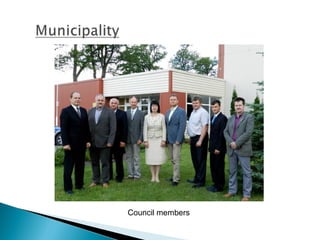
Council members
Political_system-Latvia

Political_system-Latvia

  • 1.
  • 2.
     Latvian statewas proclaimed on the 18th November,1918.  By the World War II, Latvia was an independent parliamentary republic  At the beginning of the second World War on the 17th June ,1940 ,Latvia was occupied by the USSR. Till 1991 Latvia was a part of the USSR.  On the fourth May,1991 is accepted the declaration of independence and in Latvia is slowly restored the country's independence.  From 1991 Latvia again is an independent parliamentary state.  From 2004 Latvia EU member.  From 2014. Latvia joins the euro.  On the 18th November,2018, Latvia will celebrate its 100th birthday.
  • 4.
    1. Latvia isan independent democratic republic. 2. The sovereign power of the State of Latvia is voted by the people of Latvia. 3. The territory of the State of Latvia, within the borders established by international agreements, consists of Vidzeme, Latgale, Kurzeme and Zemgale. 4. The Latvian language is the official language in the Republic of Latvia. The carmine-white-carmine flag of Latvia is one of the oldest in the world
  • 5.
  • 6.
    According to theSatversme (Constitution), Latvia is a parliamentary republic in which the sovereign power belongs to the people, who are represented by a unicameral parliament (Saeima), with 100 members elected in general, equal, direct, secret and proportional elections for a four-year period.
  • 7.
    The Saeima, and alsothe people, have the right to legislate, in accordance with the procedures, and to the extent, provided for by the Constitution. The Saeima elects President for a term of four years. The same person must not hold office as President for more than eight consecutive years. The President signs laws, chooses the Prime Minister (who heads the government) and performs representative functions
  • 8.
     The electionsfor Parliament (Saeima) in Latvia are held every four years on the first Saturday in October.  All citizens of Latvia who have reached the age of 18 by election day have the right to vote unless any of the restrictions apply.  Any legally registered political party or association of political parties may submit a list of candidates for Saeima.  Any citizen of Latvia who has reached the age of 21 by election day may be nominated as a candidate, unless any of the restrictions apply.  Only those list of candidates which have received at least 5% of the total number of votes cast in all five election constituencies will be elected to the Saeima.
  • 11.
     The workof the Saeima is administered by the Presidium, which is elected by the Saeima at the beginning of its mandate. The Presidium is composed of five members of parliament: the Speaker of the Saeima, two Deputy Speakers and a Deputy Secretary.  The Speaker of the Saeima is the official of the Saeima who -Represents the Saeima, -Conduct the Saeima sittings, -In special cases temporarily assumes the duties of the President of the State
  • 12.
     Committees Currently, thereare 15 standing committees in the Saeima: - Foreign AffairsCommittee - Budget and Finance Committee - Legal Affairs Commitee - Human Rights and Public Affairs Committee - Education, Culture and Science Committee - Defence, Internal Affairs and Corruption Provention Committee - Public Administration and Local Government Committee - Economic, Agricultural, Environmental and Regional Policy Committee
  • 13.
    - Social andEnvironmental Matters Committee - Mandate, Ethics and Submissions Comittee - Government Review Committee - Public Expenditure and Audit Commettee - National Security Committee - Social Cohesion Committee - European Affairs Committee The committees prepare for consideration all matters that are discussed by the Saeima. Broader discussions about laws take place within the committees
  • 14.
    Chairman of theSaeima (Parliament) of the Republic of Latvia, was elected on 2 October, 2010 from the “New Era” Party.
  • 15.
  • 16.
    President of the Republicof Latvia, was elected on 2 June 2011 by the Parliament for a four-year term.
  • 17.
    J. čakste G.Zemgals A. Kviesis K. Ulmanis G. Ulmanis V. Vīķe- Freiberga V. Zatlers
  • 18.
    The Cabinet ofMinisters is the highest executive body of the country. The role and functions of the executive power are stipulated in the Satversme (Constitution) of the Republic of Latvia and in the Law on the Structure of Cabinet Law. The Cabinet of Ministers is formed by a person invited by the State President.
  • 19.
    Prime Minister ofthe Republic of Latvia, was elected on 12 March, 2009 by the Saeima (Parliament).
  • 20.
  • 21.
    The President representsthe State in international relations, appoints the diplomatic representatives of Latvia, and also receives diplomatic representatives of other states. The President implements the decisions of the Saeima concerning the ratification of international agreements.
  • 22.
    The President isthe Commander-in-Chief of the Armed Forces of Latvia. During wartime, the President appoints a Supreme Commander. The President has the right to initiate legislation. The President proclaims laws passed by the Saeima not earlier than the seventh day and not later than the twenty-first day after the law has been adopted. A law comes into force fourteen days after its proclamation unless a different term has been specified in the law.
  • 23.
    Map of Latviandistricts- 110 districts and 9 big cities
  • 24.
     Municipal councils(hereinafter the councils) shall be elected for a period of four years in equal, democratic, direct, secret and proportional elections.  The general elections of the councils take place on the first Saturday in June.  The number of deputies to be elected to the municipality councils shall be determined in proportion to the number of residents registered in the Population Register in the territory of the respective local government on the date the elections are announced: up to 5,000 residents – 9 Council members; from 5,001 to 20,000 residents – 15 Council members; from 20,001 to 50,000 residents – 17 Council members; over 50,000 residents – 19 Council members.
  • 25.
     in municipalitieswhere the number of residents exceeds 5,000 on the day of announcement of the election, as well as in cities the following shall be eligible to submit lists of candidates for city councils and municipality councils: 1) a registered political party; 2) a registered association of registered political parties; 3) two or more registered political parties, which have not joined in a registered association of political parties.  In municipalities where the number of residents is under 5,000 on the day of announcement of the election, the following shall be eligible to submit lists of candidates for Municipality councils: 1) a registered political party; 2) a registered association of registered political parties; 3) two or more registered political parties, which have not joined in a registered association of political parties; 4) voters associations.
  • 27.