DEFINITION OF POLIO
•Polio, or poliomyelitis, is a highly contagious viral disease
caused by the poliovirus.
• It primarily affects children under the age of five
• It can lead to irreversible paralysis, respiratory failure, or
even death in severe cases.
• The virus spreads through the fecal-oral route and, less
commonly, through respiratory droplets.
3.
BRIEF HISTORY OFPOLIO
Ancient Times:
Evidence of polio-like paralysis has
been found in ancient Egyptian art,
depicting individuals with withered
limbs.
19th
Century:
Polio outbreaks began to emerge in
Europe and North America as hygiene
practices improved, paradoxically
delaying natural immunity from early
exposure.
4.
20th
Century:
1916: First majorpolio epidemic occurred in the United
States, causing widespread fear.
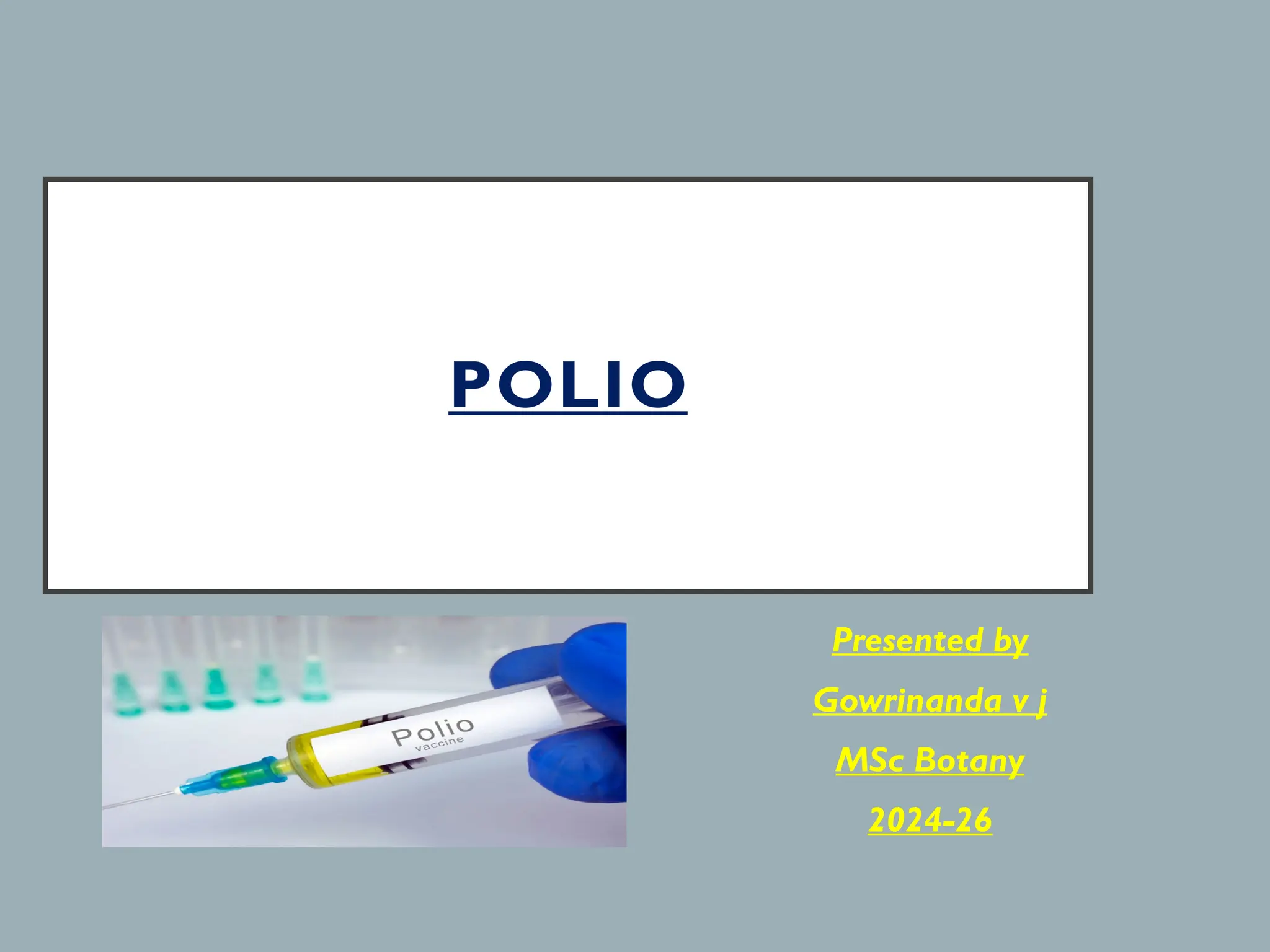
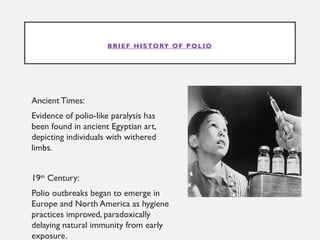
• 1950s: Development of the first effective vaccine by Dr.
Jonas Salk in 1955, followed by Albert Sabin’s oral polio
vaccine in 1961.
5.
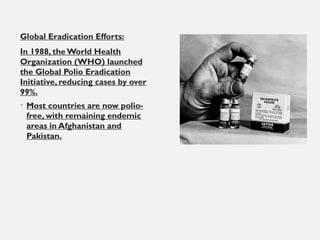
Global Eradication Efforts:
In1988, the World Health
Organization (WHO) launched
the Global Polio Eradication
Initiative, reducing cases by over
99%.
• Most countries are now polio-
free, with remaining endemic
areas in Afghanistan and
Pakistan.
6.
ORGANISMS CHARACTERISTICS
1. Structure:
-Small (~30 nm), non-enveloped, icosahedral capsid.
2. Genetic Material:
- Single-stranded, positive-sense RNA genome (~7,500 nucleotides).
3. Resistance:
- Stable in acidic environments; survives outside the body in certain
conditions.
4. Infection Process:
- Targets human cells in the gastrointestinal tract.
• - Can invade the CNS, destroying motor neurons.
7.
TYPES OF POLIO
•Polio can manifest in three main types, depending on the
severity and symptoms:
1. Abortive Polio
2. Non-paralytic polio
3. Paralytic polio
8.
ABORTIVE POLIO(MINOR ILLNESS)
Themost common form, accounting for approximately 90-
95% of cases.
Symptoms:
Fever
Fatigue
Sore throat
Nausea and vomiting
Headache
Features:
Mild and non-specific symptoms resembling the flu.
No involvement of the central nervous system (CNS).
9.
NON-PARALYTIC POLIO (ASEPTIC
MENINGITIS)
.
Occursin about 1-5% of infections.
Symptoms:
Stiff neck and back
Muscle spasms
Increased sensitivity to light (photophobia)
Fever, fatigue, and headache (similar to abortive polio)
Features:
Involves inflammation of the meninges (the protective
membranes around the brain and spinal cord).
Does not lead to paralysis.
10.
PARALYTIC POLIO
The mostsevere form, occurring in less than 1% of cases.
Types of Paralytic Polio:
Spinal Polio: Affects motor neurons in the spinal cord, leading to asymmetrical
paralysis, typically in the legs.
Bulbar Polio:Affects the brainstem, impairing breathing, swallowing, and
speaking.
Bulbospinal Polio: A combination of spinal and bulbar polio.
Symptoms:
Sudden onset of flaccid paralysis (loss of muscle function).
Weakness or stiffness in limbs.
Respiratory difficulty in severe cases.
Features:
Paralysis may be temporary or permanent.
11.
PATHOGEN
• - Poliovirus:
•Member of the Enterovirus genus in the Picornaviridae family.
• - Non-enveloped RNA virus with a single-stranded, positive-sense RNA
genome.
12.
TRANSMISSION
• 1. Fecal-oralroute:
- Ingesting contaminated food or water.
• 2. Droplet transmission:
-Via saliva or respiratory droplets.
• 3. Other Factors:
- Poor sanitation and close contact with infected individuals.
13.
MICROBIOLOGICAL DIAGNOSIS
. SampleCollection
Stool Samples:
Most reliable for detecting the poliovirus, as it is shed in feces during the acute phase of infection.
Two samples are collected 24–48 hours apart.
Throat Swabs:
Collected early in the infection to detect the virus in respiratory secretions.
Cerebrospinal Fluid (CSF):
• Obtained via lumbar puncture in cases of suspected central nervous system involvement.
14.
VIRUS ISOLATION ANDCULTURE
Samples are inoculated into human or monkey kidney cell lines (e.g., HeLa or
Vero cells).
Cytopathic Effects (CPE):
Poliovirus replication in cell cultures leads to visible cell damage, confirming its
presence.
15.
Molecular Identification
ReverseTranscriptase PolymeraseChain Reaction (RT
-PCR):
Detects and amplifies poliovirus RNA from stool, throat, or CSF
samples.
• Can differentiate between wild-type poliovirus and vaccine-derived
poliovirus strains.
AntigenicTyping
Identifies the specificserotype of poliovirus (types 1, 2, or 3) using
neutralization tests with type-specific antisera.
6. Genetic Sequencing
Used to analyze the RNA sequence of the virus.
• Helps track the origin and transmission of wild poliovirus strains during
outbreaks.