Policy Primer: Online Privacy
NET303, STUDY PERIOD 3, 2017
STEPHEN MCKEE
Executive Summary: Online Privacy
• Online privacy affects us all.
• What are some of the ways we can view online privacy?
• Privacy and the “terms of use” we agree to in everyday online life.
• Privacy and you, as an individual.
2
Online Privacy Effects Us All.
• Privacy has changed: In rural communities and small social groups
everyone has an idea of what their neighbors are doing in public.
• Privacy once relied heavily on social influence and the rule of law to
protect you.
• In the offline world we have walls ,doors, rooms , barriers and other
spaces that can give us individual privacy.
• When you are online all this collapses. There is no context or
boundaries anymore.
(Lessig, 1988) 3
Some Of The Ways We Can View Online
Privacy.
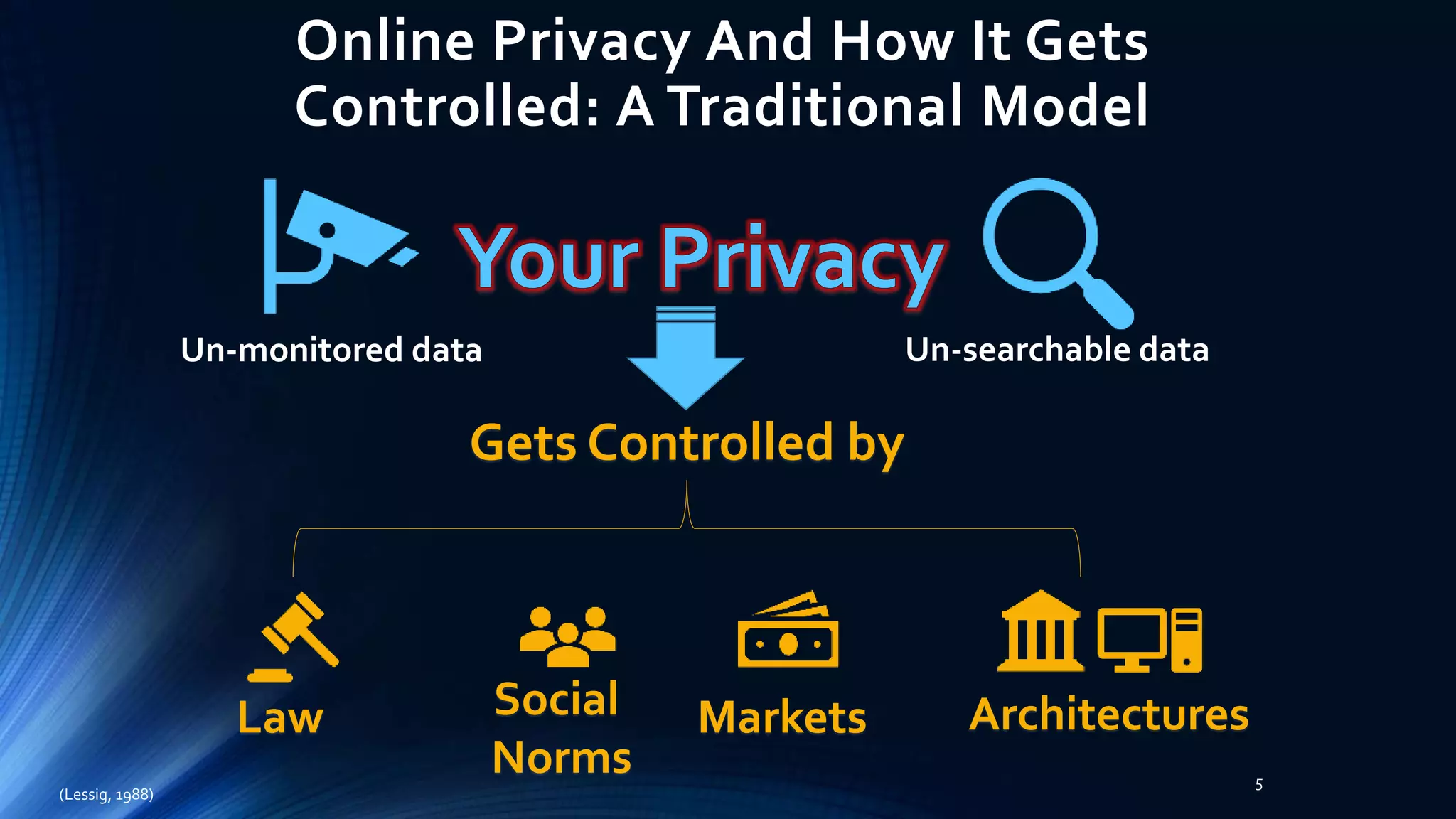
• Privacy can be seen as how easy it is to monitor us, or how easy it is to
search and cross reference our data (and meta data). This has four
main areas.
1. The Legal aspects.
2. The social aspects and acceptable normal behaviors in society.
3. The markets and their influence.
4. The architecture of the systems (both literal computer systems and
the metaphor of building architecture).
(Lessig, 1988) 4
Online Privacy And How It Gets
Controlled: A Traditional Model
Un-monitored data Un-searchable data
Law Social
Norms
Markets Architectures
Gets Controlled by
(Lessig, 1988)
5
A Modern View Of Online Privacy
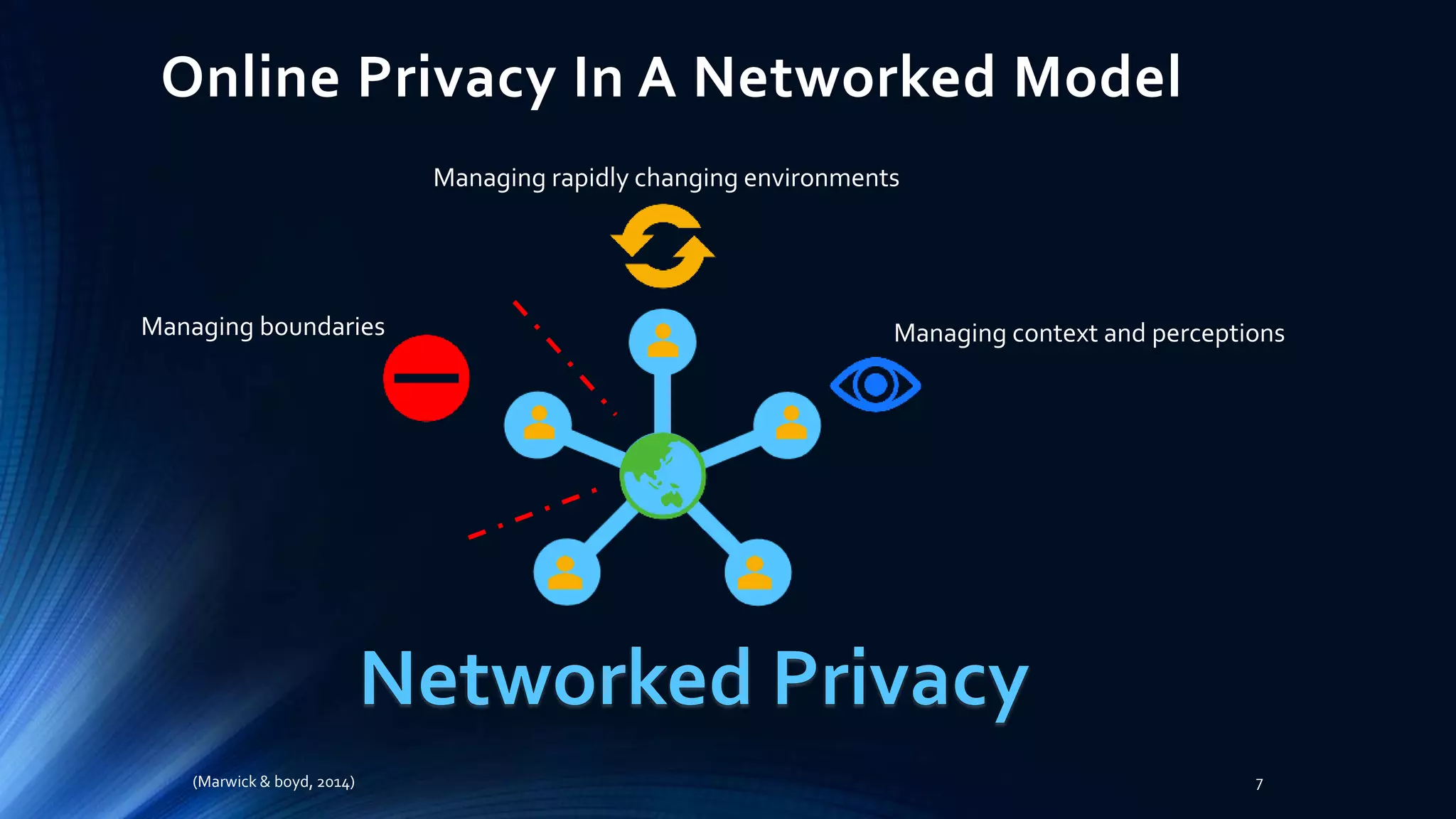
• We can also look at privacy as the way in which parts of a network
interact.
• In the online world it means how we manage the boundaries of those
we interact with from different parts of our life.
• It is about managing the way our data gets seen once someone in the
network views it.
• Privacy and how it is perceived moves more frequently
(Marwick & boyd, 2014) 6
Online Privacy In A Networked Model
Managing boundaries
Managing rapidly changing environments
Managing context and perceptions
(Marwick & boyd, 2014) 7
Online Privacy &“Terms and Conditions”
• Your data is never truly anonymous in the modern world.
• What are the types of data retained?
• Who is collecting data?
• What are we giving away?
• Participation is no longer a choice !
8
What The Experts Are Saying About
losing Privacy Through Connectivity
THE QUESTION POSED
• As billions more everyday objects are
connected in the Internet ofThings, they
are sending and receiving data that
enhances local, national and global systems
as well as individuals’ lives. But such
connectedness also creates exploitable
vulnerabilities. As automobiles, medical
devices, smartTVs, manufacturing
equipment and other tools and
infrastructure are networked, is it likely
that attacks, hacks or ransomware
concerns in the next decade will cause
significant numbers of people to decide to
disconnect, or will the trend toward greater
connectivity of objects and people continue
unabated?
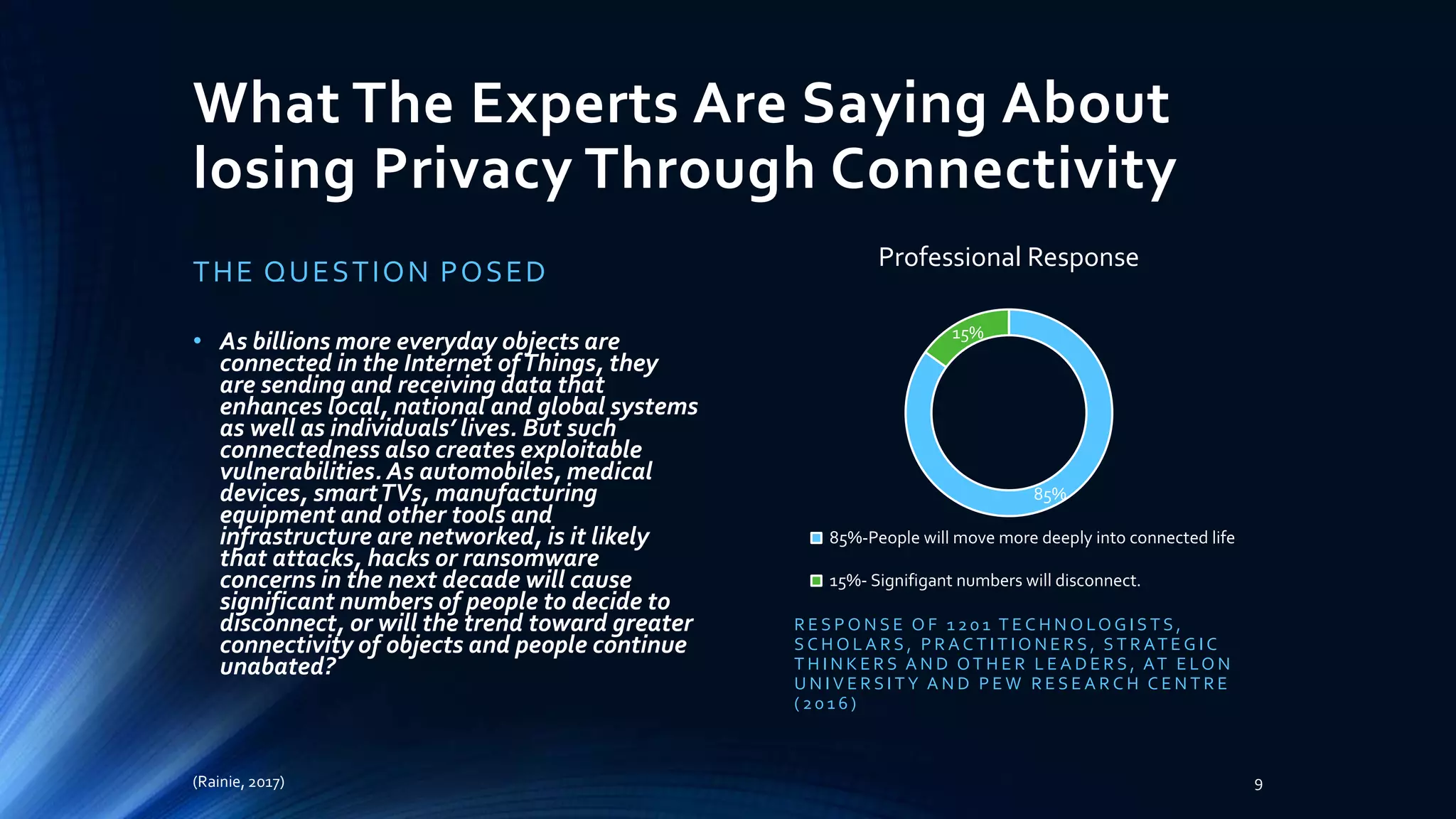
R E S P O N S E O F 1 20 1 T E C H N O LO G I S T S ,
S C H O L A R S , P R A C T I T I O N E R S , S T R AT E G I C
T H I N K E R S A N D OT H E R L E A D E R S , AT E LO N
U N I V E R S I T Y A N D P E W R E S E A R C H C E N T R E
( 20 1 6 )
85%
15%
Professional Response
85%-People will move more deeply into connected life
15%- Signifigant numbers will disconnect.
(Rainie, 2017) 9
What Are The Types Of Data Retained?
• It is not simply the words you put into your profile, or the information someone
holds about you.
• What Is Meta data?- Well, it is data about your data. And most of it we do not see-
The 5 standard types of Meta data that travel with your information are:
1. Access Meta data
2. Semantic Meta data-Adds meaning to the raw data stored.
3. Quality Meta data-The stats-LikeGoogle analytics.
4. Transfer Meta data-is the data that explains how the data gets moved about, for
example XML or SQL
5. Storage Meta data- IS where the data is do be stored and how it should be stored
(Prothman, 2000) 10
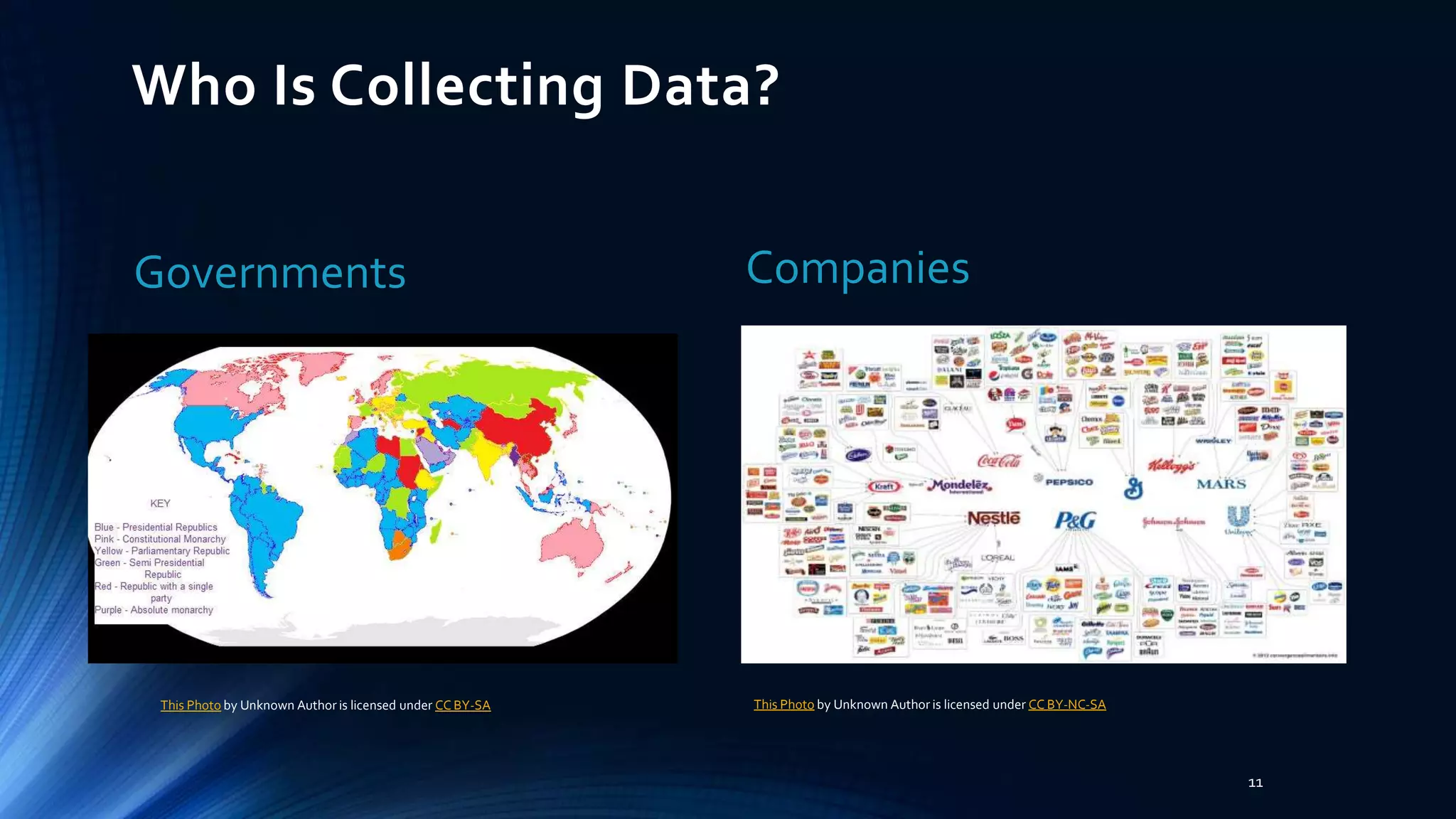
Who Is Collecting Data?
This Photo by Unknown Author is licensed under CC BY-SA
Governments
This Photo by Unknown Author is licensed under CC BY-NC-SA
Companies
11
Who Else Is Collecting Data?
Third Parties listed in theTerms and Conditions of
your agreements.
12
What are we giving away?
• Your views and requirements on privacy are an individual preference. Your personal
comfort on the internet often results in your ideas on privacy. It is a classic risk vs.
reward situation.
• Information will be kept no matter how hard you try to remain anonymous-This
information can be pieced together to take advantage of you. This could be
financial damage, reputation damage, or in severe cases result in imprisonment.
• You do not know how the information can be used in the future. You do not know
who might end up using the information and for what outcomes.
• The organization that has your data may not be the same in the future. Companies
go out of business and governments and political systems change.
• It is not all “doom and gloom”. The more open we are with our information the
better the service and products we can be provided with. Companies can innovate,
Governments can get the right services to the right people.
(Bergström, 2015) 13
Participation Is No Longer A Choice!
• You cannot reasonably say to Apple, or Microsoft that you don’t want to
accept their “terms and conditions”. If you said No! You would be left
without a usable product.
• You cannot be expected to live a life completely free of internet influences.
• The Australian government now has mandatory data retention laws.
• Knowledge of what you are giving away and how these institutions use
your data can help.
• There are a few websites which can help break the walls of text on your T&C
into easy to read information. One example is here: https://tosdr.org/
(Bergström, 2015) 14
This Photo by
Unknown Author is
licensed under CC
BY-SA
This Photo by Unknown Author is
licensed under CC BY-NC-SA
This Photo by
Unknown Author is
licensed under CC BY-
SA
A Summary Of This Presentation
• Online privacy effects us all.
• There is more than one view on what privacy is
• Privacy is affected by what is kept and who is keeping the data.
• Data can be shared and when you agree to “Terms of use” it impacts
privacy.
• Privacy effects you, as an individual.
15
The End
Some Further Reading On The Topic Of This Policy Primer.
• Bergström, A. (2015). Online privacy concerns: A broad approach to understanding the concerns of different
groups for different uses. Computers in Human Behavior, 53, 419-426. doi:10.1016/j.chb.2015.07.025
• Duggan, M. (2017). Online Harassment 2017. Retrieved 16 Sep 17, from @pewinternet
http://www.pewinternet.org/2017/07/11/online-harassment-2017/
• Lessig, L. (1988). The Architecture of privacy. Paper presented at theTaiwan Net 1998,Taipei.
https://cyber.harvard.edu/works/lessig/architecture_priv.pdf
• Marwick, A. E., & boyd, d. (2014). Networked privacy: How teenagers negotiate context in social media. New
Media & Society, 16(7), 1051-1067. doi:10.1177/1461444814543995
• Prothman, B. (2000). Meta data. Potentials, IEEE, 19(1), 20-23. doi:10.1109/45.825636
• Rainie, L. A., Janna. (2017).The Internet ofThings Connectivity Binge: What Are the Implications? Retrieved
2017-06-06, from @pewinternet http://www.pewinternet.org/2017/06/06/the-internet-of-things-connectivity-
binge-what-are-the-implications/
• Westerman, H. a. J., Emil (Producer). (2014, 15 Oct 17). Metadata and data retention: what information is at
risk? . [Online Media presentation] Retrieved from
https://www.sbs.com.au/news/article/2014/08/08/infographic-metadata-and-data-retention-explained
16
Declaration of Conflict of Interests
The author of this paper is currently employed by OPTUS in a role unrelated to the subject
matter. This presentation is private study in the course of Internet Communications
through Curtin University. The positions are the author's own and are in in no way
intended to represent the views of OPTUS.
17
Funding
The author of this presentation received no financial support for the research, authorship
and/or publication of this presentation.
Copyright
This presentation has been brought to you under the provisions of fair dealing Australia,
as a news item.
The presentation has been created as part of an approved course of study at Curtin
University and contains copyright material not created by the author. All copyright
material used remains copyright of the respective owners and it has been used here
pursuant to section 40 of the copyright act 1968 (Commonwealth of Australia). No part of
this work may be reproduced without the consent of the original copyright owners.

Policy primer net303 study period 3, 2017

  • 1.
    Policy Primer: OnlinePrivacy NET303, STUDY PERIOD 3, 2017 STEPHEN MCKEE
  • 2.
    Executive Summary: OnlinePrivacy • Online privacy affects us all. • What are some of the ways we can view online privacy? • Privacy and the “terms of use” we agree to in everyday online life. • Privacy and you, as an individual. 2
  • 3.
    Online Privacy EffectsUs All. • Privacy has changed: In rural communities and small social groups everyone has an idea of what their neighbors are doing in public. • Privacy once relied heavily on social influence and the rule of law to protect you. • In the offline world we have walls ,doors, rooms , barriers and other spaces that can give us individual privacy. • When you are online all this collapses. There is no context or boundaries anymore. (Lessig, 1988) 3
  • 4.
    Some Of TheWays We Can View Online Privacy. • Privacy can be seen as how easy it is to monitor us, or how easy it is to search and cross reference our data (and meta data). This has four main areas. 1. The Legal aspects. 2. The social aspects and acceptable normal behaviors in society. 3. The markets and their influence. 4. The architecture of the systems (both literal computer systems and the metaphor of building architecture). (Lessig, 1988) 4
  • 5.
    Online Privacy AndHow It Gets Controlled: A Traditional Model Un-monitored data Un-searchable data Law Social Norms Markets Architectures Gets Controlled by (Lessig, 1988) 5
  • 6.
    A Modern ViewOf Online Privacy • We can also look at privacy as the way in which parts of a network interact. • In the online world it means how we manage the boundaries of those we interact with from different parts of our life. • It is about managing the way our data gets seen once someone in the network views it. • Privacy and how it is perceived moves more frequently (Marwick & boyd, 2014) 6
  • 7.
    Online Privacy InA Networked Model Managing boundaries Managing rapidly changing environments Managing context and perceptions (Marwick & boyd, 2014) 7
  • 8.
    Online Privacy &“Termsand Conditions” • Your data is never truly anonymous in the modern world. • What are the types of data retained? • Who is collecting data? • What are we giving away? • Participation is no longer a choice ! 8
  • 9.
    What The ExpertsAre Saying About losing Privacy Through Connectivity THE QUESTION POSED • As billions more everyday objects are connected in the Internet ofThings, they are sending and receiving data that enhances local, national and global systems as well as individuals’ lives. But such connectedness also creates exploitable vulnerabilities. As automobiles, medical devices, smartTVs, manufacturing equipment and other tools and infrastructure are networked, is it likely that attacks, hacks or ransomware concerns in the next decade will cause significant numbers of people to decide to disconnect, or will the trend toward greater connectivity of objects and people continue unabated? R E S P O N S E O F 1 20 1 T E C H N O LO G I S T S , S C H O L A R S , P R A C T I T I O N E R S , S T R AT E G I C T H I N K E R S A N D OT H E R L E A D E R S , AT E LO N U N I V E R S I T Y A N D P E W R E S E A R C H C E N T R E ( 20 1 6 ) 85% 15% Professional Response 85%-People will move more deeply into connected life 15%- Signifigant numbers will disconnect. (Rainie, 2017) 9
  • 10.
    What Are TheTypes Of Data Retained? • It is not simply the words you put into your profile, or the information someone holds about you. • What Is Meta data?- Well, it is data about your data. And most of it we do not see- The 5 standard types of Meta data that travel with your information are: 1. Access Meta data 2. Semantic Meta data-Adds meaning to the raw data stored. 3. Quality Meta data-The stats-LikeGoogle analytics. 4. Transfer Meta data-is the data that explains how the data gets moved about, for example XML or SQL 5. Storage Meta data- IS where the data is do be stored and how it should be stored (Prothman, 2000) 10
  • 11.
    Who Is CollectingData? This Photo by Unknown Author is licensed under CC BY-SA Governments This Photo by Unknown Author is licensed under CC BY-NC-SA Companies 11
  • 12.
    Who Else IsCollecting Data? Third Parties listed in theTerms and Conditions of your agreements. 12
  • 13.
    What are wegiving away? • Your views and requirements on privacy are an individual preference. Your personal comfort on the internet often results in your ideas on privacy. It is a classic risk vs. reward situation. • Information will be kept no matter how hard you try to remain anonymous-This information can be pieced together to take advantage of you. This could be financial damage, reputation damage, or in severe cases result in imprisonment. • You do not know how the information can be used in the future. You do not know who might end up using the information and for what outcomes. • The organization that has your data may not be the same in the future. Companies go out of business and governments and political systems change. • It is not all “doom and gloom”. The more open we are with our information the better the service and products we can be provided with. Companies can innovate, Governments can get the right services to the right people. (Bergström, 2015) 13
  • 14.
    Participation Is NoLonger A Choice! • You cannot reasonably say to Apple, or Microsoft that you don’t want to accept their “terms and conditions”. If you said No! You would be left without a usable product. • You cannot be expected to live a life completely free of internet influences. • The Australian government now has mandatory data retention laws. • Knowledge of what you are giving away and how these institutions use your data can help. • There are a few websites which can help break the walls of text on your T&C into easy to read information. One example is here: https://tosdr.org/ (Bergström, 2015) 14 This Photo by Unknown Author is licensed under CC BY-SA This Photo by Unknown Author is licensed under CC BY-NC-SA This Photo by Unknown Author is licensed under CC BY- SA
  • 15.
    A Summary OfThis Presentation • Online privacy effects us all. • There is more than one view on what privacy is • Privacy is affected by what is kept and who is keeping the data. • Data can be shared and when you agree to “Terms of use” it impacts privacy. • Privacy effects you, as an individual. 15 The End
  • 16.
    Some Further ReadingOn The Topic Of This Policy Primer. • Bergström, A. (2015). Online privacy concerns: A broad approach to understanding the concerns of different groups for different uses. Computers in Human Behavior, 53, 419-426. doi:10.1016/j.chb.2015.07.025 • Duggan, M. (2017). Online Harassment 2017. Retrieved 16 Sep 17, from @pewinternet http://www.pewinternet.org/2017/07/11/online-harassment-2017/ • Lessig, L. (1988). The Architecture of privacy. Paper presented at theTaiwan Net 1998,Taipei. https://cyber.harvard.edu/works/lessig/architecture_priv.pdf • Marwick, A. E., & boyd, d. (2014). Networked privacy: How teenagers negotiate context in social media. New Media & Society, 16(7), 1051-1067. doi:10.1177/1461444814543995 • Prothman, B. (2000). Meta data. Potentials, IEEE, 19(1), 20-23. doi:10.1109/45.825636 • Rainie, L. A., Janna. (2017).The Internet ofThings Connectivity Binge: What Are the Implications? Retrieved 2017-06-06, from @pewinternet http://www.pewinternet.org/2017/06/06/the-internet-of-things-connectivity- binge-what-are-the-implications/ • Westerman, H. a. J., Emil (Producer). (2014, 15 Oct 17). Metadata and data retention: what information is at risk? . [Online Media presentation] Retrieved from https://www.sbs.com.au/news/article/2014/08/08/infographic-metadata-and-data-retention-explained 16
  • 17.
    Declaration of Conflictof Interests The author of this paper is currently employed by OPTUS in a role unrelated to the subject matter. This presentation is private study in the course of Internet Communications through Curtin University. The positions are the author's own and are in in no way intended to represent the views of OPTUS. 17 Funding The author of this presentation received no financial support for the research, authorship and/or publication of this presentation. Copyright This presentation has been brought to you under the provisions of fair dealing Australia, as a news item. The presentation has been created as part of an approved course of study at Curtin University and contains copyright material not created by the author. All copyright material used remains copyright of the respective owners and it has been used here pursuant to section 40 of the copyright act 1968 (Commonwealth of Australia). No part of this work may be reproduced without the consent of the original copyright owners.