POL / SOC 360-01
Spring 2015
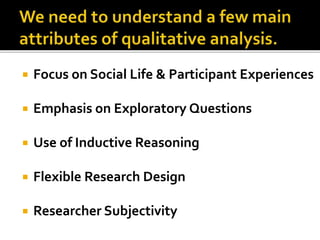
 Focus on Social Life & Participant Experiences
 Emphasis on Exploratory Questions
 Use of Inductive Reasoning
 Flexible Research Design
 Researcher Subjectivity
 Case Studies
 Ethnography
 Netnography
 Social science research is rooted in some kind
of observational technique
 We collect data in this way everyday
 Examples?
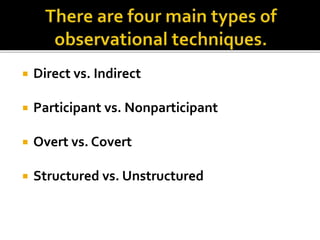
 Direct vs. Indirect
 Participant vs. Nonparticipant
 Overt vs. Covert
 Structured vs. Unstructured
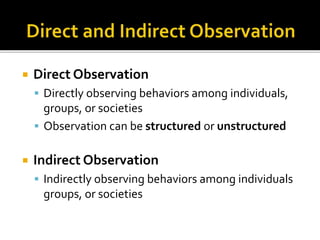
 Direct Observation
 Directly observing behaviors among individuals,
groups, or societies
 Observation can be structured or unstructured
 Indirect Observation
 Indirectly observing behaviors among individuals
groups, or societies
 Participant Observation
 Investigator is both actor and spectator
 Regular participant in the activities being observed
 Example: Studying Campaigns; Social Problems
 Nonparticipant Observation
 Observer does not participate in group’s activities
or become a member of the group or community
 Example: City Council Meetings
 Acceptance by group is necessary
 Use of informants
 Advantages? Disadvantages?
Ruth Horowitz
ADVANTAGES
 Natural Setting
 Opportunity to
observe for long
periods of time
 Degree of accuracy
and completeness
DISADVANTAGES
 Many instances of
political behavior are
not accessible for
observation
 Lack of control over
the environment
 “Small-N” Problem
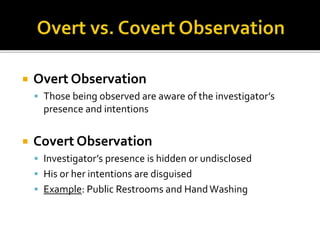
 Overt Observation
 Those being observed are aware of the investigator’s
presence and intentions
 Covert Observation
 Investigator’s presence is hidden or undisclosed
 His or her intentions are disguised
 Example: Public Restrooms and HandWashing
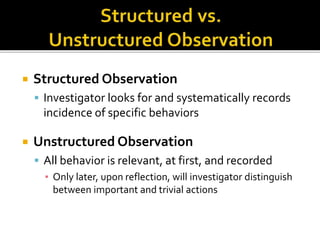
 Structured Observation
 Investigator looks for and systematically records
incidence of specific behaviors
 Unstructured Observation
 All behavior is relevant, at first, and recorded
▪ Only later, upon reflection, will investigator distinguish
between important and trivial actions
 Nonverbal Behavior
 Spatial Behavior
 Linguistic Behavior
 Extralingustic Behavior
ADVANTAGES
 ResearcherControl
 Convenience
DISADVANTAGES
 Subjects know they
are being observed
 People generally behave as they would
ordinarily
 Investigator is able to observe for longer
periods than would be possible in laboratory
setting
 “Going Native”
 Field Notes

Pol soc 360_01_qualitative_methods

  • 1.
    POL / SOC360-01 Spring 2015
  • 4.
     Focus onSocial Life & Participant Experiences  Emphasis on Exploratory Questions  Use of Inductive Reasoning  Flexible Research Design  Researcher Subjectivity
  • 6.
     Case Studies Ethnography  Netnography
  • 8.
     Social scienceresearch is rooted in some kind of observational technique  We collect data in this way everyday  Examples?
  • 9.
     Direct vs.Indirect  Participant vs. Nonparticipant  Overt vs. Covert  Structured vs. Unstructured
  • 10.
     Direct Observation Directly observing behaviors among individuals, groups, or societies  Observation can be structured or unstructured  Indirect Observation  Indirectly observing behaviors among individuals groups, or societies
  • 11.
     Participant Observation Investigator is both actor and spectator  Regular participant in the activities being observed  Example: Studying Campaigns; Social Problems  Nonparticipant Observation  Observer does not participate in group’s activities or become a member of the group or community  Example: City Council Meetings
  • 12.
     Acceptance bygroup is necessary  Use of informants  Advantages? Disadvantages?
  • 13.
  • 14.
    ADVANTAGES  Natural Setting Opportunity to observe for long periods of time  Degree of accuracy and completeness DISADVANTAGES  Many instances of political behavior are not accessible for observation  Lack of control over the environment  “Small-N” Problem
  • 15.
     Overt Observation Those being observed are aware of the investigator’s presence and intentions  Covert Observation  Investigator’s presence is hidden or undisclosed  His or her intentions are disguised  Example: Public Restrooms and HandWashing
  • 16.
     Structured Observation Investigator looks for and systematically records incidence of specific behaviors  Unstructured Observation  All behavior is relevant, at first, and recorded ▪ Only later, upon reflection, will investigator distinguish between important and trivial actions
  • 18.
     Nonverbal Behavior Spatial Behavior  Linguistic Behavior  Extralingustic Behavior
  • 19.
  • 20.
     People generallybehave as they would ordinarily  Investigator is able to observe for longer periods than would be possible in laboratory setting
  • 21.