PHILOSOPHY OF PNP SERVICE
• SERVICE
• HONOR
• JUSTICE
Basic Police Mission
• The basic police mission is preserving order by enforcing rules of
conduct or laws. This was the same in ancient societies as it is today
in sophisticated urban communities.
BASIC CONCEPT IN POLICE ORGANIZATION
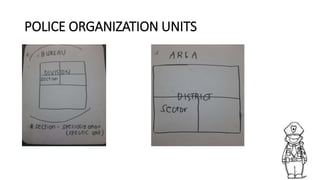
POLICE ORGANIZATION UNITS
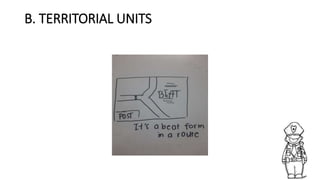
B. TERRITORIAL UNITS
TYPES OF POLICE ORGANIZATIONAL
STRUCTURES
• POLICE FUNCTIONS
- Duties and responsibilities explicitly carried out by police agencies to
meet the demands concerning public order and public safety.
Types of Police Functions
1. Line Functions - these are designed to meet the basic police
mission like patrol, traffic enforcement, or criminal investigation.
2. Staff Functions - those that exist to support line functions, either
directly or indirectly like planning and research unit.
a. Auxiliary Support Services
- Those charged with the responsibility of giving immediate assistance
to the operations of line elements like communications and crime
laboratory services.
b. Administrative Services
-Those that provide services that are of less immediate assistance and
are supportive of the entire police department like personnel and
training.
Functions of the Police
1. Maintain peace and order
2. Enforce the laws in their respective assigned jurisdictions.
3. Prevent crimes.
4. Make arrests, searches, and seizure in accordance with law.
5. Investigate crimes.
6. Prosecute offenders.
7. Ensure public safety.
8. Protect life and property.
ELEMENTS OF ORGANIZATION
A. SPECIALIZATION
- Is the assignment of particular workers to a particular tasks.
- It can thus be thought of in terms of either jobs or people.
B. HIERARCHY OF AUTHORITY
- Formal relationship among superior and subordinates in any given
organization.
CHAIN OF COMMAND
• A line or chain of superiors from top to bottom.
• An unbroken line of authority that links all person in an organization
and defines who reports to whom
C. SPAN OF CONTROL
- Is the maximum number of subordinates at a given position that
superior can supervise effectively.
D. DELEGATION OF AUTHORITY
- Conferring of an amount of authority by a superior position onto a
lower-level position.
- The person to whom authority is delegated becomes the
responsibilities of superior for doing the assigned job.
• AUTHORITY
3 types
1. Line authority
2. Staff authority
3. Functional authority
E. UNITY OF COMMAND
- Each employee should have only one supervisor.
COMMAND RESPONSIBLITY
• It means that the commander is directly responsible for any act or
omission of his subordinates in relation to the performing of their
official duties.
• EXCEPTION:
11. When the commanding officer was not properly informed of the
acts or omission of his subordinates
2. When the commander was properly informed and he conducted an
immediate investigation of such act or omission.
3. When he acted upon lawful orders of superior authorities.
THE PRINCIPLES OF POLICE ORGANIZATION
1. Principle of Unity Objectives
- Every police officer should play a part in the attainment of the
objectives of the police organization.
2. Principle of Organizational Efficiency
- This principle requires that, in order that the PNP organization is
effective, it must be structured in a certain manner to accomplish the
objectives with a minimum cost.
• 3. Scalar Principle
- This principle requires a vertical hierarchy of an organization which
defines the unbroken chain of units and command from top to bottom
describing explicitly the flow of authority.
4. Functional Principle - This principle is otherwise known as division of
work according to type, place, time, and specialization.
5. Line and Staff Principle - It implies a system of varied functions
arranged into a workable pattern.
6. Principle of Balance
- Application of the principles of organization must be balanced to
ensure the effectiveness of the patrol force in accomplishing its
objectives.
7. Principle of Absoluteness of Responsibility
- It states that the responsibility for performance of the deputy chief to
the chief of police is absolute (unconditional) and vice versa, and that
the chief of police cannot escape his accountability on the activities
performed by his subordinates.
8. Principle of Flexibility
- It states that there is higher tendency that the PNP can fulfill its
purpose if the organization receives more provisions for flexibility
(adaptability).
9. Principle of Authority Level (Hierarchy of Authority)
- Decisions within the authority of the police station commanders should
be made by them and should not be referred to their superiors, such as
the police district commander (or PNP provincial director).
10. Principle of Parity and Responsibility
- The responsibility of the head of the Investigation Section for the
actions of his detectives cannot be greater than that implied by the
authority he has delegated, nor should it be less.
OTHER TERMINOLOGY:
• SWORN OFFICER
• SUPERIOR OFFICER
• COMMANDING OFFICER
• RANKING OFFICER
• LENGTH OF SERVICE
• ON DUTY
• OFF DUTY
• SPECIAL DAY
• LEAVE OF ABSENCE
• SICK LEAVE
• SUSPENSION
• DEPARTMENT RULES
• DUTY MANUAL
• ORDER
• REPORT

PNP-ORGANIZATION-TOPIC-2-1.pptx

  • 1.
  • 2.
  • 3.
    Basic Police Mission •The basic police mission is preserving order by enforcing rules of conduct or laws. This was the same in ancient societies as it is today in sophisticated urban communities.
  • 4.
    BASIC CONCEPT INPOLICE ORGANIZATION
  • 5.
  • 6.
  • 7.
    TYPES OF POLICEORGANIZATIONAL STRUCTURES
  • 8.
    • POLICE FUNCTIONS -Duties and responsibilities explicitly carried out by police agencies to meet the demands concerning public order and public safety.
  • 9.
    Types of PoliceFunctions 1. Line Functions - these are designed to meet the basic police mission like patrol, traffic enforcement, or criminal investigation. 2. Staff Functions - those that exist to support line functions, either directly or indirectly like planning and research unit. a. Auxiliary Support Services - Those charged with the responsibility of giving immediate assistance to the operations of line elements like communications and crime laboratory services. b. Administrative Services -Those that provide services that are of less immediate assistance and are supportive of the entire police department like personnel and training.
  • 10.
    Functions of thePolice 1. Maintain peace and order 2. Enforce the laws in their respective assigned jurisdictions. 3. Prevent crimes. 4. Make arrests, searches, and seizure in accordance with law. 5. Investigate crimes. 6. Prosecute offenders. 7. Ensure public safety. 8. Protect life and property.
  • 11.
  • 12.
    A. SPECIALIZATION - Isthe assignment of particular workers to a particular tasks. - It can thus be thought of in terms of either jobs or people.
  • 13.
    B. HIERARCHY OFAUTHORITY - Formal relationship among superior and subordinates in any given organization.
  • 14.
    CHAIN OF COMMAND •A line or chain of superiors from top to bottom. • An unbroken line of authority that links all person in an organization and defines who reports to whom
  • 15.
    C. SPAN OFCONTROL - Is the maximum number of subordinates at a given position that superior can supervise effectively.
  • 16.
    D. DELEGATION OFAUTHORITY - Conferring of an amount of authority by a superior position onto a lower-level position. - The person to whom authority is delegated becomes the responsibilities of superior for doing the assigned job.
  • 17.
    • AUTHORITY 3 types 1.Line authority 2. Staff authority 3. Functional authority
  • 18.
    E. UNITY OFCOMMAND - Each employee should have only one supervisor.
  • 19.
    COMMAND RESPONSIBLITY • Itmeans that the commander is directly responsible for any act or omission of his subordinates in relation to the performing of their official duties. • EXCEPTION: 11. When the commanding officer was not properly informed of the acts or omission of his subordinates 2. When the commander was properly informed and he conducted an immediate investigation of such act or omission. 3. When he acted upon lawful orders of superior authorities.
  • 20.
    THE PRINCIPLES OFPOLICE ORGANIZATION
  • 21.
    1. Principle ofUnity Objectives - Every police officer should play a part in the attainment of the objectives of the police organization. 2. Principle of Organizational Efficiency - This principle requires that, in order that the PNP organization is effective, it must be structured in a certain manner to accomplish the objectives with a minimum cost.
  • 22.
    • 3. ScalarPrinciple - This principle requires a vertical hierarchy of an organization which defines the unbroken chain of units and command from top to bottom describing explicitly the flow of authority.
  • 23.
    4. Functional Principle- This principle is otherwise known as division of work according to type, place, time, and specialization. 5. Line and Staff Principle - It implies a system of varied functions arranged into a workable pattern.
  • 24.
    6. Principle ofBalance - Application of the principles of organization must be balanced to ensure the effectiveness of the patrol force in accomplishing its objectives. 7. Principle of Absoluteness of Responsibility - It states that the responsibility for performance of the deputy chief to the chief of police is absolute (unconditional) and vice versa, and that the chief of police cannot escape his accountability on the activities performed by his subordinates.
  • 25.
    8. Principle ofFlexibility - It states that there is higher tendency that the PNP can fulfill its purpose if the organization receives more provisions for flexibility (adaptability). 9. Principle of Authority Level (Hierarchy of Authority) - Decisions within the authority of the police station commanders should be made by them and should not be referred to their superiors, such as the police district commander (or PNP provincial director). 10. Principle of Parity and Responsibility - The responsibility of the head of the Investigation Section for the actions of his detectives cannot be greater than that implied by the authority he has delegated, nor should it be less.
  • 26.
    OTHER TERMINOLOGY: • SWORNOFFICER • SUPERIOR OFFICER • COMMANDING OFFICER • RANKING OFFICER
  • 27.
    • LENGTH OFSERVICE • ON DUTY • OFF DUTY • SPECIAL DAY • LEAVE OF ABSENCE
  • 28.
    • SICK LEAVE •SUSPENSION • DEPARTMENT RULES • DUTY MANUAL • ORDER • REPORT