Level 2
Makeup Color Theory
AGENDA


         •  Color Theory
         •  Color Contrast
         •  Color Temperature
         •  Texture in Makeup
         •  Review
COLOR THEORY TERMINOLOGY

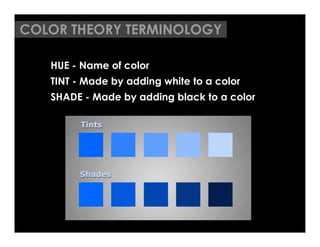
   HUE - Name of color
   TINT - Made by adding white to a color
   SHADE - Made by adding black to a color
COLOR THEORY TERMINOLOGY

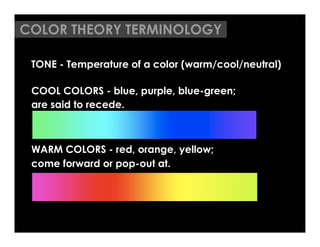
 TONE - Temperature of a color (warm/cool/neutral)

 COOL COLORS - blue, purple, blue-green;
 are said to recede.


 WARM COLORS - red, orange, yellow;
 come forward or pop-out at.
COLOR THEORY TERMINOLOGY

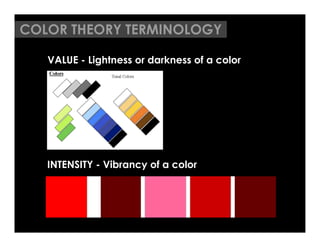
   VALUE - Lightness or darkness of a color


   INTENSITY - Vibrancy of a color
LIGHT & DARK THEORY

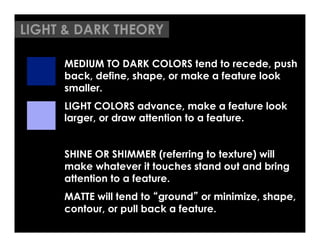
     MEDIUM TO DARK COLORS tend to recede, push
     back, define, shape, or make a feature look
     smaller.
     LIGHT COLORS advance, make a feature look
     larger, or draw attention to a feature.


     SHINE OR SHIMMER (referring to texture) will
     make whatever it touches stand out and bring
     attention to a feature.
     MATTE will tend to ground or minimize, shape,
     contour, or pull back a feature.
The Coloring DVD
The Laws of Color
LAWS OF COLOR

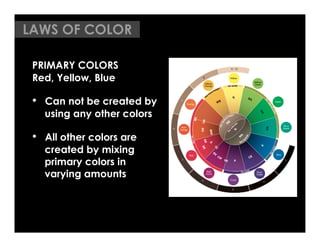
 PRIMARY COLORS
 Red, Yellow, Blue
 
 •  Can not be created by
     using any other colors

 •  All other colors are
     created by mixing
     primary colors in
     varying amounts
COLOR MAP
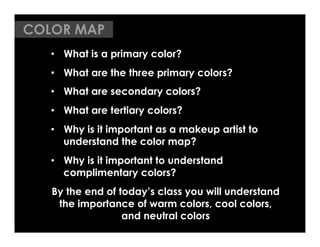
   •  What is a primary color?
   •  What are the three primary colors?
   •  What are secondary colors?
   •  What are tertiary colors?
   •  Why is it important as a makeup artist to
      understand the color map?
   •  Why is it important to understand
      complimentary colors?
   By the end of today’s class you will understand
    the importance of warm colors, cool colors,
                  and neutral colors
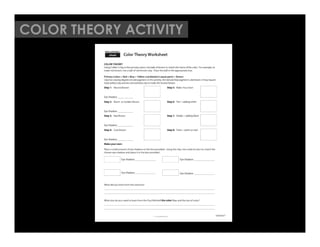
COLOR THEORY ACTIVITY
COLOR CONTRAST

    Applying makeup at an individuals contrast
    level according to their personal features
    and contrast level will achieve the most
    pleasing result.
    Each individual can be characterized into
    three main groups using their features.
    1.  Hair
    2.  Eyes
    3.  Skin
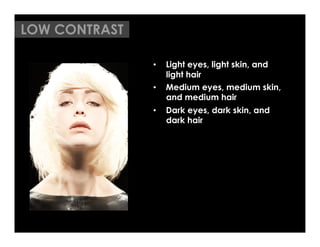
LOW CONTRAST

               •    Light eyes, light skin, and
                    light hair
               •    Medium eyes, medium skin,
                    and medium hair
               •    Dark eyes, dark skin, and
                    dark hair
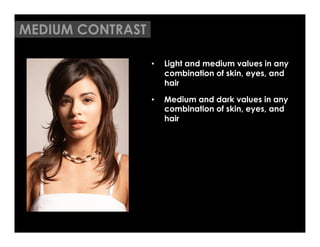
MEDIUM CONTRAST

                  •    Light and medium values in any
                       combination of skin, eyes, and
                       hair

                  •    Medium and dark values in any
                       combination of skin, eyes, and
                       hair
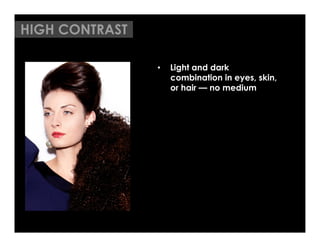
HIGH CONTRAST

                •    Light and dark
                     combination in eyes, skin,
                     or hair — no medium
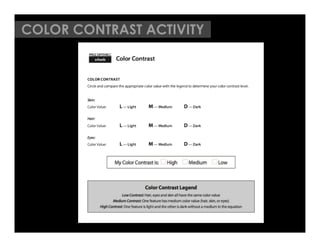
COLOR CONTRAST ACTIVITY
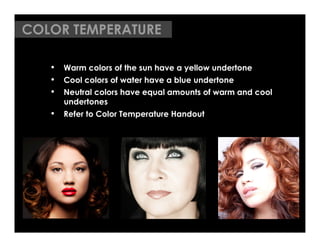
COLOR TEMPERATURE

   •  Warm colors of the sun have a yellow undertone
   •  Cool colors of water have a blue undertone
   •  Neutral colors have equal amounts of warm and cool
      undertones
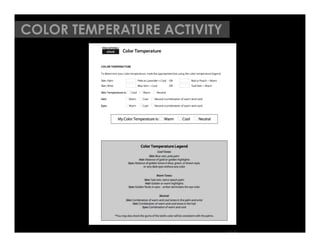
   •  Refer to Color Temperature Handout
COLOR TEMPERATURE

   Steps to determine an individual s color temperature:

   •    Two components determine the color temperature of the
        skin: the wrist and the palm of the hand. See below:

   •    Check the inside of the wrist for color undertone and
        observe the vein colors: (Blue vein = cool) (Teal vein =
        warm)

   •    Check the palm of the hand and observe the color:
        (Pink palm = cool) (Red or peach palm = warm)

   •    When there is a combination of surface color or
        undertone in the wrist and palm (for example: cool wrist,
        warm palm), the color temperature is considered neutral.
COLOR TEMPERATURE
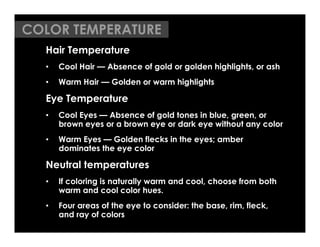
  Hair Temperature
  •    Cool Hair — Absence of gold or golden highlights, or ash
  •    Warm Hair — Golden or warm highlights

  Eye Temperature
  •    Cool Eyes — Absence of gold tones in blue, green, or
       brown eyes or a brown eye or dark eye without any color
  •    Warm Eyes — Golden flecks in the eyes; amber
       dominates the eye color

  Neutral temperatures
  •    If coloring is naturally warm and cool, choose from both
       warm and cool color hues.
  •    Four areas of the eye to consider: the base, rim, fleck,
       and ray of colors
COLOR TEMPERATURE ACTIVITY
TEXTURE IN MAKEUP


 It is important to understand what texture is in
 relationship to makeup.

 Texture is matte, shine, shimmer, light, and dark.

 Each aspect is important to understand when
 choosing makeup to enhance or define the face.
TEXTURE IN MAKEUP

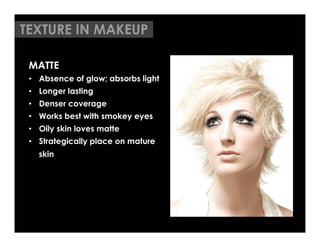
 MATTE
 •  Absence of glow; absorbs light
 •  Longer lasting
 •  Denser coverage
 •  Works best with smokey eyes
 •  Oily skin loves matte
 •  Strategically place on mature
       skin
TEXTURE IN MAKEUP

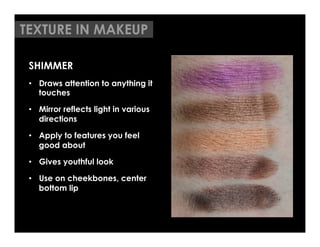
 SHIMMER
 •  Draws attention to anything it
    touches

 •  Mirror reflects light in various
    directions

 •  Apply to features you feel
    good about

 •  Gives youthful look

 •  Use on cheekbones, center
    bottom lip
TEXTURE IN MAKEUP

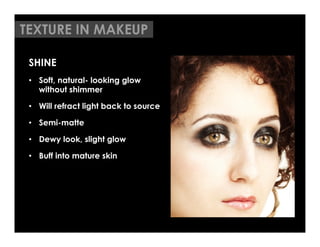
 SHINE
 •  Soft, natural- looking glow
    without shimmer

 •  Will refract light back to source

 •  Semi-matte

 •  Dewy look, slight glow

 •  Buff into mature skin
TEXTURE IN MAKEUP

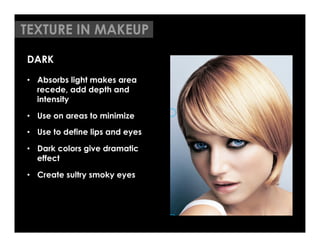
DARK
•  Absorbs light makes area
   recede, add depth and
   intensity

•  Use on areas to minimize
•  Use to define lips and eyes

•  Dark colors give dramatic
   effect

•  Create sultry smoky eyes


                                 Bling Bling Blonde
                                 Every girl loves platinum. Channel your inner diva with a platinum
TEXTURE IN MAKEUP

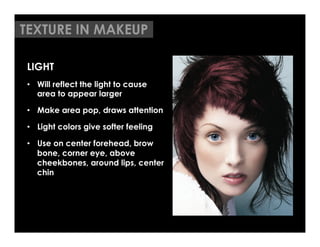
LIGHT
•  Will reflect the light to cause
   area to appear larger

•  Make area pop, draws attention

•  Light colors give softer feeling

•  Use on center forehead, brow
   bone, corner eye, above
   cheekbones, around lips, center
   chin
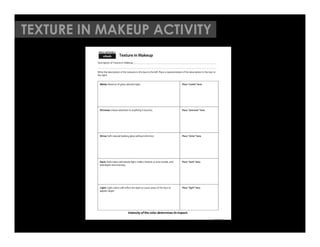
TEXTURE IN MAKEUP ACTIVITY
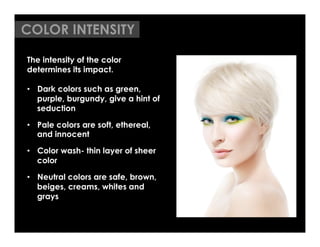
COLOR INTENSITY

The intensity of the color
determines its impact.

•  Dark colors such as green,
   purple, burgundy, give a hint of
   seduction

•  Pale colors are soft, ethereal,
   and innocent

•  Color wash- thin layer of sheer
   color

•  Neutral colors are safe, brown,
   beiges, creams, whites and
   grays
Complementary Colors
  are best for eyes.
EYE COLOR

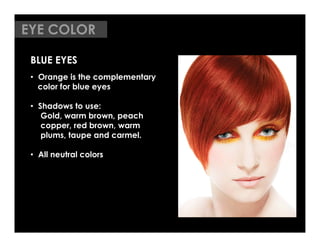
 BLUE EYES
 •  Orange is the complementary
    color for blue eyes

 •  Shadows to use:
     Gold, warm brown, peach
     copper, red brown, warm
     plums, taupe and carmel.

 •  All neutral colors
EYE COLOR


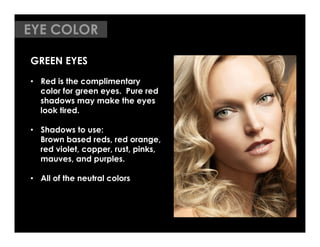
GREEN EYES
•  Red is the complimentary
   color for green eyes. Pure red
   shadows may make the eyes
   look tired.

•  Shadows to use:
   Brown based reds, red orange,
   red violet, copper, rust, pinks,
   mauves, and purples.

•  All of the neutral colors
EYE COLOR

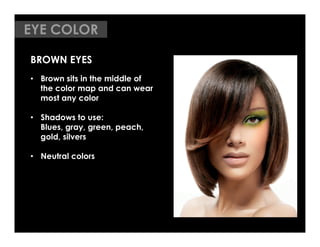
BROWN EYES
•  Brown sits in the middle of
   the color map and can wear
   most any color

•  Shadows to use:
   Blues, gray, green, peach,
   gold, silvers

•  Neutral colors
WHERE DO I START?
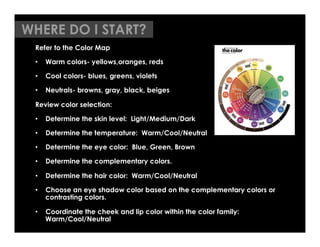
 Refer to the Color Map

 •  Warm colors- yellows,oranges, reds

 •  Cool colors- blues, greens, violets

 •  Neutrals- browns, gray, black, beiges

 Review color selection:

 •  Determine the skin level: Light/Medium/Dark

 •  Determine the temperature: Warm/Cool/Neutral

 •  Determine the eye color: Blue, Green, Brown

 •  Determine the complementary colors.
 •  Determine the hair color: Warm/Cool/Neutral

 •  Choose an eye shadow color based on the complementary colors or
    contrasting colors.
 •  Coordinate the cheek and lip color within the color family:
    Warm/Cool/Neutral
1.  Understand the basics!
2.  Learn the rules!
3.  Apply the rules!
4.  Expand the rules!
   HAVE FUN!
REVIEW

  •  What do dark colors do?
  •  What light colors do?
  •  What is color contrast? how do we use this?
  •  What is color temperature?
  •  What is texture in makeup?
  •  What is it important to understand texture in
     makeup?
Level 2
Makeup Color Theory

PMAE Level 2 Certification

  • 1.
  • 2.
    AGENDA •  Color Theory •  Color Contrast •  Color Temperature •  Texture in Makeup •  Review
  • 3.
    COLOR THEORY TERMINOLOGY HUE - Name of color TINT - Made by adding white to a color SHADE - Made by adding black to a color
  • 4.
    COLOR THEORY TERMINOLOGY TONE - Temperature of a color (warm/cool/neutral) COOL COLORS - blue, purple, blue-green; are said to recede. WARM COLORS - red, orange, yellow; come forward or pop-out at.
  • 5.
    COLOR THEORY TERMINOLOGY VALUE - Lightness or darkness of a color INTENSITY - Vibrancy of a color
  • 6.
    LIGHT & DARKTHEORY MEDIUM TO DARK COLORS tend to recede, push back, define, shape, or make a feature look smaller. LIGHT COLORS advance, make a feature look larger, or draw attention to a feature. SHINE OR SHIMMER (referring to texture) will make whatever it touches stand out and bring attention to a feature. MATTE will tend to ground or minimize, shape, contour, or pull back a feature.
  • 7.
    The Coloring DVD TheLaws of Color
  • 8.
    LAWS OF COLOR PRIMARY COLORS Red, Yellow, Blue •  Can not be created by using any other colors •  All other colors are created by mixing primary colors in varying amounts
  • 9.
    COLOR MAP •  What is a primary color? •  What are the three primary colors? •  What are secondary colors? •  What are tertiary colors? •  Why is it important as a makeup artist to understand the color map? •  Why is it important to understand complimentary colors? By the end of today’s class you will understand the importance of warm colors, cool colors, and neutral colors
  • 10.
  • 11.
    COLOR CONTRAST Applying makeup at an individuals contrast level according to their personal features and contrast level will achieve the most pleasing result. Each individual can be characterized into three main groups using their features. 1.  Hair 2.  Eyes 3.  Skin
  • 12.
    LOW CONTRAST •  Light eyes, light skin, and light hair •  Medium eyes, medium skin, and medium hair •  Dark eyes, dark skin, and dark hair
  • 13.
    MEDIUM CONTRAST •  Light and medium values in any combination of skin, eyes, and hair •  Medium and dark values in any combination of skin, eyes, and hair
  • 14.
    HIGH CONTRAST •  Light and dark combination in eyes, skin, or hair — no medium
  • 15.
  • 16.
    COLOR TEMPERATURE •  Warm colors of the sun have a yellow undertone •  Cool colors of water have a blue undertone •  Neutral colors have equal amounts of warm and cool undertones •  Refer to Color Temperature Handout
  • 17.
    COLOR TEMPERATURE Steps to determine an individual s color temperature: •  Two components determine the color temperature of the skin: the wrist and the palm of the hand. See below: •  Check the inside of the wrist for color undertone and observe the vein colors: (Blue vein = cool) (Teal vein = warm) •  Check the palm of the hand and observe the color: (Pink palm = cool) (Red or peach palm = warm) •  When there is a combination of surface color or undertone in the wrist and palm (for example: cool wrist, warm palm), the color temperature is considered neutral.
  • 18.
    COLOR TEMPERATURE Hair Temperature •  Cool Hair — Absence of gold or golden highlights, or ash •  Warm Hair — Golden or warm highlights Eye Temperature •  Cool Eyes — Absence of gold tones in blue, green, or brown eyes or a brown eye or dark eye without any color •  Warm Eyes — Golden flecks in the eyes; amber dominates the eye color Neutral temperatures •  If coloring is naturally warm and cool, choose from both warm and cool color hues. •  Four areas of the eye to consider: the base, rim, fleck, and ray of colors
  • 19.
  • 20.
    TEXTURE IN MAKEUP It is important to understand what texture is in relationship to makeup. Texture is matte, shine, shimmer, light, and dark. Each aspect is important to understand when choosing makeup to enhance or define the face.
  • 21.
    TEXTURE IN MAKEUP MATTE •  Absence of glow; absorbs light •  Longer lasting •  Denser coverage •  Works best with smokey eyes •  Oily skin loves matte •  Strategically place on mature skin
  • 22.
    TEXTURE IN MAKEUP SHIMMER •  Draws attention to anything it touches •  Mirror reflects light in various directions •  Apply to features you feel good about •  Gives youthful look •  Use on cheekbones, center bottom lip
  • 23.
    TEXTURE IN MAKEUP SHINE •  Soft, natural- looking glow without shimmer •  Will refract light back to source •  Semi-matte •  Dewy look, slight glow •  Buff into mature skin
  • 24.
    TEXTURE IN MAKEUP DARK • Absorbs light makes area recede, add depth and intensity •  Use on areas to minimize •  Use to define lips and eyes •  Dark colors give dramatic effect •  Create sultry smoky eyes Bling Bling Blonde Every girl loves platinum. Channel your inner diva with a platinum
  • 25.
    TEXTURE IN MAKEUP LIGHT • Will reflect the light to cause area to appear larger •  Make area pop, draws attention •  Light colors give softer feeling •  Use on center forehead, brow bone, corner eye, above cheekbones, around lips, center chin
  • 26.
  • 27.
    COLOR INTENSITY The intensityof the color determines its impact. •  Dark colors such as green, purple, burgundy, give a hint of seduction •  Pale colors are soft, ethereal, and innocent •  Color wash- thin layer of sheer color •  Neutral colors are safe, brown, beiges, creams, whites and grays
  • 28.
    Complementary Colors are best for eyes.
  • 29.
    EYE COLOR BLUEEYES •  Orange is the complementary color for blue eyes •  Shadows to use: Gold, warm brown, peach copper, red brown, warm plums, taupe and carmel. •  All neutral colors
  • 30.
    EYE COLOR GREEN EYES • Red is the complimentary color for green eyes. Pure red shadows may make the eyes look tired. •  Shadows to use: Brown based reds, red orange, red violet, copper, rust, pinks, mauves, and purples. •  All of the neutral colors
  • 31.
    EYE COLOR BROWN EYES • Brown sits in the middle of the color map and can wear most any color •  Shadows to use: Blues, gray, green, peach, gold, silvers •  Neutral colors
  • 32.
    WHERE DO ISTART? Refer to the Color Map •  Warm colors- yellows,oranges, reds •  Cool colors- blues, greens, violets •  Neutrals- browns, gray, black, beiges Review color selection: •  Determine the skin level: Light/Medium/Dark •  Determine the temperature: Warm/Cool/Neutral •  Determine the eye color: Blue, Green, Brown •  Determine the complementary colors. •  Determine the hair color: Warm/Cool/Neutral •  Choose an eye shadow color based on the complementary colors or contrasting colors. •  Coordinate the cheek and lip color within the color family: Warm/Cool/Neutral

  • 33.
    1.  Understand thebasics! 2.  Learn the rules! 3.  Apply the rules! 4.  Expand the rules! HAVE FUN!
  • 34.
    REVIEW • What do dark colors do? •  What light colors do? •  What is color contrast? how do we use this? •  What is color temperature? •  What is texture in makeup? •  What is it important to understand texture in makeup?
  • 35.