Project management is the discipline of planning, organizing, securing, and managing
resources to achieve specific goals. A project is a temporary endeavor with a defined
beginning and end (usually time-constrained, and often constrained by funding or
deliverables),[1] undertaken to meet unique goals and objectives,[2] typically to bring about
beneficial change or added value. The temporary nature of projects stands in contrast
with business as usual (or operations),[3] which are repetitive, permanent, or semi-
permanent functional activities to produce products or services. In practice, the
management of these two systems is often quite different, and as such requires the
development of distinct technical skills and management strategies.

The primary challenge of project management is to achieve all of the project goals[4] and
objectives while honoring the preconceived constraints.[5] Typical constraints are scope,
time, and budget.[1] The secondary—and more ambitious—challenge is to optimize the
allocation of necessary inputs and integrate them to meet pre-defined objectives.

Meaning:
Planned set of interrelated tasks to be executed over a fixed period and within certain cost
and other limitations.


Dimensions of the Project Environment
For convenience, and working outwards, the project environment may be thought of in
terms of the project time environment, the internal project culture, the original corporate
culture, and the external social surroundings.

For those who have not had experience of a construction project "in the trenches" so to
speak, it is sometimes difficult to capture the feeling of pressure, stress and ultimate
satisfaction of a project well accomplished, which the construction project management
process offers. For the first timers, many experience a bewilderment as to what is really
happening around them. Yet, most projects, if they are well run, exhibit some very typical
but distinguishing features as they run their course.

The Project Time Environment -Ê Four Distinct Project Phases

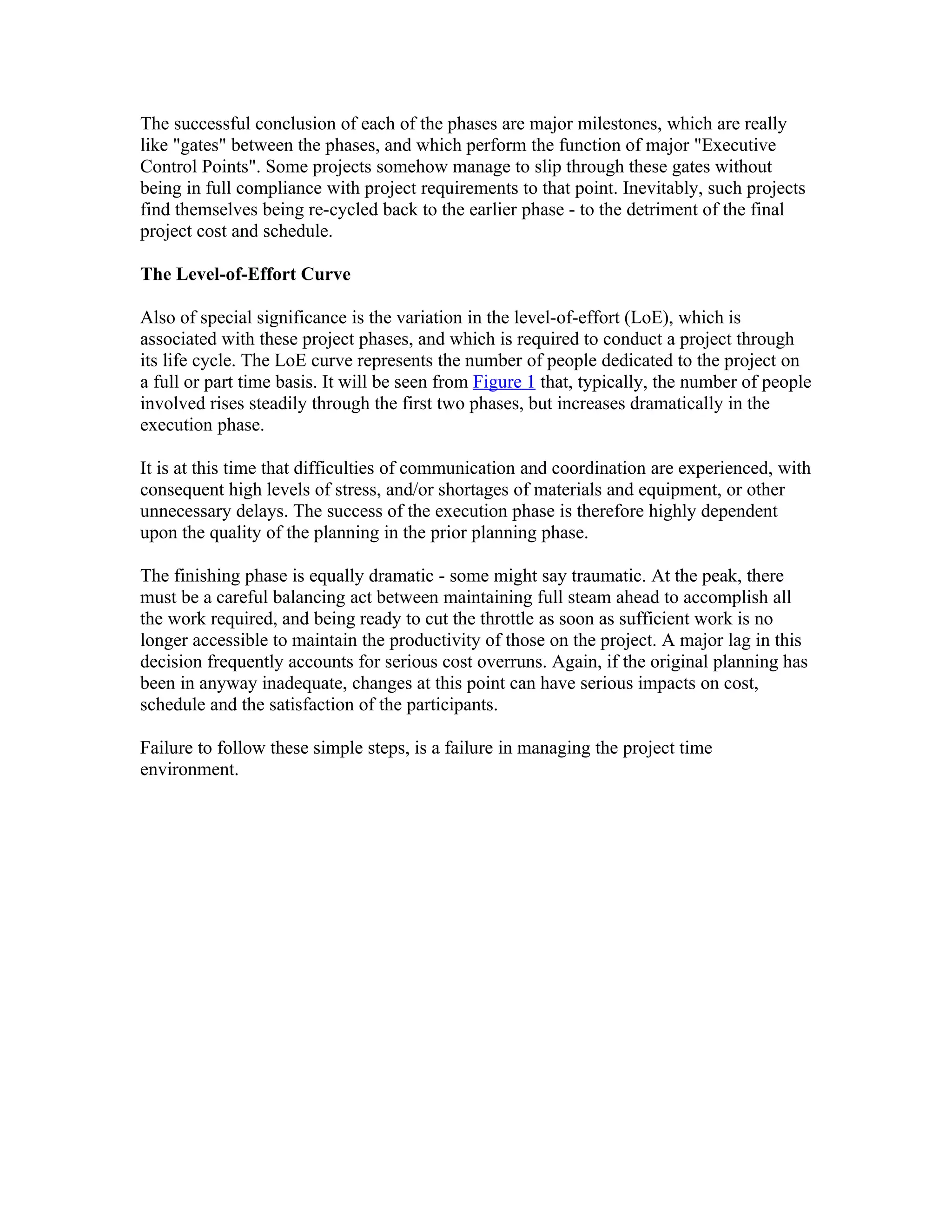
A typical construction project life cycle is shown in Figure 1.
Figure 1: Project Life Cycle - Four Basic Phases

From the figure it will be seen that there are, or should be, four distinct project periods
which make up the typical life span of a well run project. These phases are shown as

    •   Concept
    •   Planning
    •   Execution
    •   Transfer.

As an aid to memory, these phases may be readily recalled by the letters C-D-E-F
standing for: Conceive Develop Execute, and Finish.

Figure 1 also shows typical activities which are required within each phase for building,
say, a process facility. Of course, within each phase a number of sub-phases or stages can
be identified, which relate to the typical construction project. But for our purposes, the
four phases shown are generic to any type of construction project, and serve to underline
the vital importance of progression from concept to planning, if the project is to be
successfully implemented.

Thus, these first two phases, often referred to as the feasibility and engineering phases,
are the opportunity to "build the project on paper", while the third and fourth phases,
which include preparing detailed drawings and specifications, encompass the physical
implementation of the project. Note particularly that submission approvals are called for
at the end of each of the first two phases, and commissioning and completion approvals
are typically required towards the ends of the latter two phases. Thus, each phase is like a
mini-project with its own objectives and constraints. And so it should be seen to be, and
conducted accordingly.
The successful conclusion of each of the phases are major milestones, which are really
like "gates" between the phases, and which perform the function of major "Executive
Control Points". Some projects somehow manage to slip through these gates without
being in full compliance with project requirements to that point. Inevitably, such projects
find themselves being re-cycled back to the earlier phase - to the detriment of the final
project cost and schedule.

The Level-of-Effort Curve

Also of special significance is the variation in the level-of-effort (LoE), which is
associated with these project phases, and which is required to conduct a project through
its life cycle. The LoE curve represents the number of people dedicated to the project on
a full or part time basis. It will be seen from Figure 1 that, typically, the number of people
involved rises steadily through the first two phases, but increases dramatically in the
execution phase.

It is at this time that difficulties of communication and coordination are experienced, with
consequent high levels of stress, and/or shortages of materials and equipment, or other
unnecessary delays. The success of the execution phase is therefore highly dependent
upon the quality of the planning in the prior planning phase.

The finishing phase is equally dramatic - some might say traumatic. At the peak, there
must be a careful balancing act between maintaining full steam ahead to accomplish all
the work required, and being ready to cut the throttle as soon as sufficient work is no
longer accessible to maintain the productivity of those on the project. A major lag in this
decision frequently accounts for serious cost overruns. Again, if the original planning has
been in anyway inadequate, changes at this point can have serious impacts on cost,
schedule and the satisfaction of the participants.

Failure to follow these simple steps, is a failure in managing the project time
environment.
Project management is a carefully planned and organized effort to accomplish a
successful project. A project is a one-time effort that produces a specific result, for
example, a building or a major new computer system. This is in contrast to a program,
which is 1) an ongoing process, such as a quality control program, or 2) an activity to
manage a series of multiple projects together. In some countries, the term "program"
refers to a software tool and the term "programme" can mean a TV or radio show.

Project management includes developing a project plan, which includes defining and
confirming the project goals and objectives, identifying tasks and how goals will be
achieved, quantifying the resources needed, and determining budgets and timelines for
completion. It also includes managing the implementation of the project plan, along with
operating regular 'controls' to ensure that there is accurate and objective information on
'performance' relative to the plan, and the mechanisms to implement recovery actions
where necessary.

Projects usually follow major phases or stages (with various titles for these), including
feasibility, definition, project planning, implementation, evaluation and
support/maintenance.

Pm

  • 1.
    Project management isthe discipline of planning, organizing, securing, and managing resources to achieve specific goals. A project is a temporary endeavor with a defined beginning and end (usually time-constrained, and often constrained by funding or deliverables),[1] undertaken to meet unique goals and objectives,[2] typically to bring about beneficial change or added value. The temporary nature of projects stands in contrast with business as usual (or operations),[3] which are repetitive, permanent, or semi- permanent functional activities to produce products or services. In practice, the management of these two systems is often quite different, and as such requires the development of distinct technical skills and management strategies. The primary challenge of project management is to achieve all of the project goals[4] and objectives while honoring the preconceived constraints.[5] Typical constraints are scope, time, and budget.[1] The secondary—and more ambitious—challenge is to optimize the allocation of necessary inputs and integrate them to meet pre-defined objectives. Meaning: Planned set of interrelated tasks to be executed over a fixed period and within certain cost and other limitations. Dimensions of the Project Environment For convenience, and working outwards, the project environment may be thought of in terms of the project time environment, the internal project culture, the original corporate culture, and the external social surroundings. For those who have not had experience of a construction project "in the trenches" so to speak, it is sometimes difficult to capture the feeling of pressure, stress and ultimate satisfaction of a project well accomplished, which the construction project management process offers. For the first timers, many experience a bewilderment as to what is really happening around them. Yet, most projects, if they are well run, exhibit some very typical but distinguishing features as they run their course. The Project Time Environment -Ê Four Distinct Project Phases A typical construction project life cycle is shown in Figure 1.
  • 2.
    Figure 1: ProjectLife Cycle - Four Basic Phases From the figure it will be seen that there are, or should be, four distinct project periods which make up the typical life span of a well run project. These phases are shown as • Concept • Planning • Execution • Transfer. As an aid to memory, these phases may be readily recalled by the letters C-D-E-F standing for: Conceive Develop Execute, and Finish. Figure 1 also shows typical activities which are required within each phase for building, say, a process facility. Of course, within each phase a number of sub-phases or stages can be identified, which relate to the typical construction project. But for our purposes, the four phases shown are generic to any type of construction project, and serve to underline the vital importance of progression from concept to planning, if the project is to be successfully implemented. Thus, these first two phases, often referred to as the feasibility and engineering phases, are the opportunity to "build the project on paper", while the third and fourth phases, which include preparing detailed drawings and specifications, encompass the physical implementation of the project. Note particularly that submission approvals are called for at the end of each of the first two phases, and commissioning and completion approvals are typically required towards the ends of the latter two phases. Thus, each phase is like a mini-project with its own objectives and constraints. And so it should be seen to be, and conducted accordingly.
  • 3.
    The successful conclusionof each of the phases are major milestones, which are really like "gates" between the phases, and which perform the function of major "Executive Control Points". Some projects somehow manage to slip through these gates without being in full compliance with project requirements to that point. Inevitably, such projects find themselves being re-cycled back to the earlier phase - to the detriment of the final project cost and schedule. The Level-of-Effort Curve Also of special significance is the variation in the level-of-effort (LoE), which is associated with these project phases, and which is required to conduct a project through its life cycle. The LoE curve represents the number of people dedicated to the project on a full or part time basis. It will be seen from Figure 1 that, typically, the number of people involved rises steadily through the first two phases, but increases dramatically in the execution phase. It is at this time that difficulties of communication and coordination are experienced, with consequent high levels of stress, and/or shortages of materials and equipment, or other unnecessary delays. The success of the execution phase is therefore highly dependent upon the quality of the planning in the prior planning phase. The finishing phase is equally dramatic - some might say traumatic. At the peak, there must be a careful balancing act between maintaining full steam ahead to accomplish all the work required, and being ready to cut the throttle as soon as sufficient work is no longer accessible to maintain the productivity of those on the project. A major lag in this decision frequently accounts for serious cost overruns. Again, if the original planning has been in anyway inadequate, changes at this point can have serious impacts on cost, schedule and the satisfaction of the participants. Failure to follow these simple steps, is a failure in managing the project time environment.
  • 4.
    Project management isa carefully planned and organized effort to accomplish a successful project. A project is a one-time effort that produces a specific result, for example, a building or a major new computer system. This is in contrast to a program, which is 1) an ongoing process, such as a quality control program, or 2) an activity to manage a series of multiple projects together. In some countries, the term "program" refers to a software tool and the term "programme" can mean a TV or radio show. Project management includes developing a project plan, which includes defining and confirming the project goals and objectives, identifying tasks and how goals will be achieved, quantifying the resources needed, and determining budgets and timelines for completion. It also includes managing the implementation of the project plan, along with operating regular 'controls' to ensure that there is accurate and objective information on 'performance' relative to the plan, and the mechanisms to implement recovery actions where necessary. Projects usually follow major phases or stages (with various titles for these), including feasibility, definition, project planning, implementation, evaluation and support/maintenance.