PLE_SOU	
  Conference	
  
WORKSHOP	
  |	
  Fernando	
  Albuquerque	
  Costa,	
  Cristina	
  Costa,	
  José	
  Mota	


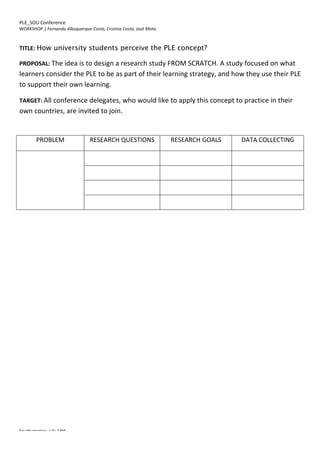
TITLE: How university students perceive the PLE concept?

PROPOSAL:	
  The	
  idea	
  is	
  to	
  design	
  a	
  research	
  study	
  FROM	
  SCRATCH.	
  A	
  study	
  focused	
  on	
  what	
  
learners	
  consider	
  the	
  PLE	
  to	
  be	
  as	
  part	
  of	
  their	
  learning	
  strategy,	
  and	
  how	
  they	
  use	
  their	
  PLE	
  
to	
  support	
  their	
  own	
  learning.	


TARGET:	
  All	
  conference	
  delegates,	
  who	
  would	
  like	
  to	
  apply	
  this	
  concept	
  to	
  practice	
  in	
  their	
  
own	
  countries,	
  are	
  invited	
  to	
  join.	


             PROBLEM	
                              RESEARCH	
  QUESTIONS	
                            RESEARCH	
  GOALS	
            DATA	
  COLLECTING	


Southampton,	
  July	
  13th	


PLE_SOU	
  Conference	
  
WORKSHOP	
  |	
  Fernando	
  Albuquerque	
  Costa,	
  Cristina	
  Costa,	
  José	
  Mota	


Abstract

The PLE represents a shift in paradigm. It is impelling a new ‘learning movement’ away from the
                             towards an open learning model in
traditional models of teaching and learning

which learners adopt their own strategies for learning. The PLE
philosophy suggests great potential in allowing educators to implement new ideas regarding how
educational contexts should be organized. It also provides new ways of implementing and
pursuing          a new kind of learning outcomes.

                                                          it
In this new perspective, learning is not just a matter of memorizing concepts and facts;

focuses more on the skills and competences learners can acquire
through the opportunities they are given. The PLE celebrates autonomy
and urges the              independent learner                                                  to develop learning strategies which match
their learning needs. The PLE provides the foundations needed to pursue lifelong learning in the
21st century.

Moreover, the proliferation of ICT at home and as well as at the University (Somekh, 2007)
provides educators with opportunities to develop learning environments that encourage students

to be more motivated and                           more effectively engaged                                         in the learning process.

These changes imply a revamping of the ways in which institutions perceive their role (Siemens,
2008). To this respect, it is fundamental to continuously improve the quality of the learning
process, viewing Education as an academic, individual and social experience, and                                            giving
learners control and freedom. These are two crucial elements of one’s lifelong
learning experience (Paulsen, 2009; Anderson, 2007). This encompasses the acknowledgment of
the importance of                  informal learning, social networking, online presence                                         and
digital identity    as part of the learning process and in the development of individuals
throughout their lives (Attwell, 2007)

PLEs have their focus onusers’ practices regarding learning with different technologies. PLEs
bridge formal and informal learning, integrate the learning experiences from various
contexts and promote connectedness and openness (Anderson, 2008; Attwell, 2007;
Downes, 2008, 2007; Wilson et al, 2006, 2007). However, building an effective personal learning
environment, with the use of various tools and services, sometimes described as “small pieces

loosely joined” (Downes, 2008; Harmelen, 2008),                                                is often not an easy task for
the common user. Additionally, and despite all its potential benefits, the learner’s new
role can, in some circumstances, also be perceived as too demanding. Hence,
it is very important to understand the nature and extension of these difficulties
when trying to devise efficient ways of helping learners make the most of what they have at their
disposal for learning.
Southampton,	
  July	
  13th	


PLE Students Perception Workshop

  • 1.
    PLE_SOU  Conference   WORKSHOP  |  Fernando  Albuquerque  Costa,  Cristina  Costa,  José  Mota       TITLE: How university students perceive the PLE concept? PROPOSAL:  The  idea  is  to  design  a  research  study  FROM  SCRATCH.  A  study  focused  on  what   learners  consider  the  PLE  to  be  as  part  of  their  learning  strategy,  and  how  they  use  their  PLE   to  support  their  own  learning.     TARGET:  All  conference  delegates,  who  would  like  to  apply  this  concept  to  practice  in  their   own  countries,  are  invited  to  join.         PROBLEM   RESEARCH  QUESTIONS   RESEARCH  GOALS   DATA  COLLECTING                             Southampton,  July  13th      
  • 2.
    PLE_SOU  Conference   WORKSHOP  |  Fernando  Albuquerque  Costa,  Cristina  Costa,  José  Mota       Abstract The PLE represents a shift in paradigm. It is impelling a new ‘learning movement’ away from the towards an open learning model in traditional models of teaching and learning which learners adopt their own strategies for learning. The PLE philosophy suggests great potential in allowing educators to implement new ideas regarding how educational contexts should be organized. It also provides new ways of implementing and pursuing a new kind of learning outcomes. it In this new perspective, learning is not just a matter of memorizing concepts and facts; focuses more on the skills and competences learners can acquire through the opportunities they are given. The PLE celebrates autonomy and urges the independent learner to develop learning strategies which match their learning needs. The PLE provides the foundations needed to pursue lifelong learning in the 21st century. Moreover, the proliferation of ICT at home and as well as at the University (Somekh, 2007) provides educators with opportunities to develop learning environments that encourage students to be more motivated and more effectively engaged in the learning process. These changes imply a revamping of the ways in which institutions perceive their role (Siemens, 2008). To this respect, it is fundamental to continuously improve the quality of the learning process, viewing Education as an academic, individual and social experience, and giving learners control and freedom. These are two crucial elements of one’s lifelong learning experience (Paulsen, 2009; Anderson, 2007). This encompasses the acknowledgment of the importance of informal learning, social networking, online presence and digital identity as part of the learning process and in the development of individuals throughout their lives (Attwell, 2007) PLEs have their focus onusers’ practices regarding learning with different technologies. PLEs bridge formal and informal learning, integrate the learning experiences from various contexts and promote connectedness and openness (Anderson, 2008; Attwell, 2007; Downes, 2008, 2007; Wilson et al, 2006, 2007). However, building an effective personal learning environment, with the use of various tools and services, sometimes described as “small pieces loosely joined” (Downes, 2008; Harmelen, 2008), is often not an easy task for the common user. Additionally, and despite all its potential benefits, the learner’s new role can, in some circumstances, also be perceived as too demanding. Hence, it is very important to understand the nature and extension of these difficulties when trying to devise efficient ways of helping learners make the most of what they have at their disposal for learning. Southampton,  July  13th