Distributed Control System
Control Systems Types
PLC : Introduced in the late 1960 to replace Relays
and Hard-wired Programming.
DCS : Introduced in the Mid-1970 to replace
pneumatic controls by using computers.
PC-Based Control : Introduced by the early 1980s to
avoid the proprietary PLC & DCS systems.
SCADA : Supervisory control & Data Acquisition
basically introduced for long distance material
transfer
DCS Evolution
DCS Evolution
 LOCAL CONTROL : Initially control was performed local to the
equipment control. The ADVANTAGE was low wiring
costs .DISADVANTAGES were - not much control, monitoring, alarming
& history.
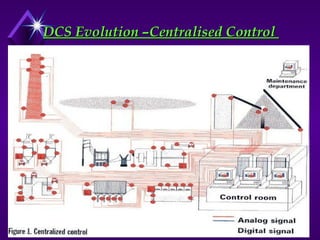
 CENTRALISED CONTROL: With the advent of minicomputer, sensors
and actuators were into the Central Control (Computer).
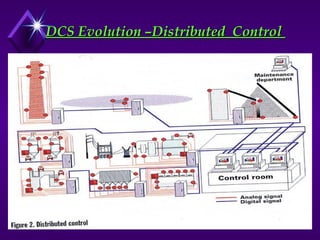
 DISTRIBUTED CONTROL: With the advent of microcomputer,
Distributed control systems were installed in the plants near to the control
room via proprietary digital communications lines called as Data Hiway.
First DCS was developed by Honeywell,U.S in 1975.
The ADVANTAGES were greatly reduced wiring costs, much
more limited failure and less cost to add more points. The
DISADVANTAGES were that wiring costs were that wiring costs were
still significant and there was lack of interoperability among controllers of
various manufacturers due to the proprietary protocols. Hence the user
was locked into a single vendor.
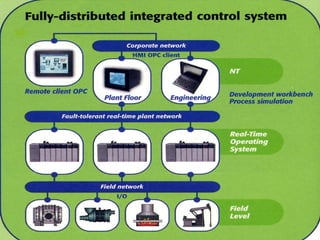
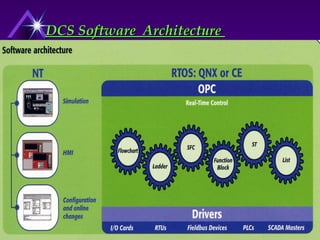
DCS Software Architecture
DCS Evolution –Centralised Control
DCS Evolution –Distributed Control
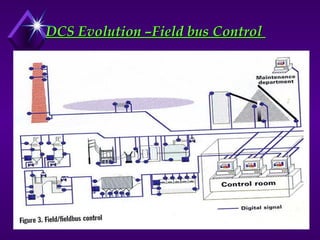
DCS Evolution –Field bus Control
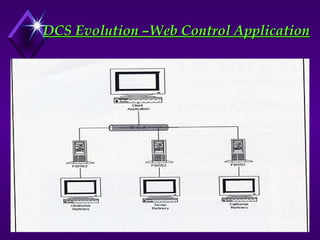
DCS Evolution –Web Control Application
Distributed Control System
 The importance of DCS systems to increase as global
competitive dynamics in food and beverage, specialty
metals, pulp and paper, pharmaceutical and fire
chemical processing.
 The DCS has networking capabilities which are useful
for business management.
 The DCS has capacity for processing large number of
I/O points.
CONVENTIONAL DCS
This is a pure “Process only” control system. Usually purchased from one
vendor. This DCS arranged into three categories:
 Small - Less than $ 100,000.
 Medium - Greater than $100,000 & Less than $500,000.
 Large - Greater than $500,000.
PLC Based DCS. This is a network of PLC’s used to perform the task of
conventional DCS and programmable functionality when required.
Hybrid DCS. Performs both process and sequential control.
Open DCS System.
This is Field-Bus Control. Advantages are lower wiring cost and less
failure, smaller expansion costs and multi vendor interoperability DCS and
PLC can be more closely and efficiently interconnected.
DCS Types
DCS Types
Popular DCS Systems Available
 Yokogawa – Centum Excel , CS 3000, CS 5000
 Fisher - Rosemant - Delta V
 Honeywell - TDC 3000, GUS
 ABB - Freelance 2000
 Moore - APACS
 Fox boro - I/A series

PLC as a digital electronic devic programmable memor

  • 1.
  • 2.
    Control Systems Types ControlSystems Types PLC : Introduced in the late 1960 to replace Relays and Hard-wired Programming. DCS : Introduced in the Mid-1970 to replace pneumatic controls by using computers. PC-Based Control : Introduced by the early 1980s to avoid the proprietary PLC & DCS systems. SCADA : Supervisory control & Data Acquisition basically introduced for long distance material transfer
  • 3.
    DCS Evolution DCS Evolution LOCAL CONTROL : Initially control was performed local to the equipment control. The ADVANTAGE was low wiring costs .DISADVANTAGES were - not much control, monitoring, alarming & history.  CENTRALISED CONTROL: With the advent of minicomputer, sensors and actuators were into the Central Control (Computer).  DISTRIBUTED CONTROL: With the advent of microcomputer, Distributed control systems were installed in the plants near to the control room via proprietary digital communications lines called as Data Hiway. First DCS was developed by Honeywell,U.S in 1975. The ADVANTAGES were greatly reduced wiring costs, much more limited failure and less cost to add more points. The DISADVANTAGES were that wiring costs were that wiring costs were still significant and there was lack of interoperability among controllers of various manufacturers due to the proprietary protocols. Hence the user was locked into a single vendor.
  • 5.
    DCS Software Architecture DCSSoftware Architecture
  • 6.
    DCS Evolution –CentralisedControl DCS Evolution –Centralised Control
  • 7.
    DCS Evolution –DistributedControl DCS Evolution –Distributed Control
  • 8.
    DCS Evolution –Fieldbus Control DCS Evolution –Field bus Control
  • 9.
    DCS Evolution –WebControl Application DCS Evolution –Web Control Application
  • 10.
    Distributed Control System DistributedControl System  The importance of DCS systems to increase as global competitive dynamics in food and beverage, specialty metals, pulp and paper, pharmaceutical and fire chemical processing.  The DCS has networking capabilities which are useful for business management.  The DCS has capacity for processing large number of I/O points.
  • 11.
    CONVENTIONAL DCS This isa pure “Process only” control system. Usually purchased from one vendor. This DCS arranged into three categories:  Small - Less than $ 100,000.  Medium - Greater than $100,000 & Less than $500,000.  Large - Greater than $500,000. PLC Based DCS. This is a network of PLC’s used to perform the task of conventional DCS and programmable functionality when required. Hybrid DCS. Performs both process and sequential control. Open DCS System. This is Field-Bus Control. Advantages are lower wiring cost and less failure, smaller expansion costs and multi vendor interoperability DCS and PLC can be more closely and efficiently interconnected. DCS Types DCS Types
  • 12.
    Popular DCS SystemsAvailable Popular DCS Systems Available  Yokogawa – Centum Excel , CS 3000, CS 5000  Fisher - Rosemant - Delta V  Honeywell - TDC 3000, GUS  ABB - Freelance 2000  Moore - APACS  Fox boro - I/A series

Editor's Notes