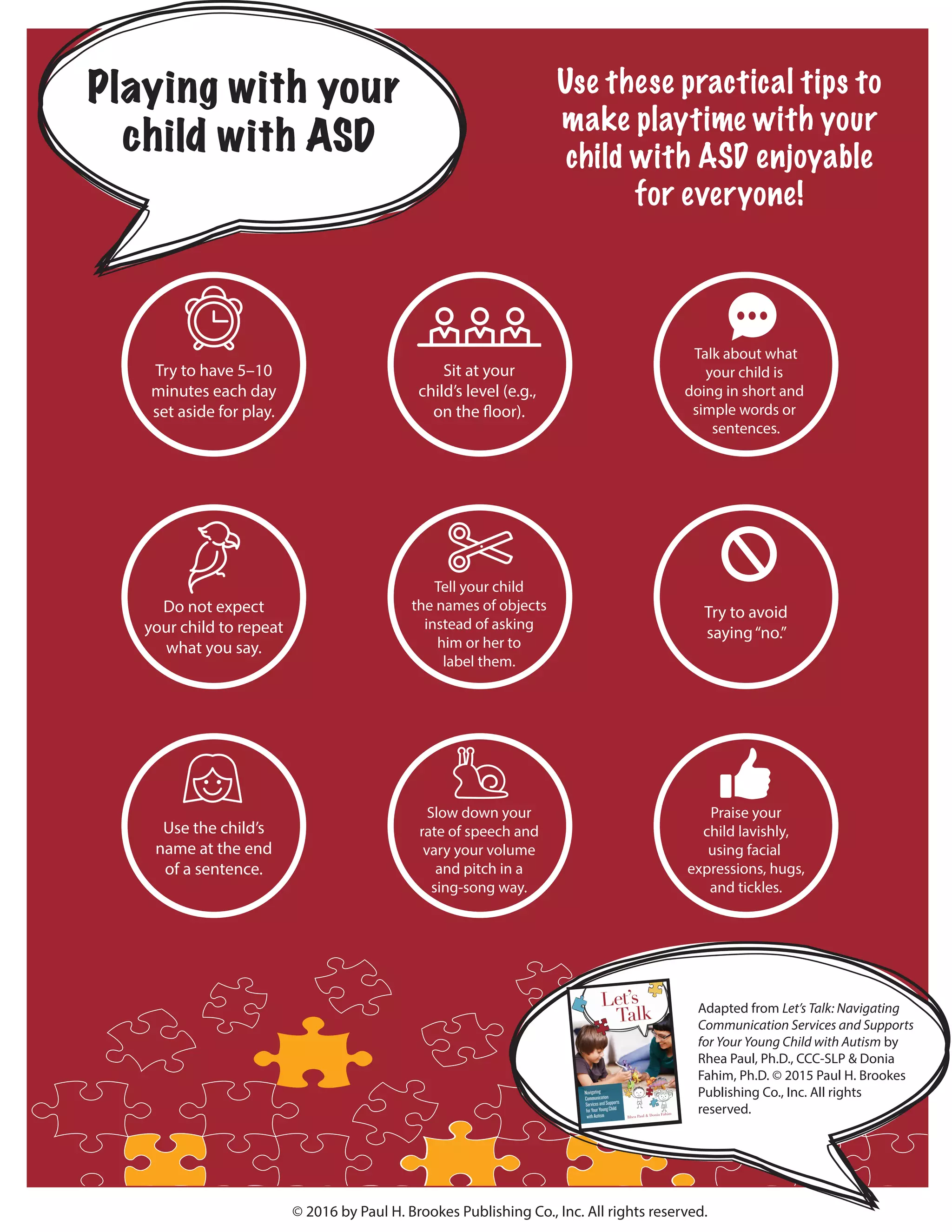
Playing with your
child with ASD
© 2016 by Paul H. Brookes Publishing Co., Inc. All rights reserved.
Adapted from Let’s Talk: Navigating
Communication Services and Supports
for Your Young Child with Autism by
Rhea Paul, Ph.D., CCC-SLP & Donia
Fahim, Ph.D. © 2015 Paul H. Brookes
Publishing Co., Inc. All rights
reserved.
Use these practical tips to
make playtime with your
child with ASD enjoyable
for everyone!
Try to have 5–10
minutes each day
set aside for play.
Sit at your
child’s level (e.g.,
on the floor).
Talk about what
your child is
doing in short and
simple words or
sentences.
Do not expect
your child to repeat
what you say.
Tell your child
the names of objects
instead of asking
him or her to
label them.
Try to avoid
saying“no.”
Use the child’s
name at the end
of a sentence.
Slow down your
rate of speech and
vary your volume
and pitch in a
sing-song way.
Praise your
child lavishly,
using facial
expressions, hugs,
and tickles.

Playing with your child with asd

  • 1.
    Playing with your childwith ASD © 2016 by Paul H. Brookes Publishing Co., Inc. All rights reserved. Adapted from Let’s Talk: Navigating Communication Services and Supports for Your Young Child with Autism by Rhea Paul, Ph.D., CCC-SLP & Donia Fahim, Ph.D. © 2015 Paul H. Brookes Publishing Co., Inc. All rights reserved. Use these practical tips to make playtime with your child with ASD enjoyable for everyone! Try to have 5–10 minutes each day set aside for play. Sit at your child’s level (e.g., on the floor). Talk about what your child is doing in short and simple words or sentences. Do not expect your child to repeat what you say. Tell your child the names of objects instead of asking him or her to label them. Try to avoid saying“no.” Use the child’s name at the end of a sentence. Slow down your rate of speech and vary your volume and pitch in a sing-song way. Praise your child lavishly, using facial expressions, hugs, and tickles.