Tongue twisters as an
educational tool in ESL
“Another way to improve
your spoken English skills”
Tuesday, May 7, 2013
if I persevere, I will get better and,
eventually, succeed.
Tuesday, May 7, 2013
Tongue twisters are a lot of fun for all ages and, sadly, are
an unrecognized or underutilized learning tool for young
children as well as those learning spoken English or English
as a second Language (ESL). In addition, they are
excellent aids in teaching language, tongue twisters can
teach us many valuable life lessons. They are not just
means of amusement but are excellent sources of speech
therapy. One who masters tongue twisters can be a better
spokesperson. It helps one to speak fluently at a fast pace
and also helps in building confidence.
Some teachers recognize the usefulness of bringing tongue
twisters into the classroom whether its full of English
speaking children or those learning ESL. All students are
introduced to sound, words, pronunciation and diction
when acquiring language.
Tuesday, May 7, 2013
The objective of this spoken English exercise is to habituate
our tongues to pronounce difficult and same sounding words
easily.
What is a Tongue Twister?
A tongue twister is a combination of words designed to be
hard to pronounce. The individual words themselves are
usually quite commonplace, and easy to pronounce, but,
combined as a set of words, they are surprisingly difficult to
say.
Tongue twisters are sentences containing alliteration.
Alliteration refers to the same phonetic sound repeated at
the beginning of each word, for several words.
The faster a person can say the tongue twister without
slipping up, the stronger their language skills become.
Tuesday, May 7, 2013
Why are the tongue twisters difficult to produce?
tongue twisters are difficult to produce because of :
•Changing the order of the sounds
•Homophones
•Repetition of Sounds: Juicy Juice juice box
•Proximity of Sounds: “She sells sea shells?”
•Mental Processing of Speaker: A person's abilities to read,
speak, listen, and recall information contribute to the
problems they may encounter when trying to say a tongue
twister.
Other tongue twisters, known as Spoonerisms in the
English language, are specifically created to cause an
accidental curse word to be uttered if the person
reciting the rhyme slips up.
Tuesday, May 7, 2013
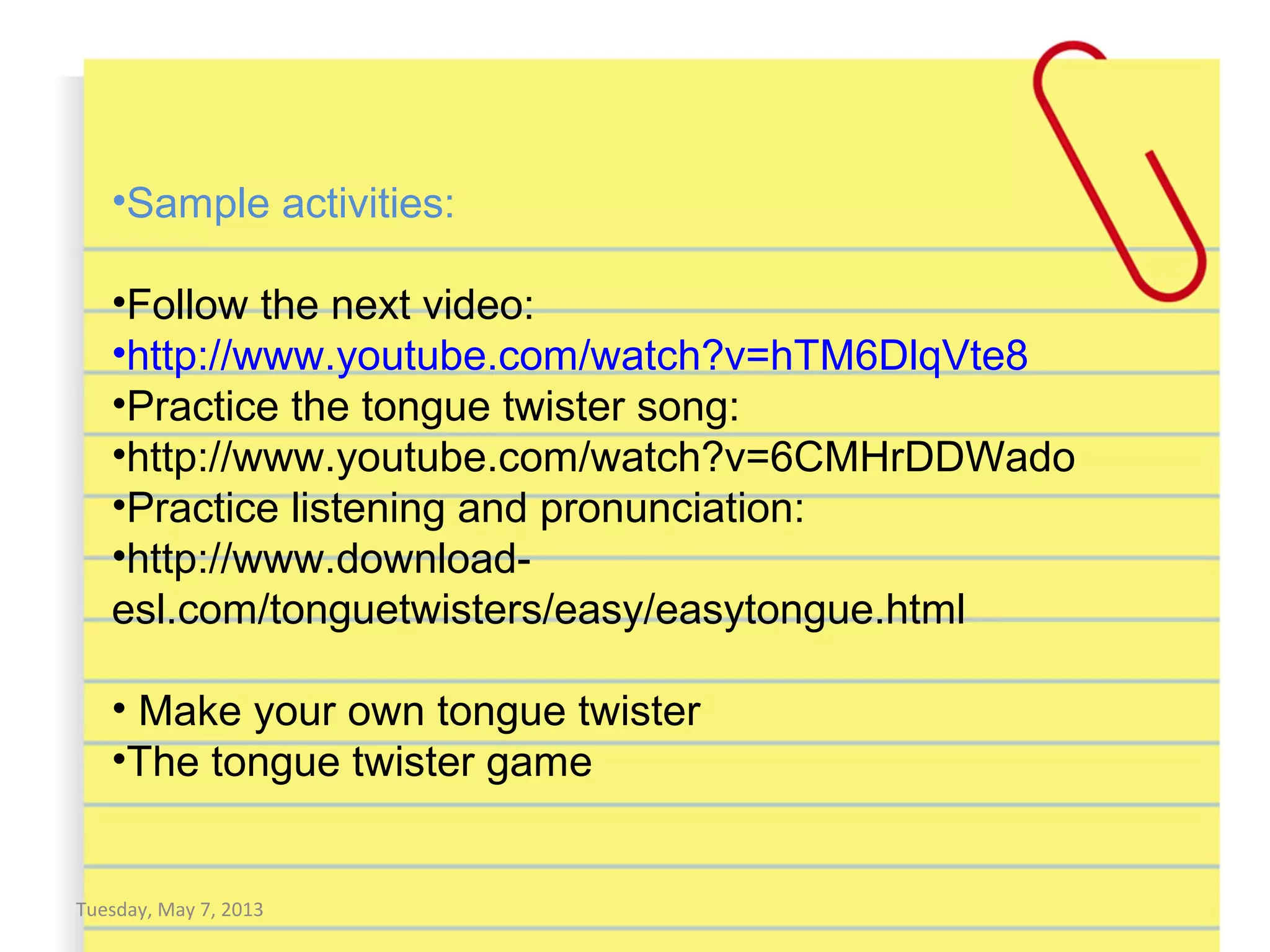
•Sample activities:
•Follow the next video:
•http://www.youtube.com/watch?v=hTM6DlqVte8
•Practice the tongue twister song:
•http://www.youtube.com/watch?v=6CMHrDDWado
•Practice listening and pronunciation:
•http://www.download-
esl.com/tonguetwisters/easy/easytongue.html
• Make your own tongue twister
•The tongue twister game
Tuesday, May 7, 2013
References:
http://tongue.obdurodon.org/analysis.html
http://volweb.utk.edu/Schools/bedford/harrisms/1allitera.htm
Tuesday, May 7, 2013
References:
http://tongue.obdurodon.org/analysis.html
http://volweb.utk.edu/Schools/bedford/harrisms/1allitera.htm

Tongue twisters

  • 1.
    Tongue twisters asan educational tool in ESL “Another way to improve your spoken English skills” Tuesday, May 7, 2013 if I persevere, I will get better and, eventually, succeed.
  • 2.
    Tuesday, May 7,2013 Tongue twisters are a lot of fun for all ages and, sadly, are an unrecognized or underutilized learning tool for young children as well as those learning spoken English or English as a second Language (ESL). In addition, they are excellent aids in teaching language, tongue twisters can teach us many valuable life lessons. They are not just means of amusement but are excellent sources of speech therapy. One who masters tongue twisters can be a better spokesperson. It helps one to speak fluently at a fast pace and also helps in building confidence. Some teachers recognize the usefulness of bringing tongue twisters into the classroom whether its full of English speaking children or those learning ESL. All students are introduced to sound, words, pronunciation and diction when acquiring language.
  • 3.
    Tuesday, May 7,2013 The objective of this spoken English exercise is to habituate our tongues to pronounce difficult and same sounding words easily. What is a Tongue Twister? A tongue twister is a combination of words designed to be hard to pronounce. The individual words themselves are usually quite commonplace, and easy to pronounce, but, combined as a set of words, they are surprisingly difficult to say. Tongue twisters are sentences containing alliteration. Alliteration refers to the same phonetic sound repeated at the beginning of each word, for several words. The faster a person can say the tongue twister without slipping up, the stronger their language skills become.
  • 4.
    Tuesday, May 7,2013 Why are the tongue twisters difficult to produce? tongue twisters are difficult to produce because of : •Changing the order of the sounds •Homophones •Repetition of Sounds: Juicy Juice juice box •Proximity of Sounds: “She sells sea shells?” •Mental Processing of Speaker: A person's abilities to read, speak, listen, and recall information contribute to the problems they may encounter when trying to say a tongue twister. Other tongue twisters, known as Spoonerisms in the English language, are specifically created to cause an accidental curse word to be uttered if the person reciting the rhyme slips up.
  • 5.
    Tuesday, May 7,2013 •Sample activities: •Follow the next video: •http://www.youtube.com/watch?v=hTM6DlqVte8 •Practice the tongue twister song: •http://www.youtube.com/watch?v=6CMHrDDWado •Practice listening and pronunciation: •http://www.download- esl.com/tonguetwisters/easy/easytongue.html • Make your own tongue twister •The tongue twister game
  • 6.
    Tuesday, May 7,2013 References: http://tongue.obdurodon.org/analysis.html http://volweb.utk.edu/Schools/bedford/harrisms/1allitera.htm
  • 7.
    Tuesday, May 7,2013 References: http://tongue.obdurodon.org/analysis.html http://volweb.utk.edu/Schools/bedford/harrisms/1allitera.htm