PLATELETS
PLETELET PHYSIOLOGY
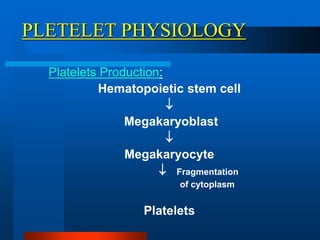
Platelets Production:
Hematopoietic stem cell

Megakaryoblast

Megakaryocyte
 Fragmentation
of cytoplasm
Platelets
 Thrombopoietin:
 Regulator of platelet production.
 Produced by the liver and kidneys.
 Levels are increased in
thrombocytopenia,and reduced in
thrombocytosis.
 It increases the no. & rate of
maturation of the megakaryocytes.
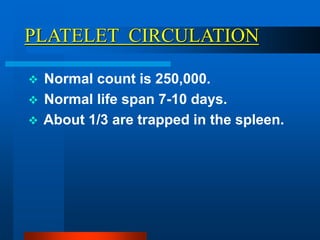
PLATELET CIRCULATION
 Normal count is 250,000.
 Normal life span 7-10 days.
 About 1/3 are trapped in the spleen.
STRUTURE
Mucopolysacch.
coat
Granules
Dense core
granules
Mucopolysacch. Coat: Glycoprotein content
which are important for interaction of platelets
with each other or aggregating agents.
-  Granules:
- Dense core:
Function
Formation of mechanical plug during
normal hemostatic response to
vascular injury.
The main steps involved are:
adhesion, release, aggregation.
PLATELETS ADHESION
Adhesion of platelet to subendothelial
collagen.
Dependent on the VW factor (Von
Willebrand part of Fact VIII). Also
dependent on glyoproteins.
RELEASE (SECRETION)
Collagen exposure results in the
release of granules contents (ADP,
serotonin, fibrinoen).
Collagen and thrombin activate
prostaglandin synthesis.
Thromboxane A2: Potentiase aggregation
and vasoconstrictor.
Aggregation: Release ADP+thromboxane
A2 aggregation. This is followed by more
secration secondary aggregation.
platelet mass or plug.
Membrane Phospholipid

Arachidonic acid
 Cyclo-oxygenase
Thromboxane synthetase 
Thromboxane A2
Platelets Disorders
Platelet disorders are the most
common cause of bleeding. The
disorder could be  number
(thrombocytopenia) or defective
function.
THORMBOCYTOPENIA
Loss of platelets from the circulation faster
than the rate of their production by the bone
marrow. So thrombocytopenia is due to:
A. Failure of platelets production,
most common cause,
Megakaryocytes are  in the
bone marrow e.g. drugs.
B.  rate of removal of platelets
from the circulation.
 Megakaryocytes are  or normal
in the bone marrow I.e production
is normal but platelets are
destroyed e.g. by antibodies.
Causes of Thrombocytopenia
Congenital
• Megakaryocytic hypoplasia
• TAR syndrome
• Wiscott Aldrich syndrome
Acquired
• Immunothrombocytopenia
• Thrombotic thrombocytopenic
purpura
• DIC
• Drugs
• Infections
• Splenomegaly
• Bone marrow suppression or
infiltration
• Aplastic anaemia
Immunothrombocytopenia (ITP)
Autoimmune disorder characterized by
platelets bound antibodies:
Classification:
• Acute: Usually in children, self limiting
preceeded by infection usually viral.
• Chronic: Usually in adults, more common in
female.
Etiology:
• Idiopathic
Pathogenesis of
Immunothrombocytopenia
1. Platelets are sensitized with
autoantibodies.
2. Premature removal of platelets from
the circulation by macrophages of the
R-E system and destroyed mainly in
the spleen.
Acute Immunothrombocytopenia
 Self limiting usually weeks.
 In children.
 Usually preceeded by viral infection.
 Bone marrow shows normal or increased
megakaryocytes.
 Due to immune complexes bound to
platelets. (Complex = viral antigen-
antibody complex). These complexes are
removed by the reticuloendothelial system
(RE system).
 5-10% can go into chronic ITP.
Chronic Immunothrombocytopenia
Pathogenesis:
Autoimmune. Antibodies are formed
against antigens on platelet surface.
Clinical:
• Usually adults, young female 15-50 yrs.
• Insidious onset.
• Chronic: last months or years.
• No precipitating causes.
• Shows fluctuating (cyclical) course with
periods in which platelets number return
to normal.
Manifestations
• Skin purpura, superfacial bruising,
epistaxis, menorrhagia.
• Mucossal hemorrhage is seen in
severe cases and intra-cranial
hemorrhage is rare.
• Splenomegaly: 10% of cases.
Laboratory Findings
• Thrombocytopenia with giant forms.
Count usually 10-50,000.
• Bone marrow shows normal or
increased megakaryocytes.
• Platelet bound IgG is +.
• .
Other Causes of Thrombocytopenia
Bone Marrow Suppression:
Due to effect of infections (viral) or toxins or due
to replacement e.g., by malignancy e.g.,
leukemias, metastatic tumors, or due to fibrosis
of the bone marrow e.g., due to irradiation.
DIC:
• Due to consumption of platelets.
Drugs:
• Due to suppression e.g., phenylbutazone,
Gold, Thiazide.
• Other mechanisms of action are immune, or by
causing direct aggregation of platelets.
• May be accompanied by other signs e.g., fever,
joint pain, rash, leukopenia.
Aplastic Anemia
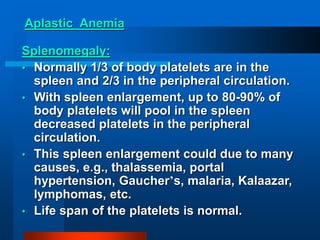
Splenomegaly:
• Normally 1/3 of body platelets are in the
spleen and 2/3 in the peripheral circulation.
• With spleen enlargement, up to 80-90% of
body platelets will pool in the spleen
decreased platelets in the peripheral
circulation.
• This spleen enlargement could due to many
causes, e.g., thalassemia, portal
hypertension, Gaucher’s, malaria, Kalaazar,
lymphomas, etc.
• Life span of the platelets is normal.
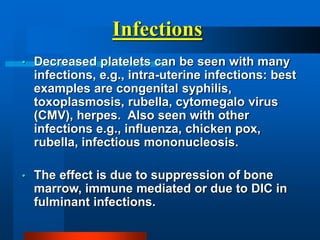
Infections
• Decreased platelets can be seen with many
infections, e.g., intra-uterine infections: best
examples are congenital syphilis,
toxoplasmosis, rubella, cytomegalo virus
(CMV), herpes. Also seen with other
infections e.g., influenza, chicken pox,
rubella, infectious mononucleosis.
• The effect is due to suppression of bone
marrow, immune mediated or due to DIC in
fulminant infections.
Defective Platelets Function
• A defect in function is suspected if
there is prolonged bleeding time with or
without skin or mucosal hemorrhage in
the presence of normal platelet count.
Disorders of Platelets Function
Congenital
• Glanzman’s disease
• Bernard Soluier’s
• Storage granules defect
Acquired
• Drugs
• Uremia
• Myeloproliferative disorders
• Multiple myeloma
Glanzman’s Disease (Thrombasthenia)
• Autosomal recessive inheritance.
• Normal platelets count and appearance.
• No clumps are seen on peripheral blood film
(I.e., no platelets clumps).
• Due to decreased surface membrane
glycoproteins 11b + 111a failure of
primary aggregation.
• Platelets do not aggregate with all
aggregating agents but they aggregate with
ristocetin.
• Bleeding time is prolonged.
Acquired Disorders of Platelet
Function
Causes:
• Drugs e.g., Aspirin
• Myeloproliferative disorder.
• Paraproteinemias e.g., multiple myeloma.
• Cardiopulmonary bypass.
• Autoimmune diseases e.g., SLE (Systemic
Lupus Erythromitosis)
• Uremia (renal failure).
Acquired Disorders of Platelet Function
(Cont…)
Drugs:
• Best example is ASPIRIN which is the MOST
COMMON cause of acquired platelet function
disorder.
• Aspirin irreversibly affect the cyclo-
oxygenase enzyme. The effect last 4-7 days
and it takes about 10 days before the
platelets are replaced.
• Presents as elevated bleeding time but
purpura is unusual.
Thank You For Your
Attention!

PLATELETS.ppt PLATELETS.ppt PLATELETS.ppt

  • 1.
  • 2.
    PLETELET PHYSIOLOGY Platelets Production: Hematopoieticstem cell  Megakaryoblast  Megakaryocyte  Fragmentation of cytoplasm Platelets
  • 4.
     Thrombopoietin:  Regulatorof platelet production.  Produced by the liver and kidneys.  Levels are increased in thrombocytopenia,and reduced in thrombocytosis.  It increases the no. & rate of maturation of the megakaryocytes.
  • 5.
    PLATELET CIRCULATION  Normalcount is 250,000.  Normal life span 7-10 days.  About 1/3 are trapped in the spleen.
  • 6.
    STRUTURE Mucopolysacch. coat Granules Dense core granules Mucopolysacch. Coat:Glycoprotein content which are important for interaction of platelets with each other or aggregating agents. -  Granules: - Dense core:
  • 7.
    Function Formation of mechanicalplug during normal hemostatic response to vascular injury. The main steps involved are: adhesion, release, aggregation.
  • 8.
    PLATELETS ADHESION Adhesion ofplatelet to subendothelial collagen. Dependent on the VW factor (Von Willebrand part of Fact VIII). Also dependent on glyoproteins.
  • 10.
    RELEASE (SECRETION) Collagen exposureresults in the release of granules contents (ADP, serotonin, fibrinoen). Collagen and thrombin activate prostaglandin synthesis.
  • 11.
    Thromboxane A2: Potentiaseaggregation and vasoconstrictor. Aggregation: Release ADP+thromboxane A2 aggregation. This is followed by more secration secondary aggregation. platelet mass or plug. Membrane Phospholipid  Arachidonic acid  Cyclo-oxygenase Thromboxane synthetase  Thromboxane A2
  • 12.
    Platelets Disorders Platelet disordersare the most common cause of bleeding. The disorder could be  number (thrombocytopenia) or defective function.
  • 13.
    THORMBOCYTOPENIA Loss of plateletsfrom the circulation faster than the rate of their production by the bone marrow. So thrombocytopenia is due to: A. Failure of platelets production, most common cause, Megakaryocytes are  in the bone marrow e.g. drugs. B.  rate of removal of platelets from the circulation.
  • 14.
     Megakaryocytes are or normal in the bone marrow I.e production is normal but platelets are destroyed e.g. by antibodies.
  • 15.
    Causes of Thrombocytopenia Congenital •Megakaryocytic hypoplasia • TAR syndrome • Wiscott Aldrich syndrome Acquired • Immunothrombocytopenia • Thrombotic thrombocytopenic purpura • DIC • Drugs • Infections • Splenomegaly • Bone marrow suppression or infiltration • Aplastic anaemia
  • 17.
    Immunothrombocytopenia (ITP) Autoimmune disordercharacterized by platelets bound antibodies: Classification: • Acute: Usually in children, self limiting preceeded by infection usually viral. • Chronic: Usually in adults, more common in female. Etiology: • Idiopathic
  • 18.
    Pathogenesis of Immunothrombocytopenia 1. Plateletsare sensitized with autoantibodies. 2. Premature removal of platelets from the circulation by macrophages of the R-E system and destroyed mainly in the spleen.
  • 19.
    Acute Immunothrombocytopenia  Selflimiting usually weeks.  In children.  Usually preceeded by viral infection.  Bone marrow shows normal or increased megakaryocytes.  Due to immune complexes bound to platelets. (Complex = viral antigen- antibody complex). These complexes are removed by the reticuloendothelial system (RE system).  5-10% can go into chronic ITP.
  • 20.
    Chronic Immunothrombocytopenia Pathogenesis: Autoimmune. Antibodiesare formed against antigens on platelet surface. Clinical: • Usually adults, young female 15-50 yrs. • Insidious onset. • Chronic: last months or years. • No precipitating causes. • Shows fluctuating (cyclical) course with periods in which platelets number return to normal.
  • 21.
    Manifestations • Skin purpura,superfacial bruising, epistaxis, menorrhagia. • Mucossal hemorrhage is seen in severe cases and intra-cranial hemorrhage is rare. • Splenomegaly: 10% of cases.
  • 22.
    Laboratory Findings • Thrombocytopeniawith giant forms. Count usually 10-50,000. • Bone marrow shows normal or increased megakaryocytes. • Platelet bound IgG is +. • .
  • 25.
    Other Causes ofThrombocytopenia Bone Marrow Suppression: Due to effect of infections (viral) or toxins or due to replacement e.g., by malignancy e.g., leukemias, metastatic tumors, or due to fibrosis of the bone marrow e.g., due to irradiation. DIC: • Due to consumption of platelets. Drugs: • Due to suppression e.g., phenylbutazone, Gold, Thiazide. • Other mechanisms of action are immune, or by causing direct aggregation of platelets. • May be accompanied by other signs e.g., fever, joint pain, rash, leukopenia.
  • 26.
    Aplastic Anemia Splenomegaly: • Normally1/3 of body platelets are in the spleen and 2/3 in the peripheral circulation. • With spleen enlargement, up to 80-90% of body platelets will pool in the spleen decreased platelets in the peripheral circulation. • This spleen enlargement could due to many causes, e.g., thalassemia, portal hypertension, Gaucher’s, malaria, Kalaazar, lymphomas, etc. • Life span of the platelets is normal.
  • 27.
    Infections • Decreased plateletscan be seen with many infections, e.g., intra-uterine infections: best examples are congenital syphilis, toxoplasmosis, rubella, cytomegalo virus (CMV), herpes. Also seen with other infections e.g., influenza, chicken pox, rubella, infectious mononucleosis. • The effect is due to suppression of bone marrow, immune mediated or due to DIC in fulminant infections.
  • 28.
    Defective Platelets Function •A defect in function is suspected if there is prolonged bleeding time with or without skin or mucosal hemorrhage in the presence of normal platelet count.
  • 29.
    Disorders of PlateletsFunction Congenital • Glanzman’s disease • Bernard Soluier’s • Storage granules defect Acquired • Drugs • Uremia • Myeloproliferative disorders • Multiple myeloma
  • 30.
    Glanzman’s Disease (Thrombasthenia) •Autosomal recessive inheritance. • Normal platelets count and appearance. • No clumps are seen on peripheral blood film (I.e., no platelets clumps). • Due to decreased surface membrane glycoproteins 11b + 111a failure of primary aggregation. • Platelets do not aggregate with all aggregating agents but they aggregate with ristocetin. • Bleeding time is prolonged.
  • 33.
    Acquired Disorders ofPlatelet Function Causes: • Drugs e.g., Aspirin • Myeloproliferative disorder. • Paraproteinemias e.g., multiple myeloma. • Cardiopulmonary bypass. • Autoimmune diseases e.g., SLE (Systemic Lupus Erythromitosis) • Uremia (renal failure).
  • 34.
    Acquired Disorders ofPlatelet Function (Cont…) Drugs: • Best example is ASPIRIN which is the MOST COMMON cause of acquired platelet function disorder. • Aspirin irreversibly affect the cyclo- oxygenase enzyme. The effect last 4-7 days and it takes about 10 days before the platelets are replaced. • Presents as elevated bleeding time but purpura is unusual.
  • 35.
    Thank You ForYour Attention!