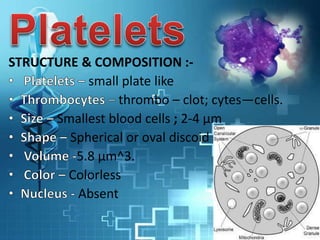
STRUCTURE & COMPOSITION :-
small plate like
thrombo – clot; cytes—cells.
Smallest blood cells ; 2-4 μm
Spherical or oval discoid
5.8 μm^3.
Colorless
Absent
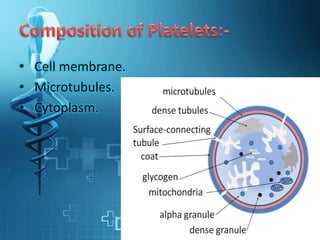
• Cell membrane.
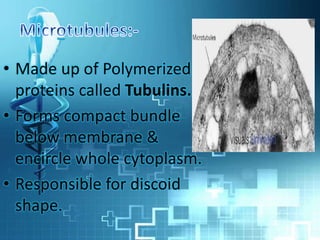
• Microtubules.
• Cytoplasm.
• Made up of Polymerized
proteins called Tubulins.
• Forms compact bundle
below membrane &
encircle whole cytoplasm.
• Responsible for discoid
shape.
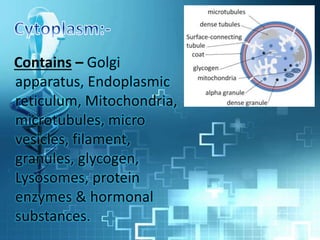
Contains – Golgi
apparatus, Endoplasmic
reticulum, Mitochondria,
microtubules, micro
vesicles, filament,
granules, glycogen,
Lysosomes, protein
enzymes & hormonal
substances.
• Aggregation – property to stick to each other
-Factors responsible are ADP & Thromboxane A2
• Agglutination – property of clumping together of
platelet
- Its due to platelet Agglutinins.
• Adhesiveness – whenever comes in contact with any
wet or rough surface gets activated & stick to surface.
- Factors responsible are –
collagen, thrombin, ADP,
thromboxane A2, Ca ion & Von-Willebrand Factor
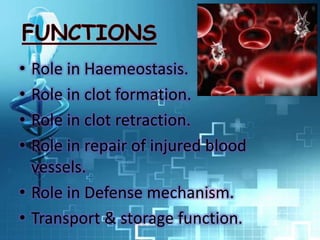
• Role in Haemeostasis.
• Role in clot formation.
• Role in clot retraction.
• Role in repair of injured blood
vessels.
• Role in Defense mechanism.
• Transport & storage function.
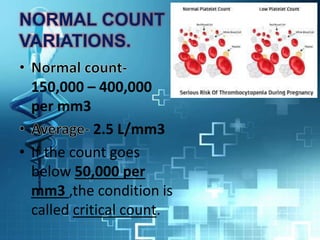
NORMAL COUNT &
VARIATIONS.
150,000 – 400,000
per mm3
2.5 L/mm3
• If the count goes
below 50,000 per
mm3 ,the condition is
called critical count.
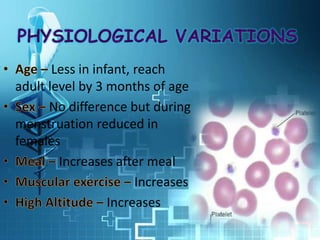
Less in infant, reach
adult level by 3 months of age
No difference but during
menstruation reduced in
females
Increases after meal
Increases
Increases
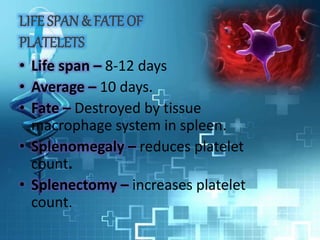
LIFE SPAN & FATE OF
PLATELETS
• Life span – 8-12 days
• Average – 10 days.
• Fate – Destroyed by tissue
macrophage system in spleen.
• Splenomegaly – reduces platelet
count.
• Splenectomy – increases platelet
count.
Haemostasis includes three
basic steps :-
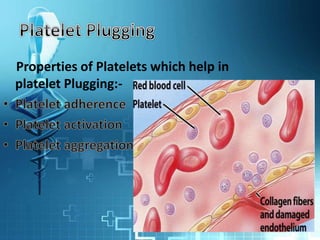
Properties of Platelets which help in
platelet Plugging:-
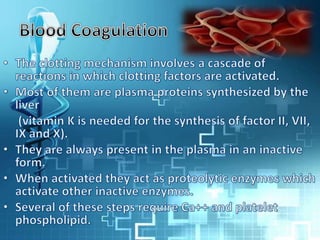
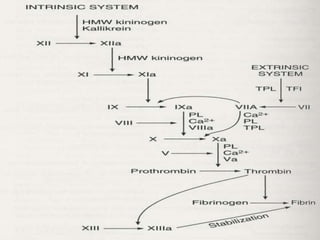
Blood Coagulation
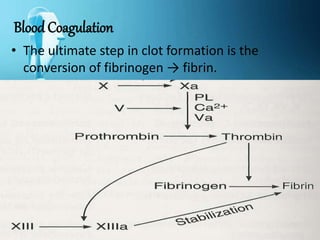
• The ultimate step in clot formation is the
conversion of fibrinogen → fibrin.
:
• An Intrinsic system.
• An Extrinsic system
• The initial reaction is the conversion of
inactive factor XII to active factor XIIa.
• Factor XII is activated in vitro by exposing
blood to foreign surface (glass test tube).
• Activation in vivo occurs when blood is
exposed to collagen fibers underlying the
endothelium in the blood vessels.
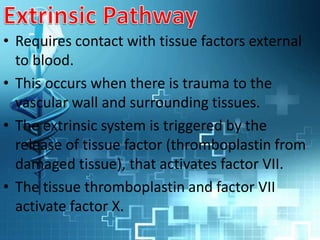
• Requires contact with tissue factors external
to blood.
• This occurs when there is trauma to the
vascular wall and surrounding tissues.
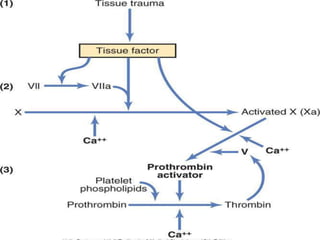
• The extrinsic system is triggered by the
release of tissue factor (thromboplastin from
damaged tissue), that activates factor VII.
• The tissue thromboplastin and factor VII
activate factor X.
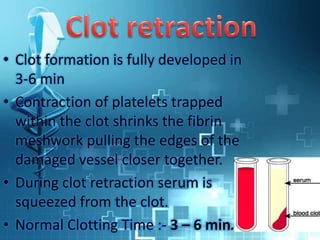
• Clot formation is fully developed in
3-6 min
• Contraction of platelets trapped
within the clot shrinks the fibrin
meshwork pulling the edges of the
damaged vessel closer together.
• During clot retraction serum is
squeezed from the clot.
• Normal Clotting Time :- 3 – 6 min.
• Blood group antigens are actually sugars
attached to the red blood cell.
• Antigens are “built” onto the red cell.
• Individuals inherit a gene which codes for
specific sugar(s) to be added to the red
cell.
• The type of sugar added determines the
blood group
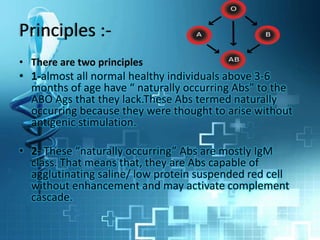
Principles :-
• There are two principles
• 1-almost all normal healthy individuals above 3-6
months of age have “ naturally occurring Abs” to the
ABO Ags that they lack.These Abs termed naturally
occurring because they were thought to arise without
antigenic stimulation.
• 2- These “naturally occurring” Abs are mostly IgM
class. That means that, they are Abs capable of
agglutinating saline/ low protein suspended red cell
without enhancement and may activate complement
cascade.
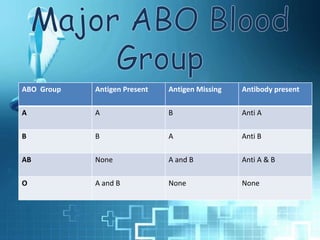
ABO Group Antigen Present Antigen Missing Antibody present
A A B Anti A
B B A Anti B
AB None A and B Anti A & B
O A and B None None
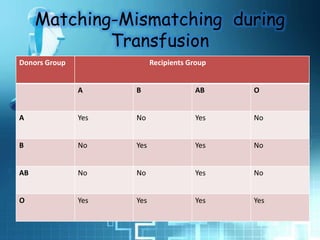
Matching-Mismatching during
Transfusion
Donors Group Recipients Group
A B AB O
A Yes No Yes No
B No Yes Yes No
AB No No Yes No
O Yes Yes Yes Yes
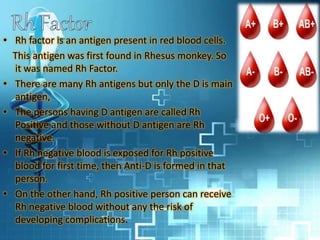
• Rh factor is an antigen present in red blood cells.
This antigen was first found in Rhesus monkey. So
it was named Rh Factor.
• There are many Rh antigens but only the D is main
antigen,
• The persons having D antigen are called Rh
Positive and those without D antigen are Rh
negative.
• If Rh negative blood is exposed for Rh positive
blood for first time, then Anti-D is formed in that
person.
• On the other hand, Rh positive person can receive
Rh negative blood without any the risk of
developing complications.
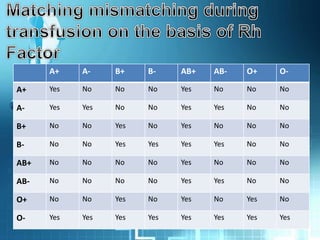
A+ A- B+ B- AB+ AB- O+ O-
A+ Yes No No No Yes No No No
A- Yes Yes No No Yes Yes No No
B+ No No Yes No Yes No No No
B- No No Yes Yes Yes Yes No No
AB+ No No No No Yes No No No
AB- No No No No Yes Yes No No
O+ No No Yes No Yes No Yes No
O- Yes Yes Yes Yes Yes Yes Yes Yes
Platelets, Blood Coagulation And Blood Grouping.

Platelets, Blood Coagulation And Blood Grouping.

  • 2.
    STRUCTURE & COMPOSITION:- small plate like thrombo – clot; cytes—cells. Smallest blood cells ; 2-4 μm Spherical or oval discoid 5.8 μm^3. Colorless Absent
  • 3.
    • Cell membrane. •Microtubules. • Cytoplasm.
  • 5.
    • Made upof Polymerized proteins called Tubulins. • Forms compact bundle below membrane & encircle whole cytoplasm. • Responsible for discoid shape.
  • 6.
    Contains – Golgi apparatus,Endoplasmic reticulum, Mitochondria, microtubules, micro vesicles, filament, granules, glycogen, Lysosomes, protein enzymes & hormonal substances.
  • 7.
    • Aggregation –property to stick to each other -Factors responsible are ADP & Thromboxane A2 • Agglutination – property of clumping together of platelet - Its due to platelet Agglutinins. • Adhesiveness – whenever comes in contact with any wet or rough surface gets activated & stick to surface. - Factors responsible are – collagen, thrombin, ADP, thromboxane A2, Ca ion & Von-Willebrand Factor
  • 8.
    • Role inHaemeostasis. • Role in clot formation. • Role in clot retraction. • Role in repair of injured blood vessels. • Role in Defense mechanism. • Transport & storage function.
  • 9.
    NORMAL COUNT & VARIATIONS. 150,000– 400,000 per mm3 2.5 L/mm3 • If the count goes below 50,000 per mm3 ,the condition is called critical count.
  • 10.
    Less in infant,reach adult level by 3 months of age No difference but during menstruation reduced in females Increases after meal Increases Increases
  • 11.
    LIFE SPAN &FATE OF PLATELETS • Life span – 8-12 days • Average – 10 days. • Fate – Destroyed by tissue macrophage system in spleen. • Splenomegaly – reduces platelet count. • Splenectomy – increases platelet count.
  • 14.
  • 16.
    Properties of Plateletswhich help in platelet Plugging:-
  • 18.
    Blood Coagulation • Theultimate step in clot formation is the conversion of fibrinogen → fibrin.
  • 19.
    : • An Intrinsicsystem. • An Extrinsic system
  • 20.
    • The initialreaction is the conversion of inactive factor XII to active factor XIIa. • Factor XII is activated in vitro by exposing blood to foreign surface (glass test tube). • Activation in vivo occurs when blood is exposed to collagen fibers underlying the endothelium in the blood vessels.
  • 22.
    • Requires contactwith tissue factors external to blood. • This occurs when there is trauma to the vascular wall and surrounding tissues. • The extrinsic system is triggered by the release of tissue factor (thromboplastin from damaged tissue), that activates factor VII. • The tissue thromboplastin and factor VII activate factor X.
  • 24.
    • Clot formationis fully developed in 3-6 min • Contraction of platelets trapped within the clot shrinks the fibrin meshwork pulling the edges of the damaged vessel closer together. • During clot retraction serum is squeezed from the clot. • Normal Clotting Time :- 3 – 6 min.
  • 26.
    • Blood groupantigens are actually sugars attached to the red blood cell. • Antigens are “built” onto the red cell. • Individuals inherit a gene which codes for specific sugar(s) to be added to the red cell. • The type of sugar added determines the blood group
  • 27.
    Principles :- • Thereare two principles • 1-almost all normal healthy individuals above 3-6 months of age have “ naturally occurring Abs” to the ABO Ags that they lack.These Abs termed naturally occurring because they were thought to arise without antigenic stimulation. • 2- These “naturally occurring” Abs are mostly IgM class. That means that, they are Abs capable of agglutinating saline/ low protein suspended red cell without enhancement and may activate complement cascade.
  • 28.
    ABO Group AntigenPresent Antigen Missing Antibody present A A B Anti A B B A Anti B AB None A and B Anti A & B O A and B None None
  • 29.
    Matching-Mismatching during Transfusion Donors GroupRecipients Group A B AB O A Yes No Yes No B No Yes Yes No AB No No Yes No O Yes Yes Yes Yes
  • 30.
    • Rh factoris an antigen present in red blood cells. This antigen was first found in Rhesus monkey. So it was named Rh Factor. • There are many Rh antigens but only the D is main antigen, • The persons having D antigen are called Rh Positive and those without D antigen are Rh negative. • If Rh negative blood is exposed for Rh positive blood for first time, then Anti-D is formed in that person. • On the other hand, Rh positive person can receive Rh negative blood without any the risk of developing complications.
  • 31.
    A+ A- B+B- AB+ AB- O+ O- A+ Yes No No No Yes No No No A- Yes Yes No No Yes Yes No No B+ No No Yes No Yes No No No B- No No Yes Yes Yes Yes No No AB+ No No No No Yes No No No AB- No No No No Yes Yes No No O+ No No Yes No Yes No Yes No O- Yes Yes Yes Yes Yes Yes Yes Yes