PLATE TECTONICS
THEORY
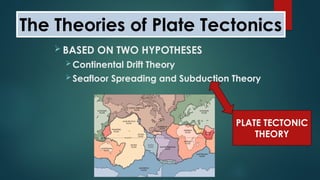
The Theories of Plate Tectonics
 BASED ON TWO HYPOTHESES
 Continental Drift Theory
 Seafloor Spreading and Subduction Theory
PLATE TECTONIC
THEORY
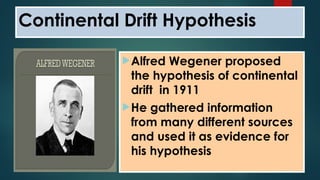
Alfred Wegener proposed
the hypothesis of continental
drift in 1911
He gathered information
from many different sources
and used it as evidence for
his hypothesis
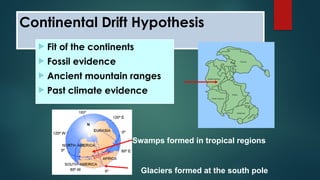
Continental Drift Hypothesis
Continental Drift theory (Alfred Wegener) (Oskin,
2017)
- supercontinent called Pangaea
two sub-continents, Laurasia and Gondwanaland.
Laurasia split into a few smaller continents forming
the continents in the northern hemisphere of the
Earth. -Asia, Europe and North America
southern hemisphere, South America, India, Africa
Australia and Antarctica, are the two continents
divided from Gondwanaland.
Continental Drift Hypothesis
Glaciers formed at the south pole
Swamps formed in tropical regions
 Fit of the continents
 Fossil evidence
 Ancient mountain ranges
 Past climate evidence
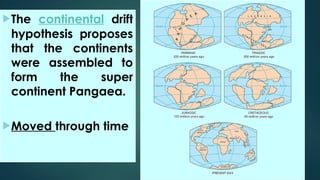
The continental drift
hypothesis proposes
that the continents
were assembled to
form the super
continent Pangaea.
Moved through time
Fitting of Continents
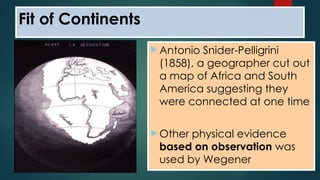
 Antonio Snider-Pelligrini
(1858), a geographer cut out
a map of Africa and South
America suggesting they
were connected at one time
 Other physical evidence
based on observation was
used by Wegener
Fit of Continents
Fossil Correlations
Fossil Evidence
 Similar terrestrial
species were found
on many
continents now
separated by
oceans.
 Information
collected by
paleontologists
Rock and Mountain
Correlations
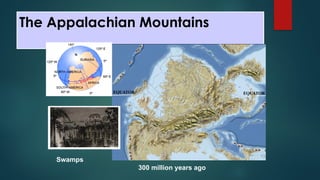
Ancient Mountain Ranges
The same sequence of rocks is found in North America,
Great Brittan, and Norway. The pattern does not make
sense with the continents in their current configuration.
The Appalachian Mountains
Swamps
300 million years ago
Past Climate/
Paleoclimate Data
Evidence of
PALEOCLIMATE
DATA
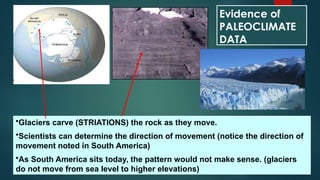
•Glaciers carve (STRIATIONS) the rock as they move.
•Scientists can determine the direction of movement (notice the direction of
movement noted in South America)
•As South America sits today, the pattern would not make sense. (glaciers
do not move from sea level to higher elevations)
Evidence of
PALEOCLIMATE
DATA
Lack of mechanism to explain
continental movement.
 Evidence implied that the continents were at one time
assembled
 Wegener’s idea was not accepted by the scientific
community because he could not explain how the
continents moved
 With advances in technology, new information was
gathered
Seafloor Spreading and
Subduction Theory
 Seafloor Spreading Theory
(www.divediscover.whoi.edu)
 - Proposed by Harry Hess of
 Princeton University and Robert
Deits
 - States that the seafloor is
continuously spreading and the
extra crust gets recycled into the
mantle through subduction
Driving Mechanisms
Convection current
within the mantle
Pushing at the mid-
oceanic ridges
Pulling at the
subduction zones
Push
Pull
Convection
How is seafloor spreading theory
and continental drift theory
related?
• Seafloor spreading explains how
the continents moved apart
Seafloor spreading, along with the
continental drift theory, became part
of the theory of plate tectonics.
Additional Information
ocean floor were much younger than those
found on the continents.
The youngest rocks were those nearest the
underwater ridge system which is a series of
mountains that extend around the world,
stretching more than 64 thousand kilometers
(40 thousand miles).
Plate Tectonics Theory
Plate Tectonics Theory (www.ck12.org; Oskin,
2017)
- States that the crust is composed of different
plates which move either towards, away or
past each other.
- The modern version of the Continental Drift
Theory of Alfred Wegener
Important concepts in the theory of plate tectonics
include the following:
1.The ocean floors are continually moving —
spreading from the center, sinking at the edges, and
being regenerated.
2.Convection currents beneath the plates are
responsible for plate movement.
3. The source of energy responsible for generating
the heat and convection currents that move the
plates is most likely radioactivity deep in Earth's
mantle.
EXPERIMENT MATERIALS
 2 table spoon cornstarch
 Dropper
 Spoon
 Glass or plastic cup
 Oil 200ml
 Food color
 Match/lighter
 Water 100 ml
 Denatured gas

Plate tectonics theories.pptx POWERPOINT

  • 1.
  • 4.
    The Theories ofPlate Tectonics  BASED ON TWO HYPOTHESES  Continental Drift Theory  Seafloor Spreading and Subduction Theory PLATE TECTONIC THEORY
  • 6.
    Alfred Wegener proposed thehypothesis of continental drift in 1911 He gathered information from many different sources and used it as evidence for his hypothesis Continental Drift Hypothesis
  • 7.
    Continental Drift theory(Alfred Wegener) (Oskin, 2017) - supercontinent called Pangaea two sub-continents, Laurasia and Gondwanaland. Laurasia split into a few smaller continents forming the continents in the northern hemisphere of the Earth. -Asia, Europe and North America southern hemisphere, South America, India, Africa Australia and Antarctica, are the two continents divided from Gondwanaland.
  • 8.
    Continental Drift Hypothesis Glaciersformed at the south pole Swamps formed in tropical regions  Fit of the continents  Fossil evidence  Ancient mountain ranges  Past climate evidence
  • 9.
    The continental drift hypothesisproposes that the continents were assembled to form the super continent Pangaea. Moved through time
  • 10.
  • 11.
     Antonio Snider-Pelligrini (1858),a geographer cut out a map of Africa and South America suggesting they were connected at one time  Other physical evidence based on observation was used by Wegener Fit of Continents
  • 12.
  • 13.
    Fossil Evidence  Similarterrestrial species were found on many continents now separated by oceans.  Information collected by paleontologists
  • 14.
  • 15.
    Ancient Mountain Ranges Thesame sequence of rocks is found in North America, Great Brittan, and Norway. The pattern does not make sense with the continents in their current configuration.
  • 16.
  • 17.
  • 18.
    Evidence of PALEOCLIMATE DATA •Glaciers carve(STRIATIONS) the rock as they move. •Scientists can determine the direction of movement (notice the direction of movement noted in South America) •As South America sits today, the pattern would not make sense. (glaciers do not move from sea level to higher elevations)
  • 19.
  • 20.
    Lack of mechanismto explain continental movement.  Evidence implied that the continents were at one time assembled  Wegener’s idea was not accepted by the scientific community because he could not explain how the continents moved  With advances in technology, new information was gathered
  • 22.
    Seafloor Spreading and SubductionTheory  Seafloor Spreading Theory (www.divediscover.whoi.edu)  - Proposed by Harry Hess of  Princeton University and Robert Deits  - States that the seafloor is continuously spreading and the extra crust gets recycled into the mantle through subduction
  • 23.
    Driving Mechanisms Convection current withinthe mantle Pushing at the mid- oceanic ridges Pulling at the subduction zones Push Pull Convection
  • 24.
    How is seafloorspreading theory and continental drift theory related?
  • 25.
    • Seafloor spreadingexplains how the continents moved apart Seafloor spreading, along with the continental drift theory, became part of the theory of plate tectonics.
  • 26.
    Additional Information ocean floorwere much younger than those found on the continents. The youngest rocks were those nearest the underwater ridge system which is a series of mountains that extend around the world, stretching more than 64 thousand kilometers (40 thousand miles).
  • 27.
    Plate Tectonics Theory PlateTectonics Theory (www.ck12.org; Oskin, 2017) - States that the crust is composed of different plates which move either towards, away or past each other. - The modern version of the Continental Drift Theory of Alfred Wegener
  • 28.
    Important concepts inthe theory of plate tectonics include the following: 1.The ocean floors are continually moving — spreading from the center, sinking at the edges, and being regenerated. 2.Convection currents beneath the plates are responsible for plate movement. 3. The source of energy responsible for generating the heat and convection currents that move the plates is most likely radioactivity deep in Earth's mantle.
  • 29.
    EXPERIMENT MATERIALS  2table spoon cornstarch  Dropper  Spoon  Glass or plastic cup  Oil 200ml  Food color  Match/lighter  Water 100 ml  Denatured gas