Presented by : Bhagwat Burange
Guided by : Dr. Prashant Chintal
Plastic Memory
Content
• Introduction
• Uses of Plastic Memory
• Goal of Plastic Memory
• Memory
• Types of RAM
• Types of ROM
• Types of HYBRIDS
• Advantages of Plastic Memory
• Limitations of Flash Memory
• Conclusion
• References
INTRODUCTION
• A new form of permanent computer memory which uses
plastic and is much cheaper and faster than the existing silicon
circuits was invented by Researchers at Princeton University
working with Hewlett-Packard.
USES OF PLASTIC MEMORY
• Polymer devices can be used in data storage devices and also
as a switch whose state can be changed externally by a voltage
pulse.
GOAL OF PLASTIC MEMORY
• The goal is to make the technology fast enough to store video.
• The reaserches hope that this technology will decrease the
size, increase reliability and speed up reading and writing of
memory chips.
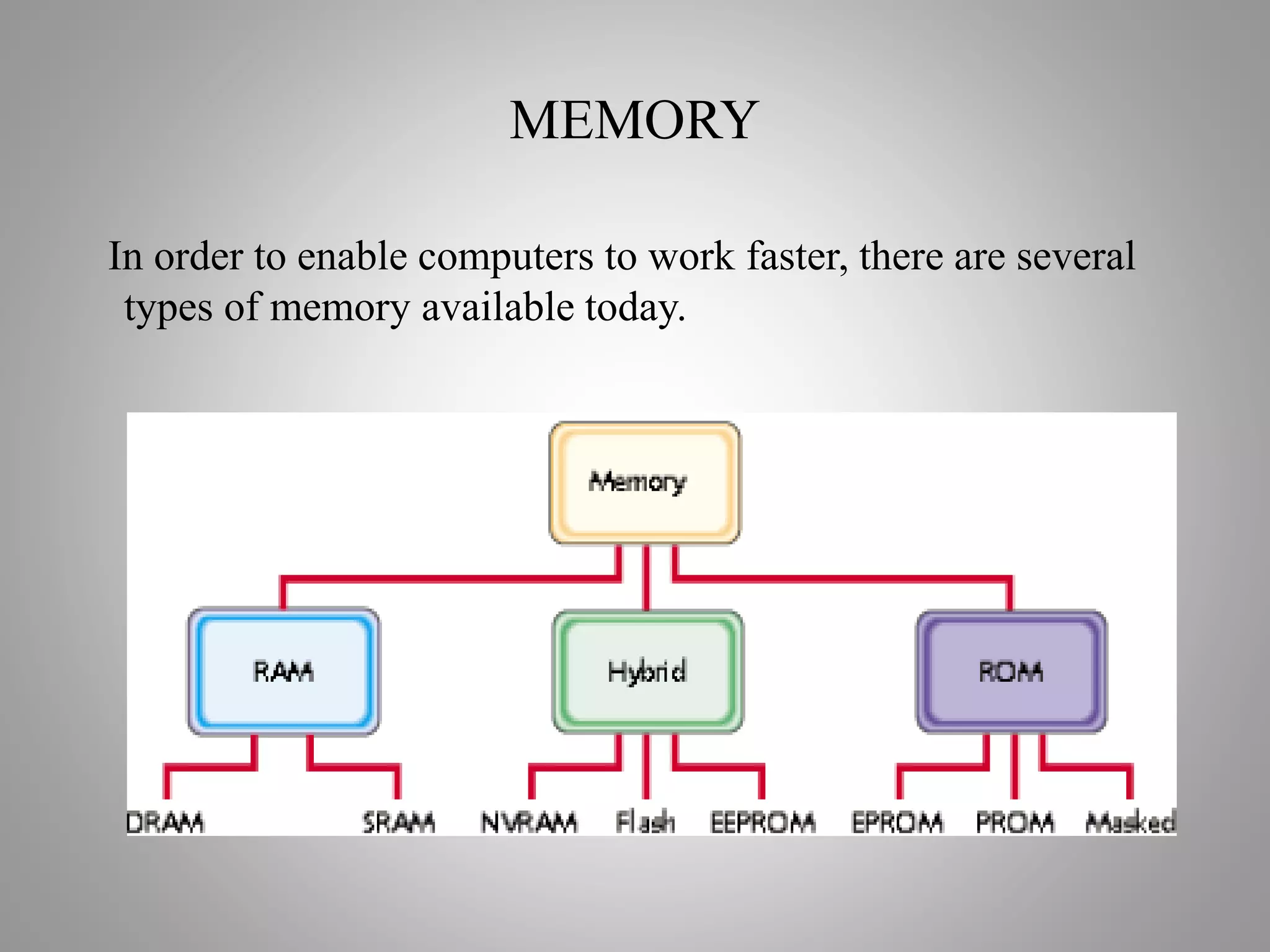
MEMORY
In order to enable computers to work faster, there are several
types of memory available today.
TYPES of RAM
• SRAM -Static RAM
• DRAM- Dynamic RAM
TYPES OF ROM
• ROM - Read Only Memory.
• PROM - Programmable Read Only Memory.
• EPROM - Erasable Programmable Read Only Memory.
TYPES of HYBRIDS
• EEPROM - Electrically Erasable Programmable Read Only
Memory.
• Flash EEPROM memory.
ADVANTAGES OF PLASTIC MEMORY
• The plastic memory technology promises to store more
data at less cost than the expensive-to-build silicon chips
used by popular consumer gadgets including digital
cameras, cell phones and portable music players.
• The memory cannot be rewritten, but can be read very
fast and with low power consumption.
• So this would be suitable only for permanent storage.
LIMITATIONS OF FLASH MEMORY
• The dimension demands on devices increasingly get smaller to
host a variety of form factors.
• Smaller memory space means the transistors leak more
electricity and suck up more power.
CONCLUSION
• Plastic memory is much cheaper and faster than the existing
silicon a circuit was invented by Researchers at Princeton
University working with Hewlett-Packard.
• Plastic memory is a combination of materials that could lower
the cost and boost the density of electronic memory.
• It is an all-organic memory system with manifold advantages:
in speed, production, energy consumption, storage capacity
and cost.
REFERENCES
• www.google.com
• www.wikipedia.com
• www.studymafia.org
Thanks

Plastic Memory.pptx

  • 1.
    Presented by :Bhagwat Burange Guided by : Dr. Prashant Chintal Plastic Memory
  • 2.
    Content • Introduction • Usesof Plastic Memory • Goal of Plastic Memory • Memory • Types of RAM • Types of ROM • Types of HYBRIDS • Advantages of Plastic Memory • Limitations of Flash Memory • Conclusion • References
  • 3.
    INTRODUCTION • A newform of permanent computer memory which uses plastic and is much cheaper and faster than the existing silicon circuits was invented by Researchers at Princeton University working with Hewlett-Packard.
  • 4.
    USES OF PLASTICMEMORY • Polymer devices can be used in data storage devices and also as a switch whose state can be changed externally by a voltage pulse.
  • 5.
    GOAL OF PLASTICMEMORY • The goal is to make the technology fast enough to store video. • The reaserches hope that this technology will decrease the size, increase reliability and speed up reading and writing of memory chips.
  • 6.
    MEMORY In order toenable computers to work faster, there are several types of memory available today.
  • 7.
    TYPES of RAM •SRAM -Static RAM • DRAM- Dynamic RAM
  • 8.
    TYPES OF ROM •ROM - Read Only Memory. • PROM - Programmable Read Only Memory. • EPROM - Erasable Programmable Read Only Memory.
  • 9.
    TYPES of HYBRIDS •EEPROM - Electrically Erasable Programmable Read Only Memory. • Flash EEPROM memory.
  • 10.
    ADVANTAGES OF PLASTICMEMORY • The plastic memory technology promises to store more data at less cost than the expensive-to-build silicon chips used by popular consumer gadgets including digital cameras, cell phones and portable music players. • The memory cannot be rewritten, but can be read very fast and with low power consumption. • So this would be suitable only for permanent storage.
  • 11.
    LIMITATIONS OF FLASHMEMORY • The dimension demands on devices increasingly get smaller to host a variety of form factors. • Smaller memory space means the transistors leak more electricity and suck up more power.
  • 12.
    CONCLUSION • Plastic memoryis much cheaper and faster than the existing silicon a circuit was invented by Researchers at Princeton University working with Hewlett-Packard. • Plastic memory is a combination of materials that could lower the cost and boost the density of electronic memory. • It is an all-organic memory system with manifold advantages: in speed, production, energy consumption, storage capacity and cost.
  • 13.
  • 14.

Editor's Notes