1
Startup Model of an innovation project: The
planning limitation in high uncertainty context
September 23rd, 2018
Mondher KHANFIR
mondher.khanfir@gmail.com
PMI Tunisia Chapter Annual Event 2018
copyright2018@Mondher.Khanfir
2START-UP CORPORATE SOCIAL BUSINESS
2018
2017
2016
2015
2014
2013
2012
2011
2010
2009
2008
2007
2006
2005
2004
2003
2002
2001
2000
1999
1998
BARAC (CyberSecurity)
MAGHREB ENTREPRISE
(MEDI)
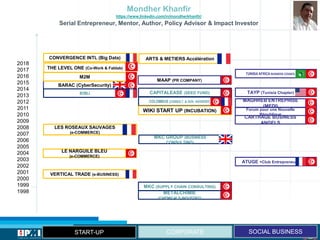
Mondher Khanfir
https://www.linkedin.com/in/mondherkhanfir/
Serial Entrepreneur, Mentor, Author, Policy Advisor & Impact Investor
MAAP (PR COMPANY)
CAPITALEASE (SEED FUND)
VERTICAL TRADE (e-BUSINESS)
LE NARGUILE BLEU
(e-COMMERCE)
LES ROSEAUX SAUVAGES
(e-COMMERCE)
COLOMBUS (CONSULT. & GOV. ADVISORY)
ATUGE +Club Entrepreneurs
WIKI START UP (INCUBATION)
TAYP (Tunisia Chapter)
THE LEVEL ONE (Co-Work & Fablab)
MKC GROUP (BUSINESS
CONSULTING)
TUNISIA AFRICA BUSINESS COUNCIL
Forum pour une Nouvelle
République
MKC (SUPPLY CHAIN CONSULTING)
METALCHIMIE
(CHEMICALS INDUSTRY)
CARTHAGE BUSINESS
ANGELS
CONVERGENCE INTL (Big Data) ARTS & METIERS Accélération
M2M
BOBLI
3
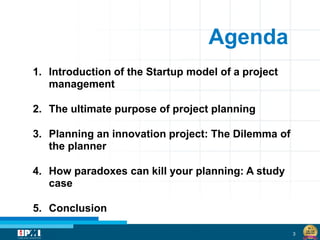
Agenda
1. Introduction of the Startup model of a project
management
2. The ultimate purpose of project planning
3. Planning an innovation project: The Dilemma of
the planner
4. How paradoxes can kill your planning: A study
case
5. Conclusion
4
1- Introduction of the Startup model of a project
management
5
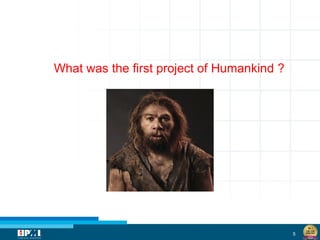
What was the first project of Humankind ?
6
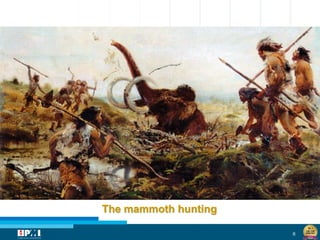
The mammoth hunting
7
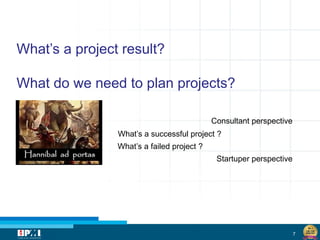
What’s a project result?
What do we need to plan projects?
What’s a successful project ?
What’s a failed project ?
Consultant perspective
Startuper perspective
8
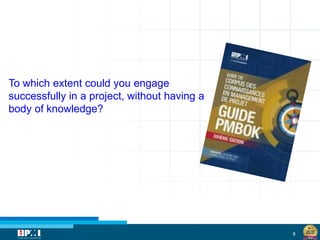
To which extent could you engage
successfully in a project, without having a
body of knowledge?
9
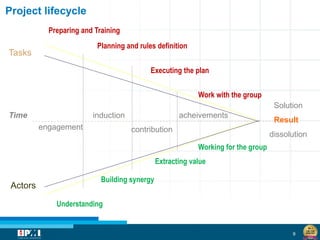
Project lifecycle
Result
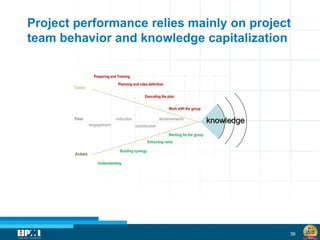
engagement
induction
contribution
acheivements
Actors
Tasks
Understanding
Preparing and Training
Planning and rules definition
Building synergy
Time
Executing the plan
Extracting value
Work with the group
Working for the group
Solution
dissolution
10
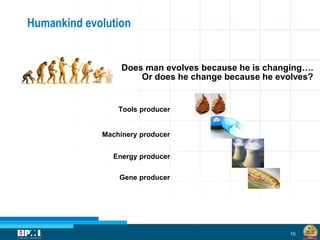
Humankind evolution
Does man evolves because he is changing….
Or does he change because he evolves?
Tools producer
Machinery producer
Energy producer
Gene producer
11
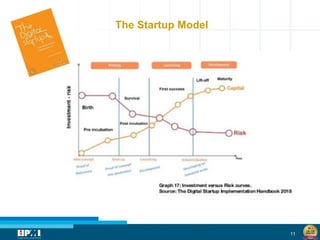
The Startup Model
12
2- The ultimate purpose of project planning
13
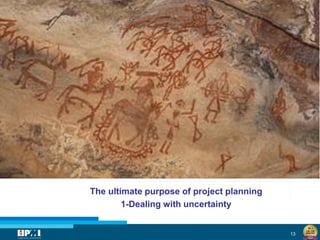
The ultimate purpose of project planning
1-Dealing with uncertainty
14
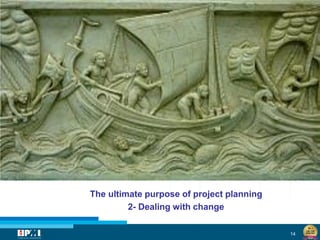
The ultimate purpose of project planning
2- Dealing with change
15
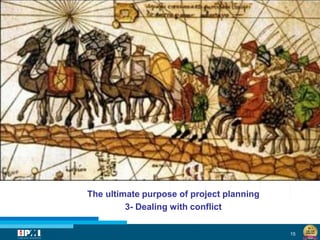
The ultimate purpose of project planning
3- Dealing with conflict
16
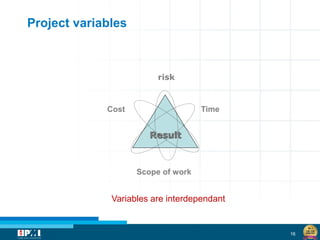
Project variables
Result
Cost Time
Scope of work
Variables are interdependant
risk
17
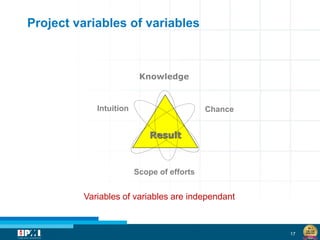
Project variables of variables
Result
Intuition Chance
Scope of efforts
Variables of variables are independant
Knowledge
18
3- Planning an innovation project: The
Dilemma of the planner
19
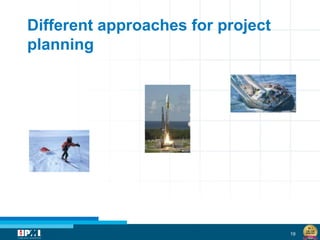
Different approaches for project
planning
Méthode « Aventure »
Méthode prédictive
Méthode adaptative
20
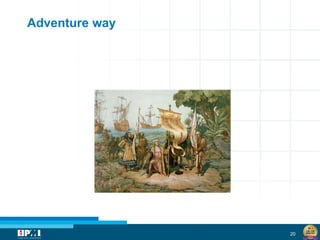
Adventure way
21
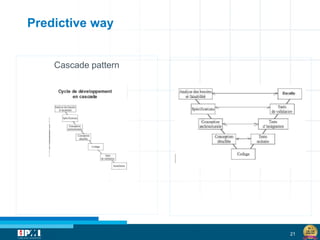
Predictive way
Cascade pattern
Cycle en V
22
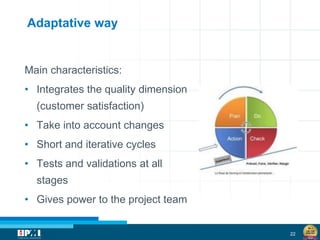
Adaptative way
Main characteristics:
• Integrates the quality dimension
(customer satisfaction)
• Take into account changes
• Short and iterative cycles
• Tests and validations at all
stages
• Gives power to the project team
23
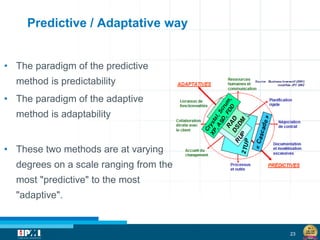
Predictive / Adaptative way
• The paradigm of the predictive
method is predictability
• The paradigm of the adaptive
method is adaptability
• These two methods are at varying
degrees on a scale ranging from the
most "predictive" to the most
"adaptive".
24
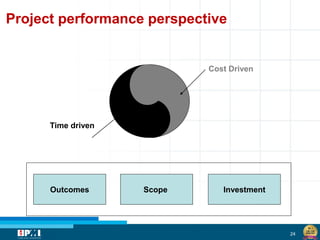
Project performance perspective
Outcomes Scope Investment
Cost Driven
Time driven
25
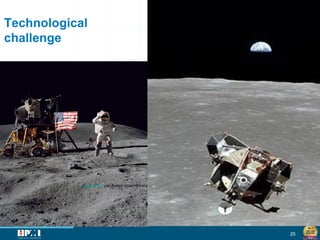
Technological
challenge
Cette photo par Auteur inconnu est soumis à la licence CC BY-NC
26
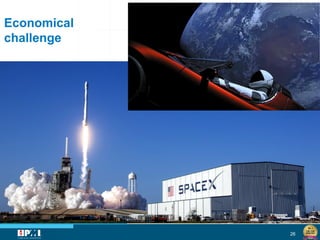
Economical
challenge
27
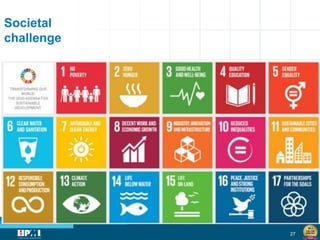
Societal
challenge
28
The dilemma of the project planner
✓ Time Driven v/s Cost Driven
✓ Performance v/s compliance
✓ Planned tasks v/s executed tasks
29
4- How paradoxes can kill your planning:
A case study
30
What’s a paradox?
• a statement or proposition that seems self-
contradictory or absurd but in reality expresses a possible
truth.
• a self-contradictory and false proposition.
• any person, thing, or situation exhibiting an apparently con
tradictory nature.
Source: www.dictionary.com
31
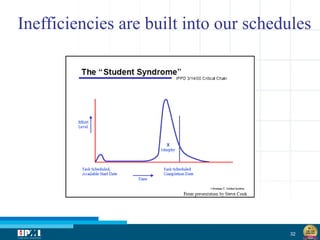
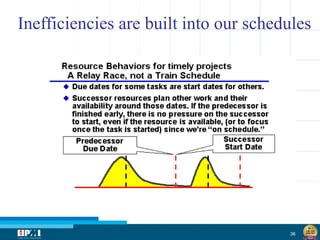
• Contributors to Wasted Protection
– Student Syndrome (“Wait until the last moment and cram”)
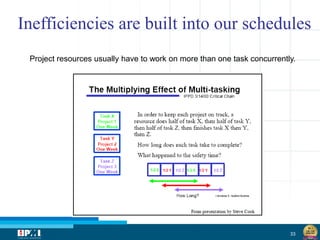
– Work released too early (“Resource already in use”; diffused focus)
– Bad Multi-tasking (“Suspend and Set-up” for each task attempt)
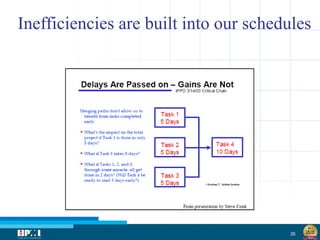
– Unreported early finishes (“I fought hard to get this time . .”)
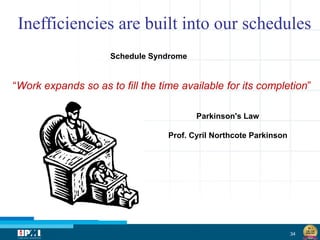
– Parkinson’s Law (“Work expands . . . . to fill time available”)
Inefficiencies are built into our Schedules
The safety time is often wasted
32
Inefficiencies are built into our schedules
33
Project resources usually have to work on more than one task concurrently.
Inefficiencies are built into our schedules
34
Schedule Syndrome
“Work expands so as to fill the time available for its completion”
Parkinson's Law
Prof. Cyril Northcote Parkinson
Inefficiencies are built into our schedules
35
Inefficiencies are built into our schedules
36
Inefficiencies are built into our schedules
37
5- Conclusion
38
Project performance relies mainly on project
team behavior and knowledge capitalization
39
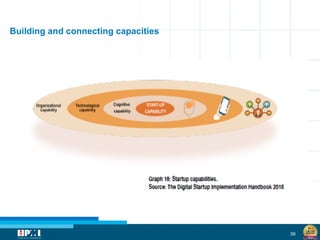
Building and connecting capacities
40
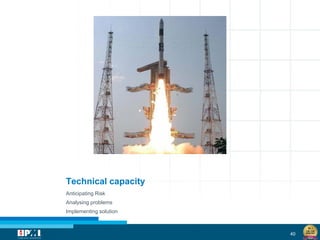
Anticipating Risk
Analysing problems
Implementing solution
Technical capacity
41
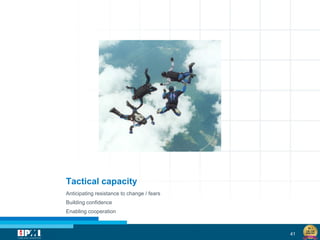
Anticipating resistance to change / fears
Building confidence
Enabling cooperation
Tactical capacity
42
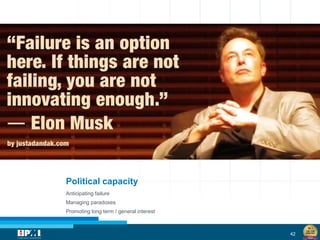
Anticipating failure
Managing paradoxes
Promoting long term / general interest
Political capacity
43
The hidden question
What to do to succeed?
What to avoid to do, to not fail ?
44
Thank you for your time and
attention !
https://www.linkedin.com/in/mondherkhanfir/
copyright2018@Mondher.Khanfir

Planning limitation in high uncertainty projects