Agenda
1) General context & Introduction
2) Innovation ecosystem landscape in Africa
• The major enablers of the African Innovation Ecosystem
• Venture capital investments in Africa in 2019-2020
• Effects of the COVID19 pandemic on the Africa Startup scene
3) Startup Ecosystem potential and performance
• Key findings from the survey
• The concept of potential and performance
• Measuring African Startup Ecosystem Performance
4) Tunisia case study
5) Q&A
General context & Introduction
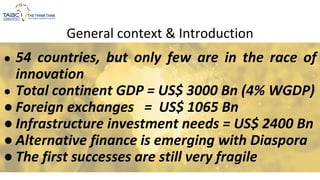
● 54 countries, but only few are in the race of
innovation
● Total continent GDP = US$ 3000 Bn (4% WGDP)
● Foreign exchanges = US$ 1065 Bn
● Infrastructure investment needs = US$ 2400 Bn
● Alternative finance is emerging with Diaspora
● The first successes are still very fragile
General context & Introduction
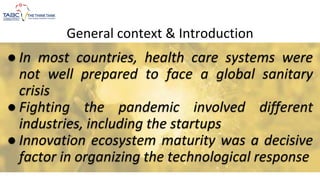
● In most countries, health care systems were
not well prepared to face a global sanitary
crisis
● Fighting the pandemic involved different
industries, including the startups
● Innovation ecosystem maturity was a decisive
factor in organizing the technological response
Agenda
1) General context & Introduction
2) Innovation ecosystem landscape in Africa
• The major enablers of the African Innovation Ecosystem
• Venture capital investments in Africa in 2019
• Effects of the COVID19 pandemic on the Africa Startup scene
3) Startup Ecosystem potential and performance
• Key findings from the survey
• The concept of potential and performance
• Measuring African Startup Ecosystem Performance
4) Tunisia Case study
5) Q&A + Wrapp up
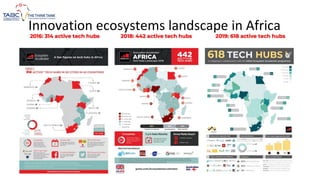
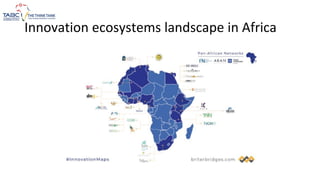
Innovation ecosystems landscape in Africa
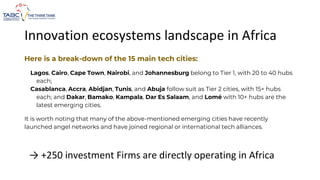
Here is a break-down of the 15 main tech cities:
Lagos, Cairo, Cape Town, Nairobi, and Johannesburg belong to Tier 1, with 20 to 40 hubs
each;
Casablanca, Accra, Abidjan, Tunis, and Abuja follow suit as Tier 2 cities, with 15+ hubs
each; and Dakar, Bamako, Kampala, Dar Es Salaam, and Lomé with 10+ hubs are the
latest emerging cities.
It is worth noting that many of the above-mentioned emerging cities have recently
launched angel networks and have joined regional or international tech alliances.
→ +250 investment Firms are directly operating in Africa
Innovation ecosystems landscape in Africa
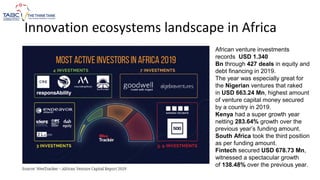
African venture investments
records USD 1.340
Bn through 427 deals in equity and
debt financing in 2019.
The year was especially great for
the Nigerian ventures that raked
in USD 663.24 Mn, highest amount
of venture capital money secured
by a country in 2019.
Kenya had a super growth year
netting 283.64% growth over the
previous year’s funding amount.
South Africa took the third position
as per funding amount.
Fintech secured USD 678.73 Mn,
witnessed a spectacular growth
of 138.48% over the previous year.
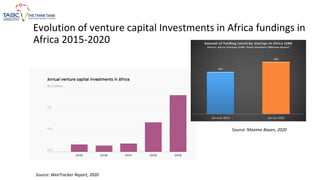
Evolution of venture capital Investments in Africa fundings in
Africa 2015-2020
Source: WeeTracker Report, 2020
Source: Maxime Bayen, 2020
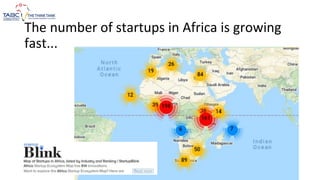
The number of startups in Africa is growing
fast...
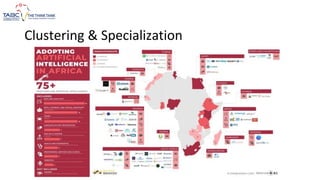
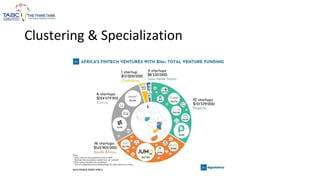
Clustering & Specialization
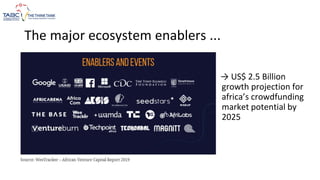
The major ecosystem enablers ...
→ US$ 2.5 Billion
growth projection for
africa’s crowdfunding
market potential by
2025
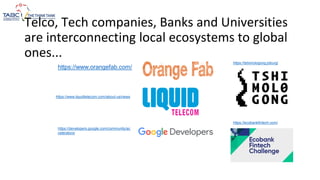
Telco, Tech companies, Banks and Universities
are interconnecting local ecosystems to global
ones...
https://www.orangefab.com/
https://www.liquidtelecom.com/about-us/news
https://developers.google.com/community/ac
celerators/
https://tshimologong.joburg/
https://ecobankfintech.com/
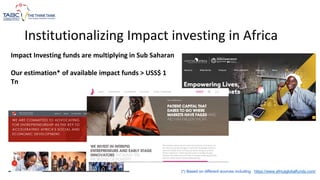
Institutionalizing Impact investing in Africa
Impact Investing funds are multiplying in Sub Saharan
Our estimation* of available impact funds > USS$ 1
Tn
(*) Based on different sources including https://www.africaglobalfunds.com/
Agenda
1) General context & Introduction
2) Innovation ecosystem landscape in Africa
• The major enablers of the African Innovation Ecosystem
• Venture capital investments in Africa in 2019
• Effects of the COVID19 pandemic on the Africa Startup scene
3) Startup Ecosystem potential and performance
• Key findings from the survey
• The concept of potential and performance
• Measuring African Startup Ecosystem Potential &
Performance
4) Tunisia case study
5) Q&A + Wrapp up
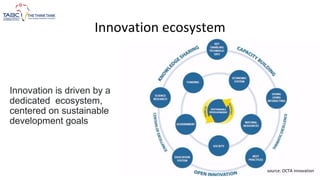
Innovation ecosystem
Innovation is driven by a
dedicated ecosystem,
centered on sustainable
development goals
source: OCTA innovation
→ Making all actors agree to commit with the final objective of
sustainable development
→ Setting up favorable conditions for actors to interact and undertake
risk
→ Accompany the rise of a new wealth creation agent the “Startup”
Innovation Ecosystem policy covers a large chapter on the
startup industry
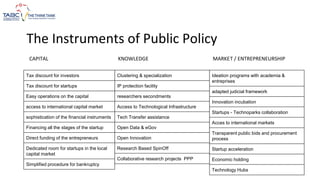
The Instruments of Public Policy
Tax discount for investors
Tax discount for startups
Easy operations on the capital
access to international capital market
sophistication of the financial instruments
Financing all the stages of the startup
Direct funding of the entrepreneurs
Dedicated room for startups in the local
capital market
Simplified procedure for bankruptcy
Clustering & specialization
IP protection facility
researchers secondments
Access to Technological Infrastructure
Tech Transfer assistance
Open Data & eGov
Open Innovation
Research Based SpinOff
Collaborative research projects PPP
Ideation programs with academia &
entreprises
adapted judicial framework
Innovation incubation
Startups - Technoparks collaboration
Acces to international markets
Transparent public bids and procurement
process
Startup acceleration
Economic holding
Technology Hubs
CAPITAL KNOWLEDGE MARKET / ENTREPRENEURSHIP
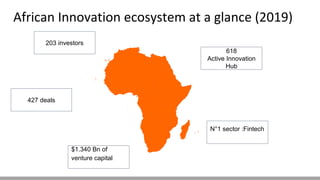
African Innovation ecosystem at a glance (2019)
618
Active Innovation
Hub
203 investors
427 deals
$1.340 Bn of
venture capital
N°1 sector :Fintech
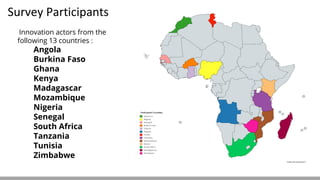
Survey Participants
Innovation actors from the
following 13 countries :
Angola
Burkina Faso
Ghana
Kenya
Madagascar
Mozambique
Nigeria
Senegal
South Africa
Tanzania
Tunisia
Zimbabwe
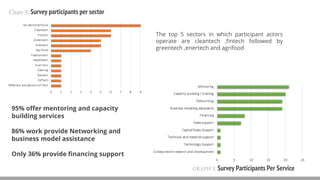
Chart 3: Survey participants per sector
GRAPH 3: Survey Participants Per Service
The top 5 sectors in which participant actors
operate are cleantech ,fintech followed by
greentech ,enertech and agrifood
95% offer mentoring and capacity
building services
86% work provide Networking and
business model assistance
Only 36% provide financing support
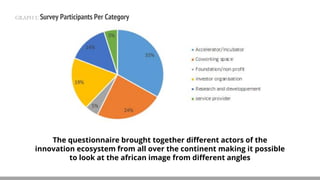
GRAPH 1: Survey Participants Per Category
The questionnaire brought together different actors of the
innovation ecosystem from all over the continent making it possible
to look at the african image from different angles
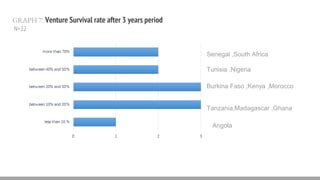
GRAPH 7: Venture Survival rate after 3 years period
N=22
Burkina Faso ,Kenya ,Morocco
Tanzania,Madagascar ,Ghana
Senegal ,South Africa
Tunisia ,Nigeria
Angola
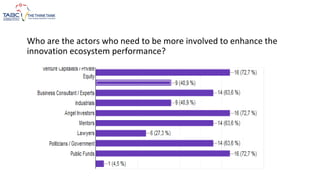
Who are the actors who need to be more involved to enhance the
innovation ecosystem performance?
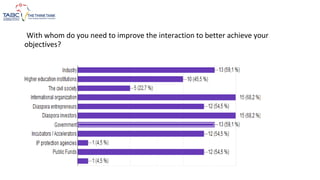
With whom do you need to improve the interaction to better achieve your
objectives?
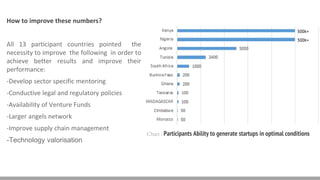
How to improve these numbers?
All 13 participant countries pointed the
necessity to improve the following in order to
achieve better results and improve their
performance:
-Develop sector specific mentoring
-Conductive legal and regulatory policies
-Availability of Venture Funds
-Larger angels network
-Improve supply chain management
-Technology valorisation
Chart : Participants Ability to generate startups in optimal conditions
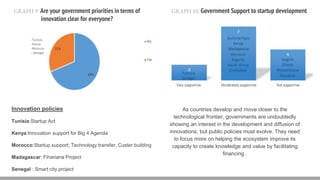
Innovation policies
Tunisia:Startup Act
Kenya:Innovation support for Big 4 Agenda
Morocco:Startup support; Technology transfer, Custer building
Madagascar: Fihariana Project
Senegal : Smart city project
As countries develop and move closer to the
technological frontier, governments are undoubtedly
showing an interest in the development and diffusion of
innovations, but public policies must evolve. They need
to focus more on helping the ecosystem improve its
capacity to create knowledge and value by facilitating
financing .
GRAPH 9: Are your government priorities in terms of
innovation clear for everyone?
GRAPH 10: Government Support to startup development
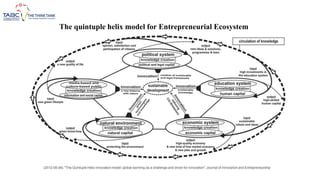
The quintuple helix model for Entrepreneurial Ecosystem
(2012-08-08). "The Quintuple Helix innovation model: global warming as a challenge and driver for innovation". Journal of Innovation and Entrepreneurship
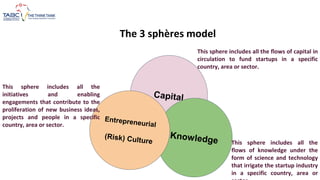
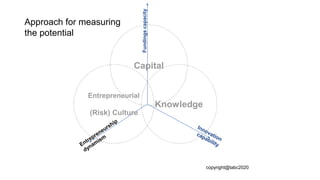
The 3 sphères model
This sphere includes all the flows of capital in
circulation to fund startups in a specific
country, area or sector.
This sphere includes all the
flows of knowledge under the
form of science and technology
that irrigate the startup industry
in a specific country, area or
This sphere includes all the
initiatives and enabling
engagements that contribute to the
proliferation of new business ideas,
projects and people in a specific
country, area or sector.
Fundingscapacity
Approach for measuring
the potential
copyright@tabc2020
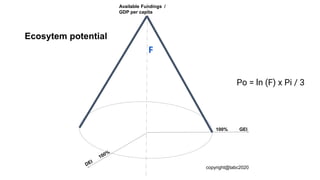
Available Fundings /
GDP per capita
Po = ln (F) x Pi / 3
F
Ecosytem potential
copyright@tabc2020
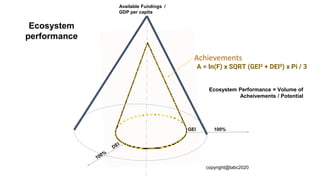
Available Fundings /
GDP per capita
Ecosystem
performance
Achievements
Ecosystem Performance = Volume of
Acheivements / Potential
A = ln(F) x SQRT (GEI² + DEI²) x Pi / 3
copyright@tabc2020
1. Funding capacity
The Funding Capacity or dry powder for the startups is the
capacity to support startup ecosystem with fundings. It stands
for the Logarithm (Ln) of the dry powder in a given country or
region adjusted by its GDP/capita.
2. Knowledge and technological capability
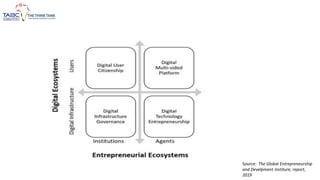
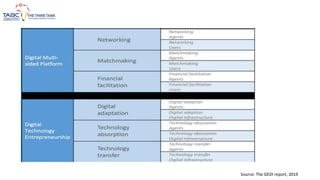
The Digital Entrepreneurial Index (DEI) fits the second sphere and
attempts to measure the digital entrepreneurial ecosystem. The DEI
framework includes Digital Infrastructure Governance, Digital User
Citizenship, Digital Multi-sided Platform, and Digital Technology
Entrepreneurship. 12 Pillars are identified as the most important
constituents of the model and measured by the authors .
Pillars are comprised from 24 variables, representing digital
ecosystem (12) and entrepreneurship ecosystem (12).
Source: The Global Entrepreneurship
and Develpment Institure, report,
2019
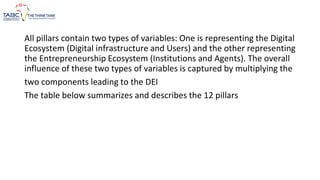
All pillars contain two types of variables: One is representing the Digital
Ecosystem (Digital infrastructure and Users) and the other representing
the Entrepreneurship Ecosystem (Institutions and Agents). The overall
influence of these two types of variables is captured by multiplying the
two components leading to the DEI
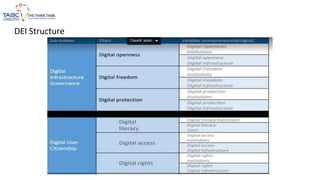
The table below summarizes and describes the 12 pillars
DEI Structure
Source: The GEDI report, 2019
3. Market and Entrepreneurship ability
The third component is captured by the Global Entrepreneurship
Index. The GEI combines a set of values, norms, attitudes,
competencies and behavior related to risk awareness and risk taking
(active business decisions) that determines the entrepreneur’s
commitment to and style of risk management. Hence, it is the
entrepreneur who drive the trial and error dynamic
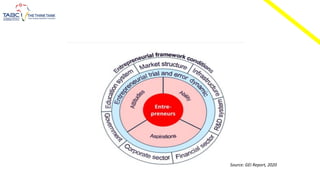
It notes “the dynamic, institutionally embedded interaction
between entrepreneurial attitudes, entrepreneurial abilities, and
entrepreneurial aspirations by individuals, which drives the
allocation of resources through the creation and operation of new
ventures.”
Source : Global Entrepreneurship Index Report (2019)
→ The 3 building blocks composing the GEI fit the risk culture sphere
where nascent and new entrepreneurs are at the core of the system.
1. Entrepreneurial Attitudes: reflects the potential of the opportunity
recognition and perception with respect to the property rights and
the regulatory difficulties that could obstruct the realization of the
opportunity.
It is also about skills perception. The potential entrepreneur should have
the adequate startup skills to launch a business. In developing countries
skills are usually acquired through workplace trial and error in relatively
simple business activities. In developed countries, business formation &
operation require skills that are acquired through formal education and
training.
Risk Acceptance: Aversion to high-risk enterprises and fear of failure
attitudes can impede entrepreneurial action.
Networking Entrepreneurs who have better networks are more
successful, can identify more viable opportunities, and can access more
and better resources
cultural support how a country’s inhabitants view entrepreneurs in terms
of status and career choice, and how the level of corruption in that
country affects this view
2. Entrepreneurial abilities : Combines opportunity startups by
people who are motivated by opportunity as an important signal of
quality. Technology absorption indicates that ICT provides better
chances for businesses to survive and or their potential for growth.
The prevalence of high-quality human capital is vitally important for
ventures that are highly innovative and require an educated,
experienced, and healthy workforce to continue to grow and finally
competition.
3. Entrepreneurial Aspiration: Product innovation (Potential to
generate new products), process innovation (Applying and/or creating
high technology), high growth business ( 10 people at least and intend
more),internationalization (Exporting demand capabilities) and risk
capital (The availability of risk finance) are the last four pillars that
define the third sub-index
Source: GEI Report, 2020
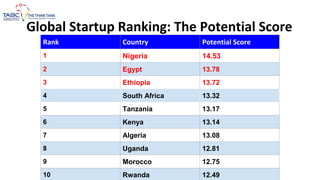
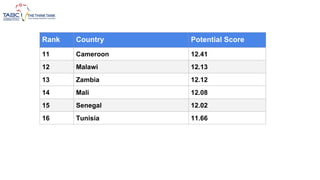
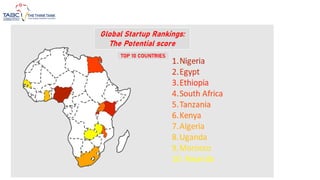
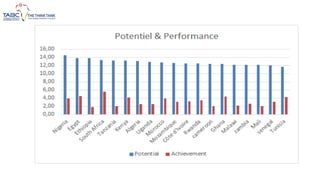
Global Startup Ranking: The Potential Score
Rank Country Potential Score
1 Nigeria 14.53
2 Egypt 13.78
3 Ethiopia 13.72
4 South Africa 13.32
5 Tanzania 13.17
6 Kenya 13.14
7 Algeria 13.08
8 Uganda 12.81
9 Morocco 12.75
10 Rwanda 12.49
Rank Country Potential Score
11 Cameroon 12.41
12 Malawi 12.13
13 Zambia 12.12
14 Mali 12.08
15 Senegal 12.02
16 Tunisia 11.66
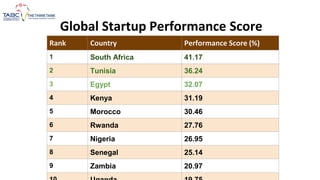
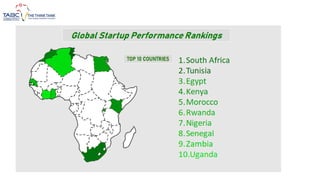
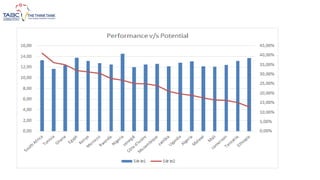
Global Startup Performance Score
Rank Country Performance Score (%)
1 South Africa 41.17
2 Tunisia 36.24
3 Egypt 32.07
4 Kenya 31.19
5 Morocco 30.46
6 Rwanda 27.76
7 Nigeria 26.95
8 Senegal 25.14
9 Zambia 20.97
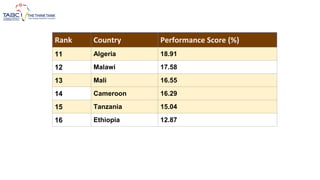
Rank Country Performance Score (%)
11 Algeria 18.91
12 Malawi 17.58
13 Mali 16.55
14 Cameroon 16.29
15 Tanzania 15.04
16 Ethiopia 12.87
Agenda
1) General context & Introduction
2) Innovation ecosystem landscape in Africa
• The major enablers of the African Innovation Ecosystem
• Venture capital investments in Africa in 2019
• Effects of the COVID19 pandemic on the Africa Startup scene
3) Startup Ecosystem potential and performance
• Key findings from the survey
• The concept of potential and performance
• Measuring African Startup Ecosystem Performance
4) Tunisia case study
5) Q&A + Wrapp up
Le contexte et les contingences locales
• La Révolution de 2011 n’a pas apporté de fruits en matière de développement
économique, et ce malgré les fonds de soutien abondants qui ont été
mobilisés à cet égard, par les pays partenaires et les institutions financières
internationales.
• Le marché des capitaux a faiblement bougé pour rattraper quelques retards,
et n’a produit qu’une dynamique d’investissement timide dans les nouveaux
compartiments (Micro, PME, Mezzo Finance, PPP,…)
• En particulier, l’innovation en Tunisie connaît des barrières réglementaires,
technologiques et financières. La création de Startups se fait en explorant le
champs du possible, et souvent en outrepassant les limites fixées par les
autorités. D’où l’importance d’une révision complète des politiques publiques,
en plus des appels à projets à lancer dans le sillage de la crise du COVID19.
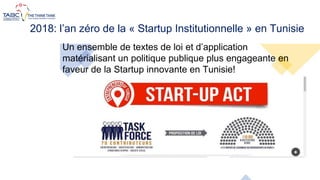
2018: l’an zéro de la « Startup Institutionnelle » en Tunisie
Un ensemble de textes de loi et d’application
matérialisant un politique publique plus engageante en
faveur de la Startup innovante en Tunisie!
1) Absence d’un tableau de bord pour l’écosystème des startups
2) Une partie des décisions de Startup Act non encore actée
3) Autres futures améliorations
• Article 7.1 obligation de réaliser ses objectifs
• Article 7.2 Comptabilité simplifiée
• Article 7.3 Contrôle de conformité par convocation « physique »
• Article 12 Décaissement des frais de prise en charge des brevets à
l’international
La mesure d’impact de la politique publique n’est pas
formellement établie
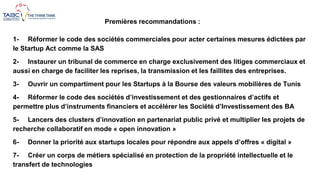
1- Réformer le code des sociétés commerciales pour acter certaines mesures édictées par
le Startup Act comme la SAS
2- Instaurer un tribunal de commerce en charge exclusivement des litiges commerciaux et
aussi en charge de faciliter les reprises, la transmission et les faillites des entreprises.
3- Ouvrir un compartiment pour les Startups à la Bourse des valeurs mobilières de Tunis
4- Réformer le code des sociétés d’investissement et des gestionnaires d’actifs et
permettre plus d’instruments financiers et accélérer les Société d’Investissement des BA
5- Lancers des clusters d’innovation en partenariat public privé et multiplier les projets de
recherche collaboratif en mode « open innovation »
6- Donner la priorité aux startups locales pour répondre aux appels d’offres « digital »
7- Créer un corps de métiers spécialisé en protection de la propriété intellectuelle et le
transfert de technologies
Premières recommandations :
Agenda
1) General context & Introduction
2) Innovation ecosystem landscape in Africa
• The major enablers of the African Innovation Ecosystem
• Venture capital investments in Africa in 2019
• Effects of the COVID19 pandemic on the Africa Startup scene
3) Startup Ecosystem potential and performance
• Key findings from the survey
• The concept of potential and performance
• Measuring African Startup Ecosystem Performance
4) Tunisia case study
5) Q&A + Wrapp up
Thank you for your attention !

Innovation ecosystem potential & performance in Africa (abstract)

  • 2.
    Agenda 1) General context& Introduction 2) Innovation ecosystem landscape in Africa • The major enablers of the African Innovation Ecosystem • Venture capital investments in Africa in 2019-2020 • Effects of the COVID19 pandemic on the Africa Startup scene 3) Startup Ecosystem potential and performance • Key findings from the survey • The concept of potential and performance • Measuring African Startup Ecosystem Performance 4) Tunisia case study 5) Q&A
  • 3.
    General context &Introduction ● 54 countries, but only few are in the race of innovation ● Total continent GDP = US$ 3000 Bn (4% WGDP) ● Foreign exchanges = US$ 1065 Bn ● Infrastructure investment needs = US$ 2400 Bn ● Alternative finance is emerging with Diaspora ● The first successes are still very fragile
  • 4.
    General context &Introduction ● In most countries, health care systems were not well prepared to face a global sanitary crisis ● Fighting the pandemic involved different industries, including the startups ● Innovation ecosystem maturity was a decisive factor in organizing the technological response
  • 5.
    Agenda 1) General context& Introduction 2) Innovation ecosystem landscape in Africa • The major enablers of the African Innovation Ecosystem • Venture capital investments in Africa in 2019 • Effects of the COVID19 pandemic on the Africa Startup scene 3) Startup Ecosystem potential and performance • Key findings from the survey • The concept of potential and performance • Measuring African Startup Ecosystem Performance 4) Tunisia Case study 5) Q&A + Wrapp up
  • 6.
  • 7.
  • 8.
    Innovation ecosystems landscapein Africa Here is a break-down of the 15 main tech cities: Lagos, Cairo, Cape Town, Nairobi, and Johannesburg belong to Tier 1, with 20 to 40 hubs each; Casablanca, Accra, Abidjan, Tunis, and Abuja follow suit as Tier 2 cities, with 15+ hubs each; and Dakar, Bamako, Kampala, Dar Es Salaam, and Lomé with 10+ hubs are the latest emerging cities. It is worth noting that many of the above-mentioned emerging cities have recently launched angel networks and have joined regional or international tech alliances. → +250 investment Firms are directly operating in Africa
  • 9.
    Innovation ecosystems landscapein Africa African venture investments records USD 1.340 Bn through 427 deals in equity and debt financing in 2019. The year was especially great for the Nigerian ventures that raked in USD 663.24 Mn, highest amount of venture capital money secured by a country in 2019. Kenya had a super growth year netting 283.64% growth over the previous year’s funding amount. South Africa took the third position as per funding amount. Fintech secured USD 678.73 Mn, witnessed a spectacular growth of 138.48% over the previous year.
  • 10.
    Evolution of venturecapital Investments in Africa fundings in Africa 2015-2020 Source: WeeTracker Report, 2020 Source: Maxime Bayen, 2020
  • 11.
    The number ofstartups in Africa is growing fast...
  • 13.
  • 14.
  • 15.
    The major ecosystemenablers ... → US$ 2.5 Billion growth projection for africa’s crowdfunding market potential by 2025
  • 16.
    Telco, Tech companies,Banks and Universities are interconnecting local ecosystems to global ones... https://www.orangefab.com/ https://www.liquidtelecom.com/about-us/news https://developers.google.com/community/ac celerators/ https://tshimologong.joburg/ https://ecobankfintech.com/
  • 17.
    Institutionalizing Impact investingin Africa Impact Investing funds are multiplying in Sub Saharan Our estimation* of available impact funds > USS$ 1 Tn (*) Based on different sources including https://www.africaglobalfunds.com/
  • 18.
    Agenda 1) General context& Introduction 2) Innovation ecosystem landscape in Africa • The major enablers of the African Innovation Ecosystem • Venture capital investments in Africa in 2019 • Effects of the COVID19 pandemic on the Africa Startup scene 3) Startup Ecosystem potential and performance • Key findings from the survey • The concept of potential and performance • Measuring African Startup Ecosystem Potential & Performance 4) Tunisia case study 5) Q&A + Wrapp up
  • 19.
    Innovation ecosystem Innovation isdriven by a dedicated ecosystem, centered on sustainable development goals source: OCTA innovation
  • 20.
    → Making allactors agree to commit with the final objective of sustainable development → Setting up favorable conditions for actors to interact and undertake risk → Accompany the rise of a new wealth creation agent the “Startup” Innovation Ecosystem policy covers a large chapter on the startup industry
  • 21.
    The Instruments ofPublic Policy Tax discount for investors Tax discount for startups Easy operations on the capital access to international capital market sophistication of the financial instruments Financing all the stages of the startup Direct funding of the entrepreneurs Dedicated room for startups in the local capital market Simplified procedure for bankruptcy Clustering & specialization IP protection facility researchers secondments Access to Technological Infrastructure Tech Transfer assistance Open Data & eGov Open Innovation Research Based SpinOff Collaborative research projects PPP Ideation programs with academia & entreprises adapted judicial framework Innovation incubation Startups - Technoparks collaboration Acces to international markets Transparent public bids and procurement process Startup acceleration Economic holding Technology Hubs CAPITAL KNOWLEDGE MARKET / ENTREPRENEURSHIP
  • 22.
    African Innovation ecosystemat a glance (2019) 618 Active Innovation Hub 203 investors 427 deals $1.340 Bn of venture capital N°1 sector :Fintech
  • 23.
    Survey Participants Innovation actorsfrom the following 13 countries : Angola Burkina Faso Ghana Kenya Madagascar Mozambique Nigeria Senegal South Africa Tanzania Tunisia Zimbabwe
  • 24.
    Chart 3: Surveyparticipants per sector GRAPH 3: Survey Participants Per Service The top 5 sectors in which participant actors operate are cleantech ,fintech followed by greentech ,enertech and agrifood 95% offer mentoring and capacity building services 86% work provide Networking and business model assistance Only 36% provide financing support
  • 25.
    GRAPH 1: SurveyParticipants Per Category The questionnaire brought together different actors of the innovation ecosystem from all over the continent making it possible to look at the african image from different angles
  • 26.
    GRAPH 7: VentureSurvival rate after 3 years period N=22 Burkina Faso ,Kenya ,Morocco Tanzania,Madagascar ,Ghana Senegal ,South Africa Tunisia ,Nigeria Angola
  • 27.
    Who are theactors who need to be more involved to enhance the innovation ecosystem performance?
  • 28.
    With whom doyou need to improve the interaction to better achieve your objectives?
  • 29.
    How to improvethese numbers? All 13 participant countries pointed the necessity to improve the following in order to achieve better results and improve their performance: -Develop sector specific mentoring -Conductive legal and regulatory policies -Availability of Venture Funds -Larger angels network -Improve supply chain management -Technology valorisation Chart : Participants Ability to generate startups in optimal conditions
  • 30.
    Innovation policies Tunisia:Startup Act Kenya:Innovationsupport for Big 4 Agenda Morocco:Startup support; Technology transfer, Custer building Madagascar: Fihariana Project Senegal : Smart city project As countries develop and move closer to the technological frontier, governments are undoubtedly showing an interest in the development and diffusion of innovations, but public policies must evolve. They need to focus more on helping the ecosystem improve its capacity to create knowledge and value by facilitating financing . GRAPH 9: Are your government priorities in terms of innovation clear for everyone? GRAPH 10: Government Support to startup development
  • 31.
    The quintuple helixmodel for Entrepreneurial Ecosystem (2012-08-08). "The Quintuple Helix innovation model: global warming as a challenge and driver for innovation". Journal of Innovation and Entrepreneurship
  • 32.
    The 3 sphèresmodel This sphere includes all the flows of capital in circulation to fund startups in a specific country, area or sector. This sphere includes all the flows of knowledge under the form of science and technology that irrigate the startup industry in a specific country, area or This sphere includes all the initiatives and enabling engagements that contribute to the proliferation of new business ideas, projects and people in a specific country, area or sector.
  • 33.
    Fundingscapacity Approach for measuring thepotential copyright@tabc2020
  • 34.
    Available Fundings / GDPper capita Po = ln (F) x Pi / 3 F Ecosytem potential copyright@tabc2020
  • 35.
    Available Fundings / GDPper capita Ecosystem performance Achievements Ecosystem Performance = Volume of Acheivements / Potential A = ln(F) x SQRT (GEI² + DEI²) x Pi / 3 copyright@tabc2020
  • 36.
    1. Funding capacity TheFunding Capacity or dry powder for the startups is the capacity to support startup ecosystem with fundings. It stands for the Logarithm (Ln) of the dry powder in a given country or region adjusted by its GDP/capita.
  • 37.
    2. Knowledge andtechnological capability The Digital Entrepreneurial Index (DEI) fits the second sphere and attempts to measure the digital entrepreneurial ecosystem. The DEI framework includes Digital Infrastructure Governance, Digital User Citizenship, Digital Multi-sided Platform, and Digital Technology Entrepreneurship. 12 Pillars are identified as the most important constituents of the model and measured by the authors . Pillars are comprised from 24 variables, representing digital ecosystem (12) and entrepreneurship ecosystem (12).
  • 38.
    Source: The GlobalEntrepreneurship and Develpment Institure, report, 2019
  • 39.
    All pillars containtwo types of variables: One is representing the Digital Ecosystem (Digital infrastructure and Users) and the other representing the Entrepreneurship Ecosystem (Institutions and Agents). The overall influence of these two types of variables is captured by multiplying the two components leading to the DEI The table below summarizes and describes the 12 pillars
  • 40.
  • 41.
    Source: The GEDIreport, 2019
  • 42.
    3. Market andEntrepreneurship ability The third component is captured by the Global Entrepreneurship Index. The GEI combines a set of values, norms, attitudes, competencies and behavior related to risk awareness and risk taking (active business decisions) that determines the entrepreneur’s commitment to and style of risk management. Hence, it is the entrepreneur who drive the trial and error dynamic It notes “the dynamic, institutionally embedded interaction between entrepreneurial attitudes, entrepreneurial abilities, and entrepreneurial aspirations by individuals, which drives the allocation of resources through the creation and operation of new ventures.” Source : Global Entrepreneurship Index Report (2019)
  • 43.
    → The 3building blocks composing the GEI fit the risk culture sphere where nascent and new entrepreneurs are at the core of the system. 1. Entrepreneurial Attitudes: reflects the potential of the opportunity recognition and perception with respect to the property rights and the regulatory difficulties that could obstruct the realization of the opportunity.
  • 44.
    It is alsoabout skills perception. The potential entrepreneur should have the adequate startup skills to launch a business. In developing countries skills are usually acquired through workplace trial and error in relatively simple business activities. In developed countries, business formation & operation require skills that are acquired through formal education and training. Risk Acceptance: Aversion to high-risk enterprises and fear of failure attitudes can impede entrepreneurial action. Networking Entrepreneurs who have better networks are more successful, can identify more viable opportunities, and can access more and better resources cultural support how a country’s inhabitants view entrepreneurs in terms of status and career choice, and how the level of corruption in that country affects this view
  • 45.
    2. Entrepreneurial abilities: Combines opportunity startups by people who are motivated by opportunity as an important signal of quality. Technology absorption indicates that ICT provides better chances for businesses to survive and or their potential for growth. The prevalence of high-quality human capital is vitally important for ventures that are highly innovative and require an educated, experienced, and healthy workforce to continue to grow and finally competition.
  • 46.
    3. Entrepreneurial Aspiration:Product innovation (Potential to generate new products), process innovation (Applying and/or creating high technology), high growth business ( 10 people at least and intend more),internationalization (Exporting demand capabilities) and risk capital (The availability of risk finance) are the last four pillars that define the third sub-index
  • 47.
  • 48.
    Global Startup Ranking:The Potential Score Rank Country Potential Score 1 Nigeria 14.53 2 Egypt 13.78 3 Ethiopia 13.72 4 South Africa 13.32 5 Tanzania 13.17 6 Kenya 13.14 7 Algeria 13.08 8 Uganda 12.81 9 Morocco 12.75 10 Rwanda 12.49
  • 49.
    Rank Country PotentialScore 11 Cameroon 12.41 12 Malawi 12.13 13 Zambia 12.12 14 Mali 12.08 15 Senegal 12.02 16 Tunisia 11.66
  • 51.
    Global Startup PerformanceScore Rank Country Performance Score (%) 1 South Africa 41.17 2 Tunisia 36.24 3 Egypt 32.07 4 Kenya 31.19 5 Morocco 30.46 6 Rwanda 27.76 7 Nigeria 26.95 8 Senegal 25.14 9 Zambia 20.97
  • 52.
    Rank Country PerformanceScore (%) 11 Algeria 18.91 12 Malawi 17.58 13 Mali 16.55 14 Cameroon 16.29 15 Tanzania 15.04 16 Ethiopia 12.87
  • 56.
    Agenda 1) General context& Introduction 2) Innovation ecosystem landscape in Africa • The major enablers of the African Innovation Ecosystem • Venture capital investments in Africa in 2019 • Effects of the COVID19 pandemic on the Africa Startup scene 3) Startup Ecosystem potential and performance • Key findings from the survey • The concept of potential and performance • Measuring African Startup Ecosystem Performance 4) Tunisia case study 5) Q&A + Wrapp up
  • 57.
    Le contexte etles contingences locales • La Révolution de 2011 n’a pas apporté de fruits en matière de développement économique, et ce malgré les fonds de soutien abondants qui ont été mobilisés à cet égard, par les pays partenaires et les institutions financières internationales. • Le marché des capitaux a faiblement bougé pour rattraper quelques retards, et n’a produit qu’une dynamique d’investissement timide dans les nouveaux compartiments (Micro, PME, Mezzo Finance, PPP,…) • En particulier, l’innovation en Tunisie connaît des barrières réglementaires, technologiques et financières. La création de Startups se fait en explorant le champs du possible, et souvent en outrepassant les limites fixées par les autorités. D’où l’importance d’une révision complète des politiques publiques, en plus des appels à projets à lancer dans le sillage de la crise du COVID19.
  • 58.
    2018: l’an zérode la « Startup Institutionnelle » en Tunisie Un ensemble de textes de loi et d’application matérialisant un politique publique plus engageante en faveur de la Startup innovante en Tunisie!
  • 59.
    1) Absence d’untableau de bord pour l’écosystème des startups 2) Une partie des décisions de Startup Act non encore actée 3) Autres futures améliorations • Article 7.1 obligation de réaliser ses objectifs • Article 7.2 Comptabilité simplifiée • Article 7.3 Contrôle de conformité par convocation « physique » • Article 12 Décaissement des frais de prise en charge des brevets à l’international La mesure d’impact de la politique publique n’est pas formellement établie
  • 61.
    1- Réformer lecode des sociétés commerciales pour acter certaines mesures édictées par le Startup Act comme la SAS 2- Instaurer un tribunal de commerce en charge exclusivement des litiges commerciaux et aussi en charge de faciliter les reprises, la transmission et les faillites des entreprises. 3- Ouvrir un compartiment pour les Startups à la Bourse des valeurs mobilières de Tunis 4- Réformer le code des sociétés d’investissement et des gestionnaires d’actifs et permettre plus d’instruments financiers et accélérer les Société d’Investissement des BA 5- Lancers des clusters d’innovation en partenariat public privé et multiplier les projets de recherche collaboratif en mode « open innovation » 6- Donner la priorité aux startups locales pour répondre aux appels d’offres « digital » 7- Créer un corps de métiers spécialisé en protection de la propriété intellectuelle et le transfert de technologies Premières recommandations :
  • 62.
    Agenda 1) General context& Introduction 2) Innovation ecosystem landscape in Africa • The major enablers of the African Innovation Ecosystem • Venture capital investments in Africa in 2019 • Effects of the COVID19 pandemic on the Africa Startup scene 3) Startup Ecosystem potential and performance • Key findings from the survey • The concept of potential and performance • Measuring African Startup Ecosystem Performance 4) Tunisia case study 5) Q&A + Wrapp up
  • 63.
    Thank you foryour attention !