ACCESSIBLE EDUCATION FOR ALL Barriers
free environment for people with disabilities
in university of Peshawar
Proposed and prepared by: Mr. Shahab Ud Din
(Accessibility expert for Peoplewith disabilities in
Pakistan)
Contact: 0345-9090415 phone :091-5520357
Email: shahabud34@yahoo.com
PLANNING A BARRIER FREE ENVIRONMENT FOR PEOPLE WITH DISABILITIES IN PAKISTAN
Proposed and prepared by: “Accessible Pakistan group “(APG) (Accessibility
experts for People with disabilities in Pakistan) Contact: 091-5520357
Email: shahabud34@yahoo.com Page 2
PLANNING A BARRIER FREE ENVIRONMENT IN PAKISTAN
Phase 1
Make accessible and friendly university of Peshawar for people with disabilities
Proposed and prepared by: Shahab Ud Din and team of “Accessible Pakistan group “(APG)
(Accessibility Experts for People with disabilities)
Facilitation and collaboration
Proposed and prepared by: “Accessible Pakistan group “(APG) (Accessibility
experts for People with disabilities in Pakistan) Contact: 091-5520357
Email: shahabud34@yahoo.com Page 3
Shahab ud din
Disability activist
Universal accessibility expert for people with disabilities
Patient liaison officer paraplegic center
Accessibility Principles
The concept of the "Accessible Journey" provides a comprehensive framework and mechanism for creating
barrier free and universally usable built environments and for addressing how effectively access requirements
for people with disabilities have been implemented.
The "Accessible Journey" is a theoretical path of travel that links the three primary components of built
environment design and construction.
Critical points in the "Accessible Journey" occur at the transitions between components where:
 Transport systems deliver and pick up people
 Transport systems delivery and pick up points connect to public spaces and buildings
 Public spaces connect to buildings
 Building entrances
 The quality of “The Accessible Journey”
The quality of the "Accessible Journey" depends on the thoroughness with which the detailed requirements for
access by people with disabilities are implemented. The more comprehensive is compliance with the access
requirements; the better is the "Accessible Journey".
Three practical design principles relate to the concept of the Accessible Journey:
Approachability
The design of the exterior environs of a building, including car parking, works to ensure that people with
disabilities can get to a building;
Accessibility
Ensures that people with disabilities can enter and move about freely within a building without having to call for
assistance;
Usability
The building and facilities are, in fact, usable by all people with disabilities.
These practical design principles relate the Accessible Journey to an individual building and connect the
legislative requirements for access to the specific compliance detail of the "Accessible Route".
Proposed and prepared by: “Accessible Pakistan group “(APG) (Accessibility
experts for People with disabilities in Pakistan) Contact: 091-5520357
Email: shahabud34@yahoo.com Page 4
The Accessible Route
"A route that is usable by people with disabilities. It shall be a continuous route that can be negotiated unaided
by a wheelchair user, a person with a walking device or a guide dog. The route shall extend from street
boundary and car-parking area to those spaces within the building required to be accessible to enable people
with disabilities to carry out normal activities and processes within the building." (NZS 4121:2001 p13)
Universal Access Design
Universal Access Design is a concept and design approach that sets parameters but does not identify any
minimum detail to establish that it has been achieved. It involves a fundamental shift away from the practice of
removing barriers for a particular group of people, ie: people with disabilities, to a way of meeting the
environmental needs of all users, regardless of age, gender, ethnicity or ability.
It is a move away from providing separate and stigmatizing design solutions for people with disabilities. It has
an inclusive objective to ensure no one is physically excluded from use of any built environment by
unnecessary architectural or engineering barriers.
University of Peshawar should take action about implementation of barrier free and universal design is based
on compliance with the mandatory access requirements for people with disabilities.
Universal Access Design
 Equitable use - the design is useful and marketable to people with diverse abilities;
 Flexibility in use - the design accommodates a wide range of individual preferences and abilities;
 Simple and intuitive to use - use of the design is easy to understand, regardless of the user's experience,
knowledge, language skill or current concentration level;
 Perceptible information - the design communicates necessary information effectively to the user,
regardless of ambient conditions or the user's sensory abilities;
 Tolerance for error - the design minimizes hazards and the adverse consequences of accidental or
unintended actions;
 Low physical effort - the design can be used efficiently and effectively with a minimum of fatigue;
 Size and space for approach and use - appropriate size and space is provided for approach, reach,
manipulation, and use regardless of user's body size, posture or mobility.
 Inclusive environments
Inclusive environments are made up of many elements, such as; the attitude of individuals in society, the
design of products, communications, as well as the design of the building itself. Inclusive environments
recognize and accommodate differences in the way people use the built environment and provide solutions
that enable all of us to participate in mainstream activities equally, independently, with choice and dignity.
Why Design With Accessibility In Mind?
Inclusiveness
We are an aging population, which means more people will be living with impairments related to mobility, vision
and hearing. By providing universally accessible buildings you are maximizing the number of people able to
access your building and undertake normal activities and processes without requiring assistance.
Proposed and prepared by: “Accessible Pakistan group “(APG) (Accessibility
experts for People with disabilities in Pakistan) Contact: 091-5520357
Email: shahabud34@yahoo.com Page 5
Safety
Universal design is a safer environment for all, including; caregivers with prams, those temporarily disabled
through injury, as well as people with long term disabilities. A public building built with accessible features,
may reduce the chance of injury or harm.
Economic Good Sense
Often the cost of building fully accessible buildings is no greater than inaccessible buildings. Barrier Free NZ
Trust encourages building owners to build right the first time, thereby reducing the risk of alterations at some
later date that may be costly.
 Making workplaces accessible will increase the participation rate of impaired persons in the workforce.
 Removing barriers to schools, colleges and tertiary institutions will increase opportunity to achieve
educational attainment for persons with impairments.
 Savings in health-care and social assistance costs as more individuals with impairments become self-
supporting.
 The retail and tourist sectors will expand when persons with impairments can easily travel and shop.
Proposed and prepared by: “Accessible Pakistan group “(APG) (Accessibility
experts for People with disabilities in Pakistan) Contact: 091-5520357
Email: shahabud34@yahoo.com Page 6
Sanaullah (Disability Expert)
Occupational therapy assistant
Providing equal access to all is the goal of the Friends of Paraplegics (FOP). This deed has helped
improve access to a variety of facilities, including public sector facilities such as parks, universities,
hospitals, shopping malls, and private sector facilities such as stores, Hotels, and theaters. Even the
availability of accessible restrooms plays a role in making the environment of a facility useful. We
know that imbalance in access will continue to exist, but as money is spent on Rehabilitations,
remodeling, and removing barriers across the urban country, attention should be directed towards
making cost effective decisions, decisions that will help make the greatest improvement in overall
accessibility. We have proposed that a relative access measure be used in conjunction with the more
traditional measure of absolute access to help make such decisions we hope that this discussion will
lead to further research as well as better decision-making.
Proposed and prepared by: “Accessible Pakistan group “(APG) (Accessibility
experts for People with disabilities in Pakistan) Contact: 091-5520357
Email: shahabud34@yahoo.com Page 7
Planning a barrier free environment in Pakistan is based on UNCRPD article 9
About Article 9 (Accessibility)
1. To enable persons with disabilities to live independently and participate fully in all aspects of life, States
Parties shall take appropriate measures to ensure to persons with disabilities access, on an equal basis with
others, to the physical environment, to transportation, to information and communications, including information
and communications technologies and systems, and to other facilities and services open or provided to the
public, both in urban and in rural areas. These measures, which shall include the identification and elimination
of obstacles and barriers to accessibility, shall apply to, inter alia:
(a) Buildings, roads, transportation and other indoor and outdoor facilities, including schools, housing, medical
facilities and workplaces.
(b) Information, communications and other services, including electronic services and emergency services.
2. States Parties shall also take appropriate measures:
(a) To develop, promulgate and monitor the implementation of minimum standards and guidelines for the
accessibility of facilities and services open or provided to the public;
(b) To ensure that private entities that offer facilities and services which are open or provided to the public take
into account all aspects of accessibility for persons with disabilities;
(c) To provide training for stakeholders on accessibility issues facing persons with disabilities;
(d) To provide in buildings and other facilities open to the public signage in Braille and in easy to read and
understand forms;
(e) To provide forms of live assistance and intermediaries, including guides, readers and professional sign
language interpreters, to facilitate accessibility to buildings and other facilities open to the public;
(f) To promote other appropriate forms of assistance and support to persons with disabilities to ensure their
access to information;
(g) To promote access for persons with disabilities to new information and communications technologies and
systems, including the Internet;
(h) To promote the design, development, production and distribution of accessible information and
communications technologies and systems at an early stage, so that these technologies and systems become
accessible at minimum cost.
Proposed and prepared by: “Accessible Pakistan group “(APG) (Accessibility
experts for People with disabilities in Pakistan) Contact: 091-5520357
Email: shahabud34@yahoo.com Page 8
PREFACE
The publication 'Planning a Barrier Free Environment' published in 2016 was hailed as a welcome
initiative. The manual is being used extensively to promote barrier free environment. A copy of the
manual will be circulating at several workshops will be organized by the Office of the Chief
Commissioner for, all over the country.
As spelt out obviously in the Persons with Disabilities (Equal Opportunities, shelter of Rights and Full
Participation) UNCRPD Article 9, a hurdle free built environment is essential to facilitate the disabled.
It is hoped that this manual will help in bringing us as closer to our goal of an inclusive, barriers free
and rights based society as probable.
People with Disability (PWD, s)
A person who, as a consequence of physical disability or impairment, is either ambulant disabled, a
wheelchair user, has visual impairment, speech and hearing impairment or learning disability which
affects his mobility and use of buildings.
I deeplyappreciate the efforts put in by Ms. Shivani Gupta and Mr. Vikas Sharma and Dr. Uma Tuli of Indian Spinal Injury Centre in
this much needed and useful manual.
Proposed and prepared by: “Accessible Pakistan group “(APG) (Accessibility
experts for People with disabilities in Pakistan) Contact: 091-5520357
Email: shahabud34@yahoo.com Page 9
Contents
1. SCOPE AND DEFINITIONS.................................................................5 – 8
2. ANTHROPOMETRICS..........................................................................9 - 16
2.1. Scope
2.2. Reach Range
2.3. Wheelchair Dimensions
2.4. Circulation Dimensions
2.5. Vision Zone
2.6. Heights of People
3. FUNDAMENTAL NEEDS................................................................ 17 – 20
3.1. People with Impaired Mobility
3.2. People with Impaired Vision
3.3. People with Impaired Hearing
3.4. People with Learning Disabilities & Mental Retardation
4. BUILDING COMPONENTS & SPACES.............. ....................... ... 21 – 42
4.1. Space Allowance
4.2. Floor Surface
4.3. Approach
4.4. Accessible Route, Corridor and Path
4.5. Gratings
4.6. Door
4.7. Window
4.8. Handrail / Grab Bar
4.9. Controls and Operating Mechanism 4.10.Seating Spaces
4.11. Other Facilities
4.11.1. Drinking Water Outlet
4.11.2. Public Telephone
4.11.3. Mailbox
4.11.4. Vending Machine
4.11.5. ATM
4.12. Signage
4.13. Reference Tables
Proposed and prepared by: “Accessible Pakistan group “(APG) (Accessibility
experts for People with disabilities in Pakistan) Contact: 091-5520357
Email: shahabud34@yahoo.com Page 10
5. CHANGE IN LEVEL………………………………………………….. 43 – 56
5.1. Curb Ramp
5.2. Slope Ramp
5.3. Stairs
5.4. Lift
5.5. Platform Lift
6. ACCESS TO TOILET FACILITIES................................................... 57 - 72
6.1. General
6.2. Individual Washroom
6.3. Toilet Cubicle for Wheelchair User
6.4. Toilet Cubicle for Ambulatory Disabled
6.5. Door
6.6. Water Closet
6.7. Water Closet Grab Bar
6.8. Wash Basin
6.9. Washroom Accessories
6.10. Urinals
6.11. Bathtub
6.12. Shower Cubicle
7. ALIGHTING AND BOARDING AREA ......................................... 73 - 82
7.1. Car Park
7.2. Taxi Stand
7.3. Bus Stop
7.4. Railway Station and Airport
7.5. Piers and Jetties
8. FIRE EVACUATION NEEDS........................................................... 83 – 86
9. TRANSPORT AND ROAD PLANNING......................................... 87 - 96
9.1. Sidewalk
9.2. Curb Ramp at Walkway and Pedestrian Crossing
9.3. Road Intersection
9.4. Islands
9.5. Traffic Signals
9.6. Subway and Overhead Bridge
9.7. Public Transport
9.7.1. Land Transport
9.7.2. Rail Transport
9.7.3. Water Transport
9.7.4. Air Transport
Proposed and prepared by: “Accessible Pakistan group “(APG) (Accessibility
experts for People with disabilities in Pakistan) Contact: 091-5520357
Email: shahabud34@yahoo.com Page 11
10. RECREATIONAL FACILITIES 97- 102
10.1. Hotel and Eating Outlet
10.1.1. General
10.1.2. Walkway within Outlet
10.1.3. Counter
10.1.4. Seating Arrangement
10.1.5. Guest Room
10.1.6. Signage
10.2. Park and Garden
10.3. Auditorium & Cinema Halls
11. ADAPTED HOUSING............................................................... 103 - 110
11.1. Exterior Accessibility
11.2. General Interior Accessibility
11.3. Bedroom Area
11.4. Living Room
11.5. Washroom
11.6. Kitchen
11.7. Masques
12. ANNEXURE.................................................................................. 111 - 139
12.1. Provision of Access in the 'People with Disabilities Act, 1995'
12.2. Slip resistant Floor Surfacing
12.3. Understanding Wheelchair Transfers
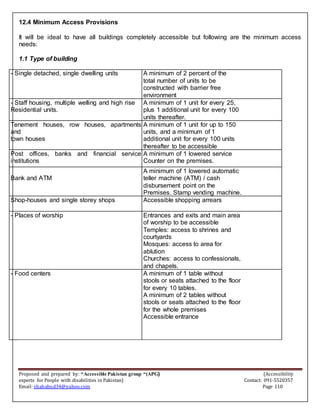
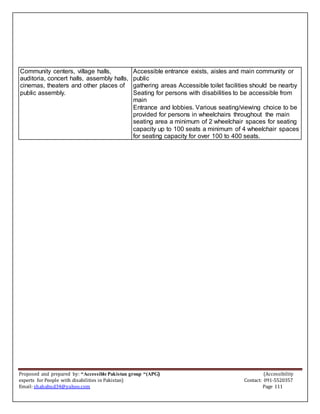
12.4. Minimum Access Needs
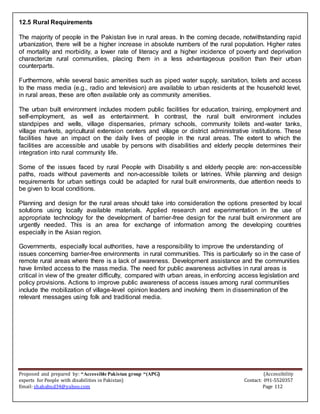
12.5. Rural Requirements
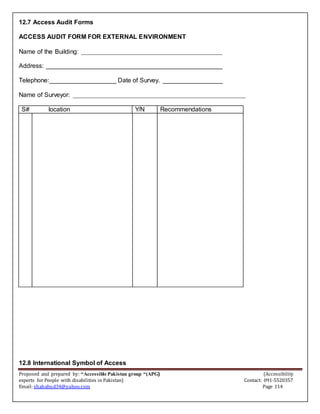
12.6. Access Audit Forms
12.7. Conducting Access Audits
12.8. International Symbol of Access
12.9. Photographs of Accessible Facilities
Proposed and prepared by: “Accessible Pakistan group “(APG) (Accessibility
experts for People with disabilities in Pakistan) Contact: 091-5520357
Email: shahabud34@yahoo.com Page 12
Chapter 1
Scope and Definitions
1.1 Scope
This manual is concerned with access to, movement within and around, buildings, by people with
disabilities. The specifications of this manual are intended to make buildings and facilities accessible
to and usable by people with such physical disabilities as the inability to walk, difficulty in walking,
reliance on walking aids, blindness and visual impairments, speech and hearing impairments, in-
coordination, reaching and manipulation disabilities, lack of stamina, difficulty interpretation and
reacting to sensory information, and extremes in physical size.
1.2 Definitions
The following terms shall, for the purpose of this manual, have the meaning indicated in this section: -
Access Aisle
An accessible pedestrian space between elements, such as parking spaces, seating and desks that
provides clearances appropriate for use of the elements.
Accessible
A site, building, facility, or portion thereof that complies with this manual and that can be approached,
entered and used by people with disabilities.
Accessible Route
A continuous unobstructed path connecting all accessible elements and spaces in a building or facility
that can be negotiated by a severely People with Disability using a wheelchair and that is also safe for
and usable by people with other disabilities. Interior accessible routes may include corridors, ramps,
elevators, lifts, and dear floor space at fixtures. Exterior accessible routes may include parking,
access aisles, curb ramps, walkways and ramps
Ambulatory Disabled
A person who is able, either with or without personal assistance, and who may depend on prostheses
(artificial limbs), orthoses
Proposed and prepared by: “Accessible Pakistan group “(APG) (Accessibility
experts for People with disabilities in Pakistan) Contact: 091-5520357
Email: shahabud34@yahoo.com Page 13
(Calipers), sticks, crutches or walking aids to walk on level or negotiate suitably graded steps
provided that convenient handrails are available.
Automatic Door
A door equipped with a power operated mechanism and controls that open and close the door
automatically upon receipt of a momentary signal. The switch that begins the automatic cycle may be
photoelectrical device, floor mat, sensing device, or manual switch mounted on or near the door itself.
Beveled
Smooth, slanted angle between two surfaces; for example, a slant or inclination between two uneven
surfaces to allow easier passage of a wheelchair
Circulation Path
An exterior or interior way of passage from one place to another for pedestrians, including walkways,
hallways, courtyards, stairways and stair landings.
Clear
Unobstructed
Curb
A side barrier to a trafficable surface
Curb Ramp
A short ramp cutting through a curb or built up to it.
Grab Bars
A bar used to give a steadying or stabilizing assistance to a person engaged in a particular function.
Proposed and prepared by: “Accessible Pakistan group “(APG) (Accessibility
experts for People with disabilities in Pakistan) Contact: 091-5520357
Email: shahabud34@yahoo.com Page 14
Handrails
A rail used in circulation areas such as corridors, passageways, ramps and stairways to assist in
continuous movement.
Individual Washrooms
A compartment having the basic requirements of a water closet compartment, washbasin and other
essential washroom accessories as required by people with disabilities.
Knurled Surface
Roughened area, often in a crisscross pattern; used on either doorknobs or grab bars. On doorknobs
It is used to provide tactile clues to visually impaired persons to indicate that passage leads to an
area of danger. On grab bars it is used to improve grasp and to prevent slipping.
Operable Parts
A part of a piece of equipment or appliance used to insert or withdraw objects, or to activate,
deactivates, or adjust the equipment or appliance (for example coin slot, pushbutton, handle)
Public Use
Describes interior and exterior rooms or spaces that are made available to the general public. Public
use may be provided at a building or facility that is privately or publicly owned.
Ramp
An inclined way connecting one level with another.
Space
A definable area (for example, toilet room, hall, assembly area, entrance, storage, room alcove,
courtyard, or lobby).
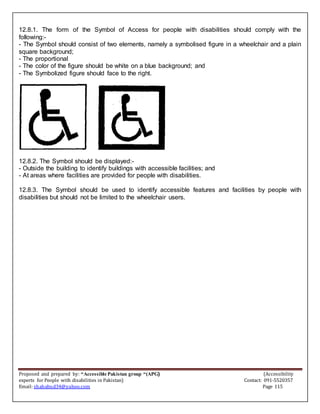
Symbol
Symbol of Access for the People with Disability.
Tactile
An object that can be perceived using the sense of touch.
Water Closet Compartment/Toilet Cubicle
A compartment having a water closet with grab bars installed to assist people with physical
disabilities.
Wheelchair User
A person who depends on a wheelchair for mobility
Proposed and prepared by: “Accessible Pakistan group “(APG) (Accessibility
experts for People with disabilities in Pakistan) Contact: 091-5520357
Email: shahabud34@yahoo.com Page 15
Chapter 2
Anthropometrics
2.1 Scope
This chapter contains dimensions that can be used for guidance when designing facilities and
equipment to be used by persons with Disabilities.
2.2. Reach Range
2.2.1. Forward reach for wheelchair users
- Without obstruction
The maximum forward reach is 1200mm from the floor and the minimum forward reach is 400mm
from the floor as shown in the figure below.
- Over Obstruction
The maximum reach over an obstruction 500mm deep is 1100mm from the floor as shown in the
figure below.
Proposed and prepared by: “Accessible Pakistan group “(APG) (Accessibility
experts for People with disabilities in Pakistan) Contact: 091-5520357
Email: shahabud34@yahoo.com Page 16
2.2.2. Side Reach for wheelchair users
- Without Obstruction
The maximum side-reach without obstruction is 1300mm from the floor and the minimum side reach
is 250mm as shown in the figure below.
- Over Obstruction
The maximum sides reach over an obstruction 860mm high x 500mm deep is 1200mm from the floor
as shown in the figure.
Proposed and prepared by: “Accessible Pakistan group “(APG) (Accessibility
experts for People with disabilities in Pakistan) Contact: 091-5520357
Email: shahabud34@yahoo.com Page 17
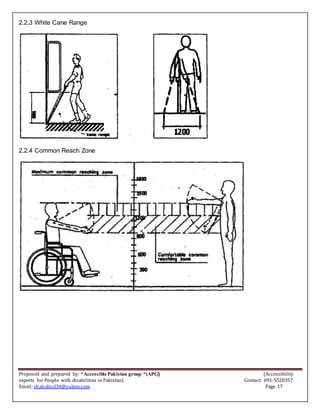
2.2.3 White Cane Range
2.2.4 Common Reach Zone
Proposed and prepared by: “Accessible Pakistan group “(APG) (Accessibility
experts for People with disabilities in Pakistan) Contact: 091-5520357
Email: shahabud34@yahoo.com Page 18
2.3 Wheelchair Dimensions
The figures illustrate some of the typical dimensions of a standard wheelchair. Electric wheelchairs
may be of a larger dimension, much heavier and do not have the same maneuverability/capability as
manual wheelchairs.
Proposed and prepared by: “Accessible Pakistan group “(APG) (Accessibility
experts for People with disabilities in Pakistan) Contact: 091-5520357
Email: shahabud34@yahoo.com Page 19
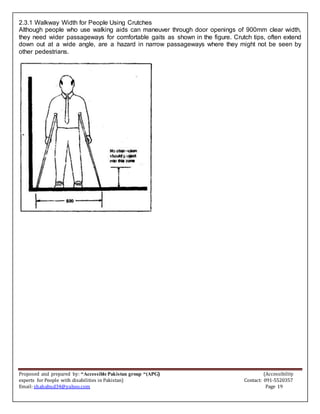
2.3.1 Walkway Width for People Using Crutches
Although people who use walking aids can maneuver through door openings of 900mm clear width,
they need wider passageways for comfortable gaits as shown in the figure. Crutch tips, often extend
down out at a wide angle, are a hazard in narrow passageways where they might not be seen by
other pedestrians.
Proposed and prepared by: “Accessible Pakistan group “(APG) (Accessibility
experts for People with disabilities in Pakistan) Contact: 091-5520357
Email: shahabud34@yahoo.com Page 20
2.4 Circulation Dimensions
Although the minimum required turning radius is 1500mm but it is ideal to provide for a 1800mm
turning radius.
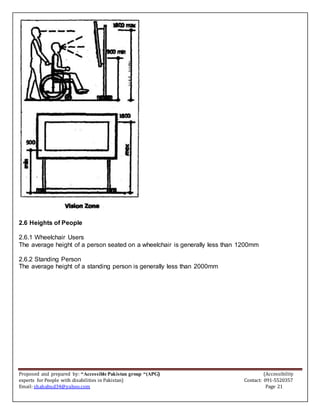
2.5 Vision Zone
Proposed and prepared by: “Accessible Pakistan group “(APG) (Accessibility
experts for People with disabilities in Pakistan) Contact: 091-5520357
Email: shahabud34@yahoo.com Page 21
2.6 Heights of People
2.6.1 Wheelchair Users
The average height of a person seated on a wheelchair is generally less than 1200mm
2.6.2 Standing Person
The average height of a standing person is generally less than 2000mm
Proposed and prepared by: “Accessible Pakistan group “(APG) (Accessibility
experts for People with disabilities in Pakistan) Contact: 091-5520357
Email: shahabud34@yahoo.com Page 22
Chapter 3
Fundamental Needs
The target group is composed of four major categories:
- People with impaired mobility
- People with visual impairment
- People with hearing impairment
- People with Learning Disabilities and Mental Retardation
3.1. People with Impaired Mobility
Wheelchair Users
The main problems of wheelchair users are. About moving and working from a sitting position; thus
many requirements are associated with the dimensions and other aspects of wheelchairs. The length
of the wheelchair varies generally between 1100mm and 1200mm. The user's feet add approximately
50mm to the overall length.
The width of the wheelchair varies between 600mm and 700mm. To propel a chair manually by
operating the rims of the main wheels, a clearance of not less than 50mm, and preferably 100mm is
needed. Over longer travel distances, additional space is needed.
Space requirements for maneuvering are always related to the activities to be performed. Different
users act in different ways, depending on individual performance and the type of chair used.
When planning spaces in buildings to cater for wheelchair turning, a guide is to impose on the plan to
provide a circle of 1800mm diameter. If this space is dear, the plan arrangement will normally be
satisfactory. However, spaces in doorways, niches and under worktops, desks or furniture can often
be used when turning. Where a high degree of accessibility is required, such as in hospital buildings,
spaces should be more generous.
Considerable energy is required to propel a wheelchair manually up ramps, over changes in level or
over soft or uneven surfaces. Thresholds and changes in level should be avoided. Ground and floor
surface should be hard and even.
Proposed and prepared by: “Accessible Pakistan group “(APG) (Accessibility
experts for People with disabilities in Pakistan) Contact: 091-5520357
Email: shahabud34@yahoo.com Page 23
Most wheelchairs have a seat height of about 50Qmm. The reach of a wheelchair user is constrained
by his seated position. Access to room comers, work benches with base units, etc., is limited by the
wheels of the chair and the footrest extension. The reach of wheelchair user is confined to a zone
700mm to 1200mm above floor level and not less than 400mm from room corners.
For wheelchair access to a workbench, washbasin or table, a dear space for knees and footrests is
needed. This should be at least 800mm wide, 480mm deep and 750 mm high.
Ambulant Disabled People
For ambulant disabled people to move securely, ground and floor surfaces should be even and slip
resistant. Handrails should be provided on stairs and ramps. Resting places, such as benches,
should be provided along travel routes.
Where there is a change of ground or floor surfaces, these should have similar friction, to decrease
the risk of stumbling. Benches and chairs should have a seat height of approximately 450mm and
they should have armrests approximately 700mm above floor level.
3.2. People With Impaired Vision
For people with impaired vision, orientation can be aided by marking with the use of color, illumination
and, in certain cases, the texture of material. Design and plan arrangement should be simple and
uncomplicated.
Contrasting colors and warning blocks should be used to aid the identification of doors, stairs, ramps,
passageways, etc. Surfaces can be varied to indicate pathway, changes of directions etc. Orientation
cues should be specially illuminated. Handrails can be used as a location aid.
To minimize the risk of falls and injuries, hazards such as posts, single steps and projections from
walls should be avoided wherever possible. Hazards should be emphasized by means of Illumination
and by contrasting colors and materials. If unavoidable, the projections should be placed higher then
2000mm from the floor.
Proposed and prepared by: “Accessible Pakistan group “(APG) (Accessibility
experts for People with disabilities in Pakistan) Contact: 091-5520357
Email: shahabud34@yahoo.com Page 24
People with impaired vision are often sensitive to glare. Unwanted mirroring effects and
Reflections may be avoided by attention to the location of windows and illumination, and the choice of
floor and wall surface.
People with impaired vision often have difficulty reading signs and other printed information. Blind
people are restricted to tactile reading (some can read Braille as well). Visual information in, for
example, railway stations and airports should be supplemented with audible information.
3.3. People with Impaired Hearing
People with impaired hearing have a particular difficulty in comprehending sounds and words in the
environment. Rooms should be acoustically well insulated.
In public buildings, loud-speaking systems should be clearly audible. Supplementary visual
information should be provided in, for example, railway stations and airports.
People with impaired hearing may rely on lip reading; this is helped if there is good overall light that is
non-reflective. They may have difficulty using telephones, etc. Audible signals may, in certain cases,
be supplemented with visual signals.
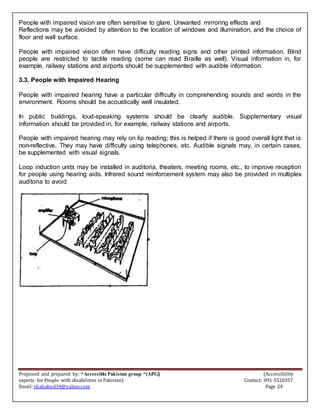
Loop induction units may be installed in auditoria, theaters, meeting rooms, etc., to improve reception
for people using hearing aids. Infrared sound reinforcement system may also be provided in multiplex
auditoria to avoid
Proposed and prepared by: “Accessible Pakistan group “(APG) (Accessibility
experts for People with disabilities in Pakistan) Contact: 091-5520357
Email: shahabud34@yahoo.com Page 25
sound overspill from one area to another.
3.4. People with Learning Disabilities & Mental Retardation
There are many different types of disabilities In this group. In addition to congenital deficiencies and
various kinds of central nervous system diseases and brain disorders, it covers disabilities caused by
an accident or a cerebral hemorrhage.
A considerable number of persons among the mentally impaired are paralytics. In addition to being
mentally disabled they may have difficulties In coordinating and controlling their movements.
When moving about out doors, persons in this group are confronted with the special problem that
they find it difficult to perceive, comprehend, or interpret information such as signs. They may stumble
easily over even minor bumps and fall heavily. They may also have spatial orientation difficulties and
in some cases lack the ability to distinguish color or to differentiate between left and right.
It may be difficult to meet all their needs but minimum provisions would include:
- Clear and easy-to-grasp information as an aid to orientation
- Even road surface
Proposed and prepared by: “Accessible Pakistan group “(APG) (Accessibility
experts for People with disabilities in Pakistan) Contact: 091-5520357
Email: shahabud34@yahoo.com Page 26
Chapter 4
Building Component and Spaces
4.1. Space Allowances
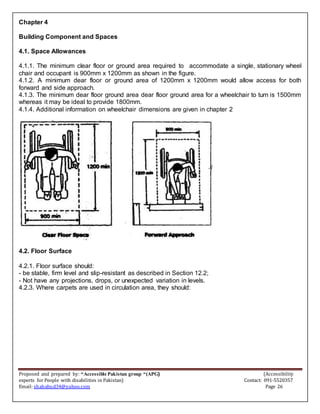
4.1.1. The minimum clear floor or ground area required to accommodate a single, stationary wheel
chair and occupant is 900mm x 1200mm as shown in the figure.
4.1.2. A minimum dear floor or ground area of 1200mm x 1200mm would allow access for both
forward and side approach.
4.1.3. The minimum dear floor ground area dear floor ground area for a wheelchair to turn is 1500mm
whereas it may be ideal to provide 1800mm.
4.1.4. Additional information on wheelchair dimensions are given in chapter 2
4.2. Floor Surface
4.2.1. Floor surface should:
- be stable, firm level and slip-resistant as described in Section 12.2;
- Not have any projections, drops, or unexpected variation in levels.
4.2.3. Where carpets are used in circulation area, they should:
Proposed and prepared by: “Accessible Pakistan group “(APG) (Accessibility
experts for People with disabilities in Pakistan) Contact: 091-5520357
Email: shahabud34@yahoo.com Page 27
- Be securely fixed
- Have firm cushion, pad or backing; and
- Have exposed edges of carpets fastened to floor surface and trim along the entire length of the
exposed edge complying with Table 1 (Pg 39).
4.3. Approaches
4.3.3. Approach to building
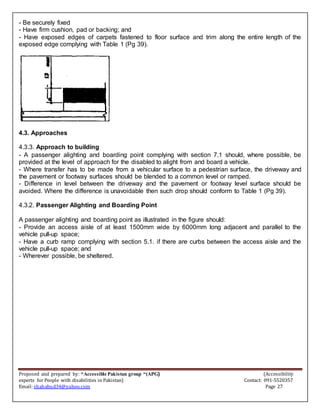
- A passenger alighting and boarding point complying with section 7.1 should, where possible, be
provided at the level of approach for the disabled to alight from and board a vehicle.
- Where transfer has to be made from a vehicular surface to a pedestrian surface, the driveway and
the pavement or footway surfaces should be blended to a common level or ramped.
- Difference in level between the driveway and the pavement or footway level surface should be
avoided. Where the difference is unavoidable then such drop should conform to Table 1 (Pg 39).
4.3.2. Passenger Alighting and Boarding Point
A passenger alighting and boarding point as illustrated in the figure should:
- Provide an access aisle of at least 1500mm wide by 6000mm long adjacent and parallel to the
vehicle pull-up space;
- Have a curb ramp complying with section 5.1. if there are curbs between the access aisle and the
vehicle pull-up space; and
- Wherever possible, be sheltered.
Proposed and prepared by: “Accessible Pakistan group “(APG) (Accessibility
experts for People with disabilities in Pakistan) Contact: 091-5520357
Email: shahabud34@yahoo.com Page 28
4.3.3 Access to Building
- The building should have at least one accessible entrance door served by an approach complying
with section 4.3.
- The access should preferably be through the main entrance of the building.
- Symbol should be displayed at all other non-accessible entrances to direct people with disabilities to
the accessible entrance.
- At least one accessible route leading to an accessible entrance of the building should be provided
from the alighting and boarding point of taxi stands and car park tots for people with disabilities.
- The width of the accessible entrance door should not be less than 900mm and the width of the
corridors or passageways leading to and from such access door should not be less than 1200mm.
4.4 Accessible Routes, Corridors or Paths
4.4.1 Width
The minimum clear width of:
- An accessible route should be 1200mm to allow both a wheelchair and a walking person to pass as
shown in the figure except when additional maneuvering space is required at doorways.
- A checkout lane should be at least 900mm as shown in the figure.
Proposed and prepared by: “Accessible Pakistan group “(APG) (Accessibility
experts for People with disabilities in Pakistan) Contact: 091-5520357
Email: shahabud34@yahoo.com Page 29
- Where space is required for two wheelchairs to pass, the minimum clear width should be 1800mm.
4.4.2 Bollard
Where bollards are erected at entrances to walkways or pathways, a minimum dear space of 900mm
should be provided) between the bollards.
4.4.3 Protruding Object
- Obstacles, projections or other protrusions should be avoided In pedestrian areas such as
walkways, nails, corridors, passageways or aisles.
- Long paths of travel should be avoided and resting areas should be provided at frequent
Intervals not exceeding 30 meters.
- Wherever possible, exterior walkways should be protected from the elements.
Proposed and prepared by: “Accessible Pakistan group “(APG) (Accessibility
experts for People with disabilities in Pakistan) Contact: 091-5520357
Email: shahabud34@yahoo.com Page 30
4.5. Grating
Grating located along the exterior circulation should:-
- Preferably be covered;
- Have spaces not greater than 12 mm wide in one direction; and
- Have long dimension across the dominant direction of travel as illustrated in the figure.
Proposed and prepared by: “Accessible Pakistan group “(APG) (Accessibility
experts for People with disabilities in Pakistan) Contact: 091-5520357
Email: shahabud34@yahoo.com Page 31
4.6. Doors
4.6.1. General
- Doorways should be level.
- Wherever possible and practical, automatic doors - swing or sliding type - should be preferred
instead of manually opening doors.
- Wherever revolving doors or turnstiles are installed they should be supplemented with an auxiliary
side-hung door with minimum clear opening width of 900 mm.
- Bathroom doors should swing out so that the person inside does not fall against; the door and block
it. In case there is not much space available, consideration should be given to the use of sliding or
folding doors, which are easier to operate and require less wheelchair maneuvering space.
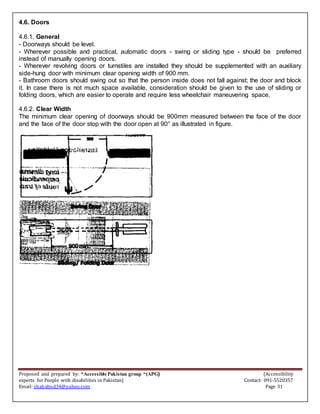
4.6.2. Clear Width
The minimum clear opening of doorways should be 900mm measured between the face of the door
and the face of the door stop with the door open at 90° as illustrated in figure.
Proposed and prepared by: “Accessible Pakistan group “(APG) (Accessibility
experts for People with disabilities in Pakistan) Contact: 091-5520357
Email: shahabud34@yahoo.com Page 32
4.6.3. Thresholds
There should be no doorsills. If thresholds are unavoidable, they should not exceed 20 mm and
preferably be beveled.
4.6.4. Double- Leaf Doors
In case the door has two independently operated door leaves, at least one active leaf should comply
with section 4.6.2 and 4.6.4
4.6.5. Maneuvering Space at Doors Wheelchair maneuvering spaces should be free of any
obstructions and be provided on the side of the door handle in the following manner: - On the pull
side, a minimum space of 600 mm;
- On the push side, a minimum space of 300 mm;
- For two-way swing door, a minimum space of 300 mm.
Proposed and prepared by: “Accessible Pakistan group “(APG) (Accessibility
experts for People with disabilities in Pakistan) Contact: 091-5520357
Email: shahabud34@yahoo.com Page 33
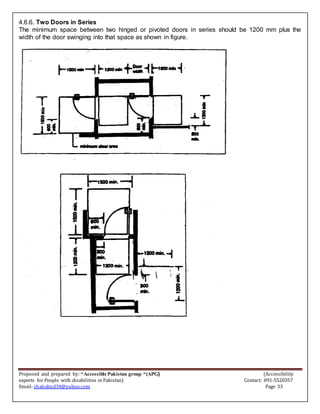
4.6.6. Two Doors in Series
The minimum space between two hinged or pivoted doors in series should be 1200 mm plus the
width of the door swinging into that space as shown in figure.
Proposed and prepared by: “Accessible Pakistan group “(APG) (Accessibility
experts for People with disabilities in Pakistan) Contact: 091-5520357
Email: shahabud34@yahoo.com Page 34
4.6.7. Door Hardware
Operable devices such as handles, pulls, latches and locks should:-
- Be operable: by one hand;
- Not require fine finger control, tight grasping, pinching or twisting to operate; and
- Be mounted at a height of 900 mm to 1100 mm from the floor.
4.6.8. Door Handles
The following characteristics are recommended:-
- Push-pull mechanisms that require no grasping;
- Lever handles to be preferred on latched doors;
- It is safer to use U-shaped handles as they reduce the risk of catching on clothing, or injuring from
the exposed lever end.
Doorknob Is not recommended, as it does not provide adequate grip for persons with impaired hand
functions.
4.6.9. Sliding/ Folding Doors
Operating hardware should be exposed and usable from both the sides when the door is fully open.
4.6.10. Door Opening Force
The maximum force for pushing or pulling a door should be: -
- 38 N for exterior hinged doors;
- 22 N for interior hinged doors; and
Proposed and prepared by: “Accessible Pakistan group “(APG) (Accessibility
experts for People with disabilities in Pakistan) Contact: 091-5520357
Email: shahabud34@yahoo.com Page 35
- 22 N for sliding or folding doors.
This section does not apply to the force required to retract latch bolts or disengage other devices that
may hold &e door in a dosed position.
4.6.11. Door Closure
The sweep period of the door should be adjusted so that from an open position of 90 ° the door does
not take less than 3 seconds to move to a semi- closed position of approximately 12°.
4.6.12. Vision Panel
All two- way swing doors or doors in general circulation areas should be provided with vision panels
giving a visibility from a height of 800 mm to 1500 mm. This will enable both the wheelchair user and
the ambulatory disable to be noticed by a person on the opposite side in order to prevent him from
being accidentally struck by the door.
4.6.13. Kick-plate
Kick- plates of not less than 250 mm height are recommended for doors In high- use in order to
protect the push side of doors from damage.
4.6.14 wherever possible, all door should have warning blocks installed at entrances.
Proposed and prepared by: “Accessible Pakistan group “(APG) (Accessibility
experts for People with disabilities in Pakistan) Contact: 091-5520357
Email: shahabud34@yahoo.com Page 36
4.7. Window
- Windows should have handles/ controls in accordance to section 4.9
- Should provide an unobstructed viewing zone for wheelchair users between 600mm and 1400mm
- Curtain or Venetian blind controls/ropes should be accessible for wheelchair users.
4.8. Handrail/ Grab Bar
4.8.1. General
- Handrails/ Grab bars are extremely important features and must be designed to be easy to grasp
and to provide a firm and comfortable grip so that the hand can slide along the rail without
obstruction.
- Many PWD rely upon handrails/ grab bars to maintain balance or prevent serious falls.
- Handrails may be provided with Braille/ tactile markings at the beginning and the end to give
information to people with visual impairment.
4.8.2. Handrail requirements
Handrails should: -
- Be slip-resistant with round ends;
- Have a circular section of 30-45mm in diameter;
- Be free of any sharp or abrasive elements;
- Have continuous gripping surfaces, without interruptions or obstructions that can break a
Proposed and prepared by: “Accessible Pakistan group “(APG) (Accessibility
experts for People with disabilities in Pakistan) Contact: 091-5520357
Email: shahabud34@yahoo.com Page 37
Handhold;
- For stairs and ramps:-
- Be provided on both the sides;
- Be continuous, even at the landings; and
- Extend at least 300 mm beyond the stairs/ ramps.
- Have a minimum dear space of 40mm from the wall; and
- Be installed at a height of 800 mm to 900mm.
In case the handrail is enclosed in a recess, the recess should extend at least 450 mm above the top
of the rail.
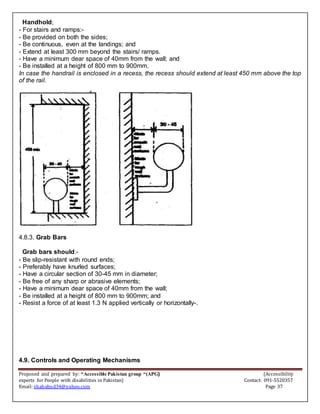
4.8.3. Grab Bars
Grab bars should:-
- Be slip-resistant with round ends;
- Preferably have knurled surfaces;
- Have a circular section of 30-45 mm in diameter;
- Be free of any sharp or abrasive elements;
- Have a minimum dear space of 40mm from the wall;
- Be installed at a height of 800 mm to 900mm; and
- Resist a force of at least 1.3 N applied vertically or horizontally-.
4.9. Controls and Operating Mechanisms
Proposed and prepared by: “Accessible Pakistan group “(APG) (Accessibility
experts for People with disabilities in Pakistan) Contact: 091-5520357
Email: shahabud34@yahoo.com Page 38
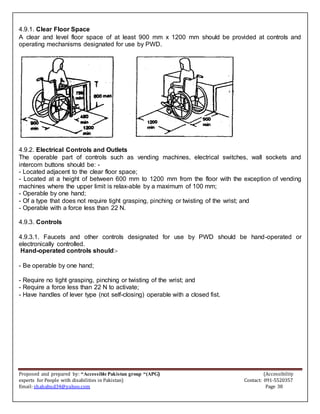
4.9.1. Clear Floor Space
A clear and level floor space of at least 900 mm x 1200 mm should be provided at controls and
operating mechanisms designated for use by PWD.
4.9.2. Electrical Controls and Outlets
The operable part of controls such as vending machines, electrical switches, wall sockets and
intercom buttons should be: -
- Located adjacent to the clear floor space;
- Located at a height of between 600 mm to 1200 mm from the floor with the exception of vending
machines where the upper limit is relax-able by a maximum of 100 mm;
- Operable by one hand;
- Of a type that does not require tight grasping, pinching or twisting of the wrist; and
- Operable with a force less than 22 N.
4.9.3. Controls
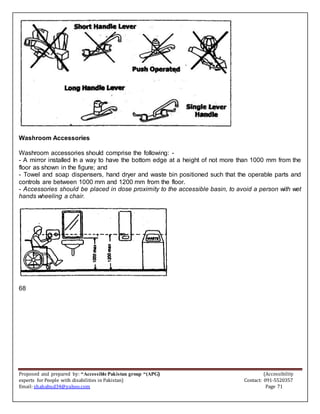
4.9.3.1. Faucets and other controls designated for use by PWD should be hand-operated or
electronically controlled.
Hand-operated controls should:-
- Be operable by one hand;
- Require no tight grasping, pinching or twisting of the wrist; and
- Require a force less than 22 N to activate;
- Have handles of lever type (not self-closing) operable with a closed fist.
Proposed and prepared by: “Accessible Pakistan group “(APG) (Accessibility
experts for People with disabilities in Pakistan) Contact: 091-5520357
Email: shahabud34@yahoo.com Page 39
4.10. Seating Spaces
4.10.1. Clear Floor Space
Seating space, such as those provided at counters, tables, or work surfaces for persons in
wheelchairs should have a dear and level floor space of not less than 900 mm x 1200 mm.
4.10.2. Clear Knee Space
Where a forward approach is used, a clear knee space of at least 900 mm wide, 480 mm deep and
750 mm high should be provided, which may overlap the clear floor space by a maximum of 480 mm
as illustrated in the figure.
4.10.3. Counter Tops
Writing surfaces or service counters should not be more than 800 mm from the floor.
4.11. Other Facilities
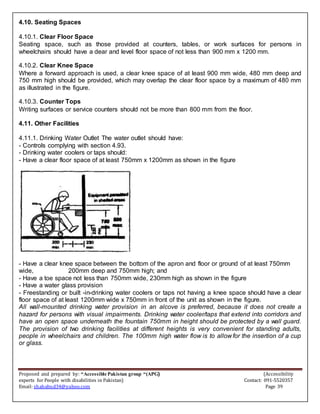
4.11.1. Drinking Water Outlet The water outlet should have:
- Controls complying with section 4.93.
- Drinking water coolers or taps should:
- Have a clear floor space of at least 750mm x 1200mm as shown in the figure
- Have a clear knee space between the bottom of the apron and floor or ground of at least 750mm
wide, 200mm deep and 750mm high; and
- Have a toe space not less than 750mm wide, 230mm high as shown in the figure
- Have a water glass provision
- Freestanding or built -in-drinking water coolers or taps not having a knee space should have a clear
floor space of at least 1200mm wide x 750mm in front of the unit as shown in the figure.
All wall-mounted drinking water provision in an alcove is preferred, because it does not create a
hazard for persons with visual impairments. Drinking water cooler/taps that extend into corridors and
have an open space underneath the fountain 750mm in height should be protected by a wall guard.
The provision of two drinking facilities at different heights is very convenient for standing adults,
people in wheelchairs and children. The 100mm high water flow is to allow for the insertion of a cup
or glass.
Proposed and prepared by: “Accessible Pakistan group “(APG) (Accessibility
experts for People with disabilities in Pakistan) Contact: 091-5520357
Email: shahabud34@yahoo.com Page 40
4.11.2 Public Telephone and other operation access
4.11.2.1 General
- Where payphones are provided, at least one payphone should be made accessible.
- A seat adjacent to the payphone is recommended for the ambulant disabled but should not impede
the approach by the wheelchair user to the telephone.
4.11.2.2 Clear Foot Space
A dear foot space of not less than 900mm by 1200mm should be provided in front of the telephone
booth or counter.
4.11.2.3 Counter Top
- Counter tops, where provided, should be between 750mm and 800mm from the floor and have a
minimum dear knee space of 750mm
- The depth of the counter top should be not less than 480mm as shown in the figure.
4.11.2.4 Telephone Booth
- The opening of the telephone booth should have a clear width of at least 870mm
- The enclosed space should have dimensions of at least 870mm by 1000mm that should not be
restricted by fixed seats as shown in the figure.
4.11.2.5 Height
The height of ail operable parts of the telephone should be between 800mm and 1200mm
4.11.2.6. Telephone Cord
The minimum length of the cord should be 900mm
4.11.2.7. Telephone Books
Telephone books, if provided, should be located within the reach of a wheelchair user.
Proposed and prepared by: “Accessible Pakistan group “(APG) (Accessibility
experts for People with disabilities in Pakistan) Contact: 091-5520357
Email: shahabud34@yahoo.com Page 41
4.11.2.8. Signage
The Symbol should be displayed to identify the location of such telephones.
4.11.3 Mailbox
- The mail slot should be located at the height of maximum 1200mm
- It should have a clear floor space
4.11.4 Vending Machine
- The coin slot must be located at height of 1200mm or less
- It should have a dear floor space
- Operating buttons should be in raised numbers and in contrasting colors
4.11.5 ATM- Money Machine
- It should have a clear floor space
- Should have a dear knee space
- Control buttons should be between 900mm and 1200mm height from the floor
- Control buttons should be in raised numbers and in contrasting colors.
Proposed and prepared by: “Accessible Pakistan group “(APG) (Accessibility
experts for People with disabilities in Pakistan) Contact: 091-5520357
Email: shahabud34@yahoo.com Page 42
4.12 Signage
4.12.1 General
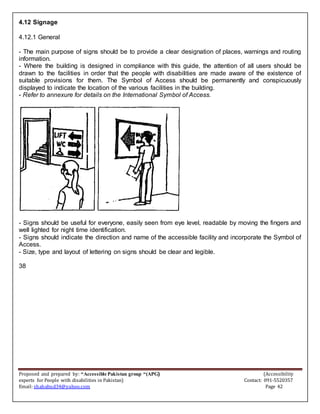
- The main purpose of signs should be to provide a clear designation of places, warnings and routing
information.
- Where the building is designed in compliance with this guide, the attention of all users should be
drawn to the facilities in order that the people with disabilities are made aware of the existence of
suitable provisions for them. The Symbol of Access should be permanently and conspicuously
displayed to indicate the location of the various facilities in the building.
- Refer to annexure for details on the International Symbol of Access.
- Signs should be useful for everyone, easily seen from eye level, readable by moving the fingers and
well lighted for night time identification.
- Signs should indicate the direction and name of the accessible facility and incorporate the Symbol of
Access.
- Size, type and layout of lettering on signs should be clear and legible.
38
Proposed and prepared by: “Accessible Pakistan group “(APG) (Accessibility
experts for People with disabilities in Pakistan) Contact: 091-5520357
Email: shahabud34@yahoo.com Page 43
4.12.2 Specifications
4.12.2.1 A person on a wheelchair is less than 1200 mm high. The acceptable zone for
Notices/ signs exclusively for wheelchair users should be between 750 mm and 1200 mm.
4.12.2.2 Acceptable zone for installing wall/ door signs for standing users, e.g. people with visual
disabilities and people with ambulatory disabilities, should be between 1200 mm and 1350 mm from
the floor level.
4.12.2.3 A minimum clearance of 2000:mm height from the floor level should be provided for
suspended or projecting signs.
4.12.2.4 People With Disability s may have limitations in the movement of. Their head or a reduction
in peripheral vision.
- Signs positioned perpendicular to the path of travel are easiest for them to notice.
- Persons can generally distinguish signs within an angle of 30° to either side of the centerline of their
faces without moving their heads.
4.12.2.5 Signs should be in contrasting colour and preferably be embossed in distinct relief to allow
people with visual impairments to obtain the information by touching them.
4.12.2.6 Audible signs should be installed in dangerous areas for the aid of people with visual
impairments.
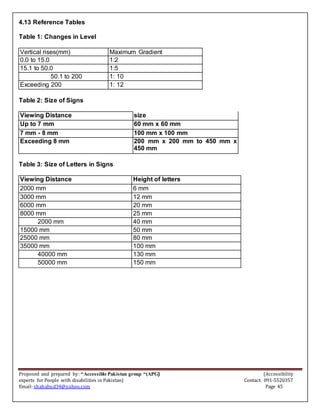
4.12.2.7 The size of the characters and symbols should be based on the intended viewing distance
and determined in accordance with table 2 (page 39).
4.12.2.8 Height of the letters in the signs for varying viewing distances should be determined in
accordance to table 3 (page 39).
4.12.3 Directional Signs
4.12.3.1 Directional signs as shown in the figure should be displayed at main lobbies or passageways
and at points where there is a change of direction, to direct people with disabilities, to the various
facilities such as lifts, entrances, telephone booths, toilets, car park, etc.
4.12.3.2 Where the location of the designated facility is not obvious or is distant from the approach
viewpoints, directional signs as shown in the figure should be placed along the route.
Proposed and prepared by: “Accessible Pakistan group “(APG) (Accessibility
experts for People with disabilities in Pakistan) Contact: 091-5520357
Email: shahabud34@yahoo.com Page 44
4.12.4 Service Identification Signs
The Symbol as shown in the figure should be displayed at various facilities for people with disabilities
such as lifts, entrances, telephone booths, toilets, car parks and the like.
Proposed and prepared by: “Accessible Pakistan group “(APG) (Accessibility
experts for People with disabilities in Pakistan) Contact: 091-5520357
Email: shahabud34@yahoo.com Page 45
4.13 Reference Tables
Table 1: Changes in Level
Vertical rises(mm) Maximum Gradient
0.0 to 15.0 1:2
15.1 to 50.0 1:5
50.1 to 200 1: 10
Exceeding 200 1: 12
Table 2: Size of Signs
Viewing Distance size
Up to 7 mm 60 mm x 60 mm
7 mm - 8 mm 100 mm x 100 mm
Exceeding 8 mm 200 mm x 200 mm to 450 mm x
450 mm
Table 3: Size of Letters in Signs
Viewing Distance Height of letters
2000 mm 6 mm
3000 mm 12 mm
6000 mm 20 mm
8000 mm 25 mm
2000 mm 40 mm
15000 mm 50 mm
25000 mm 80 mm
35000 mm 100 mm
40000 mm 130 mm
50000 mm 150 mm
Proposed and prepared by: “Accessible Pakistan group “(APG) (Accessibility
experts for People with disabilities in Pakistan) Contact: 091-5520357
Email: shahabud34@yahoo.com Page 46
42 Chapter 5
Changes in Levels
5.1. Curb Ramp
5.1.1. General
Curb ramps: -
- are provided where the vertical rise is less than 150 mm;
- should have a slip-resistant surface;
- should be designed not to allow water accumulating on the walking surface;
- do not require handrails;
- should not project into the road surface;
- should be located or protected to prevent obstruction by parked vehicles; and
- should be free from any obstruction such as signposts, traffic lights, etc.
5.1.2. Gradient
The gradient of a curb ramp should not be steeper than 1:10.
5.1.3. Width
The width should not be less than 900 mm.
5.1.4. Flared Sides
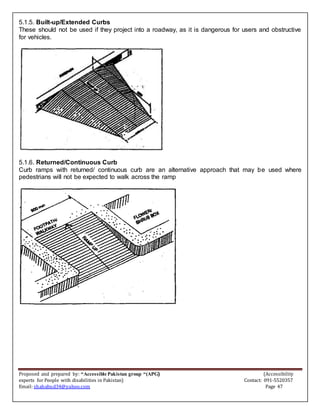
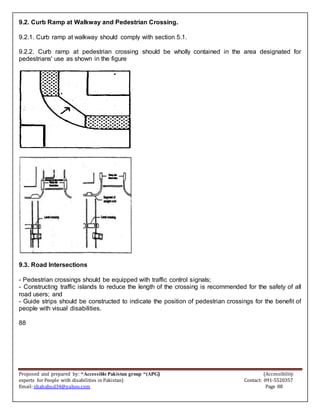
- Curb ramps should have flared sides where pedestrians are likely to walk across them as shown in
the figure; and
- The gradient of the flared side should not be steeper than 1:10.
Proposed and prepared by: “Accessible Pakistan group “(APG) (Accessibility
experts for People with disabilities in Pakistan) Contact: 091-5520357
Email: shahabud34@yahoo.com Page 47
5.1.5. Built-up/Extended Curbs
These should not be used if they project into a roadway, as it is dangerous for users and obstructive
for vehicles.
5.1.6. Returned/Continuous Curb
Curb ramps with returned/ continuous curb are an alternative approach that may be used where
pedestrians will not be expected to walk across the ramp
Proposed and prepared by: “Accessible Pakistan group “(APG) (Accessibility
experts for People with disabilities in Pakistan) Contact: 091-5520357
Email: shahabud34@yahoo.com Page 48
5.1.7. Warning blocks
Warning blocks should be installed at the end of the curb ramp to aid people with visual impairments.
Where the vertical rise is greater than 150 mm, it should constitute a slope ramp and should comply
with section 5.2
5.2. Slope Ramp
5.2.1. General
- Ramps allow persons in wheelchair to move from one level to another. However, many ambulant
persons with disabilities negotiate steps more easily and safely. Hence it is preferable to provide
accessibility by both steps and ramps. 'o Where the horizontal run of the approach ramp exceeds
9000 mm in length, an alternative stepped approach as described in section 5.3, in addition to the
ramp approach, should be provided for people with ambulatory disabilities.
- Where there is a large change in elevation that requires multiple ramps and landing combination,
other solutions such as elevators should be considered.
5.2.2. Gradient
Gradient of a ramp should: -
- Not be steeper than 1:12 (complying with table 1, Pg. 39); and
- Be constant between landings.
5.2.3. Width
The minimum clear width of a ramp should be 1200 mm.
5.2.4. Surface
- Ramps and landing surfaces should be slip resistant as described in the annexure; and
- Outdoor ramps and their surfaces should be designed to prevent water from accumulating on the
walking surfaces.
Proposed and prepared by: “Accessible Pakistan group “(APG) (Accessibility
experts for People with disabilities in Pakistan) Contact: 091-5520357
Email: shahabud34@yahoo.com Page 49
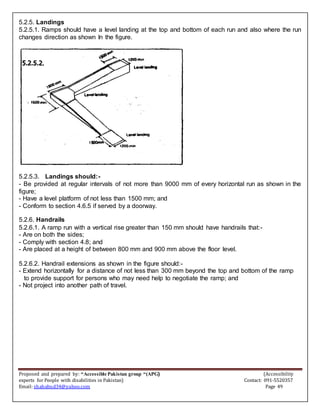
5.2.5. Landings
5.2.5.1. Ramps should have a level landing at the top and bottom of each run and also where the run
changes direction as shown In the figure.
5.2.5.3. Landings should:-
- Be provided at regular intervals of not more than 9000 mm of every horizontal run as shown in the
figure;
- Have a level platform of not less than 1500 mm; and
- Conform to section 4.6.5 if served by a doorway.
5.2.6. Handrails
5.2.6.1. A ramp run with a vertical rise greater than 150 mm should have handrails that:-
- Are on both the sides;
- Comply with section 4.8; and
- Are placed at a height of between 800 mm and 900 mm above the floor level.
5.2.6.2. Handrail extensions as shown in the figure should:-
- Extend horizontally for a distance of not less than 300 mm beyond the top and bottom of the ramp
to provide support for persons who may need help to negotiate the ramp; and
- Not project into another path of travel.
Proposed and prepared by: “Accessible Pakistan group “(APG) (Accessibility
experts for People with disabilities in Pakistan) Contact: 091-5520357
Email: shahabud34@yahoo.com Page 50
5.2.7. Edge Protection
Ramps and landings not adjacent to a wall should have an edge protection such as: -
5.2.7.1 A curb with a minimum height of 75 mm as shown in the figure;
5.2.7.2. A raised barrier with its lower edge not more than 75 mm from the ramp or
landing surface as shown I the figure; or
5.2.7.3. A rail with the bottom edge not more than 75 mm from the ramp or landing surface as shown
in the figure.
47
Proposed and prepared by: “Accessible Pakistan group “(APG) (Accessibility
experts for People with disabilities in Pakistan) Contact: 091-5520357
Email: shahabud34@yahoo.com Page 51
5.2.8. Warning blocks
Warning blocks may be installed at the beginning and end of the ramp to aid people with visual
Impairments.
5.3. Stairs
5.3.1. In public buildings, at least one of the staircases should be designed to comply with sections
5.3.2 to 5.3.5
5.3.2. Tread and Riser
A flight of steps should have: -
- uniform riser of maximum 150 mm and tread of 300 mm; and
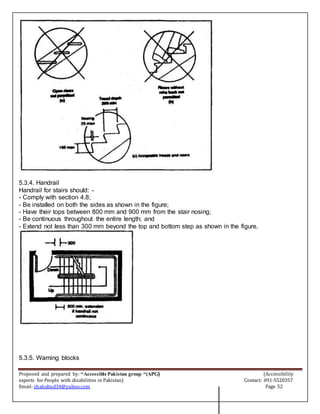
- no open riser as shown in the figure, open riser are hazardous for everyone as the leg can get stuck
under the tread.
5.3.3. Nosing should: -
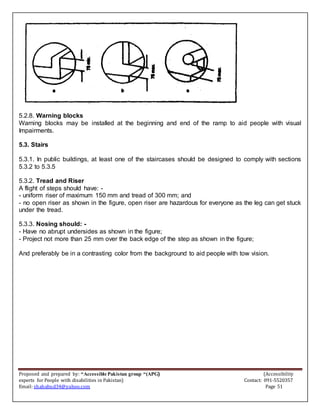
- Have no abrupt undersides as shown in the figure;
- Project not more than 25 mm over the back edge of the step as shown in the figure;
And preferably be in a contrasting color from the background to aid people with tow vision.
Proposed and prepared by: “Accessible Pakistan group “(APG) (Accessibility
experts for People with disabilities in Pakistan) Contact: 091-5520357
Email: shahabud34@yahoo.com Page 52
5.3.4. Handrail
Handrail for stairs should: -
- Comply with section 4.8;
- Be installed on both the sides as shown in the figure;
- Have their tops between 800 mm and 900 mm from the stair nosing;
- Be continuous throughout the entire length; and
- Extend not less than 300 mm beyond the top and bottom step as shown in the figure.
5.3.5. Warning blocks
Proposed and prepared by: “Accessible Pakistan group “(APG) (Accessibility
experts for People with disabilities in Pakistan) Contact: 091-5520357
Email: shahabud34@yahoo.com Page 53
Warning blocks should be installed at the beginning and at the end of each flight of steps to aid
people with visual impairments.
5.4. Lift
5.4.1. General
5.4.1.1. Where lifts are provided in a building, at least one lift should be made accessible from the
entrance level for vertical circulation.
5.4.1.2. The lift should serve all levels intended for access by people with disabilities.
5.4.1.3. Lifts designated for use by people with disabilities should be marked with proper signage
and directional signs be provided from all other entrances of the building to the accessible lift.
50
Proposed and prepared by: “Accessible Pakistan group “(APG) (Accessibility
experts for People with disabilities in Pakistan) Contact: 091-5520357
Email: shahabud34@yahoo.com Page 54
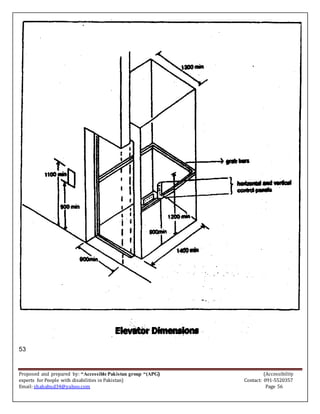
5.4.2. Lift Size
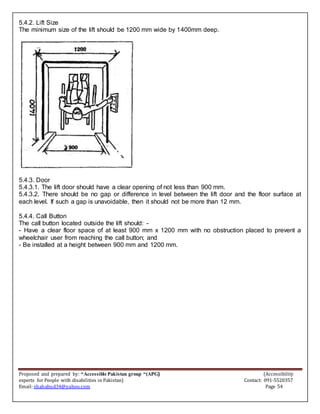
The minimum size of the lift should be 1200 mm wide by 1400mm deep.
5.4.3. Door
5.4.3.1. The lift door should have a clear opening of not less than 900 mm.
5.4.3.2. There should be no gap or difference in level between the lift door and the floor surface at
each level. If such a gap is unavoidable, then it should not be more than 12 mm.
5.4.4. Call Button
The call button located outside the lift should: -
- Have a clear floor space of at least 900 mm x 1200 mm with no obstruction placed to prevent a
wheelchair user from reaching the call button; and
- Be installed at a height between 900 mm and 1200 mm.
Proposed and prepared by: “Accessible Pakistan group “(APG) (Accessibility
experts for People with disabilities in Pakistan) Contact: 091-5520357
Email: shahabud34@yahoo.com Page 55
5.4.5. Control Panel
The control panel should: -
- Have a dear floor space of at least 900 mm x 1200 mm with no obstruction placed to prevent a
wheelchair user from reaching it;
- Be placed at a height of between 900 mm and 1200 mm from the floor level; and
- Have buttons with Braille/raised letters and in sharp contrast from the background to aid people with
visual impairments.
5.4.6. Grab Bars
Grab bars should: -
- Comply with section 4.8;
- Be placed at a height of 900 mm from the floor level; and
- Be fixed on both sides and at the rear of the lift.
5.4.7. Audio and Visual Indicators
The lift should have a voice announcement system along with a visual display to indicate the floor
level.
Proposed and prepared by: “Accessible Pakistan group “(APG) (Accessibility
experts for People with disabilities in Pakistan) Contact: 091-5520357
Email: shahabud34@yahoo.com Page 56
53
Proposed and prepared by: “Accessible Pakistan group “(APG) (Accessibility
experts for People with disabilities in Pakistan) Contact: 091-5520357
Email: shahabud34@yahoo.com Page 57
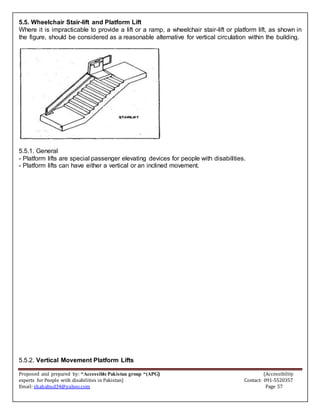
5.5. Wheelchair Stair-lift and Platform Lift
Where it is impracticable to provide a lift or a ramp, a wheelchair stair-lift or platform lift, as shown in
the figure, should be considered as a reasonable alternative for vertical circulation within the building.
5.5.1. General
- Platform lifts are special passenger elevating devices for people with disabilities.
- Platform lifts can have either a vertical or an inclined movement.
5.5.2. Vertical Movement Platform Lifts
Proposed and prepared by: “Accessible Pakistan group “(APG) (Accessibility
experts for People with disabilities in Pakistan) Contact: 091-5520357
Email: shahabud34@yahoo.com Page 58
- For maximum level changes of 2500 mm, vertical movement platform lifts may be installed,
- For level changes of more than 1200 mm, the lift should be placed in a dosed structure with doors at
different accessible levels.
- O Vertical platform lifts can have a variety of openings for entry and exit.
5.5.3. Inclined Movement Platform Lifts
- Inclined movement platform lifts consist of three elements: a railing, an electric generator, and a
moving platform or seat.
- The operating system of the lift may be lateral or suspended.
- Inclined movement platform lifts can be installed along the stair wall, as long as they
do not obstruct the required width of the exit. The seat or platform can be folded when not in use.
- The minimum width of the stairs should be 900 mm to allow the installation of a lift.
- Platform lifts can be installed on ail types of stairs including switchback stairs i.e. those with a
rotation angle of 180o end spiral staircases.
- Inclined movement platform lifts are usually used to connect one or more floors or to overcome split-
levels in existing buildings.
Proposed and prepared by: “Accessible Pakistan group “(APG) (Accessibility
experts for People with disabilities in Pakistan) Contact: 091-5520357
Email: shahabud34@yahoo.com Page 59
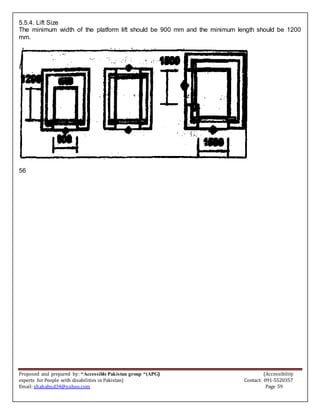
5.5.4. Lift Size
The minimum width of the platform lift should be 900 mm and the minimum length should be 1200
mm.
56
Proposed and prepared by: “Accessible Pakistan group “(APG) (Accessibility
experts for People with disabilities in Pakistan) Contact: 091-5520357
Email: shahabud34@yahoo.com Page 60
Chapter 6
Access to Toilet Facility
6.1 General Provision
6.1.1. Signage at washroom entrance should be dearly visible and should comply with the Symbol of
Access as described in annexure.
6.1.2. At every level of the building where toilets are required to be provided, at least:
- One individual accessible washroom for the wheelchair users should be provided for both the male
and the female; or
- One accessible toilet cubicle for wheelchair users shall be provided in both the mate and the female
toilets.
6.1.3. Where two or more dusters of toilets are provided at the same level but at different locations,
the corresponding number of accessible washrooms or toilet cubicles should be provided.
6.1.4. At least one wash basin in the toilet should comply with the section 6.8
6.1.5. Where washroom accessories are provided, at least one of each type should be made usable
to the wheelchair user in accordance to the section 6.9
6.1.6. Where urinals are provided, at least one should comply with section 6.10 to cater to the
ambulant disabled.
6.1.7. Installation of a separate unisex unit is always desirable in public buildings, even when all
washrooms are accessible, so as to allow a person with disability to be assisted by an attendant of
the opposite sex.
Proposed and prepared by: “Accessible Pakistan group “(APG) (Accessibility
experts for People with disabilities in Pakistan) Contact: 091-5520357
Email: shahabud34@yahoo.com Page 61
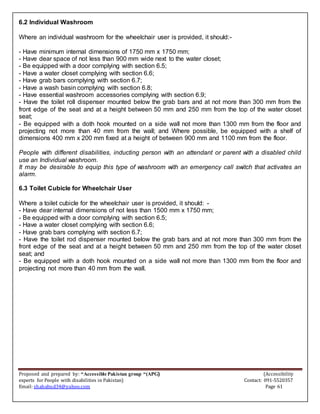
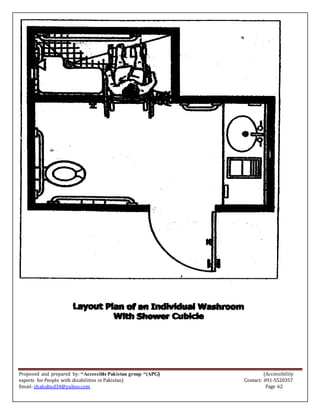
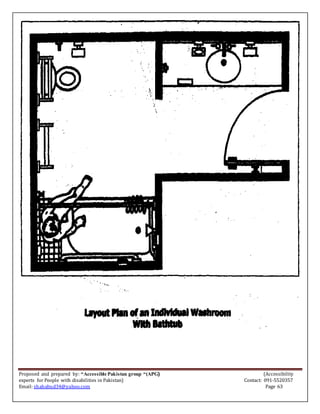
6.2 Individual Washroom
Where an individual washroom for the wheelchair user is provided, it should:-
- Have minimum internal dimensions of 1750 mm x 1750 mm;
- Have dear space of not less than 900 mm wide next to the water closet;
- Be equipped with a door complying with section 6.5;
- Have a water closet complying with section 6.6;
- Have grab bars complying with section 6.7;
- Have a wash basin complying with section 6.8;
- Have essential washroom accessories complying with section 6.9;
- Have the toilet roll dispenser mounted below the grab bars and at not more than 300 mm from the
front edge of the seat and at a height between 50 mm and 250 mm from the top of the water closet
seat;
- Be equipped with a doth hook mounted on a side wall not more than 1300 mm from the floor and
projecting not more than 40 mm from the wall; and Where possible, be equipped with a shelf of
dimensions 400 mm x 200 mm fixed at a height of between 900 mm and 1100 mm from the floor.
People with different disabilities, inducting person with an attendant or parent with a disabled child
use an Individual washroom.
It may be desirable to equip this type of washroom with an emergency call switch that activates an
alarm.
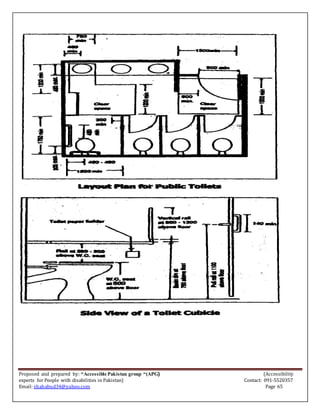
6.3 Toilet Cubicle for Wheelchair User
Where a toilet cubicle for the wheelchair user is provided, it should: -
- Have dear internal dimensions of not less than 1500 mm x 1750 mm;
- Be equipped with a door complying with section 6.5;
- Have a water closet complying with section 6.6;
- Have grab bars complying with section 6.7;
- Have the toilet rod dispenser mounted below the grab bars and at not more than 300 mm from the
front edge of the seat and at a height between 50 mm and 250 mm from the top of the water closet
seat; and
- Be equipped with a doth hook mounted on a side wall not more than 1300 mm from the floor and
projecting not more than 40 mm from the wall.
Proposed and prepared by: “Accessible Pakistan group “(APG) (Accessibility
experts for People with disabilities in Pakistan) Contact: 091-5520357
Email: shahabud34@yahoo.com Page 62
Proposed and prepared by: “Accessible Pakistan group “(APG) (Accessibility
experts for People with disabilities in Pakistan) Contact: 091-5520357
Email: shahabud34@yahoo.com Page 63
Proposed and prepared by: “Accessible Pakistan group “(APG) (Accessibility
experts for People with disabilities in Pakistan) Contact: 091-5520357
Email: shahabud34@yahoo.com Page 64
Proposed and prepared by: “Accessible Pakistan group “(APG) (Accessibility
experts for People with disabilities in Pakistan) Contact: 091-5520357
Email: shahabud34@yahoo.com Page 65
Proposed and prepared by: “Accessible Pakistan group “(APG) (Accessibility
experts for People with disabilities in Pakistan) Contact: 091-5520357
Email: shahabud34@yahoo.com Page 66
6.4 Toilet cubicle for ambulatory disabled
Where provided, it should: -
- Have internal dimensions of a standard cubicle;
- Have grab bars on both the sides of the cubicle to act as handhold for the person with ambulatory
disability to stand; and
- Be equipped with a door complying with section 6.5.
- Toilet cubicle for person with ambulatory disability is not suitable for the wheelchair user unless the
grab bar on the transfer side is a swing-up or swing-away type.
63
Proposed and prepared by: “Accessible Pakistan group “(APG) (Accessibility
experts for People with disabilities in Pakistan) Contact: 091-5520357
Email: shahabud34@yahoo.com Page 67
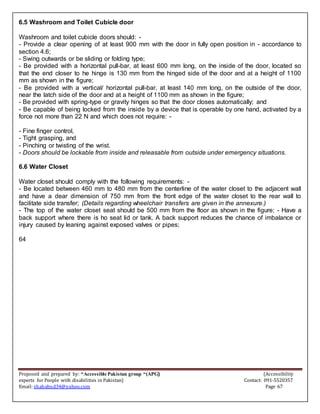
6.5 Washroom and Toilet Cubicle door
Washroom and toilet cubicle doors should: -
- Provide a clear opening of at least 900 mm with the door in fully open position in - accordance to
section 4.6;
- Swing outwards or be sliding or folding type;
- Be provided with a horizontal pull-bar, at least 600 mm long, on the inside of the door, located so
that the end closer to he hinge is 130 mm from the hinged side of the door and at a height of 1100
mm as shown in the figure;
- Be provided with a vertical/ horizontal pull-bar, at least 140 mm long, on the outside of the door,
near the latch side of the door and at a height of 1100 mm as shown in the figure;
- Be provided with spring-type or gravity hinges so that the door closes automatically; and
- Be capable of being locked from the inside by a device that is operable by one hand, activated by a
force not more than 22 N and which does not require: -
- Fine finger control,
- Tight grasping, and
- Pinching or twisting of the wrist.
- Doors should be lockable from inside and releasable from outside under emergency situations.
6.6 Water Closet
Water closet should comply with the following requirements: -
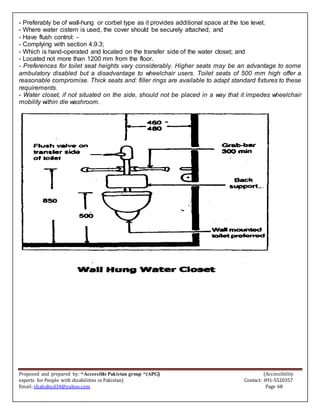
- Be located between 460 mm to 480 mm from the centerline of the water closet to the adjacent wall
and have a dear dimension of 750 mm from the front edge of the water closet to the rear wall to
facilitate side transfer; (Details regarding wheelchair transfers are given in the annexure.)
- The top of the water closet seat should be 500 mm from the floor as shown in the figure; - Have a
back support where there is ho seat lid or tank. A back support reduces the chance of imbalance or
injury caused by leaning against exposed valves or pipes;
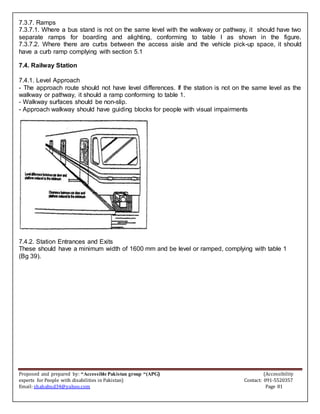
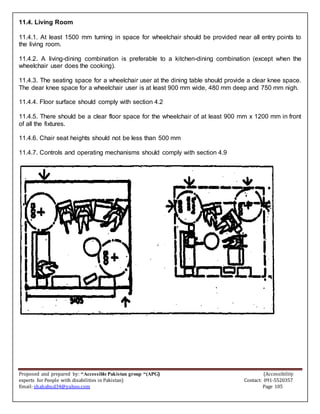
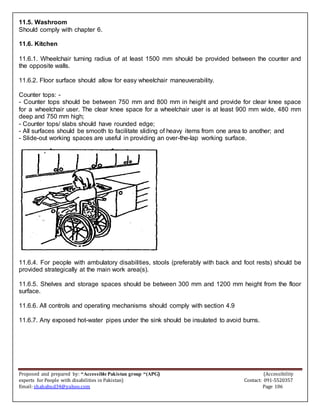
64
Proposed and prepared by: “Accessible Pakistan group “(APG) (Accessibility
experts for People with disabilities in Pakistan) Contact: 091-5520357
Email: shahabud34@yahoo.com Page 68
- Preferably be of wall-hung or corbel type as it provides additional space at the toe level;
- Where water cistern is used, the cover should be securely attached; and
- Have flush control: -
- Complying with section 4.9.3;
- Which is hand-operated and located on the transfer side of the water closet; and
- Located not more than 1200 mm from the floor.
- Preferences for toilet seat heights vary considerably. Higher seats may be an advantage to some
ambulatory disabled but a disadvantage to wheelchair users. Toilet seats of 500 mm high offer a
reasonable compromise. Thick seats and: filler rings are available to adapt standard fixtures to these
requirements.
- Water closet, if not situated on the side, should not be placed in a way that it impedes wheelchair
mobility within die washroom.
Proposed and prepared by: “Accessible Pakistan group “(APG) (Accessibility
experts for People with disabilities in Pakistan) Contact: 091-5520357
Email: shahabud34@yahoo.com Page 69
6.7 Water Closet Grab Bars
Water closets should be provided with grab bars, as illustrated in the figure, which should comply with
the following: -
- Be in accordance with section 4.8;
- Be mounted at a height between 280 mm and 300 mm from the water closet seat;
- One horizontal grab bar should be mounted on the side wall closest to the water closet
extending from the rear wall to at least 450 mm in front of the water closet seat;
- Another horizontal grab bar should be mounted on the wall behind the water closet and be at least
750 mm long; and
- where possible, a vertical grab bar should be provided on the side wall closest to the water closet as
illustrated in the figure.
Proposed and prepared by: “Accessible Pakistan group “(APG) (Accessibility
experts for People with disabilities in Pakistan) Contact: 091-5520357
Email: shahabud34@yahoo.com Page 70
6.8. Wash Basin
Wash basins, as illustrated in the figure, should: -
- Be of a standard size with dimensions of approximately 520 mm x 410 mm;
- Be mounted such that the minimum distance between the centerline of the fixture and the side wall
is 460 mm;
- Be mounted such that the top edge is between 800 mm and 840 mm from the floor;
- Have a knee space of at least 750 mm wide by 200 mm deep by 680 mm high with an additional toe
space of at least 750 mm wide by 230 mm deep by 230 mm high;
- Have a minimum clear floor space of 750 mm wide by 1200 mm deep, of which a maximum of 480
mm in depth may be under the wash basin;
- Have the hot water and drain pipes within the knee space or toe space property insulated; and
- Have faucets and other controls complying with section 4.9.3.
- Where space is a constraint it may be a good option to install a corner basin.
Proposed and prepared by: “Accessible Pakistan group “(APG) (Accessibility
experts for People with disabilities in Pakistan) Contact: 091-5520357
Email: shahabud34@yahoo.com Page 71
Washroom Accessories
Washroom accessories should comprise the following: -
- A mirror installed In a way to have the bottom edge at a height of not more than 1000 mm from the
floor as shown in the figure; and
- Towel and soap dispensers, hand dryer and waste bin positioned such that the operable parts and
controls are between 1000 mm and 1200 mm from the floor.
- Accessories should be placed in dose proximity to the accessible basin, to avoid a person with wet
hands wheeling a chair.
68
Proposed and prepared by: “Accessible Pakistan group “(APG) (Accessibility
experts for People with disabilities in Pakistan) Contact: 091-5520357
Email: shahabud34@yahoo.com Page 72
6.8 Urinals
6.8.1 Where urinals for the ambulatory disabled are provided, they should comply with the following
as illustrated in the figure: -
- Be of the wall-hung type with the rim not more than 430 mm from the floor;
- Have a minimum clear floor space of 750 mm wide by 1200 mm wide without steps in front of the
urinal;
- Not have privacy shields extending beyond the front edge of the urinal rim unless such shields allow
a clear width of not less than 750 mm; and
- Have grab bars on both sides of the urinals:-
- extending from 1000 mm to 1500 mm above the floor level; and
- With a clear space of 120 mm between the urinal grab bar and the wall surface.
6.8.2 Flush Controls should:-
- Comply with section 4.9.3; and
- Be located not more than 1200 mm from the floor.
6.9 Bathtub
6.9.1 There should be a clear floor space of at least 750 mm width in front bathtub. The wash basin
may encroach to a maximum of 300 mm into this space provided there is a clear knee and toe space
under the basin as shown in the figure.
6.9.2 The bathtub should be provided with a seat of at least 250 mm width along its entire length or
with a seat of at least 400 mm depth across its width. The seat should be located at the opposite end
of the controls to allow easier access.
6.9.3 The base of bathtub should be slip-resistant. Where this is not possible, a slip-resistant rubber
mat may be provided.
6.9.4 The bathtub should be provided with grab bars:-
- Complying with section 4.8.3;
- At least 1200 mm long, located horizontally along the length of the bathtub, 180 mm to 280 mm
above the bathtub rim; and
- At least 1200 mm long, located vertically along the foot end of the bathtub adjacent to the clear floor
space with the lower end 180 mm to 280 mm above the bathtub rim as shown in the figure.
Proposed and prepared by: “Accessible Pakistan group “(APG) (Accessibility
experts for People with disabilities in Pakistan) Contact: 091-5520357
Email: shahabud34@yahoo.com Page 73
6.9.5 Faucets and other controls should:-
- Comply with section 4.9;
- Be located at the foot of the bathtub between the centerline and to the outer edge; and
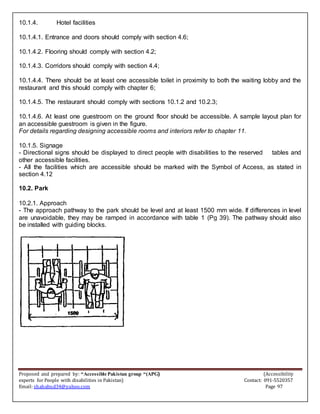
- Be not more than 450 mm above the bathtub rim.
6.9.6 A shower head should:-
- Be of the handheld type;
- Be provided with a hose not less than 1500 mm long; and
- Allow for use in a fixed position.
6.9.7 Where the shower head is mounted on a vertical bar, the bar should be installed so as not to
obstruct the use of grab bars.
6.9.8 Enclosures for bathtub should not:-
- Obstruct controls;
- Interfere with a person transferring from a wheelchair; and
- Have tracks mounted on the bathtub rim.
6.10 Shower Cubicles
6.10.1 Shower cubicles should have minimum interior dimensions of 1500 mm x 750 mm.
6.10.2 The minimum dear floor space in front of the shower entrance should be 1200 mm x 900 mm
with the 1200 mm dimension parallel to the shower entrance as shown in the figure.
6.10.3 The floor of the shower should be slip-resistant. (See annexure for additional information on
slip-resistance)
6.10.4 Grab bars for the shower cubicle should:-
- Comply with section 4.8.3;
- Have one L-shaped bar or two grab bars in L-shaped configuration between 700 mm and 800 mm
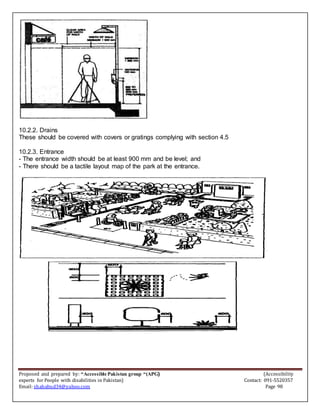
from the shower floor as shown in the figure; and
- Have one grab bar at least 750 mm long installed vertically with another at least 900 mm long
mounted horizontally as shown in the figure.
6.10.5 Controls for the shower cubicle should comply with section 4.9.
6.10.6 A shower head should:-
- Be of the handheld type;
- Be provided with a hose not less than 1500 mm long; and
- Allow for use in fixed position.
6.10.7 Where the shower head is mounted on a vertical bar, the bar should be installed so as not to
obstruct the use of grab bars.
Proposed and prepared by: “Accessible Pakistan group “(APG) (Accessibility
experts for People with disabilities in Pakistan) Contact: 091-5520357
Email: shahabud34@yahoo.com Page 74
6.10.8 Curbs for the roll-in shower cubicle should not be more than 10 mm high, beveled at a slope of
1:2.
6.10.9 If a seat is provided in the shower cubicle, the seat should: -
- Be self-draining, non-slip and with rounded edge;
- Be on the wall nearest to the controls;
- Have a minimum dimension of 400 mm wide extending the full depth of the cubicle, less a space
required for the shower curtain; and
- Have its top 500 mm from the floor.
6.1.8. Enclosures for the shower cubicle should not obstruct transfer from wheelchair onto shower
seat.
Proposed and prepared by: “Accessible Pakistan group “(APG) (Accessibility
experts for People with disabilities in Pakistan) Contact: 091-5520357
Email: shahabud34@yahoo.com Page 75
Chapter 7
Alighting and Boarding Areas
7.1. Car Park
7.1.1. Signage
7.1.1.1. The Symbol of Access should be displayed at approaches and entrances to car parks to
indicate the provision of accessible parking lot for people with disabilities within the vicinity.
7.1.1.2. Directional signs should be displayed at points where there is a change of direction to direct
people with disabilities to the accessible parking lot.
7.1.1.3. Where the location of the accessible parking lot is not obvious or is distant from the approach
viewpoints, directional signs should be placed along the route leading to the accessible parking lot
7.1.1.4. Accessible parking lot should be. Identifiable by the Symbol of Access in accordance to the
section 7.2.1. The sighs should not be obscured by a vehicle parked in the designated lot.
7.1.1.5. Vertical signs should be provided, in accordance to section 4.12, to make it easily visible.
Proposed and prepared by: “Accessible Pakistan group “(APG) (Accessibility
experts for People with disabilities in Pakistan) Contact: 091-5520357
Email: shahabud34@yahoo.com Page 76
7.1.2. Symbol
7.1.2.1. The Symbol of Access should be dearly marked on the accessible parking lot for drivers/
riders with disabilities only.
7.1.2.2. The Symbol painted on the designated lot should comply with section 4.12 and the following:
-
- A square with dimensions of at least 1000 mm but not exceeding 1500 mm in length;
- Be located at the center of the lot; and o The color of the symbol should be white on a blue
background.
7.1.3. Car Park Entrance
The car park entrance should have a height clearance of at least 2000 mm.
7.1.4. Location
7.1.4.1. Accessible parking lots that serve a building should be located nearest to an accessible
entrance and/ or lift lobby.
7.1.4.2. For a car park that does not serve a particular building, accessible parking lot should not be a
part of the driveway.
7.1.4.3. The accessible route should not require persons in wheelchairs to pass behind vehicles that
may be backing out
7.1.5. Accessible Car Parking Lot The accessible car parking lot should: -
- Have minimum dimensions 4800 mm x 3600 mm;
Proposed and prepared by: “Accessible Pakistan group “(APG) (Accessibility
experts for People with disabilities in Pakistan) Contact: 091-5520357
Email: shahabud34@yahoo.com Page 77
- Have a firm, level surface without aeration slabs; and
- Wherever possible, be sheltered.
7.1.6. Accessible Route
There should be an accessible route, complying with section 4.4, connecting the designated parking
lot with the accessible entrance of the building.
7.2. Taxi Stand
7.2.1. General
- At least one accessible route should be provided from the alighting and boarding point of the taxi
stand to the walkway that leads to the accessible building entrance.
- Directional signs should be installed to direct people with disabilities to an accessible entrance.
- Guiding blocks should be provided along the accessible walkway from the taxi stand to the building
entrance for the aid of people with visual impairments.
- The taxi stand pole should be visible after dark.
Proposed and prepared by: “Accessible Pakistan group “(APG) (Accessibility
experts for People with disabilities in Pakistan) Contact: 091-5520357
Email: shahabud34@yahoo.com Page 78
7.2.2. Location
7.2.2.1. Taxi stand should be located nearest to an accessible entrance.
7.2.2.2. A taxi bay should, where possible be provided at the level of approach or people with
disabilities to alight and to board he vehicle.
7.2.2.3. Where transfer has to be made from a vehicular surface to a pedestrian surface, the
driveway, pathway or walkway should be blended to a common level or be ramped.
7.2.3. Passage Width
A clear passageway-with a minimum width of 900 mm should be provided.
7.2.4. Handrails
Handrails should: -
- Comply with section 4.8; and
- Be installed at a height of 900 mm from the floor level.
Proposed and prepared by: “Accessible Pakistan group “(APG) (Accessibility
experts for People with disabilities in Pakistan) Contact: 091-5520357
Email: shahabud34@yahoo.com Page 79
7.2.5. Ramps
7.2.5.1. Where a taxi stand is not on the same level with the walkway or pathway, it should have two
separate ramps for boarding and alighting, conforming to table 1 and as shown in the figure.
7.2.5.2. Where there are curbs between the access aisle and the vehicle pick-up space, it should
have a curb ramp
7.2.6. Seats
Seats should be provided at the taxi stand for people with ambulatory disabilities. These seats should
be positioned such as not to impede the movement of wheelchair users.
7.2.7. Shelter
A shelter should be provided at the taxi stand for protection against adverse weather conditions.
7.3. Bus Stop
7.3.1. General
- At least one accessible route should be provided from the alighting and boarding point of the bus
stand to the walkway that leads to the accessible building entrance.
- Directional signs should be installed to direct people with disabilities to an accessible entrance.
- Guiding blocks should be provided along the accessible walkway from the bus stand to the building
entrance for the aid of people with visual impairments.
- The bus stand pole should be visible after dark.
Proposed and prepared by: “Accessible Pakistan group “(APG) (Accessibility
experts for People with disabilities in Pakistan) Contact: 091-5520357
Email: shahabud34@yahoo.com Page 80
7.3.2. Location
7.3.2.1. Bus stand should be located nearest to an accessible entrance.
7.3.2.2. Where transfer has to be made from a vehicular surface to a pedestrian surface, the
driveway, pathway or walkway should be blended to a common level or be ramped.
7.3.3. Passage Width
A clear passageway with a minimum width of 900 mm should be provided.
7.3.4. Handrails
Handrails should: -
- Comply with section 4.8; and
- Be installed at a height of 900 mm from the floor level.
7.3.5. Seats
Seats should be provided at the bus stand for people with ambulatory disabilities. These seats should
be positioned such as not to impede the movement of wheelchair users.
7.3.6. Shelter
A shelter should be provided at the bus stand for protection against adverse weather conditions.
Proposed and prepared by: “Accessible Pakistan group “(APG) (Accessibility
experts for People with disabilities in Pakistan) Contact: 091-5520357
Email: shahabud34@yahoo.com Page 81
7.3.7. Ramps
7.3.7.1. Where a bus stand is not on the same level with the walkway or pathway, it should have two
separate ramps for boarding and alighting, conforming to table l as shown in the figure.
7.3.7.2. Where there are curbs between the access aisle and the vehicle pick-up space, it should
have a curb ramp complying with section 5.1
7.4. Railway Station
7.4.1. Level Approach
- The approach route should not have level differences. If the station is not on the same level as the
walkway or pathway, it should a ramp conforming to table 1.
- Walkway surfaces should be non-slip.
- Approach walkway should have guiding blocks for people with visual impairments
7.4.2. Station Entrances and Exits
These should have a minimum width of 1600 mm and be level or ramped, complying with table 1
(Bg 39).
Proposed and prepared by: “Accessible Pakistan group “(APG) (Accessibility
experts for People with disabilities in Pakistan) Contact: 091-5520357
Email: shahabud34@yahoo.com Page 82
7.4.3. General Station Interiors
- There should be a tactile layout map of the station placed right at the entrance.
- The lobby/ corridor width should be at least 1800 mm.
- The floor surfaces should be non-slip and level.
- There should be directional signs indicating all the facilities and the various platform numbers.
- The signage should also be displayed in Braille/ raised numbers to aid people with visual
impairments
- Guiding and warning blocks should be installed on the corridors/concourse.
- Stairs should comply with section 5.3
- Lifts should comply with section 5.4
- All the audio announcements should be supplemented with visual information displays for people
with hearing impairments.
- Seating areas should be provided at regular intervals for people with ambulatory disabilities.
7.4.4. Reservation and Information Counters
- Should have clear floor space of at least 900 mm x 1200 mm in front of the counters;
- There should be at least one low counter at a height of 750 mm to 800 mm from the floor with clear
knee space of 750 mm high by 900 mm wide by 480 mm deep;
- At least one of the counters should have an induction loop unit to aid people with hearing
impairments; and
- The counters should have pictographic maps indicating all the services offered at
the counter and at least one of the counter staff should be sign language literate.
Proposed and prepared by: “Accessible Pakistan group “(APG) (Accessibility
experts for People with disabilities in Pakistan) Contact: 091-5520357
Email: shahabud34@yahoo.com Page 83
7.4.5. Toilet Facilities
There should be at least one accessible toilet complying with chapter 8.
7.4.6. Ticket Gates
At least one of the ticket gates should: -
- be minimum 900 mm wide to allow a wheelchair user through; and
- have a continuous line of guiding blocks for people with visual impairments.
7.4.7. Platforms
Platforms should: -
- Have a row of warning blocks installed next to the edge;
- Have non-slip and level flooring;
- Have seating areas for people with ambulatory disabilities; and
- Be well illuminated.
- There should be no gap or difference in level between the train entry door and the platform.
7.4.8. Airports
- Airports have similar requirements as detailed in section 7.4
7.5. Piers and Jetties
7.5.1. General
- All forms of water transport should be accessible to people with disabilities.
- Ferries should be fitted with accessible ramps complying with table 1 (Pg 39).
- Within a cabin, space should be set aside for securing a wheelchair in a position for comfortable
integration with other passengers.
- Piers should be fully accessible and have simple boarding and disembarkation procedures.
- Guidelines for designing accessible piers and jetties are similar to the ones for railway stations
except for the platform.
Proposed and prepared by: “Accessible Pakistan group “(APG) (Accessibility
experts for People with disabilities in Pakistan) Contact: 091-5520357
Email: shahabud34@yahoo.com Page 84
Chapter 8
Fire Evacuation Needs
Efforts to integrate people with disabilities into mainstream society may result in new or increased
challenges to raise standards regarding safety in the event of fire. This section describes the
important aspects of fire safety to be considered by designers, engineers, fire safety personnel,
building managers, as well as non-disabled and disabled facility users.
8.1. Understanding Fire
Unless there are items in a room that are especially flammable, fire at its initial stage spreads slowly.
As the fire gets bigger, toxic gases are given off; these quickly rise to the ceiling and spread under
doorways. If there is enough material in the room, the fire will eventually develop very rapidly with
flames and smoke engulfing the entire room or building.
If fires are discovered while they are still very small, they can usually be easily extinguished.
However, a well-established fire cannot be extinguished by untrained persons and trying to stop such
a fire could be extremely dangerous and could waste valuable escape time.
8.2. Fire-emergency Safety
8.2.1. General Principles
- Safety is important for everyone;
- Persons with disabilities should be helped to protect themselves; and
- Persons with disabilities should be included in fire safety training.
8.2.2. Design Elements and Safety Measures
1. It is important for buildings to be designed with safety features. Fire-safety design elements are
Proposed and prepared by: “Accessible Pakistan group “(APG) (Accessibility
experts for People with disabilities in Pakistan) Contact: 091-5520357
Email: shahabud34@yahoo.com Page 85
directed towards three objectives:
- Detecting the fire;
- Separating people from the fire either by enabling prompt evacuation of the building, or by providing
a refuge area within the building where occupants may safely await rescue; and
- Controlling or extinguishing the fire.
In certain cases, persons with disabilities may not require specific design features. However,
adequate fire-safety education is a necessary preventive measure. In a fire-emergency situation, non-
People With Disability s can become handicapped. Everyone is effectively disabled in the case of a
fire. Smoke and toxic gases can obscure vision; bells and alarms can impair hearing and create panic
and fear, thus limiting the judgmental abilities of everyone.
- The ideal situation is for everyone to be as aware and capable of self-preservation as much as
possible during an emergency. This often involves modification of the built environment. For example:
-
- Flashing lights could be activated simultaneously with an audible alarm system to alert persons with
hearing impairments.
- Tactile maps showing alternative escape routes could be installed for persons who are visually
impaired.
- Persons with mobility impairments require little, and sometimes, no assistance from others if areas
of refuge have been pre-established and are dearly indicated.
- Large public buildings could introduce voluntary registration in the main lobby so that persons with
disabilities may easily be located in case of an emergency.
- Persons with disabilities need to be included in all fire drills.
Proposed and prepared by: “Accessible Pakistan group “(APG) (Accessibility
experts for People with disabilities in Pakistan) Contact: 091-5520357
Email: shahabud34@yahoo.com Page 86
8.3. Alarm System
- Alarm signals such as flashing lights, vibrating beds or variable velocity fans can alert residents with
hearing and/ or visual impairments.
- Emergency exit lights and directional signals mounted near the floor have been found to be useful in
cases where a lot of smoke is present.
- Pre-recorded messages and on-the-spot broadcasts from a central control centre would be of great
benefit.
8.4. Raising the Alarm
- Special devices, e.g., fire alarm boxes, emergency call buttons and lighted panels may be needed
by persons who have hearing and/ or visual impairments.
- Telecommunication devices for persons with hearing impairments (TDD) are practical for typing in
conversations. A pre-recorded message installed in the telephone would be useful for notifying the
fire department.
8.5. Fireproof Lifts
- High-rise buildings should have special fireproof lifts for the exclusive use of people with mobility
impairments, in emergencies.
- These lifts should comply with section 5.4
These lifts are also beneficial for the fire fighters to get into the building in case of fire.
8.6. Refuge
An alternative to immediate evacuation of a building via staircases and/or lifts is the movement of
People With Disability s to areas of safety within a building. If possible, they could remain there until
the fire is controlled and extinguished or until rescued by fire fighters.
It is useful to have the provision of a refuge area, usually at the fire-protected stair landing on each
floor that can safely hold one or two wheelchairs.
The refuge area should:-
- Have doorways with dear opening width of 900 mm and complying with section 4.6; and
- Have an alarm switch installed between 900 mm and 1200 mm from the floor level.
Proposed and prepared by: “Accessible Pakistan group “(APG) (Accessibility
experts for People with disabilities in Pakistan) Contact: 091-5520357
Email: shahabud34@yahoo.com Page 87
Chapter 9
Transport and Road Planning
9.1. Sidewalk
Sidewalk should: -
- Have non-slip floor surface;
- Be along the entire length of the road;
- Be at least 1500 mm wide;
- Have guiding blocks for people with visual impairments;
- Be fitted with visual signs and tactile dues (e.g., Braille blocks) as route finders;
- Preferably have well defined edges of paths and routes by use of different colors and textures;
- Have no obstacles or projections along the pathway. If this is unavoidable, there should be clear
headroom of at least 2000 mm from the floor level;
- Have curb cuts complying with section 5.1 where-ever a person is expected to walk into or off the
pathway; and
- Have warning blocks installed next to all entry and exit points from the pathway.
Proposed and prepared by: “Accessible Pakistan group “(APG) (Accessibility
experts for People with disabilities in Pakistan) Contact: 091-5520357
Email: shahabud34@yahoo.com Page 88
9.2. Curb Ramp at Walkway and Pedestrian Crossing.
9.2.1. Curb ramp at walkway should comply with section 5.1.
9.2.2. Curb ramp at pedestrian crossing should be wholly contained in the area designated for
pedestrians' use as shown in the figure
9.3. Road Intersections
- Pedestrian crossings should be equipped with traffic control signals;
- Constructing traffic islands to reduce the length of the crossing is recommended for the safety of all
road users; and
- Guide strips should be constructed to indicate the position of pedestrian crossings for the benefit of
people with visual disabilities.
88
Proposed and prepared by: “Accessible Pakistan group “(APG) (Accessibility
experts for People with disabilities in Pakistan) Contact: 091-5520357
Email: shahabud34@yahoo.com Page 89
- Road bumps are helpful in reducing the speed of traffic approaching the intersection.
9.4. Islands
Raised islands in crossings should: -
- Be cut through and level with the street as shown in the figure; or
- Have curb ramps, complying with section 5.1, at both the sides and have a level area of not less
then 1500 mm long in the middle; and
- A colored tactile marking strip at least 600 mm wide should mark the beginning and the end of a
traffic island, to guide pedestrians with impaired vision to its location.
Proposed and prepared by: “Accessible Pakistan group “(APG) (Accessibility
experts for People with disabilities in Pakistan) Contact: 091-5520357
Email: shahabud34@yahoo.com Page 90
9.5. Traffic signal
- Pedestrian traffic lights should be provided with clearly audible signals for the benefit of pedestrians
with visual impairments;
- Acoustic devices should be installed on a pole at the point of origin of crossing and not at the point
of destination;
- The installation of two adjacent acoustic devices such as beepers is not recommended in order to
avoid disorientation; and
- The time interval allowed for crossing should be programmed according to the slowest crossing
persons.
- Acoustical signals encourage safer crossing behavior among children as well
9.6.Subway and Overhead Bridge
Subways and overhead bridges should be accessible for people with disabilities. This may be
achieved by: -
- Provision of slope ramps or lifts at both the ends to enable wheelchair accessibility;
- Ensuring that the walkway is at least 1500 mm wide;
- Provision of tactile guiding and warning blocks along the length of the walkway;
- Keeping the walkway free from any obstructions and projections; and
- Providing for seats for people with ambulatory disabilities at regular intervals along the walkway and
at landings.
9.7. Public Transport
9.7.1. Land Transport
General
- Buses, trams, taxis, mini-buses and three-wheelers should be designed as far as practicable to
include facilities that can accommodate people with disabilities.
- New vehicles when purchased should comply with accessibility standards to enable all people,
including those in wheelchairs, to use the service provided.
- Equally important, travel routes to bus stops should also be barrier-free to ensure that persons can
travel from their homes to their chosen pick-up point. Training should be provided for drivers to help
them become aware of the needs of persons with disabilities. - For details regarding accessible bus
stops refer to section 7.3
9.7.1.1. Accessible buses
Accessible buses should have the following features:
Doors
Bus doors should: -
- Be at least 900 mm wide;
- Have a low-level step installed;
- Have handrail and footlight installed; and
- Have apparatus such as a hydraulic lift or pull-out ramp installed in the doorway for wheelchair
users.
Proposed and prepared by: “Accessible Pakistan group “(APG) (Accessibility
experts for People with disabilities in Pakistan) Contact: 091-5520357
Email: shahabud34@yahoo.com Page 91
Wheelchair Space
- Space for a wheelchair should be provided in an appropriate position, without preventing other
passengers from getting on and off;
- The location of that space should be as indicated, inside and outside the bus, using the
Standard symbol for wheelchair accessibility;
- Wheel stoppers and wheelchair safety belts should be provided.
Proposed and prepared by: “Accessible Pakistan group “(APG) (Accessibility
experts for People with disabilities in Pakistan) Contact: 091-5520357
Email: shahabud34@yahoo.com Page 92
Alighting Buzzers
- An appropriate number of alighting buzzers should be provided in positions that are easily
accessible for seated or standing passengers; and
- The push button of an alighting buzzer should be clearly visible, of adequate size, installed at 900
mm to 1200 mm from the bus floor level and display the information in Braille/ raised numbers as
well.
Information Signs
- Information on the names of all stops along a bus route should be indicated inside the bus by
displaying the text in a suitable position; and
- Information on a route and its final destination should be displayed outside the bus in large text,
especially on the front and side of the bus. This information should be in a bright contrasting color and
be well illuminated be an external tight to make it readable in the dark.
9.7.1.2. Taxi Interiors
Taxi should be adapted to allow passengers to get in and out of them while remaining seated in their
wheelchairs.
9.7.1.3. Rail Transport
General
- Whether over-ground or underground, rail travel is a highly effective mode of transport. - Every train
should contain fully accessible carriages.
- Staff should be trained in methods of assistance and be at hand on request.
- Stations for all rail travel should be fully accessible with extra wide turnstiles where possible
alongside wheelchair .accessible doorways complying with section 4.6.
- Staff should be on hand to assist persons with disabilities to enter or exit through convenient gates.
- All new railway stations should be designed to be fully accessible.
- In a situation where full accessibility is not secured at the initial construction 'stage, it is imperative to
design the layout of the station in such a manner that access features can be easily modified at a
later stage.
Proposed and prepared by: “Accessible Pakistan group “(APG) (Accessibility
experts for People with disabilities in Pakistan) Contact: 091-5520357
Email: shahabud34@yahoo.com Page 93
- For details regarding accessible railway stations refer to section 7.4
Accessible Railway Cars
Railway cars should have the following features: -
- Railway Car Doors
- Car doors should be at least 900.mm wide; and
- The gap between the car doors and the platform should be less than 12 mm.
- If the car door and the platform cannot be at the same level, then at least one car door should have
apparatus such as a hydraulic lift or pull-out ramp installed in the doorway for wheelchair users.
- Wheelchair space
- Space for a wheelchair should be available at the side of the door;
- The space should be indicated inside and outside the car by using the international symbol of
access; and
- Wheel stoppers and ring-strap or other appropriate safety grip should be provided for wheelchair
users.
Proposed and prepared by: “Accessible Pakistan group “(APG) (Accessibility
experts for People with disabilities in Pakistan) Contact: 091-5520357
Email: shahabud34@yahoo.com Page 94
- Seats
An appropriate number of designated seats for passengers with disabilities and elderly people should
be provided near the doors.
- Aisles
Aisles should be at least 750 mm wide.
- Information Signs and Announcements
- A map of train routes should be installed. This should be in Braille/ raised numbers as well;
- In each car, there should be an announcement and provision of a visual display of the names of
stations en route. This display should be in raised numbers with sharp contrast from the background.
9.8 Water Transport
- All forms of water transport should be accessible to people with disabilities.
- Ferries should be fitted with accessible ramps complying
with table 1 (pg 39).
- Within a cabin, space should be set aside for securing a wheelchair in a position for comfortable
integration with other passengers.
- Piers should be fully accessible and have simple boarding and disembarkation procedures.
- For details regarding accessible piers and jetties refer to section 7.5
9.8.1 Ship and Ferry Interior
- Doors should be at least 900 mm wide;
- Aisles should be at least 750 mm wide;
- An accessible toilet cubicle should be provided on board the ship, complying with section 6.3 and
6.4; and
- Wheel stoppers and ring-strap or other appropriate safety grip should be provided for wheelchair
users.
9.9. Air Transport
General
- All domestic, short-haul aircraft should have the capacity to safely accommodate at least one
wheelchair passenger.
- All national and international airports should be fully accessible and have appropriate boarding
facilities.
- Special attention should be given to accessible toilet facilities on board aircraft.
- For details regarding accessible airports refer to section 7.6
Aircraft Interior
- Doors should be at least 900 mm wide;
- Aisles should be at least 750 mm wide;
- An accessible toilet cubicle should be provided on board the aircraft, complying with section 6.3 and
6.4; and
- Plugs should be accessible for passengers requiring their respirators to be plugged into electricity
outlets.
Proposed and prepared by: “Accessible Pakistan group “(APG) (Accessibility
experts for People with disabilities in Pakistan) Contact: 091-5520357
Email: shahabud34@yahoo.com Page 95
Chapter 10
Recreational Facilities
10.1. Hotel and Eating Outlet
10.1.1. General
Provisions of access should be made available to people with disabilities at all eating outlets and
establishments, such as food courts, fast food outlets, restaurants and hotels.
10.1.2. Walkways within Outlet
- A circulation path of at feast 1200 mm wide should be provided in front of ail the eating outlets.
- An accessible route with a minimum dear width of 900 mm should be provided from the circulation
path to the tables reserved for people with disabilities.
10.1.3. Seating Arrangement
- Height of the table reserved for people with disabilities should not be higher than 800 mm with a
minimum clear knee space of 750 mm high and 480 mm deep as shown in the figure.
Proposed and prepared by: “Accessible Pakistan group “(APG) (Accessibility
experts for People with disabilities in Pakistan) Contact: 091-5520357
Email: shahabud34@yahoo.com Page 96
- Where the eating outlet or establishment is provided with fixed seats, the minimum clear space
between the seats for a wheelchair user to pass should be 750 mm.
- Where fixed seats are provided, it is advisable to provide empty spaces between the seats to
accommodate the wheelchair user.
Proposed and prepared by: “Accessible Pakistan group “(APG) (Accessibility
experts for People with disabilities in Pakistan) Contact: 091-5520357
Email: shahabud34@yahoo.com Page 97
10.1.4. Hotel facilities
10.1.4.1. Entrance and doors should comply with section 4.6;
10.1.4.2. Flooring should comply with section 4.2;
10.1.4.3. Corridors should comply with section 4.4;
10.1.4.4. There should be at least one accessible toilet in proximity to both the waiting lobby and the
restaurant and this should comply with chapter 6;
10.1.4.5. The restaurant should comply with sections 10.1.2 and 10.2.3;
10.1.4.6. At least one guestroom on the ground floor should be accessible. A sample layout plan for
an accessible guestroom is given in the figure.
For details regarding designing accessible rooms and interiors refer to chapter 11.
10.1.5. Signage
- Directional signs should be displayed to direct people with disabilities to the reserved tables and
other accessible facilities.
- All the facilities which are accessible should be marked with the Symbol of Access, as stated in
section 4.12
10.2. Park
10.2.1. Approach
- The approach pathway to the park should be level and at least 1500 mm wide. If differences in level
are unavoidable, they may be ramped in accordance with table 1 (Pg 39). The pathway should also
be installed with guiding blocks.
Proposed and prepared by: “Accessible Pakistan group “(APG) (Accessibility
experts for People with disabilities in Pakistan) Contact: 091-5520357
Email: shahabud34@yahoo.com Page 98
10.2.2. Drains
These should be covered with covers or gratings complying with section 4.5
10.2.3. Entrance
- The entrance width should be at least 900 mm and be level; and
- There should be a tactile layout map of the park at the entrance.
Proposed and prepared by: “Accessible Pakistan group “(APG) (Accessibility
experts for People with disabilities in Pakistan) Contact: 091-5520357
Email: shahabud34@yahoo.com Page 99
10.2.4. Interiors
- Benches, dustbins and drinking water facilities should be installed with adequate space around
them for wheelchair users to maneuver.
- Wheelchair accessible pathways of at least 1500 mm width should be constructed in the park.
- The pathways should also be lined with tactile guiding blocks.
- There should be warning blocks placed in proximity to obstructions, projections and hazards.
10.3. Auditorium and Cinema Halls
10.3.1. Accessible seating spaces should be provided in a variety of locations to give people with
disabilities a viewing option.
10.3.2. Some fixed seats will have to be taken off from various locations next to the to provide
wheelchair parking space of minimum 750 mm wide by 1200 mm long.
10.3.3. All the facilities should be accessible to people with disabilities.
Proposed and prepared by: “Accessible Pakistan group “(APG) (Accessibility
experts for People with disabilities in Pakistan) Contact: 091-5520357
Email: shahabud34@yahoo.com Page 100
Chapter 11
Adapted Housing
11.1. Exterior Accessibility
11.1.1. Route of Entry
11.1.1.1. Street should: -
- Have hard, non-slip and even surface;
- Be free of lose gravel;
- Provide continuing common surface not interrupted by steps or sudden changes in level and other
obstructions such as manhole covers, light or telephone poles; and
- Be marked with signage in Braille and visual signage at appropriate height to indicate the shopping
area, apartment blocks, bus stop, taxi stand, etc.
11.1.1.2. If there is more than one entry to the dwelling, the most accessible one should be selected
considering proximity to the driveway, most level walking surface, height of stairs and available
handrails.
11.1.1.3. The driveway should provide easy access to the home by means of a walkway that is level
and free of cracks and uneven surfaces. For details regarding parking refer to section 7.1
11.1.1.4. Stairs should conform to section 5.3 and be provided with handrails conforming to section
4.8
11.1.1.5. If a ramp is to be installed, it should conform to section 5.2
Proposed and prepared by: “Accessible Pakistan group “(APG) (Accessibility
experts for People with disabilities in Pakistan) Contact: 091-5520357
Email: shahabud34@yahoo.com Page 101
11.1.2. Entrance
11.1.2.1. Entrance should be well lit and be provided with an adequate cover from adverse weather
conditions.
11.1.2.2. For wheelchair users, the entrance should have a platform of at least 1500 mm x 1500 mm.
This will enable the person to rest and prepare for entry.
11.1.2.3. The door should comply with section 4.6 and have handles complying with section 4.9.
11.2. General Interior Considerations
11.2.1. Furniture Arrangement
- Sufficient room should be made available for maneuvering a wheelchair (at least 1500 mm turning
radius) or ambulating with an assistive device such as a walking frame or a white cane;
- Clear passage should be allowed from one room to the next;
- Unrestricted access should be provided to electrical outlets, telephones and wall switches;
- All controls and operating mechanisms should comply with section 4.9; and
- A clear floor space for the wheelchair, of at least 900 mm x 1200 mm, should be provided in front of
all the utilities and furniture.
11.2.2. Floors
- Floor surface should comply with section 4.2; and
- For people with low vision, lines of brightly colored tape may be placed on the floor surface to assist
mobility in poorly lighted areas.
11.2.3. Doors
- Should comply with section 4.6;
- Should have handles complying with section 4.9;
- Knurled surface door handles should be used on interiors of dwellings frequented by people with
visual impairments. These abrasive, knurled surfaces indicate that the door opens to a hazardous
area and alerts the individual to danger.
Proposed and prepared by: “Accessible Pakistan group “(APG) (Accessibility
experts for People with disabilities in Pakistan) Contact: 091-5520357
Email: shahabud34@yahoo.com Page 102
Glass doors should be marked with a bright colored motif at eye level to aid people with low vision.
Proposed and prepared by: “Accessible Pakistan group “(APG) (Accessibility
experts for People with disabilities in Pakistan) Contact: 091-5520357
Email: shahabud34@yahoo.com Page 103
11.2.4. Stairs
- Should comply with section 5.3; and
- Should be well lit;
11.3. Bedroom Area
11.3.1. The bedroom should be planned to provide a 1500 mm turning in space for wheelchair, at
least near all the doors.
11.3.2. There should be a dear floor space of at least 900 mm x 1200 mm In front of all the furniture.
11.3.3. Bed for a wheelchair user should: -
- Have a height of 500 mm from the floor surface;
- Be stable. Stability may be improved by placing the bed against a wall or in the comer of the room
(except for when the wheelchair user plans to make the bed); and
- Be positioned to provide at least a 1500 mm turning in space at the transfer side.
11.3.4. A bedside table or cabinet between 450 mm and 900 mm from the floor may be useful to hold
a lamp, a telephone, necessary medications and a call bell if assistance is needed.
11.3.5. The closet should: -
- Have a dear floor space of at least 900 mm x 1200 mm;
- Have the clothes bar at a height of 1200 mm from the floor;
- Have shelves installed at various levels between 300 mm and 1150 mm from the
floor surface;
- Have door handle conforming to section 4.9
11.3.6. Wall hook installed at a height of 1100 mm to 1300 mm may be a useful addition to the closet
area.
106
Proposed and prepared by: “Accessible Pakistan group “(APG) (Accessibility
experts for People with disabilities in Pakistan) Contact: 091-5520357
Email: shahabud34@yahoo.com Page 104
Proposed and prepared by: “Accessible Pakistan group “(APG) (Accessibility
experts for People with disabilities in Pakistan) Contact: 091-5520357
Email: shahabud34@yahoo.com Page 105
11.4. Living Room
11.4.1. At least 1500 mm turning in space for wheelchair should be provided near all entry points to
the living room.
11.4.2. A living-dining combination is preferable to a kitchen-dining combination (except when the
wheelchair user does the cooking).
11.4.3. The seating space for a wheelchair user at the dining table should provide a clear knee space.
The dear knee space for a wheelchair user is at least 900 mm wide, 480 mm deep and 750 mm nigh.
11.4.4. Floor surface should comply with section 4.2
11.4.5. There should be a clear floor space for the wheelchair of at least 900 mm x 1200 mm in front
of all the fixtures.
11.4.6. Chair seat heights should not be less than 500 mm
11.4.7. Controls and operating mechanisms should comply with section 4.9
Proposed and prepared by: “Accessible Pakistan group “(APG) (Accessibility
experts for People with disabilities in Pakistan) Contact: 091-5520357
Email: shahabud34@yahoo.com Page 106
11.5. Washroom
Should comply with chapter 6.
11.6. Kitchen
11.6.1. Wheelchair turning radius of at least 1500 mm should be provided between the counter and
the opposite walls.
11.6.2. Floor surface should allow for easy wheelchair maneuverability.
Counter tops: -
- Counter tops should be between 750 mm and 800 mm in height and provide for clear knee space
for a wheelchair user. The clear knee space for a wheelchair user is at least 900 mm wide, 480 mm
deep and 750 mm high;
- Counter tops/ slabs should have rounded edge;
- All surfaces should be smooth to facilitate sliding of heavy items from one area to another; and
- Slide-out working spaces are useful in providing an over-the-lap working surface.
11.6.4. For people with ambulatory disabilities, stools (preferably with back and foot rests) should be
provided strategically at the main work area(s).
11.6.5. Shelves and storage spaces should be between 300 mm and 1200 mm height from the floor
surface.
11.6.6. All controls and operating mechanisms should comply with section 4.9
11.6.7. Any exposed hot-water pipes under the sink should be insulated to avoid burns.
Proposed and prepared by: “Accessible Pakistan group “(APG) (Accessibility
experts for People with disabilities in Pakistan) Contact: 091-5520357
Email: shahabud34@yahoo.com Page 107
Chapter 12
Annexure
12.1 Provision of Access in the 'People with Disabilities Act, 1981’
Disability Act, 1981 casts obligations on appropriate Governments and local authorities for creating
barrier free facilities. For example:
Section 30 stipulates that the appropriate governments shall by notification prepare a comprehensive
education scheme, which shall make provision for:
(b) The removal of architectural barriers from schools, colleges or other institutions, imparting
vocational and professional training
Similarly, Section 38 stipulates
(1) The appropriate governments and local authorities shall by notification formulate schemes for
ensuring employment of persons with disabilities, and such schemes may provide for-
(d) Health and safety measures and creation of a non-handicapping environment in places were
persons with disabilities are employed.
To ensure right to movement for PWD's, Section 45 calls upon the appropriate governments to
provide for-
(a) installation of auditory signals at red lights in the public roads for the benefit of persons with visual
handicap;
(b) causing curb cuts and slopes to be made in pavements for the easy access of wheelchair users
(c) engraving on the surface of the zebra crossing for the blind or for persons with low vision;
(d) Engraving on the edges of railway platforms for the blind or for with low vision;/
(e) devising appropriate symbols of disability;
In protection of the Right to have free access to public places, the Disability convention in article 9
enjoins upon the appropriate governments and the local authorities to provide for: -
(a) ramps in public buildings;
(b) Braille symbols and auditory signals in elevators or lifts;
(c) ramps in hospitals, education institutes ,masques, madrasas, primary health centers and other
medical care and rehabilitation institutions.
The architects of the Disability Act were perhaps conscious of the fact that for creation of barrier free
environment in educational institutions, vocational training centers, places of work and in other public
places, special designs of buildings and special technologies would need to be developed.
Therefore, Article 9 the convention calls upon the appropriate governments and local authorities to
promote and sponsor research, Inter alias, in the on site modifications in offices and factories.
Proposed and prepared by: “Accessible Pakistan group “(APG) (Accessibility
experts for People with disabilities in Pakistan) Contact: 091-5520357
Email: shahabud34@yahoo.com Page 108
Slip resistant surfacing
Material Dry and
unpolished
Wet Remarks
Clay Tiles (Carborundum
finish)
Very Good Very Good May be suitable for external stairs
Carpet Very Good Good
Clay Tiles (Textured) Very Good Good May be suitable for external stairs
Cork Tiles Very Good
PVC with non-slip granules Very Good Good
PVC Very Good Poor to fair Slip-resistance when wet may be
improved if PVC is textured.
Edges of sheet liable to cause
tripping if not fixed firmly to base.
Rubber (sheets or tiles) Very good Very poor Not suitable near entrance doors.
Mastic asphalt Good Good
Vinyl Asbestos tiles Good Fair
Linoleum Good Poor to Fair Edges of Sheets may cause
tripping if not securely fixed to
base
Concrete Good Poor to fair If a textured finish or a non-slip
aggregate is used, slip resistance
value when wet, may be
increased to good.
Granolithic Good Poor to fair Slip-resistance when wet may be
improved to good, by
incorporating carborundum finish.
Cast Iron Good Poor to fair Slip-resistance may be acceptable
when wet if open treads used.
Clay Tiles Good Poor to fair Slip-resistance when wet and
polished very poor
Terrazzo Good Poor to fair Non-Slip nosing necessary on
stairs. Slip-resistance when
polished or if polish is transferred
by shoes from adjacent surface
very poor.
Proposed and prepared by: “Accessible Pakistan group “(APG) (Accessibility
experts for People with disabilities in Pakistan) Contact: 091-5520357
Email: shahabud34@yahoo.com Page 109
12.3 Understanding Wheelchair Transfers
Proposed and prepared by: “Accessible Pakistan group “(APG) (Accessibility
experts for People with disabilities in Pakistan) Contact: 091-5520357
Email: shahabud34@yahoo.com Page 110
12.4 Minimum Access Provisions
It will be ideal to have all buildings completely accessible but following are the minimum access
needs:
1.1 Type of building
- Single detached, single dwelling units A minimum of 2 percent of the
total number of units to be
constructed with barrier free
environment
- Staff housing, multiple welling and high rise
Residential units.
A minimum of 1 unit for every 25,
plus 1 additional unit for every 100
units thereafter.
Tenement houses, row houses, apartments
and
town houses
A minimum of 1 unit for up to 150
units, and a minimum of 1
additional unit for every 100 units
thereafter to be accessible
Post offices, banks and financial service
institutions
A minimum of 1 lowered service
Counter on the premises.
Bank and ATM
A minimum of 1 lowered automatic
teller machine (ATM) / cash
disbursement point on the
Premises. Stamp vending machine.
Shop-houses and single storey shops Accessible shopping arrears
- Places of worship Entrances and exits and main area
of worship to be accessible
Temples: access to shrines and
courtyards
Mosques: access to area for
ablution
Churches: access to confessionals,
and chapels.
- Food centers A minimum of 1 table without
stools or seats attached to the floor
for every 10 tables.
A minimum of 2 tables without
stools or seats attached to the floor
for the whole premises
Accessible entrance
Proposed and prepared by: “Accessible Pakistan group “(APG) (Accessibility
experts for People with disabilities in Pakistan) Contact: 091-5520357
Email: shahabud34@yahoo.com Page 111
Community centers, village halls,
auditoria, concert halls, assembly halls,
cinemas, theaters and other places of
public assembly.
Accessible entrance exists, aisles and main community or
public
gathering areas Accessible toilet facilities should be nearby
Seating for persons with disabilities to be accessible from
main
Entrance and lobbies. Various seating/viewing choice to be
provided for persons in wheelchairs throughout the main
seating area a minimum of 2 wheelchair spaces for seating
capacity up to 100 seats a minimum of 4 wheelchair spaces
for seating capacity for over 100 to 400 seats.
Proposed and prepared by: “Accessible Pakistan group “(APG) (Accessibility
experts for People with disabilities in Pakistan) Contact: 091-5520357
Email: shahabud34@yahoo.com Page 112
12.5 Rural Requirements
The majority of people in the Pakistan live in rural areas. In the coming decade, notwithstanding rapid
urbanization, there will be a higher increase in absolute numbers of the rural population. Higher rates
of mortality and morbidity, a lower rate of literacy and a higher incidence of poverty and deprivation
characterize rural communities, placing them in a less advantageous position than their urban
counterparts.
Furthermore, while several basic amenities such as piped water supply, sanitation, toilets and access
to the mass media (e.g., radio and television) are available to urban residents at the household level,
in rural areas, these are often available only as community amenities.
The urban built environment includes modern public facilities for education, training, employment and
self-employment, as well as entertainment. In contrast, the rural built environment includes
standpipes and wells, village dispensaries, primary schools, community toilets and-water tanks,
village markets, agricultural extension centers and village or district administrative institutions. These
facilities have an impact on the daily lives of people in the rural areas. The extent to which the
facilities are accessible and usable by persons with disabilities and elderly people determines their
integration into rural community life.
Some of the issues faced by rural People with Disability s and elderly people are: non-accessible
paths, roads without pavements and non-accessible toilets or latrines. While planning and design
requirements for urban settings could be adapted for rural built environments, due attention needs to
be given to local conditions.
Planning and design for the rural areas should take into consideration the options presented by local
solutions using locally available materials. Applied research and experimentation in the use of
appropriate technology for the development of barrier-free design for the rural built environment are
urgently needed. This is an area for exchange of information among the developing countries
especially in the Asian region.
Governments, especially local authorities, have a responsibility to improve the understanding of
issues concerning barrier-free environments in rural communities. This is particularly so in the case of
remote rural areas where there is a lack of awareness. Development assistance and the communities
have limited access to the mass media. The need for public awareness activities in rural areas is
critical in view of the greater difficulty, compared with urban areas, in enforcing access legislation and
policy provisions. Actions to improve public awareness of access issues among rural communities
include the mobilization of village-level opinion leaders and involving them in dissemination of the
relevant messages using folk and traditional media.
Proposed and prepared by: “Accessible Pakistan group “(APG) (Accessibility
experts for People with disabilities in Pakistan) Contact: 091-5520357
Email: shahabud34@yahoo.com Page 113
12.6 Conducting Access Audits
Access audits are surveys conducted of already built environment that needs to be made accessible.
The access audit team should preferably consist of the following:
- People with disabilities who understand access needs
- Architect or a civil engineer, wheelchair user and other disabled persons ideally of the building
being audited.
Before going for the access audit make sure you have the following things:
- The audit Checklist
- Measuring tape
- A writing pad and a pen
- A camera
- A hat or dark glasses especially if you are surveying external environment
Once you have reached the building to be surveyed follow the checklist and keep checking the
accessibility, beginning from the parking to the main entrance and through all the sections of the
building.
It is important to keep measuring the heights and widths of all areas you pass through like the height
of the stairs, width of the doors, size of the toilet, height of the counters etc.
Keep discussing the changes you recommend for specific barriers with the architect or the civil
engineer. Also whatever recommendations are thought of keep jotting them down on the writing pad
along with the existing measurements.
While surveying the building keep photographing the areas that need change so that they can be a
reminder while drafting the main report and also when the report is submitted to the authorities it is
easier to make them understand the change required.
Once the survey is over you need to have your photographs developed and prepare a final report to
be submitted to the authorities for incorporating the changes.
The final report should be precise with well thought out recommendations. As far as possible, suggest
low cost simple solutions, as these solutions are most likely to be implemented by the authorities. But
even though a recommendation may be expensive to implement, if it is essential, make that
recommendation with suitable reasoning. Also with all recommendation do not forget mention the
present measurements along with the ideal measurements. Supplement the final report with the
photographs and if possible illustrations so that it is easy for the authorities to understand.your role do
not end with the submission of the report. Ones you have submitted your final report keep following
up with the authorities to make sure that the changes in the building are made.
Proposed and prepared by: “Accessible Pakistan group “(APG) (Accessibility
experts for People with disabilities in Pakistan) Contact: 091-5520357
Email: shahabud34@yahoo.com Page 114
12.7 Access Audit Forms
ACCESS AUDIT FORM FOR EXTERNAL ENVIRONMENT
Name of the Building: ________________________________________
Address: __________________________________________________
Telephone:___________________ Date of Survey. _________________
Name of Surveyor: _________________________________________________
S# location Y/N Recommendations
12.8 International Symbol of Access
Proposed and prepared by: “Accessible Pakistan group “(APG) (Accessibility
experts for People with disabilities in Pakistan) Contact: 091-5520357
Email: shahabud34@yahoo.com Page 115
12.8.1. The form of the Symbol of Access for people with disabilities should comply with the
following:-
- The Symbol should consist of two elements, namely a symbolised figure in a wheelchair and a plain
square background;
- The proportional
- The color of the figure should be white on a blue background; and
- The Symbolized figure should face to the right.
12.8.2. The Symbol should be displayed:-
- Outside the building to identify buildings with accessible facilities; and
- At areas where facilities are provided for people with disabilities.
12.8.3. The Symbol should be used to identify accessible features and facilities by people with
disabilities but should not be limited to the wheelchair users.
Proposed and prepared by: “Accessible Pakistan group “(APG) (Accessibility
experts for People with disabilities in Pakistan) Contact: 091-5520357
Email: shahabud34@yahoo.com Page 116

Planning barrierfreeenvironment

  • 1.
    ACCESSIBLE EDUCATION FORALL Barriers free environment for people with disabilities in university of Peshawar Proposed and prepared by: Mr. Shahab Ud Din (Accessibility expert for Peoplewith disabilities in Pakistan) Contact: 0345-9090415 phone :091-5520357 Email: shahabud34@yahoo.com PLANNING A BARRIER FREE ENVIRONMENT FOR PEOPLE WITH DISABILITIES IN PAKISTAN
  • 2.
    Proposed and preparedby: “Accessible Pakistan group “(APG) (Accessibility experts for People with disabilities in Pakistan) Contact: 091-5520357 Email: shahabud34@yahoo.com Page 2 PLANNING A BARRIER FREE ENVIRONMENT IN PAKISTAN Phase 1 Make accessible and friendly university of Peshawar for people with disabilities Proposed and prepared by: Shahab Ud Din and team of “Accessible Pakistan group “(APG) (Accessibility Experts for People with disabilities) Facilitation and collaboration
  • 3.
    Proposed and preparedby: “Accessible Pakistan group “(APG) (Accessibility experts for People with disabilities in Pakistan) Contact: 091-5520357 Email: shahabud34@yahoo.com Page 3 Shahab ud din Disability activist Universal accessibility expert for people with disabilities Patient liaison officer paraplegic center Accessibility Principles The concept of the "Accessible Journey" provides a comprehensive framework and mechanism for creating barrier free and universally usable built environments and for addressing how effectively access requirements for people with disabilities have been implemented. The "Accessible Journey" is a theoretical path of travel that links the three primary components of built environment design and construction. Critical points in the "Accessible Journey" occur at the transitions between components where:  Transport systems deliver and pick up people  Transport systems delivery and pick up points connect to public spaces and buildings  Public spaces connect to buildings  Building entrances  The quality of “The Accessible Journey” The quality of the "Accessible Journey" depends on the thoroughness with which the detailed requirements for access by people with disabilities are implemented. The more comprehensive is compliance with the access requirements; the better is the "Accessible Journey". Three practical design principles relate to the concept of the Accessible Journey: Approachability The design of the exterior environs of a building, including car parking, works to ensure that people with disabilities can get to a building; Accessibility Ensures that people with disabilities can enter and move about freely within a building without having to call for assistance; Usability The building and facilities are, in fact, usable by all people with disabilities. These practical design principles relate the Accessible Journey to an individual building and connect the legislative requirements for access to the specific compliance detail of the "Accessible Route".
  • 4.
    Proposed and preparedby: “Accessible Pakistan group “(APG) (Accessibility experts for People with disabilities in Pakistan) Contact: 091-5520357 Email: shahabud34@yahoo.com Page 4 The Accessible Route "A route that is usable by people with disabilities. It shall be a continuous route that can be negotiated unaided by a wheelchair user, a person with a walking device or a guide dog. The route shall extend from street boundary and car-parking area to those spaces within the building required to be accessible to enable people with disabilities to carry out normal activities and processes within the building." (NZS 4121:2001 p13) Universal Access Design Universal Access Design is a concept and design approach that sets parameters but does not identify any minimum detail to establish that it has been achieved. It involves a fundamental shift away from the practice of removing barriers for a particular group of people, ie: people with disabilities, to a way of meeting the environmental needs of all users, regardless of age, gender, ethnicity or ability. It is a move away from providing separate and stigmatizing design solutions for people with disabilities. It has an inclusive objective to ensure no one is physically excluded from use of any built environment by unnecessary architectural or engineering barriers. University of Peshawar should take action about implementation of barrier free and universal design is based on compliance with the mandatory access requirements for people with disabilities. Universal Access Design  Equitable use - the design is useful and marketable to people with diverse abilities;  Flexibility in use - the design accommodates a wide range of individual preferences and abilities;  Simple and intuitive to use - use of the design is easy to understand, regardless of the user's experience, knowledge, language skill or current concentration level;  Perceptible information - the design communicates necessary information effectively to the user, regardless of ambient conditions or the user's sensory abilities;  Tolerance for error - the design minimizes hazards and the adverse consequences of accidental or unintended actions;  Low physical effort - the design can be used efficiently and effectively with a minimum of fatigue;  Size and space for approach and use - appropriate size and space is provided for approach, reach, manipulation, and use regardless of user's body size, posture or mobility.  Inclusive environments Inclusive environments are made up of many elements, such as; the attitude of individuals in society, the design of products, communications, as well as the design of the building itself. Inclusive environments recognize and accommodate differences in the way people use the built environment and provide solutions that enable all of us to participate in mainstream activities equally, independently, with choice and dignity. Why Design With Accessibility In Mind? Inclusiveness We are an aging population, which means more people will be living with impairments related to mobility, vision and hearing. By providing universally accessible buildings you are maximizing the number of people able to access your building and undertake normal activities and processes without requiring assistance.
  • 5.
    Proposed and preparedby: “Accessible Pakistan group “(APG) (Accessibility experts for People with disabilities in Pakistan) Contact: 091-5520357 Email: shahabud34@yahoo.com Page 5 Safety Universal design is a safer environment for all, including; caregivers with prams, those temporarily disabled through injury, as well as people with long term disabilities. A public building built with accessible features, may reduce the chance of injury or harm. Economic Good Sense Often the cost of building fully accessible buildings is no greater than inaccessible buildings. Barrier Free NZ Trust encourages building owners to build right the first time, thereby reducing the risk of alterations at some later date that may be costly.  Making workplaces accessible will increase the participation rate of impaired persons in the workforce.  Removing barriers to schools, colleges and tertiary institutions will increase opportunity to achieve educational attainment for persons with impairments.  Savings in health-care and social assistance costs as more individuals with impairments become self- supporting.  The retail and tourist sectors will expand when persons with impairments can easily travel and shop.
  • 6.
    Proposed and preparedby: “Accessible Pakistan group “(APG) (Accessibility experts for People with disabilities in Pakistan) Contact: 091-5520357 Email: shahabud34@yahoo.com Page 6 Sanaullah (Disability Expert) Occupational therapy assistant Providing equal access to all is the goal of the Friends of Paraplegics (FOP). This deed has helped improve access to a variety of facilities, including public sector facilities such as parks, universities, hospitals, shopping malls, and private sector facilities such as stores, Hotels, and theaters. Even the availability of accessible restrooms plays a role in making the environment of a facility useful. We know that imbalance in access will continue to exist, but as money is spent on Rehabilitations, remodeling, and removing barriers across the urban country, attention should be directed towards making cost effective decisions, decisions that will help make the greatest improvement in overall accessibility. We have proposed that a relative access measure be used in conjunction with the more traditional measure of absolute access to help make such decisions we hope that this discussion will lead to further research as well as better decision-making.
  • 7.
    Proposed and preparedby: “Accessible Pakistan group “(APG) (Accessibility experts for People with disabilities in Pakistan) Contact: 091-5520357 Email: shahabud34@yahoo.com Page 7 Planning a barrier free environment in Pakistan is based on UNCRPD article 9 About Article 9 (Accessibility) 1. To enable persons with disabilities to live independently and participate fully in all aspects of life, States Parties shall take appropriate measures to ensure to persons with disabilities access, on an equal basis with others, to the physical environment, to transportation, to information and communications, including information and communications technologies and systems, and to other facilities and services open or provided to the public, both in urban and in rural areas. These measures, which shall include the identification and elimination of obstacles and barriers to accessibility, shall apply to, inter alia: (a) Buildings, roads, transportation and other indoor and outdoor facilities, including schools, housing, medical facilities and workplaces. (b) Information, communications and other services, including electronic services and emergency services. 2. States Parties shall also take appropriate measures: (a) To develop, promulgate and monitor the implementation of minimum standards and guidelines for the accessibility of facilities and services open or provided to the public; (b) To ensure that private entities that offer facilities and services which are open or provided to the public take into account all aspects of accessibility for persons with disabilities; (c) To provide training for stakeholders on accessibility issues facing persons with disabilities; (d) To provide in buildings and other facilities open to the public signage in Braille and in easy to read and understand forms; (e) To provide forms of live assistance and intermediaries, including guides, readers and professional sign language interpreters, to facilitate accessibility to buildings and other facilities open to the public; (f) To promote other appropriate forms of assistance and support to persons with disabilities to ensure their access to information; (g) To promote access for persons with disabilities to new information and communications technologies and systems, including the Internet; (h) To promote the design, development, production and distribution of accessible information and communications technologies and systems at an early stage, so that these technologies and systems become accessible at minimum cost.
  • 8.
    Proposed and preparedby: “Accessible Pakistan group “(APG) (Accessibility experts for People with disabilities in Pakistan) Contact: 091-5520357 Email: shahabud34@yahoo.com Page 8 PREFACE The publication 'Planning a Barrier Free Environment' published in 2016 was hailed as a welcome initiative. The manual is being used extensively to promote barrier free environment. A copy of the manual will be circulating at several workshops will be organized by the Office of the Chief Commissioner for, all over the country. As spelt out obviously in the Persons with Disabilities (Equal Opportunities, shelter of Rights and Full Participation) UNCRPD Article 9, a hurdle free built environment is essential to facilitate the disabled. It is hoped that this manual will help in bringing us as closer to our goal of an inclusive, barriers free and rights based society as probable. People with Disability (PWD, s) A person who, as a consequence of physical disability or impairment, is either ambulant disabled, a wheelchair user, has visual impairment, speech and hearing impairment or learning disability which affects his mobility and use of buildings. I deeplyappreciate the efforts put in by Ms. Shivani Gupta and Mr. Vikas Sharma and Dr. Uma Tuli of Indian Spinal Injury Centre in this much needed and useful manual.
  • 9.
    Proposed and preparedby: “Accessible Pakistan group “(APG) (Accessibility experts for People with disabilities in Pakistan) Contact: 091-5520357 Email: shahabud34@yahoo.com Page 9 Contents 1. SCOPE AND DEFINITIONS.................................................................5 – 8 2. ANTHROPOMETRICS..........................................................................9 - 16 2.1. Scope 2.2. Reach Range 2.3. Wheelchair Dimensions 2.4. Circulation Dimensions 2.5. Vision Zone 2.6. Heights of People 3. FUNDAMENTAL NEEDS................................................................ 17 – 20 3.1. People with Impaired Mobility 3.2. People with Impaired Vision 3.3. People with Impaired Hearing 3.4. People with Learning Disabilities & Mental Retardation 4. BUILDING COMPONENTS & SPACES.............. ....................... ... 21 – 42 4.1. Space Allowance 4.2. Floor Surface 4.3. Approach 4.4. Accessible Route, Corridor and Path 4.5. Gratings 4.6. Door 4.7. Window 4.8. Handrail / Grab Bar 4.9. Controls and Operating Mechanism 4.10.Seating Spaces 4.11. Other Facilities 4.11.1. Drinking Water Outlet 4.11.2. Public Telephone 4.11.3. Mailbox 4.11.4. Vending Machine 4.11.5. ATM 4.12. Signage 4.13. Reference Tables
  • 10.
    Proposed and preparedby: “Accessible Pakistan group “(APG) (Accessibility experts for People with disabilities in Pakistan) Contact: 091-5520357 Email: shahabud34@yahoo.com Page 10 5. CHANGE IN LEVEL………………………………………………….. 43 – 56 5.1. Curb Ramp 5.2. Slope Ramp 5.3. Stairs 5.4. Lift 5.5. Platform Lift 6. ACCESS TO TOILET FACILITIES................................................... 57 - 72 6.1. General 6.2. Individual Washroom 6.3. Toilet Cubicle for Wheelchair User 6.4. Toilet Cubicle for Ambulatory Disabled 6.5. Door 6.6. Water Closet 6.7. Water Closet Grab Bar 6.8. Wash Basin 6.9. Washroom Accessories 6.10. Urinals 6.11. Bathtub 6.12. Shower Cubicle 7. ALIGHTING AND BOARDING AREA ......................................... 73 - 82 7.1. Car Park 7.2. Taxi Stand 7.3. Bus Stop 7.4. Railway Station and Airport 7.5. Piers and Jetties 8. FIRE EVACUATION NEEDS........................................................... 83 – 86 9. TRANSPORT AND ROAD PLANNING......................................... 87 - 96 9.1. Sidewalk 9.2. Curb Ramp at Walkway and Pedestrian Crossing 9.3. Road Intersection 9.4. Islands 9.5. Traffic Signals 9.6. Subway and Overhead Bridge 9.7. Public Transport 9.7.1. Land Transport 9.7.2. Rail Transport 9.7.3. Water Transport 9.7.4. Air Transport
  • 11.
    Proposed and preparedby: “Accessible Pakistan group “(APG) (Accessibility experts for People with disabilities in Pakistan) Contact: 091-5520357 Email: shahabud34@yahoo.com Page 11 10. RECREATIONAL FACILITIES 97- 102 10.1. Hotel and Eating Outlet 10.1.1. General 10.1.2. Walkway within Outlet 10.1.3. Counter 10.1.4. Seating Arrangement 10.1.5. Guest Room 10.1.6. Signage 10.2. Park and Garden 10.3. Auditorium & Cinema Halls 11. ADAPTED HOUSING............................................................... 103 - 110 11.1. Exterior Accessibility 11.2. General Interior Accessibility 11.3. Bedroom Area 11.4. Living Room 11.5. Washroom 11.6. Kitchen 11.7. Masques 12. ANNEXURE.................................................................................. 111 - 139 12.1. Provision of Access in the 'People with Disabilities Act, 1995' 12.2. Slip resistant Floor Surfacing 12.3. Understanding Wheelchair Transfers 12.4. Minimum Access Needs 12.5. Rural Requirements 12.6. Access Audit Forms 12.7. Conducting Access Audits 12.8. International Symbol of Access 12.9. Photographs of Accessible Facilities
  • 12.
    Proposed and preparedby: “Accessible Pakistan group “(APG) (Accessibility experts for People with disabilities in Pakistan) Contact: 091-5520357 Email: shahabud34@yahoo.com Page 12 Chapter 1 Scope and Definitions 1.1 Scope This manual is concerned with access to, movement within and around, buildings, by people with disabilities. The specifications of this manual are intended to make buildings and facilities accessible to and usable by people with such physical disabilities as the inability to walk, difficulty in walking, reliance on walking aids, blindness and visual impairments, speech and hearing impairments, in- coordination, reaching and manipulation disabilities, lack of stamina, difficulty interpretation and reacting to sensory information, and extremes in physical size. 1.2 Definitions The following terms shall, for the purpose of this manual, have the meaning indicated in this section: - Access Aisle An accessible pedestrian space between elements, such as parking spaces, seating and desks that provides clearances appropriate for use of the elements. Accessible A site, building, facility, or portion thereof that complies with this manual and that can be approached, entered and used by people with disabilities. Accessible Route A continuous unobstructed path connecting all accessible elements and spaces in a building or facility that can be negotiated by a severely People with Disability using a wheelchair and that is also safe for and usable by people with other disabilities. Interior accessible routes may include corridors, ramps, elevators, lifts, and dear floor space at fixtures. Exterior accessible routes may include parking, access aisles, curb ramps, walkways and ramps Ambulatory Disabled A person who is able, either with or without personal assistance, and who may depend on prostheses (artificial limbs), orthoses
  • 13.
    Proposed and preparedby: “Accessible Pakistan group “(APG) (Accessibility experts for People with disabilities in Pakistan) Contact: 091-5520357 Email: shahabud34@yahoo.com Page 13 (Calipers), sticks, crutches or walking aids to walk on level or negotiate suitably graded steps provided that convenient handrails are available. Automatic Door A door equipped with a power operated mechanism and controls that open and close the door automatically upon receipt of a momentary signal. The switch that begins the automatic cycle may be photoelectrical device, floor mat, sensing device, or manual switch mounted on or near the door itself. Beveled Smooth, slanted angle between two surfaces; for example, a slant or inclination between two uneven surfaces to allow easier passage of a wheelchair Circulation Path An exterior or interior way of passage from one place to another for pedestrians, including walkways, hallways, courtyards, stairways and stair landings. Clear Unobstructed Curb A side barrier to a trafficable surface Curb Ramp A short ramp cutting through a curb or built up to it. Grab Bars A bar used to give a steadying or stabilizing assistance to a person engaged in a particular function.
  • 14.
    Proposed and preparedby: “Accessible Pakistan group “(APG) (Accessibility experts for People with disabilities in Pakistan) Contact: 091-5520357 Email: shahabud34@yahoo.com Page 14 Handrails A rail used in circulation areas such as corridors, passageways, ramps and stairways to assist in continuous movement. Individual Washrooms A compartment having the basic requirements of a water closet compartment, washbasin and other essential washroom accessories as required by people with disabilities. Knurled Surface Roughened area, often in a crisscross pattern; used on either doorknobs or grab bars. On doorknobs It is used to provide tactile clues to visually impaired persons to indicate that passage leads to an area of danger. On grab bars it is used to improve grasp and to prevent slipping. Operable Parts A part of a piece of equipment or appliance used to insert or withdraw objects, or to activate, deactivates, or adjust the equipment or appliance (for example coin slot, pushbutton, handle) Public Use Describes interior and exterior rooms or spaces that are made available to the general public. Public use may be provided at a building or facility that is privately or publicly owned. Ramp An inclined way connecting one level with another. Space A definable area (for example, toilet room, hall, assembly area, entrance, storage, room alcove, courtyard, or lobby). Symbol Symbol of Access for the People with Disability. Tactile An object that can be perceived using the sense of touch. Water Closet Compartment/Toilet Cubicle A compartment having a water closet with grab bars installed to assist people with physical disabilities. Wheelchair User A person who depends on a wheelchair for mobility
  • 15.
    Proposed and preparedby: “Accessible Pakistan group “(APG) (Accessibility experts for People with disabilities in Pakistan) Contact: 091-5520357 Email: shahabud34@yahoo.com Page 15 Chapter 2 Anthropometrics 2.1 Scope This chapter contains dimensions that can be used for guidance when designing facilities and equipment to be used by persons with Disabilities. 2.2. Reach Range 2.2.1. Forward reach for wheelchair users - Without obstruction The maximum forward reach is 1200mm from the floor and the minimum forward reach is 400mm from the floor as shown in the figure below. - Over Obstruction The maximum reach over an obstruction 500mm deep is 1100mm from the floor as shown in the figure below.
  • 16.
    Proposed and preparedby: “Accessible Pakistan group “(APG) (Accessibility experts for People with disabilities in Pakistan) Contact: 091-5520357 Email: shahabud34@yahoo.com Page 16 2.2.2. Side Reach for wheelchair users - Without Obstruction The maximum side-reach without obstruction is 1300mm from the floor and the minimum side reach is 250mm as shown in the figure below. - Over Obstruction The maximum sides reach over an obstruction 860mm high x 500mm deep is 1200mm from the floor as shown in the figure.
  • 17.
    Proposed and preparedby: “Accessible Pakistan group “(APG) (Accessibility experts for People with disabilities in Pakistan) Contact: 091-5520357 Email: shahabud34@yahoo.com Page 17 2.2.3 White Cane Range 2.2.4 Common Reach Zone
  • 18.
    Proposed and preparedby: “Accessible Pakistan group “(APG) (Accessibility experts for People with disabilities in Pakistan) Contact: 091-5520357 Email: shahabud34@yahoo.com Page 18 2.3 Wheelchair Dimensions The figures illustrate some of the typical dimensions of a standard wheelchair. Electric wheelchairs may be of a larger dimension, much heavier and do not have the same maneuverability/capability as manual wheelchairs.
  • 19.
    Proposed and preparedby: “Accessible Pakistan group “(APG) (Accessibility experts for People with disabilities in Pakistan) Contact: 091-5520357 Email: shahabud34@yahoo.com Page 19 2.3.1 Walkway Width for People Using Crutches Although people who use walking aids can maneuver through door openings of 900mm clear width, they need wider passageways for comfortable gaits as shown in the figure. Crutch tips, often extend down out at a wide angle, are a hazard in narrow passageways where they might not be seen by other pedestrians.
  • 20.
    Proposed and preparedby: “Accessible Pakistan group “(APG) (Accessibility experts for People with disabilities in Pakistan) Contact: 091-5520357 Email: shahabud34@yahoo.com Page 20 2.4 Circulation Dimensions Although the minimum required turning radius is 1500mm but it is ideal to provide for a 1800mm turning radius. 2.5 Vision Zone
  • 21.
    Proposed and preparedby: “Accessible Pakistan group “(APG) (Accessibility experts for People with disabilities in Pakistan) Contact: 091-5520357 Email: shahabud34@yahoo.com Page 21 2.6 Heights of People 2.6.1 Wheelchair Users The average height of a person seated on a wheelchair is generally less than 1200mm 2.6.2 Standing Person The average height of a standing person is generally less than 2000mm
  • 22.
    Proposed and preparedby: “Accessible Pakistan group “(APG) (Accessibility experts for People with disabilities in Pakistan) Contact: 091-5520357 Email: shahabud34@yahoo.com Page 22 Chapter 3 Fundamental Needs The target group is composed of four major categories: - People with impaired mobility - People with visual impairment - People with hearing impairment - People with Learning Disabilities and Mental Retardation 3.1. People with Impaired Mobility Wheelchair Users The main problems of wheelchair users are. About moving and working from a sitting position; thus many requirements are associated with the dimensions and other aspects of wheelchairs. The length of the wheelchair varies generally between 1100mm and 1200mm. The user's feet add approximately 50mm to the overall length. The width of the wheelchair varies between 600mm and 700mm. To propel a chair manually by operating the rims of the main wheels, a clearance of not less than 50mm, and preferably 100mm is needed. Over longer travel distances, additional space is needed. Space requirements for maneuvering are always related to the activities to be performed. Different users act in different ways, depending on individual performance and the type of chair used. When planning spaces in buildings to cater for wheelchair turning, a guide is to impose on the plan to provide a circle of 1800mm diameter. If this space is dear, the plan arrangement will normally be satisfactory. However, spaces in doorways, niches and under worktops, desks or furniture can often be used when turning. Where a high degree of accessibility is required, such as in hospital buildings, spaces should be more generous. Considerable energy is required to propel a wheelchair manually up ramps, over changes in level or over soft or uneven surfaces. Thresholds and changes in level should be avoided. Ground and floor surface should be hard and even.
  • 23.
    Proposed and preparedby: “Accessible Pakistan group “(APG) (Accessibility experts for People with disabilities in Pakistan) Contact: 091-5520357 Email: shahabud34@yahoo.com Page 23 Most wheelchairs have a seat height of about 50Qmm. The reach of a wheelchair user is constrained by his seated position. Access to room comers, work benches with base units, etc., is limited by the wheels of the chair and the footrest extension. The reach of wheelchair user is confined to a zone 700mm to 1200mm above floor level and not less than 400mm from room corners. For wheelchair access to a workbench, washbasin or table, a dear space for knees and footrests is needed. This should be at least 800mm wide, 480mm deep and 750 mm high. Ambulant Disabled People For ambulant disabled people to move securely, ground and floor surfaces should be even and slip resistant. Handrails should be provided on stairs and ramps. Resting places, such as benches, should be provided along travel routes. Where there is a change of ground or floor surfaces, these should have similar friction, to decrease the risk of stumbling. Benches and chairs should have a seat height of approximately 450mm and they should have armrests approximately 700mm above floor level. 3.2. People With Impaired Vision For people with impaired vision, orientation can be aided by marking with the use of color, illumination and, in certain cases, the texture of material. Design and plan arrangement should be simple and uncomplicated. Contrasting colors and warning blocks should be used to aid the identification of doors, stairs, ramps, passageways, etc. Surfaces can be varied to indicate pathway, changes of directions etc. Orientation cues should be specially illuminated. Handrails can be used as a location aid. To minimize the risk of falls and injuries, hazards such as posts, single steps and projections from walls should be avoided wherever possible. Hazards should be emphasized by means of Illumination and by contrasting colors and materials. If unavoidable, the projections should be placed higher then 2000mm from the floor.
  • 24.
    Proposed and preparedby: “Accessible Pakistan group “(APG) (Accessibility experts for People with disabilities in Pakistan) Contact: 091-5520357 Email: shahabud34@yahoo.com Page 24 People with impaired vision are often sensitive to glare. Unwanted mirroring effects and Reflections may be avoided by attention to the location of windows and illumination, and the choice of floor and wall surface. People with impaired vision often have difficulty reading signs and other printed information. Blind people are restricted to tactile reading (some can read Braille as well). Visual information in, for example, railway stations and airports should be supplemented with audible information. 3.3. People with Impaired Hearing People with impaired hearing have a particular difficulty in comprehending sounds and words in the environment. Rooms should be acoustically well insulated. In public buildings, loud-speaking systems should be clearly audible. Supplementary visual information should be provided in, for example, railway stations and airports. People with impaired hearing may rely on lip reading; this is helped if there is good overall light that is non-reflective. They may have difficulty using telephones, etc. Audible signals may, in certain cases, be supplemented with visual signals. Loop induction units may be installed in auditoria, theaters, meeting rooms, etc., to improve reception for people using hearing aids. Infrared sound reinforcement system may also be provided in multiplex auditoria to avoid
  • 25.
    Proposed and preparedby: “Accessible Pakistan group “(APG) (Accessibility experts for People with disabilities in Pakistan) Contact: 091-5520357 Email: shahabud34@yahoo.com Page 25 sound overspill from one area to another. 3.4. People with Learning Disabilities & Mental Retardation There are many different types of disabilities In this group. In addition to congenital deficiencies and various kinds of central nervous system diseases and brain disorders, it covers disabilities caused by an accident or a cerebral hemorrhage. A considerable number of persons among the mentally impaired are paralytics. In addition to being mentally disabled they may have difficulties In coordinating and controlling their movements. When moving about out doors, persons in this group are confronted with the special problem that they find it difficult to perceive, comprehend, or interpret information such as signs. They may stumble easily over even minor bumps and fall heavily. They may also have spatial orientation difficulties and in some cases lack the ability to distinguish color or to differentiate between left and right. It may be difficult to meet all their needs but minimum provisions would include: - Clear and easy-to-grasp information as an aid to orientation - Even road surface
  • 26.
    Proposed and preparedby: “Accessible Pakistan group “(APG) (Accessibility experts for People with disabilities in Pakistan) Contact: 091-5520357 Email: shahabud34@yahoo.com Page 26 Chapter 4 Building Component and Spaces 4.1. Space Allowances 4.1.1. The minimum clear floor or ground area required to accommodate a single, stationary wheel chair and occupant is 900mm x 1200mm as shown in the figure. 4.1.2. A minimum dear floor or ground area of 1200mm x 1200mm would allow access for both forward and side approach. 4.1.3. The minimum dear floor ground area dear floor ground area for a wheelchair to turn is 1500mm whereas it may be ideal to provide 1800mm. 4.1.4. Additional information on wheelchair dimensions are given in chapter 2 4.2. Floor Surface 4.2.1. Floor surface should: - be stable, firm level and slip-resistant as described in Section 12.2; - Not have any projections, drops, or unexpected variation in levels. 4.2.3. Where carpets are used in circulation area, they should:
  • 27.
    Proposed and preparedby: “Accessible Pakistan group “(APG) (Accessibility experts for People with disabilities in Pakistan) Contact: 091-5520357 Email: shahabud34@yahoo.com Page 27 - Be securely fixed - Have firm cushion, pad or backing; and - Have exposed edges of carpets fastened to floor surface and trim along the entire length of the exposed edge complying with Table 1 (Pg 39). 4.3. Approaches 4.3.3. Approach to building - A passenger alighting and boarding point complying with section 7.1 should, where possible, be provided at the level of approach for the disabled to alight from and board a vehicle. - Where transfer has to be made from a vehicular surface to a pedestrian surface, the driveway and the pavement or footway surfaces should be blended to a common level or ramped. - Difference in level between the driveway and the pavement or footway level surface should be avoided. Where the difference is unavoidable then such drop should conform to Table 1 (Pg 39). 4.3.2. Passenger Alighting and Boarding Point A passenger alighting and boarding point as illustrated in the figure should: - Provide an access aisle of at least 1500mm wide by 6000mm long adjacent and parallel to the vehicle pull-up space; - Have a curb ramp complying with section 5.1. if there are curbs between the access aisle and the vehicle pull-up space; and - Wherever possible, be sheltered.
  • 28.
    Proposed and preparedby: “Accessible Pakistan group “(APG) (Accessibility experts for People with disabilities in Pakistan) Contact: 091-5520357 Email: shahabud34@yahoo.com Page 28 4.3.3 Access to Building - The building should have at least one accessible entrance door served by an approach complying with section 4.3. - The access should preferably be through the main entrance of the building. - Symbol should be displayed at all other non-accessible entrances to direct people with disabilities to the accessible entrance. - At least one accessible route leading to an accessible entrance of the building should be provided from the alighting and boarding point of taxi stands and car park tots for people with disabilities. - The width of the accessible entrance door should not be less than 900mm and the width of the corridors or passageways leading to and from such access door should not be less than 1200mm. 4.4 Accessible Routes, Corridors or Paths 4.4.1 Width The minimum clear width of: - An accessible route should be 1200mm to allow both a wheelchair and a walking person to pass as shown in the figure except when additional maneuvering space is required at doorways. - A checkout lane should be at least 900mm as shown in the figure.
  • 29.
    Proposed and preparedby: “Accessible Pakistan group “(APG) (Accessibility experts for People with disabilities in Pakistan) Contact: 091-5520357 Email: shahabud34@yahoo.com Page 29 - Where space is required for two wheelchairs to pass, the minimum clear width should be 1800mm. 4.4.2 Bollard Where bollards are erected at entrances to walkways or pathways, a minimum dear space of 900mm should be provided) between the bollards. 4.4.3 Protruding Object - Obstacles, projections or other protrusions should be avoided In pedestrian areas such as walkways, nails, corridors, passageways or aisles. - Long paths of travel should be avoided and resting areas should be provided at frequent Intervals not exceeding 30 meters. - Wherever possible, exterior walkways should be protected from the elements.
  • 30.
    Proposed and preparedby: “Accessible Pakistan group “(APG) (Accessibility experts for People with disabilities in Pakistan) Contact: 091-5520357 Email: shahabud34@yahoo.com Page 30 4.5. Grating Grating located along the exterior circulation should:- - Preferably be covered; - Have spaces not greater than 12 mm wide in one direction; and - Have long dimension across the dominant direction of travel as illustrated in the figure.
  • 31.
    Proposed and preparedby: “Accessible Pakistan group “(APG) (Accessibility experts for People with disabilities in Pakistan) Contact: 091-5520357 Email: shahabud34@yahoo.com Page 31 4.6. Doors 4.6.1. General - Doorways should be level. - Wherever possible and practical, automatic doors - swing or sliding type - should be preferred instead of manually opening doors. - Wherever revolving doors or turnstiles are installed they should be supplemented with an auxiliary side-hung door with minimum clear opening width of 900 mm. - Bathroom doors should swing out so that the person inside does not fall against; the door and block it. In case there is not much space available, consideration should be given to the use of sliding or folding doors, which are easier to operate and require less wheelchair maneuvering space. 4.6.2. Clear Width The minimum clear opening of doorways should be 900mm measured between the face of the door and the face of the door stop with the door open at 90° as illustrated in figure.
  • 32.
    Proposed and preparedby: “Accessible Pakistan group “(APG) (Accessibility experts for People with disabilities in Pakistan) Contact: 091-5520357 Email: shahabud34@yahoo.com Page 32 4.6.3. Thresholds There should be no doorsills. If thresholds are unavoidable, they should not exceed 20 mm and preferably be beveled. 4.6.4. Double- Leaf Doors In case the door has two independently operated door leaves, at least one active leaf should comply with section 4.6.2 and 4.6.4 4.6.5. Maneuvering Space at Doors Wheelchair maneuvering spaces should be free of any obstructions and be provided on the side of the door handle in the following manner: - On the pull side, a minimum space of 600 mm; - On the push side, a minimum space of 300 mm; - For two-way swing door, a minimum space of 300 mm.
  • 33.
    Proposed and preparedby: “Accessible Pakistan group “(APG) (Accessibility experts for People with disabilities in Pakistan) Contact: 091-5520357 Email: shahabud34@yahoo.com Page 33 4.6.6. Two Doors in Series The minimum space between two hinged or pivoted doors in series should be 1200 mm plus the width of the door swinging into that space as shown in figure.
  • 34.
    Proposed and preparedby: “Accessible Pakistan group “(APG) (Accessibility experts for People with disabilities in Pakistan) Contact: 091-5520357 Email: shahabud34@yahoo.com Page 34 4.6.7. Door Hardware Operable devices such as handles, pulls, latches and locks should:- - Be operable: by one hand; - Not require fine finger control, tight grasping, pinching or twisting to operate; and - Be mounted at a height of 900 mm to 1100 mm from the floor. 4.6.8. Door Handles The following characteristics are recommended:- - Push-pull mechanisms that require no grasping; - Lever handles to be preferred on latched doors; - It is safer to use U-shaped handles as they reduce the risk of catching on clothing, or injuring from the exposed lever end. Doorknob Is not recommended, as it does not provide adequate grip for persons with impaired hand functions. 4.6.9. Sliding/ Folding Doors Operating hardware should be exposed and usable from both the sides when the door is fully open. 4.6.10. Door Opening Force The maximum force for pushing or pulling a door should be: - - 38 N for exterior hinged doors; - 22 N for interior hinged doors; and
  • 35.
    Proposed and preparedby: “Accessible Pakistan group “(APG) (Accessibility experts for People with disabilities in Pakistan) Contact: 091-5520357 Email: shahabud34@yahoo.com Page 35 - 22 N for sliding or folding doors. This section does not apply to the force required to retract latch bolts or disengage other devices that may hold &e door in a dosed position. 4.6.11. Door Closure The sweep period of the door should be adjusted so that from an open position of 90 ° the door does not take less than 3 seconds to move to a semi- closed position of approximately 12°. 4.6.12. Vision Panel All two- way swing doors or doors in general circulation areas should be provided with vision panels giving a visibility from a height of 800 mm to 1500 mm. This will enable both the wheelchair user and the ambulatory disable to be noticed by a person on the opposite side in order to prevent him from being accidentally struck by the door. 4.6.13. Kick-plate Kick- plates of not less than 250 mm height are recommended for doors In high- use in order to protect the push side of doors from damage. 4.6.14 wherever possible, all door should have warning blocks installed at entrances.
  • 36.
    Proposed and preparedby: “Accessible Pakistan group “(APG) (Accessibility experts for People with disabilities in Pakistan) Contact: 091-5520357 Email: shahabud34@yahoo.com Page 36 4.7. Window - Windows should have handles/ controls in accordance to section 4.9 - Should provide an unobstructed viewing zone for wheelchair users between 600mm and 1400mm - Curtain or Venetian blind controls/ropes should be accessible for wheelchair users. 4.8. Handrail/ Grab Bar 4.8.1. General - Handrails/ Grab bars are extremely important features and must be designed to be easy to grasp and to provide a firm and comfortable grip so that the hand can slide along the rail without obstruction. - Many PWD rely upon handrails/ grab bars to maintain balance or prevent serious falls. - Handrails may be provided with Braille/ tactile markings at the beginning and the end to give information to people with visual impairment. 4.8.2. Handrail requirements Handrails should: - - Be slip-resistant with round ends; - Have a circular section of 30-45mm in diameter; - Be free of any sharp or abrasive elements; - Have continuous gripping surfaces, without interruptions or obstructions that can break a
  • 37.
    Proposed and preparedby: “Accessible Pakistan group “(APG) (Accessibility experts for People with disabilities in Pakistan) Contact: 091-5520357 Email: shahabud34@yahoo.com Page 37 Handhold; - For stairs and ramps:- - Be provided on both the sides; - Be continuous, even at the landings; and - Extend at least 300 mm beyond the stairs/ ramps. - Have a minimum dear space of 40mm from the wall; and - Be installed at a height of 800 mm to 900mm. In case the handrail is enclosed in a recess, the recess should extend at least 450 mm above the top of the rail. 4.8.3. Grab Bars Grab bars should:- - Be slip-resistant with round ends; - Preferably have knurled surfaces; - Have a circular section of 30-45 mm in diameter; - Be free of any sharp or abrasive elements; - Have a minimum dear space of 40mm from the wall; - Be installed at a height of 800 mm to 900mm; and - Resist a force of at least 1.3 N applied vertically or horizontally-. 4.9. Controls and Operating Mechanisms
  • 38.
    Proposed and preparedby: “Accessible Pakistan group “(APG) (Accessibility experts for People with disabilities in Pakistan) Contact: 091-5520357 Email: shahabud34@yahoo.com Page 38 4.9.1. Clear Floor Space A clear and level floor space of at least 900 mm x 1200 mm should be provided at controls and operating mechanisms designated for use by PWD. 4.9.2. Electrical Controls and Outlets The operable part of controls such as vending machines, electrical switches, wall sockets and intercom buttons should be: - - Located adjacent to the clear floor space; - Located at a height of between 600 mm to 1200 mm from the floor with the exception of vending machines where the upper limit is relax-able by a maximum of 100 mm; - Operable by one hand; - Of a type that does not require tight grasping, pinching or twisting of the wrist; and - Operable with a force less than 22 N. 4.9.3. Controls 4.9.3.1. Faucets and other controls designated for use by PWD should be hand-operated or electronically controlled. Hand-operated controls should:- - Be operable by one hand; - Require no tight grasping, pinching or twisting of the wrist; and - Require a force less than 22 N to activate; - Have handles of lever type (not self-closing) operable with a closed fist.
  • 39.
    Proposed and preparedby: “Accessible Pakistan group “(APG) (Accessibility experts for People with disabilities in Pakistan) Contact: 091-5520357 Email: shahabud34@yahoo.com Page 39 4.10. Seating Spaces 4.10.1. Clear Floor Space Seating space, such as those provided at counters, tables, or work surfaces for persons in wheelchairs should have a dear and level floor space of not less than 900 mm x 1200 mm. 4.10.2. Clear Knee Space Where a forward approach is used, a clear knee space of at least 900 mm wide, 480 mm deep and 750 mm high should be provided, which may overlap the clear floor space by a maximum of 480 mm as illustrated in the figure. 4.10.3. Counter Tops Writing surfaces or service counters should not be more than 800 mm from the floor. 4.11. Other Facilities 4.11.1. Drinking Water Outlet The water outlet should have: - Controls complying with section 4.93. - Drinking water coolers or taps should: - Have a clear floor space of at least 750mm x 1200mm as shown in the figure - Have a clear knee space between the bottom of the apron and floor or ground of at least 750mm wide, 200mm deep and 750mm high; and - Have a toe space not less than 750mm wide, 230mm high as shown in the figure - Have a water glass provision - Freestanding or built -in-drinking water coolers or taps not having a knee space should have a clear floor space of at least 1200mm wide x 750mm in front of the unit as shown in the figure. All wall-mounted drinking water provision in an alcove is preferred, because it does not create a hazard for persons with visual impairments. Drinking water cooler/taps that extend into corridors and have an open space underneath the fountain 750mm in height should be protected by a wall guard. The provision of two drinking facilities at different heights is very convenient for standing adults, people in wheelchairs and children. The 100mm high water flow is to allow for the insertion of a cup or glass.
  • 40.
    Proposed and preparedby: “Accessible Pakistan group “(APG) (Accessibility experts for People with disabilities in Pakistan) Contact: 091-5520357 Email: shahabud34@yahoo.com Page 40 4.11.2 Public Telephone and other operation access 4.11.2.1 General - Where payphones are provided, at least one payphone should be made accessible. - A seat adjacent to the payphone is recommended for the ambulant disabled but should not impede the approach by the wheelchair user to the telephone. 4.11.2.2 Clear Foot Space A dear foot space of not less than 900mm by 1200mm should be provided in front of the telephone booth or counter. 4.11.2.3 Counter Top - Counter tops, where provided, should be between 750mm and 800mm from the floor and have a minimum dear knee space of 750mm - The depth of the counter top should be not less than 480mm as shown in the figure. 4.11.2.4 Telephone Booth - The opening of the telephone booth should have a clear width of at least 870mm - The enclosed space should have dimensions of at least 870mm by 1000mm that should not be restricted by fixed seats as shown in the figure. 4.11.2.5 Height The height of ail operable parts of the telephone should be between 800mm and 1200mm 4.11.2.6. Telephone Cord The minimum length of the cord should be 900mm 4.11.2.7. Telephone Books Telephone books, if provided, should be located within the reach of a wheelchair user.
  • 41.
    Proposed and preparedby: “Accessible Pakistan group “(APG) (Accessibility experts for People with disabilities in Pakistan) Contact: 091-5520357 Email: shahabud34@yahoo.com Page 41 4.11.2.8. Signage The Symbol should be displayed to identify the location of such telephones. 4.11.3 Mailbox - The mail slot should be located at the height of maximum 1200mm - It should have a clear floor space 4.11.4 Vending Machine - The coin slot must be located at height of 1200mm or less - It should have a dear floor space - Operating buttons should be in raised numbers and in contrasting colors 4.11.5 ATM- Money Machine - It should have a clear floor space - Should have a dear knee space - Control buttons should be between 900mm and 1200mm height from the floor - Control buttons should be in raised numbers and in contrasting colors.
  • 42.
    Proposed and preparedby: “Accessible Pakistan group “(APG) (Accessibility experts for People with disabilities in Pakistan) Contact: 091-5520357 Email: shahabud34@yahoo.com Page 42 4.12 Signage 4.12.1 General - The main purpose of signs should be to provide a clear designation of places, warnings and routing information. - Where the building is designed in compliance with this guide, the attention of all users should be drawn to the facilities in order that the people with disabilities are made aware of the existence of suitable provisions for them. The Symbol of Access should be permanently and conspicuously displayed to indicate the location of the various facilities in the building. - Refer to annexure for details on the International Symbol of Access. - Signs should be useful for everyone, easily seen from eye level, readable by moving the fingers and well lighted for night time identification. - Signs should indicate the direction and name of the accessible facility and incorporate the Symbol of Access. - Size, type and layout of lettering on signs should be clear and legible. 38
  • 43.
    Proposed and preparedby: “Accessible Pakistan group “(APG) (Accessibility experts for People with disabilities in Pakistan) Contact: 091-5520357 Email: shahabud34@yahoo.com Page 43 4.12.2 Specifications 4.12.2.1 A person on a wheelchair is less than 1200 mm high. The acceptable zone for Notices/ signs exclusively for wheelchair users should be between 750 mm and 1200 mm. 4.12.2.2 Acceptable zone for installing wall/ door signs for standing users, e.g. people with visual disabilities and people with ambulatory disabilities, should be between 1200 mm and 1350 mm from the floor level. 4.12.2.3 A minimum clearance of 2000:mm height from the floor level should be provided for suspended or projecting signs. 4.12.2.4 People With Disability s may have limitations in the movement of. Their head or a reduction in peripheral vision. - Signs positioned perpendicular to the path of travel are easiest for them to notice. - Persons can generally distinguish signs within an angle of 30° to either side of the centerline of their faces without moving their heads. 4.12.2.5 Signs should be in contrasting colour and preferably be embossed in distinct relief to allow people with visual impairments to obtain the information by touching them. 4.12.2.6 Audible signs should be installed in dangerous areas for the aid of people with visual impairments. 4.12.2.7 The size of the characters and symbols should be based on the intended viewing distance and determined in accordance with table 2 (page 39). 4.12.2.8 Height of the letters in the signs for varying viewing distances should be determined in accordance to table 3 (page 39). 4.12.3 Directional Signs 4.12.3.1 Directional signs as shown in the figure should be displayed at main lobbies or passageways and at points where there is a change of direction, to direct people with disabilities, to the various facilities such as lifts, entrances, telephone booths, toilets, car park, etc. 4.12.3.2 Where the location of the designated facility is not obvious or is distant from the approach viewpoints, directional signs as shown in the figure should be placed along the route.
  • 44.
    Proposed and preparedby: “Accessible Pakistan group “(APG) (Accessibility experts for People with disabilities in Pakistan) Contact: 091-5520357 Email: shahabud34@yahoo.com Page 44 4.12.4 Service Identification Signs The Symbol as shown in the figure should be displayed at various facilities for people with disabilities such as lifts, entrances, telephone booths, toilets, car parks and the like.
  • 45.
    Proposed and preparedby: “Accessible Pakistan group “(APG) (Accessibility experts for People with disabilities in Pakistan) Contact: 091-5520357 Email: shahabud34@yahoo.com Page 45 4.13 Reference Tables Table 1: Changes in Level Vertical rises(mm) Maximum Gradient 0.0 to 15.0 1:2 15.1 to 50.0 1:5 50.1 to 200 1: 10 Exceeding 200 1: 12 Table 2: Size of Signs Viewing Distance size Up to 7 mm 60 mm x 60 mm 7 mm - 8 mm 100 mm x 100 mm Exceeding 8 mm 200 mm x 200 mm to 450 mm x 450 mm Table 3: Size of Letters in Signs Viewing Distance Height of letters 2000 mm 6 mm 3000 mm 12 mm 6000 mm 20 mm 8000 mm 25 mm 2000 mm 40 mm 15000 mm 50 mm 25000 mm 80 mm 35000 mm 100 mm 40000 mm 130 mm 50000 mm 150 mm
  • 46.
    Proposed and preparedby: “Accessible Pakistan group “(APG) (Accessibility experts for People with disabilities in Pakistan) Contact: 091-5520357 Email: shahabud34@yahoo.com Page 46 42 Chapter 5 Changes in Levels 5.1. Curb Ramp 5.1.1. General Curb ramps: - - are provided where the vertical rise is less than 150 mm; - should have a slip-resistant surface; - should be designed not to allow water accumulating on the walking surface; - do not require handrails; - should not project into the road surface; - should be located or protected to prevent obstruction by parked vehicles; and - should be free from any obstruction such as signposts, traffic lights, etc. 5.1.2. Gradient The gradient of a curb ramp should not be steeper than 1:10. 5.1.3. Width The width should not be less than 900 mm. 5.1.4. Flared Sides - Curb ramps should have flared sides where pedestrians are likely to walk across them as shown in the figure; and - The gradient of the flared side should not be steeper than 1:10.
  • 47.
    Proposed and preparedby: “Accessible Pakistan group “(APG) (Accessibility experts for People with disabilities in Pakistan) Contact: 091-5520357 Email: shahabud34@yahoo.com Page 47 5.1.5. Built-up/Extended Curbs These should not be used if they project into a roadway, as it is dangerous for users and obstructive for vehicles. 5.1.6. Returned/Continuous Curb Curb ramps with returned/ continuous curb are an alternative approach that may be used where pedestrians will not be expected to walk across the ramp
  • 48.
    Proposed and preparedby: “Accessible Pakistan group “(APG) (Accessibility experts for People with disabilities in Pakistan) Contact: 091-5520357 Email: shahabud34@yahoo.com Page 48 5.1.7. Warning blocks Warning blocks should be installed at the end of the curb ramp to aid people with visual impairments. Where the vertical rise is greater than 150 mm, it should constitute a slope ramp and should comply with section 5.2 5.2. Slope Ramp 5.2.1. General - Ramps allow persons in wheelchair to move from one level to another. However, many ambulant persons with disabilities negotiate steps more easily and safely. Hence it is preferable to provide accessibility by both steps and ramps. 'o Where the horizontal run of the approach ramp exceeds 9000 mm in length, an alternative stepped approach as described in section 5.3, in addition to the ramp approach, should be provided for people with ambulatory disabilities. - Where there is a large change in elevation that requires multiple ramps and landing combination, other solutions such as elevators should be considered. 5.2.2. Gradient Gradient of a ramp should: - - Not be steeper than 1:12 (complying with table 1, Pg. 39); and - Be constant between landings. 5.2.3. Width The minimum clear width of a ramp should be 1200 mm. 5.2.4. Surface - Ramps and landing surfaces should be slip resistant as described in the annexure; and - Outdoor ramps and their surfaces should be designed to prevent water from accumulating on the walking surfaces.
  • 49.
    Proposed and preparedby: “Accessible Pakistan group “(APG) (Accessibility experts for People with disabilities in Pakistan) Contact: 091-5520357 Email: shahabud34@yahoo.com Page 49 5.2.5. Landings 5.2.5.1. Ramps should have a level landing at the top and bottom of each run and also where the run changes direction as shown In the figure. 5.2.5.3. Landings should:- - Be provided at regular intervals of not more than 9000 mm of every horizontal run as shown in the figure; - Have a level platform of not less than 1500 mm; and - Conform to section 4.6.5 if served by a doorway. 5.2.6. Handrails 5.2.6.1. A ramp run with a vertical rise greater than 150 mm should have handrails that:- - Are on both the sides; - Comply with section 4.8; and - Are placed at a height of between 800 mm and 900 mm above the floor level. 5.2.6.2. Handrail extensions as shown in the figure should:- - Extend horizontally for a distance of not less than 300 mm beyond the top and bottom of the ramp to provide support for persons who may need help to negotiate the ramp; and - Not project into another path of travel.
  • 50.
    Proposed and preparedby: “Accessible Pakistan group “(APG) (Accessibility experts for People with disabilities in Pakistan) Contact: 091-5520357 Email: shahabud34@yahoo.com Page 50 5.2.7. Edge Protection Ramps and landings not adjacent to a wall should have an edge protection such as: - 5.2.7.1 A curb with a minimum height of 75 mm as shown in the figure; 5.2.7.2. A raised barrier with its lower edge not more than 75 mm from the ramp or landing surface as shown I the figure; or 5.2.7.3. A rail with the bottom edge not more than 75 mm from the ramp or landing surface as shown in the figure. 47
  • 51.
    Proposed and preparedby: “Accessible Pakistan group “(APG) (Accessibility experts for People with disabilities in Pakistan) Contact: 091-5520357 Email: shahabud34@yahoo.com Page 51 5.2.8. Warning blocks Warning blocks may be installed at the beginning and end of the ramp to aid people with visual Impairments. 5.3. Stairs 5.3.1. In public buildings, at least one of the staircases should be designed to comply with sections 5.3.2 to 5.3.5 5.3.2. Tread and Riser A flight of steps should have: - - uniform riser of maximum 150 mm and tread of 300 mm; and - no open riser as shown in the figure, open riser are hazardous for everyone as the leg can get stuck under the tread. 5.3.3. Nosing should: - - Have no abrupt undersides as shown in the figure; - Project not more than 25 mm over the back edge of the step as shown in the figure; And preferably be in a contrasting color from the background to aid people with tow vision.
  • 52.
    Proposed and preparedby: “Accessible Pakistan group “(APG) (Accessibility experts for People with disabilities in Pakistan) Contact: 091-5520357 Email: shahabud34@yahoo.com Page 52 5.3.4. Handrail Handrail for stairs should: - - Comply with section 4.8; - Be installed on both the sides as shown in the figure; - Have their tops between 800 mm and 900 mm from the stair nosing; - Be continuous throughout the entire length; and - Extend not less than 300 mm beyond the top and bottom step as shown in the figure. 5.3.5. Warning blocks
  • 53.
    Proposed and preparedby: “Accessible Pakistan group “(APG) (Accessibility experts for People with disabilities in Pakistan) Contact: 091-5520357 Email: shahabud34@yahoo.com Page 53 Warning blocks should be installed at the beginning and at the end of each flight of steps to aid people with visual impairments. 5.4. Lift 5.4.1. General 5.4.1.1. Where lifts are provided in a building, at least one lift should be made accessible from the entrance level for vertical circulation. 5.4.1.2. The lift should serve all levels intended for access by people with disabilities. 5.4.1.3. Lifts designated for use by people with disabilities should be marked with proper signage and directional signs be provided from all other entrances of the building to the accessible lift. 50
  • 54.
    Proposed and preparedby: “Accessible Pakistan group “(APG) (Accessibility experts for People with disabilities in Pakistan) Contact: 091-5520357 Email: shahabud34@yahoo.com Page 54 5.4.2. Lift Size The minimum size of the lift should be 1200 mm wide by 1400mm deep. 5.4.3. Door 5.4.3.1. The lift door should have a clear opening of not less than 900 mm. 5.4.3.2. There should be no gap or difference in level between the lift door and the floor surface at each level. If such a gap is unavoidable, then it should not be more than 12 mm. 5.4.4. Call Button The call button located outside the lift should: - - Have a clear floor space of at least 900 mm x 1200 mm with no obstruction placed to prevent a wheelchair user from reaching the call button; and - Be installed at a height between 900 mm and 1200 mm.
  • 55.
    Proposed and preparedby: “Accessible Pakistan group “(APG) (Accessibility experts for People with disabilities in Pakistan) Contact: 091-5520357 Email: shahabud34@yahoo.com Page 55 5.4.5. Control Panel The control panel should: - - Have a dear floor space of at least 900 mm x 1200 mm with no obstruction placed to prevent a wheelchair user from reaching it; - Be placed at a height of between 900 mm and 1200 mm from the floor level; and - Have buttons with Braille/raised letters and in sharp contrast from the background to aid people with visual impairments. 5.4.6. Grab Bars Grab bars should: - - Comply with section 4.8; - Be placed at a height of 900 mm from the floor level; and - Be fixed on both sides and at the rear of the lift. 5.4.7. Audio and Visual Indicators The lift should have a voice announcement system along with a visual display to indicate the floor level.
  • 56.
    Proposed and preparedby: “Accessible Pakistan group “(APG) (Accessibility experts for People with disabilities in Pakistan) Contact: 091-5520357 Email: shahabud34@yahoo.com Page 56 53
  • 57.
    Proposed and preparedby: “Accessible Pakistan group “(APG) (Accessibility experts for People with disabilities in Pakistan) Contact: 091-5520357 Email: shahabud34@yahoo.com Page 57 5.5. Wheelchair Stair-lift and Platform Lift Where it is impracticable to provide a lift or a ramp, a wheelchair stair-lift or platform lift, as shown in the figure, should be considered as a reasonable alternative for vertical circulation within the building. 5.5.1. General - Platform lifts are special passenger elevating devices for people with disabilities. - Platform lifts can have either a vertical or an inclined movement. 5.5.2. Vertical Movement Platform Lifts
  • 58.
    Proposed and preparedby: “Accessible Pakistan group “(APG) (Accessibility experts for People with disabilities in Pakistan) Contact: 091-5520357 Email: shahabud34@yahoo.com Page 58 - For maximum level changes of 2500 mm, vertical movement platform lifts may be installed, - For level changes of more than 1200 mm, the lift should be placed in a dosed structure with doors at different accessible levels. - O Vertical platform lifts can have a variety of openings for entry and exit. 5.5.3. Inclined Movement Platform Lifts - Inclined movement platform lifts consist of three elements: a railing, an electric generator, and a moving platform or seat. - The operating system of the lift may be lateral or suspended. - Inclined movement platform lifts can be installed along the stair wall, as long as they do not obstruct the required width of the exit. The seat or platform can be folded when not in use. - The minimum width of the stairs should be 900 mm to allow the installation of a lift. - Platform lifts can be installed on ail types of stairs including switchback stairs i.e. those with a rotation angle of 180o end spiral staircases. - Inclined movement platform lifts are usually used to connect one or more floors or to overcome split- levels in existing buildings.
  • 59.
    Proposed and preparedby: “Accessible Pakistan group “(APG) (Accessibility experts for People with disabilities in Pakistan) Contact: 091-5520357 Email: shahabud34@yahoo.com Page 59 5.5.4. Lift Size The minimum width of the platform lift should be 900 mm and the minimum length should be 1200 mm. 56
  • 60.
    Proposed and preparedby: “Accessible Pakistan group “(APG) (Accessibility experts for People with disabilities in Pakistan) Contact: 091-5520357 Email: shahabud34@yahoo.com Page 60 Chapter 6 Access to Toilet Facility 6.1 General Provision 6.1.1. Signage at washroom entrance should be dearly visible and should comply with the Symbol of Access as described in annexure. 6.1.2. At every level of the building where toilets are required to be provided, at least: - One individual accessible washroom for the wheelchair users should be provided for both the male and the female; or - One accessible toilet cubicle for wheelchair users shall be provided in both the mate and the female toilets. 6.1.3. Where two or more dusters of toilets are provided at the same level but at different locations, the corresponding number of accessible washrooms or toilet cubicles should be provided. 6.1.4. At least one wash basin in the toilet should comply with the section 6.8 6.1.5. Where washroom accessories are provided, at least one of each type should be made usable to the wheelchair user in accordance to the section 6.9 6.1.6. Where urinals are provided, at least one should comply with section 6.10 to cater to the ambulant disabled. 6.1.7. Installation of a separate unisex unit is always desirable in public buildings, even when all washrooms are accessible, so as to allow a person with disability to be assisted by an attendant of the opposite sex.
  • 61.
    Proposed and preparedby: “Accessible Pakistan group “(APG) (Accessibility experts for People with disabilities in Pakistan) Contact: 091-5520357 Email: shahabud34@yahoo.com Page 61 6.2 Individual Washroom Where an individual washroom for the wheelchair user is provided, it should:- - Have minimum internal dimensions of 1750 mm x 1750 mm; - Have dear space of not less than 900 mm wide next to the water closet; - Be equipped with a door complying with section 6.5; - Have a water closet complying with section 6.6; - Have grab bars complying with section 6.7; - Have a wash basin complying with section 6.8; - Have essential washroom accessories complying with section 6.9; - Have the toilet roll dispenser mounted below the grab bars and at not more than 300 mm from the front edge of the seat and at a height between 50 mm and 250 mm from the top of the water closet seat; - Be equipped with a doth hook mounted on a side wall not more than 1300 mm from the floor and projecting not more than 40 mm from the wall; and Where possible, be equipped with a shelf of dimensions 400 mm x 200 mm fixed at a height of between 900 mm and 1100 mm from the floor. People with different disabilities, inducting person with an attendant or parent with a disabled child use an Individual washroom. It may be desirable to equip this type of washroom with an emergency call switch that activates an alarm. 6.3 Toilet Cubicle for Wheelchair User Where a toilet cubicle for the wheelchair user is provided, it should: - - Have dear internal dimensions of not less than 1500 mm x 1750 mm; - Be equipped with a door complying with section 6.5; - Have a water closet complying with section 6.6; - Have grab bars complying with section 6.7; - Have the toilet rod dispenser mounted below the grab bars and at not more than 300 mm from the front edge of the seat and at a height between 50 mm and 250 mm from the top of the water closet seat; and - Be equipped with a doth hook mounted on a side wall not more than 1300 mm from the floor and projecting not more than 40 mm from the wall.
  • 62.
    Proposed and preparedby: “Accessible Pakistan group “(APG) (Accessibility experts for People with disabilities in Pakistan) Contact: 091-5520357 Email: shahabud34@yahoo.com Page 62
  • 63.
    Proposed and preparedby: “Accessible Pakistan group “(APG) (Accessibility experts for People with disabilities in Pakistan) Contact: 091-5520357 Email: shahabud34@yahoo.com Page 63
  • 64.
    Proposed and preparedby: “Accessible Pakistan group “(APG) (Accessibility experts for People with disabilities in Pakistan) Contact: 091-5520357 Email: shahabud34@yahoo.com Page 64
  • 65.
    Proposed and preparedby: “Accessible Pakistan group “(APG) (Accessibility experts for People with disabilities in Pakistan) Contact: 091-5520357 Email: shahabud34@yahoo.com Page 65
  • 66.
    Proposed and preparedby: “Accessible Pakistan group “(APG) (Accessibility experts for People with disabilities in Pakistan) Contact: 091-5520357 Email: shahabud34@yahoo.com Page 66 6.4 Toilet cubicle for ambulatory disabled Where provided, it should: - - Have internal dimensions of a standard cubicle; - Have grab bars on both the sides of the cubicle to act as handhold for the person with ambulatory disability to stand; and - Be equipped with a door complying with section 6.5. - Toilet cubicle for person with ambulatory disability is not suitable for the wheelchair user unless the grab bar on the transfer side is a swing-up or swing-away type. 63
  • 67.
    Proposed and preparedby: “Accessible Pakistan group “(APG) (Accessibility experts for People with disabilities in Pakistan) Contact: 091-5520357 Email: shahabud34@yahoo.com Page 67 6.5 Washroom and Toilet Cubicle door Washroom and toilet cubicle doors should: - - Provide a clear opening of at least 900 mm with the door in fully open position in - accordance to section 4.6; - Swing outwards or be sliding or folding type; - Be provided with a horizontal pull-bar, at least 600 mm long, on the inside of the door, located so that the end closer to he hinge is 130 mm from the hinged side of the door and at a height of 1100 mm as shown in the figure; - Be provided with a vertical/ horizontal pull-bar, at least 140 mm long, on the outside of the door, near the latch side of the door and at a height of 1100 mm as shown in the figure; - Be provided with spring-type or gravity hinges so that the door closes automatically; and - Be capable of being locked from the inside by a device that is operable by one hand, activated by a force not more than 22 N and which does not require: - - Fine finger control, - Tight grasping, and - Pinching or twisting of the wrist. - Doors should be lockable from inside and releasable from outside under emergency situations. 6.6 Water Closet Water closet should comply with the following requirements: - - Be located between 460 mm to 480 mm from the centerline of the water closet to the adjacent wall and have a dear dimension of 750 mm from the front edge of the water closet to the rear wall to facilitate side transfer; (Details regarding wheelchair transfers are given in the annexure.) - The top of the water closet seat should be 500 mm from the floor as shown in the figure; - Have a back support where there is ho seat lid or tank. A back support reduces the chance of imbalance or injury caused by leaning against exposed valves or pipes; 64
  • 68.
    Proposed and preparedby: “Accessible Pakistan group “(APG) (Accessibility experts for People with disabilities in Pakistan) Contact: 091-5520357 Email: shahabud34@yahoo.com Page 68 - Preferably be of wall-hung or corbel type as it provides additional space at the toe level; - Where water cistern is used, the cover should be securely attached; and - Have flush control: - - Complying with section 4.9.3; - Which is hand-operated and located on the transfer side of the water closet; and - Located not more than 1200 mm from the floor. - Preferences for toilet seat heights vary considerably. Higher seats may be an advantage to some ambulatory disabled but a disadvantage to wheelchair users. Toilet seats of 500 mm high offer a reasonable compromise. Thick seats and: filler rings are available to adapt standard fixtures to these requirements. - Water closet, if not situated on the side, should not be placed in a way that it impedes wheelchair mobility within die washroom.
  • 69.
    Proposed and preparedby: “Accessible Pakistan group “(APG) (Accessibility experts for People with disabilities in Pakistan) Contact: 091-5520357 Email: shahabud34@yahoo.com Page 69 6.7 Water Closet Grab Bars Water closets should be provided with grab bars, as illustrated in the figure, which should comply with the following: - - Be in accordance with section 4.8; - Be mounted at a height between 280 mm and 300 mm from the water closet seat; - One horizontal grab bar should be mounted on the side wall closest to the water closet extending from the rear wall to at least 450 mm in front of the water closet seat; - Another horizontal grab bar should be mounted on the wall behind the water closet and be at least 750 mm long; and - where possible, a vertical grab bar should be provided on the side wall closest to the water closet as illustrated in the figure.
  • 70.
    Proposed and preparedby: “Accessible Pakistan group “(APG) (Accessibility experts for People with disabilities in Pakistan) Contact: 091-5520357 Email: shahabud34@yahoo.com Page 70 6.8. Wash Basin Wash basins, as illustrated in the figure, should: - - Be of a standard size with dimensions of approximately 520 mm x 410 mm; - Be mounted such that the minimum distance between the centerline of the fixture and the side wall is 460 mm; - Be mounted such that the top edge is between 800 mm and 840 mm from the floor; - Have a knee space of at least 750 mm wide by 200 mm deep by 680 mm high with an additional toe space of at least 750 mm wide by 230 mm deep by 230 mm high; - Have a minimum clear floor space of 750 mm wide by 1200 mm deep, of which a maximum of 480 mm in depth may be under the wash basin; - Have the hot water and drain pipes within the knee space or toe space property insulated; and - Have faucets and other controls complying with section 4.9.3. - Where space is a constraint it may be a good option to install a corner basin.
  • 71.
    Proposed and preparedby: “Accessible Pakistan group “(APG) (Accessibility experts for People with disabilities in Pakistan) Contact: 091-5520357 Email: shahabud34@yahoo.com Page 71 Washroom Accessories Washroom accessories should comprise the following: - - A mirror installed In a way to have the bottom edge at a height of not more than 1000 mm from the floor as shown in the figure; and - Towel and soap dispensers, hand dryer and waste bin positioned such that the operable parts and controls are between 1000 mm and 1200 mm from the floor. - Accessories should be placed in dose proximity to the accessible basin, to avoid a person with wet hands wheeling a chair. 68
  • 72.
    Proposed and preparedby: “Accessible Pakistan group “(APG) (Accessibility experts for People with disabilities in Pakistan) Contact: 091-5520357 Email: shahabud34@yahoo.com Page 72 6.8 Urinals 6.8.1 Where urinals for the ambulatory disabled are provided, they should comply with the following as illustrated in the figure: - - Be of the wall-hung type with the rim not more than 430 mm from the floor; - Have a minimum clear floor space of 750 mm wide by 1200 mm wide without steps in front of the urinal; - Not have privacy shields extending beyond the front edge of the urinal rim unless such shields allow a clear width of not less than 750 mm; and - Have grab bars on both sides of the urinals:- - extending from 1000 mm to 1500 mm above the floor level; and - With a clear space of 120 mm between the urinal grab bar and the wall surface. 6.8.2 Flush Controls should:- - Comply with section 4.9.3; and - Be located not more than 1200 mm from the floor. 6.9 Bathtub 6.9.1 There should be a clear floor space of at least 750 mm width in front bathtub. The wash basin may encroach to a maximum of 300 mm into this space provided there is a clear knee and toe space under the basin as shown in the figure. 6.9.2 The bathtub should be provided with a seat of at least 250 mm width along its entire length or with a seat of at least 400 mm depth across its width. The seat should be located at the opposite end of the controls to allow easier access. 6.9.3 The base of bathtub should be slip-resistant. Where this is not possible, a slip-resistant rubber mat may be provided. 6.9.4 The bathtub should be provided with grab bars:- - Complying with section 4.8.3; - At least 1200 mm long, located horizontally along the length of the bathtub, 180 mm to 280 mm above the bathtub rim; and - At least 1200 mm long, located vertically along the foot end of the bathtub adjacent to the clear floor space with the lower end 180 mm to 280 mm above the bathtub rim as shown in the figure.
  • 73.
    Proposed and preparedby: “Accessible Pakistan group “(APG) (Accessibility experts for People with disabilities in Pakistan) Contact: 091-5520357 Email: shahabud34@yahoo.com Page 73 6.9.5 Faucets and other controls should:- - Comply with section 4.9; - Be located at the foot of the bathtub between the centerline and to the outer edge; and - Be not more than 450 mm above the bathtub rim. 6.9.6 A shower head should:- - Be of the handheld type; - Be provided with a hose not less than 1500 mm long; and - Allow for use in a fixed position. 6.9.7 Where the shower head is mounted on a vertical bar, the bar should be installed so as not to obstruct the use of grab bars. 6.9.8 Enclosures for bathtub should not:- - Obstruct controls; - Interfere with a person transferring from a wheelchair; and - Have tracks mounted on the bathtub rim. 6.10 Shower Cubicles 6.10.1 Shower cubicles should have minimum interior dimensions of 1500 mm x 750 mm. 6.10.2 The minimum dear floor space in front of the shower entrance should be 1200 mm x 900 mm with the 1200 mm dimension parallel to the shower entrance as shown in the figure. 6.10.3 The floor of the shower should be slip-resistant. (See annexure for additional information on slip-resistance) 6.10.4 Grab bars for the shower cubicle should:- - Comply with section 4.8.3; - Have one L-shaped bar or two grab bars in L-shaped configuration between 700 mm and 800 mm from the shower floor as shown in the figure; and - Have one grab bar at least 750 mm long installed vertically with another at least 900 mm long mounted horizontally as shown in the figure. 6.10.5 Controls for the shower cubicle should comply with section 4.9. 6.10.6 A shower head should:- - Be of the handheld type; - Be provided with a hose not less than 1500 mm long; and - Allow for use in fixed position. 6.10.7 Where the shower head is mounted on a vertical bar, the bar should be installed so as not to obstruct the use of grab bars.
  • 74.
    Proposed and preparedby: “Accessible Pakistan group “(APG) (Accessibility experts for People with disabilities in Pakistan) Contact: 091-5520357 Email: shahabud34@yahoo.com Page 74 6.10.8 Curbs for the roll-in shower cubicle should not be more than 10 mm high, beveled at a slope of 1:2. 6.10.9 If a seat is provided in the shower cubicle, the seat should: - - Be self-draining, non-slip and with rounded edge; - Be on the wall nearest to the controls; - Have a minimum dimension of 400 mm wide extending the full depth of the cubicle, less a space required for the shower curtain; and - Have its top 500 mm from the floor. 6.1.8. Enclosures for the shower cubicle should not obstruct transfer from wheelchair onto shower seat.
  • 75.
    Proposed and preparedby: “Accessible Pakistan group “(APG) (Accessibility experts for People with disabilities in Pakistan) Contact: 091-5520357 Email: shahabud34@yahoo.com Page 75 Chapter 7 Alighting and Boarding Areas 7.1. Car Park 7.1.1. Signage 7.1.1.1. The Symbol of Access should be displayed at approaches and entrances to car parks to indicate the provision of accessible parking lot for people with disabilities within the vicinity. 7.1.1.2. Directional signs should be displayed at points where there is a change of direction to direct people with disabilities to the accessible parking lot. 7.1.1.3. Where the location of the accessible parking lot is not obvious or is distant from the approach viewpoints, directional signs should be placed along the route leading to the accessible parking lot 7.1.1.4. Accessible parking lot should be. Identifiable by the Symbol of Access in accordance to the section 7.2.1. The sighs should not be obscured by a vehicle parked in the designated lot. 7.1.1.5. Vertical signs should be provided, in accordance to section 4.12, to make it easily visible.
  • 76.
    Proposed and preparedby: “Accessible Pakistan group “(APG) (Accessibility experts for People with disabilities in Pakistan) Contact: 091-5520357 Email: shahabud34@yahoo.com Page 76 7.1.2. Symbol 7.1.2.1. The Symbol of Access should be dearly marked on the accessible parking lot for drivers/ riders with disabilities only. 7.1.2.2. The Symbol painted on the designated lot should comply with section 4.12 and the following: - - A square with dimensions of at least 1000 mm but not exceeding 1500 mm in length; - Be located at the center of the lot; and o The color of the symbol should be white on a blue background. 7.1.3. Car Park Entrance The car park entrance should have a height clearance of at least 2000 mm. 7.1.4. Location 7.1.4.1. Accessible parking lots that serve a building should be located nearest to an accessible entrance and/ or lift lobby. 7.1.4.2. For a car park that does not serve a particular building, accessible parking lot should not be a part of the driveway. 7.1.4.3. The accessible route should not require persons in wheelchairs to pass behind vehicles that may be backing out 7.1.5. Accessible Car Parking Lot The accessible car parking lot should: - - Have minimum dimensions 4800 mm x 3600 mm;
  • 77.
    Proposed and preparedby: “Accessible Pakistan group “(APG) (Accessibility experts for People with disabilities in Pakistan) Contact: 091-5520357 Email: shahabud34@yahoo.com Page 77 - Have a firm, level surface without aeration slabs; and - Wherever possible, be sheltered. 7.1.6. Accessible Route There should be an accessible route, complying with section 4.4, connecting the designated parking lot with the accessible entrance of the building. 7.2. Taxi Stand 7.2.1. General - At least one accessible route should be provided from the alighting and boarding point of the taxi stand to the walkway that leads to the accessible building entrance. - Directional signs should be installed to direct people with disabilities to an accessible entrance. - Guiding blocks should be provided along the accessible walkway from the taxi stand to the building entrance for the aid of people with visual impairments. - The taxi stand pole should be visible after dark.
  • 78.
    Proposed and preparedby: “Accessible Pakistan group “(APG) (Accessibility experts for People with disabilities in Pakistan) Contact: 091-5520357 Email: shahabud34@yahoo.com Page 78 7.2.2. Location 7.2.2.1. Taxi stand should be located nearest to an accessible entrance. 7.2.2.2. A taxi bay should, where possible be provided at the level of approach or people with disabilities to alight and to board he vehicle. 7.2.2.3. Where transfer has to be made from a vehicular surface to a pedestrian surface, the driveway, pathway or walkway should be blended to a common level or be ramped. 7.2.3. Passage Width A clear passageway-with a minimum width of 900 mm should be provided. 7.2.4. Handrails Handrails should: - - Comply with section 4.8; and - Be installed at a height of 900 mm from the floor level.
  • 79.
    Proposed and preparedby: “Accessible Pakistan group “(APG) (Accessibility experts for People with disabilities in Pakistan) Contact: 091-5520357 Email: shahabud34@yahoo.com Page 79 7.2.5. Ramps 7.2.5.1. Where a taxi stand is not on the same level with the walkway or pathway, it should have two separate ramps for boarding and alighting, conforming to table 1 and as shown in the figure. 7.2.5.2. Where there are curbs between the access aisle and the vehicle pick-up space, it should have a curb ramp 7.2.6. Seats Seats should be provided at the taxi stand for people with ambulatory disabilities. These seats should be positioned such as not to impede the movement of wheelchair users. 7.2.7. Shelter A shelter should be provided at the taxi stand for protection against adverse weather conditions. 7.3. Bus Stop 7.3.1. General - At least one accessible route should be provided from the alighting and boarding point of the bus stand to the walkway that leads to the accessible building entrance. - Directional signs should be installed to direct people with disabilities to an accessible entrance. - Guiding blocks should be provided along the accessible walkway from the bus stand to the building entrance for the aid of people with visual impairments. - The bus stand pole should be visible after dark.
  • 80.
    Proposed and preparedby: “Accessible Pakistan group “(APG) (Accessibility experts for People with disabilities in Pakistan) Contact: 091-5520357 Email: shahabud34@yahoo.com Page 80 7.3.2. Location 7.3.2.1. Bus stand should be located nearest to an accessible entrance. 7.3.2.2. Where transfer has to be made from a vehicular surface to a pedestrian surface, the driveway, pathway or walkway should be blended to a common level or be ramped. 7.3.3. Passage Width A clear passageway with a minimum width of 900 mm should be provided. 7.3.4. Handrails Handrails should: - - Comply with section 4.8; and - Be installed at a height of 900 mm from the floor level. 7.3.5. Seats Seats should be provided at the bus stand for people with ambulatory disabilities. These seats should be positioned such as not to impede the movement of wheelchair users. 7.3.6. Shelter A shelter should be provided at the bus stand for protection against adverse weather conditions.
  • 81.
    Proposed and preparedby: “Accessible Pakistan group “(APG) (Accessibility experts for People with disabilities in Pakistan) Contact: 091-5520357 Email: shahabud34@yahoo.com Page 81 7.3.7. Ramps 7.3.7.1. Where a bus stand is not on the same level with the walkway or pathway, it should have two separate ramps for boarding and alighting, conforming to table l as shown in the figure. 7.3.7.2. Where there are curbs between the access aisle and the vehicle pick-up space, it should have a curb ramp complying with section 5.1 7.4. Railway Station 7.4.1. Level Approach - The approach route should not have level differences. If the station is not on the same level as the walkway or pathway, it should a ramp conforming to table 1. - Walkway surfaces should be non-slip. - Approach walkway should have guiding blocks for people with visual impairments 7.4.2. Station Entrances and Exits These should have a minimum width of 1600 mm and be level or ramped, complying with table 1 (Bg 39).
  • 82.
    Proposed and preparedby: “Accessible Pakistan group “(APG) (Accessibility experts for People with disabilities in Pakistan) Contact: 091-5520357 Email: shahabud34@yahoo.com Page 82 7.4.3. General Station Interiors - There should be a tactile layout map of the station placed right at the entrance. - The lobby/ corridor width should be at least 1800 mm. - The floor surfaces should be non-slip and level. - There should be directional signs indicating all the facilities and the various platform numbers. - The signage should also be displayed in Braille/ raised numbers to aid people with visual impairments - Guiding and warning blocks should be installed on the corridors/concourse. - Stairs should comply with section 5.3 - Lifts should comply with section 5.4 - All the audio announcements should be supplemented with visual information displays for people with hearing impairments. - Seating areas should be provided at regular intervals for people with ambulatory disabilities. 7.4.4. Reservation and Information Counters - Should have clear floor space of at least 900 mm x 1200 mm in front of the counters; - There should be at least one low counter at a height of 750 mm to 800 mm from the floor with clear knee space of 750 mm high by 900 mm wide by 480 mm deep; - At least one of the counters should have an induction loop unit to aid people with hearing impairments; and - The counters should have pictographic maps indicating all the services offered at the counter and at least one of the counter staff should be sign language literate.
  • 83.
    Proposed and preparedby: “Accessible Pakistan group “(APG) (Accessibility experts for People with disabilities in Pakistan) Contact: 091-5520357 Email: shahabud34@yahoo.com Page 83 7.4.5. Toilet Facilities There should be at least one accessible toilet complying with chapter 8. 7.4.6. Ticket Gates At least one of the ticket gates should: - - be minimum 900 mm wide to allow a wheelchair user through; and - have a continuous line of guiding blocks for people with visual impairments. 7.4.7. Platforms Platforms should: - - Have a row of warning blocks installed next to the edge; - Have non-slip and level flooring; - Have seating areas for people with ambulatory disabilities; and - Be well illuminated. - There should be no gap or difference in level between the train entry door and the platform. 7.4.8. Airports - Airports have similar requirements as detailed in section 7.4 7.5. Piers and Jetties 7.5.1. General - All forms of water transport should be accessible to people with disabilities. - Ferries should be fitted with accessible ramps complying with table 1 (Pg 39). - Within a cabin, space should be set aside for securing a wheelchair in a position for comfortable integration with other passengers. - Piers should be fully accessible and have simple boarding and disembarkation procedures. - Guidelines for designing accessible piers and jetties are similar to the ones for railway stations except for the platform.
  • 84.
    Proposed and preparedby: “Accessible Pakistan group “(APG) (Accessibility experts for People with disabilities in Pakistan) Contact: 091-5520357 Email: shahabud34@yahoo.com Page 84 Chapter 8 Fire Evacuation Needs Efforts to integrate people with disabilities into mainstream society may result in new or increased challenges to raise standards regarding safety in the event of fire. This section describes the important aspects of fire safety to be considered by designers, engineers, fire safety personnel, building managers, as well as non-disabled and disabled facility users. 8.1. Understanding Fire Unless there are items in a room that are especially flammable, fire at its initial stage spreads slowly. As the fire gets bigger, toxic gases are given off; these quickly rise to the ceiling and spread under doorways. If there is enough material in the room, the fire will eventually develop very rapidly with flames and smoke engulfing the entire room or building. If fires are discovered while they are still very small, they can usually be easily extinguished. However, a well-established fire cannot be extinguished by untrained persons and trying to stop such a fire could be extremely dangerous and could waste valuable escape time. 8.2. Fire-emergency Safety 8.2.1. General Principles - Safety is important for everyone; - Persons with disabilities should be helped to protect themselves; and - Persons with disabilities should be included in fire safety training. 8.2.2. Design Elements and Safety Measures 1. It is important for buildings to be designed with safety features. Fire-safety design elements are
  • 85.
    Proposed and preparedby: “Accessible Pakistan group “(APG) (Accessibility experts for People with disabilities in Pakistan) Contact: 091-5520357 Email: shahabud34@yahoo.com Page 85 directed towards three objectives: - Detecting the fire; - Separating people from the fire either by enabling prompt evacuation of the building, or by providing a refuge area within the building where occupants may safely await rescue; and - Controlling or extinguishing the fire. In certain cases, persons with disabilities may not require specific design features. However, adequate fire-safety education is a necessary preventive measure. In a fire-emergency situation, non- People With Disability s can become handicapped. Everyone is effectively disabled in the case of a fire. Smoke and toxic gases can obscure vision; bells and alarms can impair hearing and create panic and fear, thus limiting the judgmental abilities of everyone. - The ideal situation is for everyone to be as aware and capable of self-preservation as much as possible during an emergency. This often involves modification of the built environment. For example: - - Flashing lights could be activated simultaneously with an audible alarm system to alert persons with hearing impairments. - Tactile maps showing alternative escape routes could be installed for persons who are visually impaired. - Persons with mobility impairments require little, and sometimes, no assistance from others if areas of refuge have been pre-established and are dearly indicated. - Large public buildings could introduce voluntary registration in the main lobby so that persons with disabilities may easily be located in case of an emergency. - Persons with disabilities need to be included in all fire drills.
  • 86.
    Proposed and preparedby: “Accessible Pakistan group “(APG) (Accessibility experts for People with disabilities in Pakistan) Contact: 091-5520357 Email: shahabud34@yahoo.com Page 86 8.3. Alarm System - Alarm signals such as flashing lights, vibrating beds or variable velocity fans can alert residents with hearing and/ or visual impairments. - Emergency exit lights and directional signals mounted near the floor have been found to be useful in cases where a lot of smoke is present. - Pre-recorded messages and on-the-spot broadcasts from a central control centre would be of great benefit. 8.4. Raising the Alarm - Special devices, e.g., fire alarm boxes, emergency call buttons and lighted panels may be needed by persons who have hearing and/ or visual impairments. - Telecommunication devices for persons with hearing impairments (TDD) are practical for typing in conversations. A pre-recorded message installed in the telephone would be useful for notifying the fire department. 8.5. Fireproof Lifts - High-rise buildings should have special fireproof lifts for the exclusive use of people with mobility impairments, in emergencies. - These lifts should comply with section 5.4 These lifts are also beneficial for the fire fighters to get into the building in case of fire. 8.6. Refuge An alternative to immediate evacuation of a building via staircases and/or lifts is the movement of People With Disability s to areas of safety within a building. If possible, they could remain there until the fire is controlled and extinguished or until rescued by fire fighters. It is useful to have the provision of a refuge area, usually at the fire-protected stair landing on each floor that can safely hold one or two wheelchairs. The refuge area should:- - Have doorways with dear opening width of 900 mm and complying with section 4.6; and - Have an alarm switch installed between 900 mm and 1200 mm from the floor level.
  • 87.
    Proposed and preparedby: “Accessible Pakistan group “(APG) (Accessibility experts for People with disabilities in Pakistan) Contact: 091-5520357 Email: shahabud34@yahoo.com Page 87 Chapter 9 Transport and Road Planning 9.1. Sidewalk Sidewalk should: - - Have non-slip floor surface; - Be along the entire length of the road; - Be at least 1500 mm wide; - Have guiding blocks for people with visual impairments; - Be fitted with visual signs and tactile dues (e.g., Braille blocks) as route finders; - Preferably have well defined edges of paths and routes by use of different colors and textures; - Have no obstacles or projections along the pathway. If this is unavoidable, there should be clear headroom of at least 2000 mm from the floor level; - Have curb cuts complying with section 5.1 where-ever a person is expected to walk into or off the pathway; and - Have warning blocks installed next to all entry and exit points from the pathway.
  • 88.
    Proposed and preparedby: “Accessible Pakistan group “(APG) (Accessibility experts for People with disabilities in Pakistan) Contact: 091-5520357 Email: shahabud34@yahoo.com Page 88 9.2. Curb Ramp at Walkway and Pedestrian Crossing. 9.2.1. Curb ramp at walkway should comply with section 5.1. 9.2.2. Curb ramp at pedestrian crossing should be wholly contained in the area designated for pedestrians' use as shown in the figure 9.3. Road Intersections - Pedestrian crossings should be equipped with traffic control signals; - Constructing traffic islands to reduce the length of the crossing is recommended for the safety of all road users; and - Guide strips should be constructed to indicate the position of pedestrian crossings for the benefit of people with visual disabilities. 88
  • 89.
    Proposed and preparedby: “Accessible Pakistan group “(APG) (Accessibility experts for People with disabilities in Pakistan) Contact: 091-5520357 Email: shahabud34@yahoo.com Page 89 - Road bumps are helpful in reducing the speed of traffic approaching the intersection. 9.4. Islands Raised islands in crossings should: - - Be cut through and level with the street as shown in the figure; or - Have curb ramps, complying with section 5.1, at both the sides and have a level area of not less then 1500 mm long in the middle; and - A colored tactile marking strip at least 600 mm wide should mark the beginning and the end of a traffic island, to guide pedestrians with impaired vision to its location.
  • 90.
    Proposed and preparedby: “Accessible Pakistan group “(APG) (Accessibility experts for People with disabilities in Pakistan) Contact: 091-5520357 Email: shahabud34@yahoo.com Page 90 9.5. Traffic signal - Pedestrian traffic lights should be provided with clearly audible signals for the benefit of pedestrians with visual impairments; - Acoustic devices should be installed on a pole at the point of origin of crossing and not at the point of destination; - The installation of two adjacent acoustic devices such as beepers is not recommended in order to avoid disorientation; and - The time interval allowed for crossing should be programmed according to the slowest crossing persons. - Acoustical signals encourage safer crossing behavior among children as well 9.6.Subway and Overhead Bridge Subways and overhead bridges should be accessible for people with disabilities. This may be achieved by: - - Provision of slope ramps or lifts at both the ends to enable wheelchair accessibility; - Ensuring that the walkway is at least 1500 mm wide; - Provision of tactile guiding and warning blocks along the length of the walkway; - Keeping the walkway free from any obstructions and projections; and - Providing for seats for people with ambulatory disabilities at regular intervals along the walkway and at landings. 9.7. Public Transport 9.7.1. Land Transport General - Buses, trams, taxis, mini-buses and three-wheelers should be designed as far as practicable to include facilities that can accommodate people with disabilities. - New vehicles when purchased should comply with accessibility standards to enable all people, including those in wheelchairs, to use the service provided. - Equally important, travel routes to bus stops should also be barrier-free to ensure that persons can travel from their homes to their chosen pick-up point. Training should be provided for drivers to help them become aware of the needs of persons with disabilities. - For details regarding accessible bus stops refer to section 7.3 9.7.1.1. Accessible buses Accessible buses should have the following features: Doors Bus doors should: - - Be at least 900 mm wide; - Have a low-level step installed; - Have handrail and footlight installed; and - Have apparatus such as a hydraulic lift or pull-out ramp installed in the doorway for wheelchair users.
  • 91.
    Proposed and preparedby: “Accessible Pakistan group “(APG) (Accessibility experts for People with disabilities in Pakistan) Contact: 091-5520357 Email: shahabud34@yahoo.com Page 91 Wheelchair Space - Space for a wheelchair should be provided in an appropriate position, without preventing other passengers from getting on and off; - The location of that space should be as indicated, inside and outside the bus, using the Standard symbol for wheelchair accessibility; - Wheel stoppers and wheelchair safety belts should be provided.
  • 92.
    Proposed and preparedby: “Accessible Pakistan group “(APG) (Accessibility experts for People with disabilities in Pakistan) Contact: 091-5520357 Email: shahabud34@yahoo.com Page 92 Alighting Buzzers - An appropriate number of alighting buzzers should be provided in positions that are easily accessible for seated or standing passengers; and - The push button of an alighting buzzer should be clearly visible, of adequate size, installed at 900 mm to 1200 mm from the bus floor level and display the information in Braille/ raised numbers as well. Information Signs - Information on the names of all stops along a bus route should be indicated inside the bus by displaying the text in a suitable position; and - Information on a route and its final destination should be displayed outside the bus in large text, especially on the front and side of the bus. This information should be in a bright contrasting color and be well illuminated be an external tight to make it readable in the dark. 9.7.1.2. Taxi Interiors Taxi should be adapted to allow passengers to get in and out of them while remaining seated in their wheelchairs. 9.7.1.3. Rail Transport General - Whether over-ground or underground, rail travel is a highly effective mode of transport. - Every train should contain fully accessible carriages. - Staff should be trained in methods of assistance and be at hand on request. - Stations for all rail travel should be fully accessible with extra wide turnstiles where possible alongside wheelchair .accessible doorways complying with section 4.6. - Staff should be on hand to assist persons with disabilities to enter or exit through convenient gates. - All new railway stations should be designed to be fully accessible. - In a situation where full accessibility is not secured at the initial construction 'stage, it is imperative to design the layout of the station in such a manner that access features can be easily modified at a later stage.
  • 93.
    Proposed and preparedby: “Accessible Pakistan group “(APG) (Accessibility experts for People with disabilities in Pakistan) Contact: 091-5520357 Email: shahabud34@yahoo.com Page 93 - For details regarding accessible railway stations refer to section 7.4 Accessible Railway Cars Railway cars should have the following features: - - Railway Car Doors - Car doors should be at least 900.mm wide; and - The gap between the car doors and the platform should be less than 12 mm. - If the car door and the platform cannot be at the same level, then at least one car door should have apparatus such as a hydraulic lift or pull-out ramp installed in the doorway for wheelchair users. - Wheelchair space - Space for a wheelchair should be available at the side of the door; - The space should be indicated inside and outside the car by using the international symbol of access; and - Wheel stoppers and ring-strap or other appropriate safety grip should be provided for wheelchair users.
  • 94.
    Proposed and preparedby: “Accessible Pakistan group “(APG) (Accessibility experts for People with disabilities in Pakistan) Contact: 091-5520357 Email: shahabud34@yahoo.com Page 94 - Seats An appropriate number of designated seats for passengers with disabilities and elderly people should be provided near the doors. - Aisles Aisles should be at least 750 mm wide. - Information Signs and Announcements - A map of train routes should be installed. This should be in Braille/ raised numbers as well; - In each car, there should be an announcement and provision of a visual display of the names of stations en route. This display should be in raised numbers with sharp contrast from the background. 9.8 Water Transport - All forms of water transport should be accessible to people with disabilities. - Ferries should be fitted with accessible ramps complying with table 1 (pg 39). - Within a cabin, space should be set aside for securing a wheelchair in a position for comfortable integration with other passengers. - Piers should be fully accessible and have simple boarding and disembarkation procedures. - For details regarding accessible piers and jetties refer to section 7.5 9.8.1 Ship and Ferry Interior - Doors should be at least 900 mm wide; - Aisles should be at least 750 mm wide; - An accessible toilet cubicle should be provided on board the ship, complying with section 6.3 and 6.4; and - Wheel stoppers and ring-strap or other appropriate safety grip should be provided for wheelchair users. 9.9. Air Transport General - All domestic, short-haul aircraft should have the capacity to safely accommodate at least one wheelchair passenger. - All national and international airports should be fully accessible and have appropriate boarding facilities. - Special attention should be given to accessible toilet facilities on board aircraft. - For details regarding accessible airports refer to section 7.6 Aircraft Interior - Doors should be at least 900 mm wide; - Aisles should be at least 750 mm wide; - An accessible toilet cubicle should be provided on board the aircraft, complying with section 6.3 and 6.4; and - Plugs should be accessible for passengers requiring their respirators to be plugged into electricity outlets.
  • 95.
    Proposed and preparedby: “Accessible Pakistan group “(APG) (Accessibility experts for People with disabilities in Pakistan) Contact: 091-5520357 Email: shahabud34@yahoo.com Page 95 Chapter 10 Recreational Facilities 10.1. Hotel and Eating Outlet 10.1.1. General Provisions of access should be made available to people with disabilities at all eating outlets and establishments, such as food courts, fast food outlets, restaurants and hotels. 10.1.2. Walkways within Outlet - A circulation path of at feast 1200 mm wide should be provided in front of ail the eating outlets. - An accessible route with a minimum dear width of 900 mm should be provided from the circulation path to the tables reserved for people with disabilities. 10.1.3. Seating Arrangement - Height of the table reserved for people with disabilities should not be higher than 800 mm with a minimum clear knee space of 750 mm high and 480 mm deep as shown in the figure.
  • 96.
    Proposed and preparedby: “Accessible Pakistan group “(APG) (Accessibility experts for People with disabilities in Pakistan) Contact: 091-5520357 Email: shahabud34@yahoo.com Page 96 - Where the eating outlet or establishment is provided with fixed seats, the minimum clear space between the seats for a wheelchair user to pass should be 750 mm. - Where fixed seats are provided, it is advisable to provide empty spaces between the seats to accommodate the wheelchair user.
  • 97.
    Proposed and preparedby: “Accessible Pakistan group “(APG) (Accessibility experts for People with disabilities in Pakistan) Contact: 091-5520357 Email: shahabud34@yahoo.com Page 97 10.1.4. Hotel facilities 10.1.4.1. Entrance and doors should comply with section 4.6; 10.1.4.2. Flooring should comply with section 4.2; 10.1.4.3. Corridors should comply with section 4.4; 10.1.4.4. There should be at least one accessible toilet in proximity to both the waiting lobby and the restaurant and this should comply with chapter 6; 10.1.4.5. The restaurant should comply with sections 10.1.2 and 10.2.3; 10.1.4.6. At least one guestroom on the ground floor should be accessible. A sample layout plan for an accessible guestroom is given in the figure. For details regarding designing accessible rooms and interiors refer to chapter 11. 10.1.5. Signage - Directional signs should be displayed to direct people with disabilities to the reserved tables and other accessible facilities. - All the facilities which are accessible should be marked with the Symbol of Access, as stated in section 4.12 10.2. Park 10.2.1. Approach - The approach pathway to the park should be level and at least 1500 mm wide. If differences in level are unavoidable, they may be ramped in accordance with table 1 (Pg 39). The pathway should also be installed with guiding blocks.
  • 98.
    Proposed and preparedby: “Accessible Pakistan group “(APG) (Accessibility experts for People with disabilities in Pakistan) Contact: 091-5520357 Email: shahabud34@yahoo.com Page 98 10.2.2. Drains These should be covered with covers or gratings complying with section 4.5 10.2.3. Entrance - The entrance width should be at least 900 mm and be level; and - There should be a tactile layout map of the park at the entrance.
  • 99.
    Proposed and preparedby: “Accessible Pakistan group “(APG) (Accessibility experts for People with disabilities in Pakistan) Contact: 091-5520357 Email: shahabud34@yahoo.com Page 99 10.2.4. Interiors - Benches, dustbins and drinking water facilities should be installed with adequate space around them for wheelchair users to maneuver. - Wheelchair accessible pathways of at least 1500 mm width should be constructed in the park. - The pathways should also be lined with tactile guiding blocks. - There should be warning blocks placed in proximity to obstructions, projections and hazards. 10.3. Auditorium and Cinema Halls 10.3.1. Accessible seating spaces should be provided in a variety of locations to give people with disabilities a viewing option. 10.3.2. Some fixed seats will have to be taken off from various locations next to the to provide wheelchair parking space of minimum 750 mm wide by 1200 mm long. 10.3.3. All the facilities should be accessible to people with disabilities.
  • 100.
    Proposed and preparedby: “Accessible Pakistan group “(APG) (Accessibility experts for People with disabilities in Pakistan) Contact: 091-5520357 Email: shahabud34@yahoo.com Page 100 Chapter 11 Adapted Housing 11.1. Exterior Accessibility 11.1.1. Route of Entry 11.1.1.1. Street should: - - Have hard, non-slip and even surface; - Be free of lose gravel; - Provide continuing common surface not interrupted by steps or sudden changes in level and other obstructions such as manhole covers, light or telephone poles; and - Be marked with signage in Braille and visual signage at appropriate height to indicate the shopping area, apartment blocks, bus stop, taxi stand, etc. 11.1.1.2. If there is more than one entry to the dwelling, the most accessible one should be selected considering proximity to the driveway, most level walking surface, height of stairs and available handrails. 11.1.1.3. The driveway should provide easy access to the home by means of a walkway that is level and free of cracks and uneven surfaces. For details regarding parking refer to section 7.1 11.1.1.4. Stairs should conform to section 5.3 and be provided with handrails conforming to section 4.8 11.1.1.5. If a ramp is to be installed, it should conform to section 5.2
  • 101.
    Proposed and preparedby: “Accessible Pakistan group “(APG) (Accessibility experts for People with disabilities in Pakistan) Contact: 091-5520357 Email: shahabud34@yahoo.com Page 101 11.1.2. Entrance 11.1.2.1. Entrance should be well lit and be provided with an adequate cover from adverse weather conditions. 11.1.2.2. For wheelchair users, the entrance should have a platform of at least 1500 mm x 1500 mm. This will enable the person to rest and prepare for entry. 11.1.2.3. The door should comply with section 4.6 and have handles complying with section 4.9. 11.2. General Interior Considerations 11.2.1. Furniture Arrangement - Sufficient room should be made available for maneuvering a wheelchair (at least 1500 mm turning radius) or ambulating with an assistive device such as a walking frame or a white cane; - Clear passage should be allowed from one room to the next; - Unrestricted access should be provided to electrical outlets, telephones and wall switches; - All controls and operating mechanisms should comply with section 4.9; and - A clear floor space for the wheelchair, of at least 900 mm x 1200 mm, should be provided in front of all the utilities and furniture. 11.2.2. Floors - Floor surface should comply with section 4.2; and - For people with low vision, lines of brightly colored tape may be placed on the floor surface to assist mobility in poorly lighted areas. 11.2.3. Doors - Should comply with section 4.6; - Should have handles complying with section 4.9; - Knurled surface door handles should be used on interiors of dwellings frequented by people with visual impairments. These abrasive, knurled surfaces indicate that the door opens to a hazardous area and alerts the individual to danger.
  • 102.
    Proposed and preparedby: “Accessible Pakistan group “(APG) (Accessibility experts for People with disabilities in Pakistan) Contact: 091-5520357 Email: shahabud34@yahoo.com Page 102 Glass doors should be marked with a bright colored motif at eye level to aid people with low vision.
  • 103.
    Proposed and preparedby: “Accessible Pakistan group “(APG) (Accessibility experts for People with disabilities in Pakistan) Contact: 091-5520357 Email: shahabud34@yahoo.com Page 103 11.2.4. Stairs - Should comply with section 5.3; and - Should be well lit; 11.3. Bedroom Area 11.3.1. The bedroom should be planned to provide a 1500 mm turning in space for wheelchair, at least near all the doors. 11.3.2. There should be a dear floor space of at least 900 mm x 1200 mm In front of all the furniture. 11.3.3. Bed for a wheelchair user should: - - Have a height of 500 mm from the floor surface; - Be stable. Stability may be improved by placing the bed against a wall or in the comer of the room (except for when the wheelchair user plans to make the bed); and - Be positioned to provide at least a 1500 mm turning in space at the transfer side. 11.3.4. A bedside table or cabinet between 450 mm and 900 mm from the floor may be useful to hold a lamp, a telephone, necessary medications and a call bell if assistance is needed. 11.3.5. The closet should: - - Have a dear floor space of at least 900 mm x 1200 mm; - Have the clothes bar at a height of 1200 mm from the floor; - Have shelves installed at various levels between 300 mm and 1150 mm from the floor surface; - Have door handle conforming to section 4.9 11.3.6. Wall hook installed at a height of 1100 mm to 1300 mm may be a useful addition to the closet area. 106
  • 104.
    Proposed and preparedby: “Accessible Pakistan group “(APG) (Accessibility experts for People with disabilities in Pakistan) Contact: 091-5520357 Email: shahabud34@yahoo.com Page 104
  • 105.
    Proposed and preparedby: “Accessible Pakistan group “(APG) (Accessibility experts for People with disabilities in Pakistan) Contact: 091-5520357 Email: shahabud34@yahoo.com Page 105 11.4. Living Room 11.4.1. At least 1500 mm turning in space for wheelchair should be provided near all entry points to the living room. 11.4.2. A living-dining combination is preferable to a kitchen-dining combination (except when the wheelchair user does the cooking). 11.4.3. The seating space for a wheelchair user at the dining table should provide a clear knee space. The dear knee space for a wheelchair user is at least 900 mm wide, 480 mm deep and 750 mm nigh. 11.4.4. Floor surface should comply with section 4.2 11.4.5. There should be a clear floor space for the wheelchair of at least 900 mm x 1200 mm in front of all the fixtures. 11.4.6. Chair seat heights should not be less than 500 mm 11.4.7. Controls and operating mechanisms should comply with section 4.9
  • 106.
    Proposed and preparedby: “Accessible Pakistan group “(APG) (Accessibility experts for People with disabilities in Pakistan) Contact: 091-5520357 Email: shahabud34@yahoo.com Page 106 11.5. Washroom Should comply with chapter 6. 11.6. Kitchen 11.6.1. Wheelchair turning radius of at least 1500 mm should be provided between the counter and the opposite walls. 11.6.2. Floor surface should allow for easy wheelchair maneuverability. Counter tops: - - Counter tops should be between 750 mm and 800 mm in height and provide for clear knee space for a wheelchair user. The clear knee space for a wheelchair user is at least 900 mm wide, 480 mm deep and 750 mm high; - Counter tops/ slabs should have rounded edge; - All surfaces should be smooth to facilitate sliding of heavy items from one area to another; and - Slide-out working spaces are useful in providing an over-the-lap working surface. 11.6.4. For people with ambulatory disabilities, stools (preferably with back and foot rests) should be provided strategically at the main work area(s). 11.6.5. Shelves and storage spaces should be between 300 mm and 1200 mm height from the floor surface. 11.6.6. All controls and operating mechanisms should comply with section 4.9 11.6.7. Any exposed hot-water pipes under the sink should be insulated to avoid burns.
  • 107.
    Proposed and preparedby: “Accessible Pakistan group “(APG) (Accessibility experts for People with disabilities in Pakistan) Contact: 091-5520357 Email: shahabud34@yahoo.com Page 107 Chapter 12 Annexure 12.1 Provision of Access in the 'People with Disabilities Act, 1981’ Disability Act, 1981 casts obligations on appropriate Governments and local authorities for creating barrier free facilities. For example: Section 30 stipulates that the appropriate governments shall by notification prepare a comprehensive education scheme, which shall make provision for: (b) The removal of architectural barriers from schools, colleges or other institutions, imparting vocational and professional training Similarly, Section 38 stipulates (1) The appropriate governments and local authorities shall by notification formulate schemes for ensuring employment of persons with disabilities, and such schemes may provide for- (d) Health and safety measures and creation of a non-handicapping environment in places were persons with disabilities are employed. To ensure right to movement for PWD's, Section 45 calls upon the appropriate governments to provide for- (a) installation of auditory signals at red lights in the public roads for the benefit of persons with visual handicap; (b) causing curb cuts and slopes to be made in pavements for the easy access of wheelchair users (c) engraving on the surface of the zebra crossing for the blind or for persons with low vision; (d) Engraving on the edges of railway platforms for the blind or for with low vision;/ (e) devising appropriate symbols of disability; In protection of the Right to have free access to public places, the Disability convention in article 9 enjoins upon the appropriate governments and the local authorities to provide for: - (a) ramps in public buildings; (b) Braille symbols and auditory signals in elevators or lifts; (c) ramps in hospitals, education institutes ,masques, madrasas, primary health centers and other medical care and rehabilitation institutions. The architects of the Disability Act were perhaps conscious of the fact that for creation of barrier free environment in educational institutions, vocational training centers, places of work and in other public places, special designs of buildings and special technologies would need to be developed. Therefore, Article 9 the convention calls upon the appropriate governments and local authorities to promote and sponsor research, Inter alias, in the on site modifications in offices and factories.
  • 108.
    Proposed and preparedby: “Accessible Pakistan group “(APG) (Accessibility experts for People with disabilities in Pakistan) Contact: 091-5520357 Email: shahabud34@yahoo.com Page 108 Slip resistant surfacing Material Dry and unpolished Wet Remarks Clay Tiles (Carborundum finish) Very Good Very Good May be suitable for external stairs Carpet Very Good Good Clay Tiles (Textured) Very Good Good May be suitable for external stairs Cork Tiles Very Good PVC with non-slip granules Very Good Good PVC Very Good Poor to fair Slip-resistance when wet may be improved if PVC is textured. Edges of sheet liable to cause tripping if not fixed firmly to base. Rubber (sheets or tiles) Very good Very poor Not suitable near entrance doors. Mastic asphalt Good Good Vinyl Asbestos tiles Good Fair Linoleum Good Poor to Fair Edges of Sheets may cause tripping if not securely fixed to base Concrete Good Poor to fair If a textured finish or a non-slip aggregate is used, slip resistance value when wet, may be increased to good. Granolithic Good Poor to fair Slip-resistance when wet may be improved to good, by incorporating carborundum finish. Cast Iron Good Poor to fair Slip-resistance may be acceptable when wet if open treads used. Clay Tiles Good Poor to fair Slip-resistance when wet and polished very poor Terrazzo Good Poor to fair Non-Slip nosing necessary on stairs. Slip-resistance when polished or if polish is transferred by shoes from adjacent surface very poor.
  • 109.
    Proposed and preparedby: “Accessible Pakistan group “(APG) (Accessibility experts for People with disabilities in Pakistan) Contact: 091-5520357 Email: shahabud34@yahoo.com Page 109 12.3 Understanding Wheelchair Transfers
  • 110.
    Proposed and preparedby: “Accessible Pakistan group “(APG) (Accessibility experts for People with disabilities in Pakistan) Contact: 091-5520357 Email: shahabud34@yahoo.com Page 110 12.4 Minimum Access Provisions It will be ideal to have all buildings completely accessible but following are the minimum access needs: 1.1 Type of building - Single detached, single dwelling units A minimum of 2 percent of the total number of units to be constructed with barrier free environment - Staff housing, multiple welling and high rise Residential units. A minimum of 1 unit for every 25, plus 1 additional unit for every 100 units thereafter. Tenement houses, row houses, apartments and town houses A minimum of 1 unit for up to 150 units, and a minimum of 1 additional unit for every 100 units thereafter to be accessible Post offices, banks and financial service institutions A minimum of 1 lowered service Counter on the premises. Bank and ATM A minimum of 1 lowered automatic teller machine (ATM) / cash disbursement point on the Premises. Stamp vending machine. Shop-houses and single storey shops Accessible shopping arrears - Places of worship Entrances and exits and main area of worship to be accessible Temples: access to shrines and courtyards Mosques: access to area for ablution Churches: access to confessionals, and chapels. - Food centers A minimum of 1 table without stools or seats attached to the floor for every 10 tables. A minimum of 2 tables without stools or seats attached to the floor for the whole premises Accessible entrance
  • 111.
    Proposed and preparedby: “Accessible Pakistan group “(APG) (Accessibility experts for People with disabilities in Pakistan) Contact: 091-5520357 Email: shahabud34@yahoo.com Page 111 Community centers, village halls, auditoria, concert halls, assembly halls, cinemas, theaters and other places of public assembly. Accessible entrance exists, aisles and main community or public gathering areas Accessible toilet facilities should be nearby Seating for persons with disabilities to be accessible from main Entrance and lobbies. Various seating/viewing choice to be provided for persons in wheelchairs throughout the main seating area a minimum of 2 wheelchair spaces for seating capacity up to 100 seats a minimum of 4 wheelchair spaces for seating capacity for over 100 to 400 seats.
  • 112.
    Proposed and preparedby: “Accessible Pakistan group “(APG) (Accessibility experts for People with disabilities in Pakistan) Contact: 091-5520357 Email: shahabud34@yahoo.com Page 112 12.5 Rural Requirements The majority of people in the Pakistan live in rural areas. In the coming decade, notwithstanding rapid urbanization, there will be a higher increase in absolute numbers of the rural population. Higher rates of mortality and morbidity, a lower rate of literacy and a higher incidence of poverty and deprivation characterize rural communities, placing them in a less advantageous position than their urban counterparts. Furthermore, while several basic amenities such as piped water supply, sanitation, toilets and access to the mass media (e.g., radio and television) are available to urban residents at the household level, in rural areas, these are often available only as community amenities. The urban built environment includes modern public facilities for education, training, employment and self-employment, as well as entertainment. In contrast, the rural built environment includes standpipes and wells, village dispensaries, primary schools, community toilets and-water tanks, village markets, agricultural extension centers and village or district administrative institutions. These facilities have an impact on the daily lives of people in the rural areas. The extent to which the facilities are accessible and usable by persons with disabilities and elderly people determines their integration into rural community life. Some of the issues faced by rural People with Disability s and elderly people are: non-accessible paths, roads without pavements and non-accessible toilets or latrines. While planning and design requirements for urban settings could be adapted for rural built environments, due attention needs to be given to local conditions. Planning and design for the rural areas should take into consideration the options presented by local solutions using locally available materials. Applied research and experimentation in the use of appropriate technology for the development of barrier-free design for the rural built environment are urgently needed. This is an area for exchange of information among the developing countries especially in the Asian region. Governments, especially local authorities, have a responsibility to improve the understanding of issues concerning barrier-free environments in rural communities. This is particularly so in the case of remote rural areas where there is a lack of awareness. Development assistance and the communities have limited access to the mass media. The need for public awareness activities in rural areas is critical in view of the greater difficulty, compared with urban areas, in enforcing access legislation and policy provisions. Actions to improve public awareness of access issues among rural communities include the mobilization of village-level opinion leaders and involving them in dissemination of the relevant messages using folk and traditional media.
  • 113.
    Proposed and preparedby: “Accessible Pakistan group “(APG) (Accessibility experts for People with disabilities in Pakistan) Contact: 091-5520357 Email: shahabud34@yahoo.com Page 113 12.6 Conducting Access Audits Access audits are surveys conducted of already built environment that needs to be made accessible. The access audit team should preferably consist of the following: - People with disabilities who understand access needs - Architect or a civil engineer, wheelchair user and other disabled persons ideally of the building being audited. Before going for the access audit make sure you have the following things: - The audit Checklist - Measuring tape - A writing pad and a pen - A camera - A hat or dark glasses especially if you are surveying external environment Once you have reached the building to be surveyed follow the checklist and keep checking the accessibility, beginning from the parking to the main entrance and through all the sections of the building. It is important to keep measuring the heights and widths of all areas you pass through like the height of the stairs, width of the doors, size of the toilet, height of the counters etc. Keep discussing the changes you recommend for specific barriers with the architect or the civil engineer. Also whatever recommendations are thought of keep jotting them down on the writing pad along with the existing measurements. While surveying the building keep photographing the areas that need change so that they can be a reminder while drafting the main report and also when the report is submitted to the authorities it is easier to make them understand the change required. Once the survey is over you need to have your photographs developed and prepare a final report to be submitted to the authorities for incorporating the changes. The final report should be precise with well thought out recommendations. As far as possible, suggest low cost simple solutions, as these solutions are most likely to be implemented by the authorities. But even though a recommendation may be expensive to implement, if it is essential, make that recommendation with suitable reasoning. Also with all recommendation do not forget mention the present measurements along with the ideal measurements. Supplement the final report with the photographs and if possible illustrations so that it is easy for the authorities to understand.your role do not end with the submission of the report. Ones you have submitted your final report keep following up with the authorities to make sure that the changes in the building are made.
  • 114.
    Proposed and preparedby: “Accessible Pakistan group “(APG) (Accessibility experts for People with disabilities in Pakistan) Contact: 091-5520357 Email: shahabud34@yahoo.com Page 114 12.7 Access Audit Forms ACCESS AUDIT FORM FOR EXTERNAL ENVIRONMENT Name of the Building: ________________________________________ Address: __________________________________________________ Telephone:___________________ Date of Survey. _________________ Name of Surveyor: _________________________________________________ S# location Y/N Recommendations 12.8 International Symbol of Access
  • 115.
    Proposed and preparedby: “Accessible Pakistan group “(APG) (Accessibility experts for People with disabilities in Pakistan) Contact: 091-5520357 Email: shahabud34@yahoo.com Page 115 12.8.1. The form of the Symbol of Access for people with disabilities should comply with the following:- - The Symbol should consist of two elements, namely a symbolised figure in a wheelchair and a plain square background; - The proportional - The color of the figure should be white on a blue background; and - The Symbolized figure should face to the right. 12.8.2. The Symbol should be displayed:- - Outside the building to identify buildings with accessible facilities; and - At areas where facilities are provided for people with disabilities. 12.8.3. The Symbol should be used to identify accessible features and facilities by people with disabilities but should not be limited to the wheelchair users.
  • 116.
    Proposed and preparedby: “Accessible Pakistan group “(APG) (Accessibility experts for People with disabilities in Pakistan) Contact: 091-5520357 Email: shahabud34@yahoo.com Page 116