Plan for Success
Adapted from The Chimp Paradox,
Prof Steve Peters
Goals and Dreams
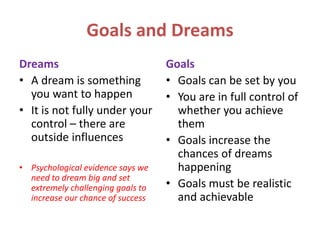
Dreams
• A dream is something
you want to happen
• It is not fully under your
control – there are
outside influences
• Psychological evidence says we
need to dream big and set
extremely challenging goals to
increase our chance of success
Goals
• Goals can be set by you
• You are in full control of
whether you achieve
them
• Goals increase the
chances of dreams
happening
• Goals must be realistic
and achievable
Task 1: Define Your Dream
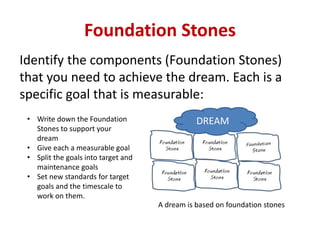
Foundation Stones
Identify the components (Foundation Stones)
that you need to achieve the dream. Each is a
specific goal that is measurable:
DREAM
A dream is based on foundation stones
• Write down the Foundation
Stones to support your
dream
• Give each a measurable goal
• Split the goals into target and
maintenance goals
• Set new standards for target
goals and the timescale to
work on them.
Task 2: Foundation Stones
• Write down the Foundation Stones to support
your dream
• Give each a measurable goal
• Split the goals into Target and Maintenance
goals
• Set new standards for Target goals and the
timescale to work on them
Target goals – select just one or two for a fixed period of time
Maintenance goals - when you reach a target goal you can swap it to a maintenance
goal and select another maintenance goal to become a target to work on
Task 3: Commitment
Are you fully aware of what is needed to take on
the dream? Are you well prepared?
1. Write out all the essential, significant and
desirable needs to take on the dream
2. Write out a list of all the hurdles, barriers and
pitfalls that may stop you and devise plans to
deal with these
The Plan: Measuring For Success
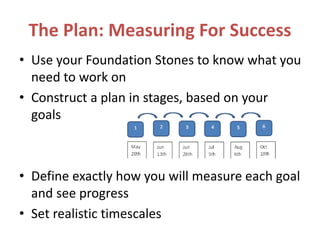
• Use your Foundation Stones to know what you
need to work on
• Construct a plan in stages, based on your
goals
• Define exactly how you will measure each goal
and see progress
• Set realistic timescales
Task 4: The Plan
• Form a plan in stages with measurable goals,
with time-frames for each stage and goal.
• Select 2 Target goals to work on
Sustaining and Encouraging
• Keep making progress by doing things that keep you
happy, encouraged and committed.
• When you reach a goal make sure you celebrate
• Use visual aids, such as a chart to show progress
• Motivational reminders are also helpful
• When you achieve a goal, look back and remind
yourself how far you have come
• Looking forward, only look towards the next step /
goal (not too far ahead)
• Involve your friends to help or to celebrate with
Task 5: Rewards and Celebrations
• Plan a reward and celebration for each goal
achieved, before you start
• Make a visual record to measure progress –
put it in a prominent place
• Display helpful reminders
• Get a friend to support you, either to share
the dream or just to encourage you.
Audit – Tracking Progress
• Are you on track towards your goals and your
dream?
• What is working well and what do you need to
review and change?
• Revisit your goals and ask if they are still the
right ones
• Be flexible in your thinking
• Hold up a mirror to yourself and be honest
Task 6: Review
• Recruit someone you can be accountable to
• Are your goals still realistic and relevant?
• Be flexible and adjust your goals if you need to
Outcomes
• Success
– Following initial success, there is a danger of complacency.
Make sure to continue with the successful strategy
– Most success is achieved by hard work and there are few, if
any, shortcuts
• Partial Success
– Consider accepting and acknowledging the small success,
to help encourage you onward
• Failure (or Setbacks)
– Try to see failure or setbacks as challenges, or an
opportunity to develop yourself and deal with problem
solving
Task 7: Outcomes
• Measure success in relative terms and
celebrate success or partial success
• Deal with failures or setbacks constructively –
see them as learning points
• Develop the ability to get a perspective on all
life events
Summary: Realising The Dream
• Define your dream and make time to go
through a structured plan
• It helps to have a friend to do this with
• Follow the steps explained in the slides
• When you have begun to implement the plan,
keep reminding yourself of why you want the
dream to happen and what it will mean to you
to succeed
Plan for Success

Plan for Success

  • 1.
    Plan for Success Adaptedfrom The Chimp Paradox, Prof Steve Peters
  • 2.
    Goals and Dreams Dreams •A dream is something you want to happen • It is not fully under your control – there are outside influences • Psychological evidence says we need to dream big and set extremely challenging goals to increase our chance of success Goals • Goals can be set by you • You are in full control of whether you achieve them • Goals increase the chances of dreams happening • Goals must be realistic and achievable
  • 3.
    Task 1: DefineYour Dream
  • 4.
    Foundation Stones Identify thecomponents (Foundation Stones) that you need to achieve the dream. Each is a specific goal that is measurable: DREAM A dream is based on foundation stones • Write down the Foundation Stones to support your dream • Give each a measurable goal • Split the goals into target and maintenance goals • Set new standards for target goals and the timescale to work on them.
  • 5.
    Task 2: FoundationStones • Write down the Foundation Stones to support your dream • Give each a measurable goal • Split the goals into Target and Maintenance goals • Set new standards for Target goals and the timescale to work on them Target goals – select just one or two for a fixed period of time Maintenance goals - when you reach a target goal you can swap it to a maintenance goal and select another maintenance goal to become a target to work on
  • 6.
    Task 3: Commitment Areyou fully aware of what is needed to take on the dream? Are you well prepared? 1. Write out all the essential, significant and desirable needs to take on the dream 2. Write out a list of all the hurdles, barriers and pitfalls that may stop you and devise plans to deal with these
  • 7.
    The Plan: MeasuringFor Success • Use your Foundation Stones to know what you need to work on • Construct a plan in stages, based on your goals • Define exactly how you will measure each goal and see progress • Set realistic timescales
  • 8.
    Task 4: ThePlan • Form a plan in stages with measurable goals, with time-frames for each stage and goal. • Select 2 Target goals to work on
  • 9.
    Sustaining and Encouraging •Keep making progress by doing things that keep you happy, encouraged and committed. • When you reach a goal make sure you celebrate • Use visual aids, such as a chart to show progress • Motivational reminders are also helpful • When you achieve a goal, look back and remind yourself how far you have come • Looking forward, only look towards the next step / goal (not too far ahead) • Involve your friends to help or to celebrate with
  • 10.
    Task 5: Rewardsand Celebrations • Plan a reward and celebration for each goal achieved, before you start • Make a visual record to measure progress – put it in a prominent place • Display helpful reminders • Get a friend to support you, either to share the dream or just to encourage you.
  • 11.
    Audit – TrackingProgress • Are you on track towards your goals and your dream? • What is working well and what do you need to review and change? • Revisit your goals and ask if they are still the right ones • Be flexible in your thinking • Hold up a mirror to yourself and be honest
  • 12.
    Task 6: Review •Recruit someone you can be accountable to • Are your goals still realistic and relevant? • Be flexible and adjust your goals if you need to
  • 13.
    Outcomes • Success – Followinginitial success, there is a danger of complacency. Make sure to continue with the successful strategy – Most success is achieved by hard work and there are few, if any, shortcuts • Partial Success – Consider accepting and acknowledging the small success, to help encourage you onward • Failure (or Setbacks) – Try to see failure or setbacks as challenges, or an opportunity to develop yourself and deal with problem solving
  • 14.
    Task 7: Outcomes •Measure success in relative terms and celebrate success or partial success • Deal with failures or setbacks constructively – see them as learning points • Develop the ability to get a perspective on all life events
  • 15.
    Summary: Realising TheDream • Define your dream and make time to go through a structured plan • It helps to have a friend to do this with • Follow the steps explained in the slides • When you have begun to implement the plan, keep reminding yourself of why you want the dream to happen and what it will mean to you to succeed