“It is impossible not to communicate”Chris BellPlain Advice
Know Your CustomersCustomers3 to 5 yearsC?OCosts3 months to a yearManagerConditionsUp to 1 monthTechnicianis the company’s sweet spot, the sell-to point, where the money is…
Talk to Your CustomersC?OAt last, somebody who understands exactly what we want. I’ll go tell someone else about    this. It’s great!ManagerTechnicianis the company’s sweet spot, the sell-to point, where the money is…
Communicating With Customers
Visual IdentityisImmediateReassuring
Beautiful but static
Verbal IdentityisFlexibleEvolving
Our Plan
WorkshopWhat makes you Unique?
WritingThe good bits are the bits we show you. Then we agree which bits are in fact good.Most of which ends up in the bin
Our Writing PrinciplesNever use a metaphor, simile, or other figure of speech which you are used to seeing in print.Never use a long word where a short one will do.If it is possible to cut a word out, always cut it out.Never use the passive where you can use the active.Never use a foreign phrase, a scientific word, or a jargon word if you can think of an everyday English equivalent.Break any of these rules sooner than say anything outright barbarous.Taken from Politics and the English Language by George Orwell
Satisfied Customers
WildPacketsThe issueEngineering-led companyFixated on product performance and usabilityThe resolutionCreated stories around “Continuity, Convergence and Compliance”
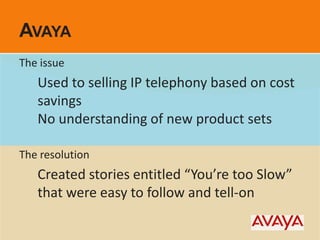
AvayaThe issueUsed to selling IP telephony based on cost savingsNo understanding of new product sets The resolutionCreated stories entitled “You’re too Slow” that were easy to follow and tell-on
Bright ideas

Plain Advice

Editor's Notes

  • #3 Any business to business relationship has to be successful at all levels within the customer organisation.To understand the customer company, it helps to consider it as being made up of three layers of staff. Technicians are at the bottom of the heap. They think no further than the next payday or round of redundancies and talk about their employment conditions.Above them is a layer of management. They think in budgetary cycles, probably up to the end of the quarter, and talk of managing costs.At the top of the pile is the CxO team. Their thinking may run out as far as five years into the future and their major concern is gaining and retaining customers.
  • #4 For a successful relationship, the selling company needs to create three sets of stories showing how their products and services can meet and exceed the expectations of everybody in the customer organisation.There need to be short term stories that explain how Technicians conditions can be improved. There need to be medium term messages to appeal to managers and their incessant cost controlling, Finally, C-level staff need to see how the sellers’ products and services can address their need to gain and retain customers.The right stories will spread quickly through the customer company, helping build trust and confidence between the companies. It is precisely these kinds of stories that we are adept at creating.
  • #5 When communicating with customers, a company has two identities. Visual and verbal.The visual identity is what many of us recognise as a ‘brand’. That is, a logo, colours, typefaces and so on.The verbal identity is rather more subtle, encompassing elements such as product naming as well as stories (as we have discussed) and tone of voice.
  • #6 A company’s visual identity is used to provide immediate recognition and reassurance about product quality
  • #7 However, once a visual identity has been established, it is very hard and expensive to change.
  • #8 If the visual identity of a business is its heart, steadily pumping away, then the verbal identity is its soul. The verbal identityis flexible and evolving, changing with new experiences and passing through a customer community.The verbal identity is often out of control of the organisation it springs from. It is the stories that customers tell themselves when they have a good experience. It is the stories customers tell each other when they’ve had a bad experience. It is the stories salesmen tell their customers to overcome hard times. It is the way the receptionist answers the phone and the way the boys in the postroom deal with the delivery driver.Our aim is to raise awareness throughout our clients’ organisations of the power of a strong verbal identity.
  • #10 Our first steps in doing this is to set up a workshop whose sole aim is to discover (usually, uncover) what it is about your business that makes you unique.
  • #11 Once we have discovered what it is that makes you unique (and that often takes an awfully long time), we then sit down to the task of developing and writing the stories that will form the heart of your verbal identity. These stories inform everything else that we do. Once they are set in our minds, these stories are built into whitepapers, brochures and web copy. Because they are at the heart of everything else, the stories keep us grounded in a clear, active, easy to understand and ‘easy to pass on’ style.
  • #12 We don’t do jargon. We keep it simple. But not too simple.