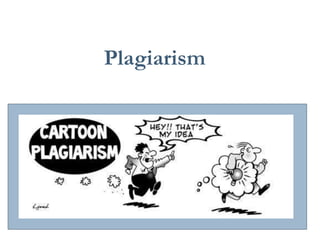
Plagiarism
What is plagiarism?
 The practice of taking someone else’s work or ideas and
passing them off as one’s own.¹
 To present as new and original an idea or product derived
from an existing source.²
 Four types:
 Copyright Infringement
 Collusion
 Self-plagiarism
 Contract Cheating
First Type: Copyright Infringement
 Copying words or ideas from someone else without giving
credit.¹
 Failing to properly cite a quotation.
 Giving incorrect information about the source of a quotation.
 Failing to properly paraphrase.
How to avoid:
Failing to properly cite a quotation
 Take detailed notes!
 Use reference guidelines to ensure ALL quotations are cited
correctly internally AND in your works cited or
bibliography page.
 Ex: According to the National Literacy Trust, reading for pleasure
is summed as “reading that we do of our own free will,
anticipating the satisfaction that we will get from the act of
reading” (Clark and Rumbold, 2006, p. 2).
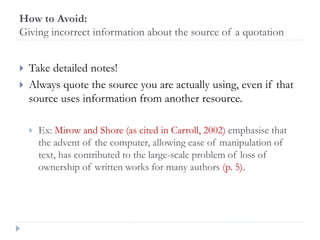
How to Avoid:
Giving incorrect information about the source of a quotation
 Take detailed notes!
 Always quote the source you are actually using, even if that
source uses information from another resource.
 Ex: Mirow and Shore (as cited in Carroll, 2002) emphasise that
the advent of the computer, allowing ease of manipulation of
text, has contributed to the large-scale problem of loss of
ownership of written works for many authors (p. 5).
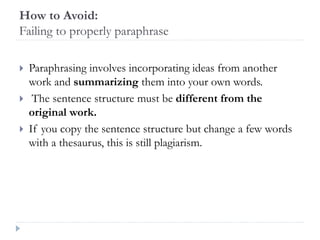
How to Avoid:
Failing to properly paraphrase
 Paraphrasing involves incorporating ideas from another
work and summarizing them into your own words.
 The sentence structure must be different from the
original work.
 If you copy the sentence structure but change a few words
with a thesaurus, this is still plagiarism.
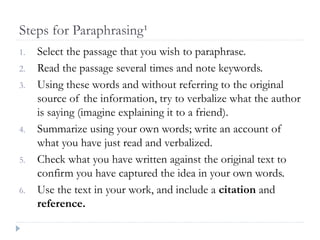
Steps for Paraphrasing¹
1. Select the passage that you wish to paraphrase.
2. Read the passage several times and note keywords.
3. Using these words and without referring to the original
source of the information, try to verbalize what the author
is saying (imagine explaining it to a friend).
4. Summarize using your own words; write an account of
what you have just read and verbalized.
5. Check what you have written against the original text to
confirm you have captured the idea in your own words.
6. Use the text in your work, and include a citation and
reference.
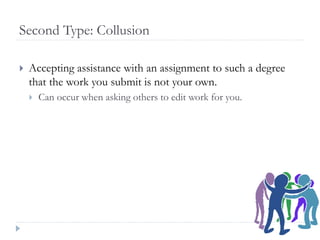
Second Type: Collusion
 Accepting assistance with an assignment to such a degree
that the work you submit is not your own.
 Can occur when asking others to edit work for you.
Avoiding Collusion
 If a friend in a class assists you with getting started on an
independent project, be careful not to recapitulate their
ideas or structure as your own.
 If using a friend or a professional to edit your work, be clear
that they must not actually change any of the work but only
make recommendations.
Third Type: Self-plagiarism
 Submitting work that has already been used for a separate
class, presentation, or published work.
Avoiding Self-Plagiarism
 Speak to your tutor or instructor before submitting work
you have already used on a separate occasion.
 Use the notes from research you have previously completed
to do further research and create a new original work.
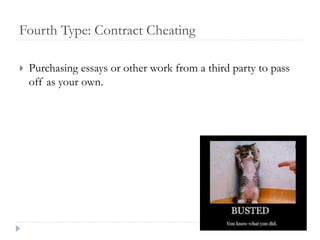
Fourth Type: Contract Cheating
 Purchasing essays or other work from a third party to pass
off as your own.
STEPS TO PREVENT PLAGIARISM:
1. Do original work. Use other resources to give you a baseline,
then analyze these ideas with your own words and ideas to
create a new original work.
2. Take copious notes. Take notes while you are reading, not
after, to avoid copyright infringement associated with citations.
3. Quotations: When using quotations, be sure to use the
referencing guidelines to create an IN-TEXT CITATION
and add the full reference to your bibliography.
4. Paraphrases: Summarize ideas in other resources using your
own words. Do not use a thesaurus. Do not keep the original
work’s sentence structure. Use an IN-TEXT CITATION to
show the original idea was not your own.
5. Include a works-cited or bibliography page.
6. Do not submit someone else’s work as your own.
7. Do not submit your own previously created work for
another course.
BIBLIOGRAPHY
1. Academicintegrity.curtin.edu.au, (2015). Overview - What is Copyright?. [online]
Available at:
https://academicintegrity.curtin.edu.au/overview/Copyright_whatis.cfm [Accessed
26 May 2015].
2. Curtin University, (2015). Student Guidelines for Avoiding Plagiarism. [online] Available
at: https://academicintegrity.curtin.edu.au/local/docs/StudentPlagiarismGuide.pdf
[Accessed 26 May 2015].
3. Lib.usm.edu, (2015). What is Plagiarism?. [online] Available at:
http://www.lib.usm.edu/legacy/plag/whatisplag.php [Accessed 26 May 2015].
4. Library.leeds.ac.uk, (2015). Harvard citations - Leeds University Library. [online] Available
at: http://library.leeds.ac.uk/homepage/91/harvard_citations#activate-
how_to_incorporate_citations_into_your_work [Accessed 26 May 2015].
5. Owl.english.purdue.edu, (2015). Purdue OWL: Avoiding Plagiarism. [online] Available
at: https://owl.english.purdue.edu/owl/resource/589/03/ [Accessed 26 May 2015].
6. Plagiarism.org - Best Practices for Ensuring Originality in Written Work,
(2015). What is Plagiarism?. [online] Available at:
http://www.plagiarism.org/plagiarism-101/what-is-plagiarism [Accessed 26 May
2015].

Plagiarism

  • 1.
  • 2.
    What is plagiarism? The practice of taking someone else’s work or ideas and passing them off as one’s own.¹  To present as new and original an idea or product derived from an existing source.²  Four types:  Copyright Infringement  Collusion  Self-plagiarism  Contract Cheating
  • 3.
    First Type: CopyrightInfringement  Copying words or ideas from someone else without giving credit.¹  Failing to properly cite a quotation.  Giving incorrect information about the source of a quotation.  Failing to properly paraphrase.
  • 4.
    How to avoid: Failingto properly cite a quotation  Take detailed notes!  Use reference guidelines to ensure ALL quotations are cited correctly internally AND in your works cited or bibliography page.  Ex: According to the National Literacy Trust, reading for pleasure is summed as “reading that we do of our own free will, anticipating the satisfaction that we will get from the act of reading” (Clark and Rumbold, 2006, p. 2).
  • 5.
    How to Avoid: Givingincorrect information about the source of a quotation  Take detailed notes!  Always quote the source you are actually using, even if that source uses information from another resource.  Ex: Mirow and Shore (as cited in Carroll, 2002) emphasise that the advent of the computer, allowing ease of manipulation of text, has contributed to the large-scale problem of loss of ownership of written works for many authors (p. 5).
  • 6.
    How to Avoid: Failingto properly paraphrase  Paraphrasing involves incorporating ideas from another work and summarizing them into your own words.  The sentence structure must be different from the original work.  If you copy the sentence structure but change a few words with a thesaurus, this is still plagiarism.
  • 7.
    Steps for Paraphrasing¹ 1.Select the passage that you wish to paraphrase. 2. Read the passage several times and note keywords. 3. Using these words and without referring to the original source of the information, try to verbalize what the author is saying (imagine explaining it to a friend). 4. Summarize using your own words; write an account of what you have just read and verbalized. 5. Check what you have written against the original text to confirm you have captured the idea in your own words. 6. Use the text in your work, and include a citation and reference.
  • 8.
    Second Type: Collusion Accepting assistance with an assignment to such a degree that the work you submit is not your own.  Can occur when asking others to edit work for you.
  • 9.
    Avoiding Collusion  Ifa friend in a class assists you with getting started on an independent project, be careful not to recapitulate their ideas or structure as your own.  If using a friend or a professional to edit your work, be clear that they must not actually change any of the work but only make recommendations.
  • 10.
    Third Type: Self-plagiarism Submitting work that has already been used for a separate class, presentation, or published work.
  • 11.
    Avoiding Self-Plagiarism  Speakto your tutor or instructor before submitting work you have already used on a separate occasion.  Use the notes from research you have previously completed to do further research and create a new original work.
  • 12.
    Fourth Type: ContractCheating  Purchasing essays or other work from a third party to pass off as your own.
  • 13.
    STEPS TO PREVENTPLAGIARISM: 1. Do original work. Use other resources to give you a baseline, then analyze these ideas with your own words and ideas to create a new original work. 2. Take copious notes. Take notes while you are reading, not after, to avoid copyright infringement associated with citations. 3. Quotations: When using quotations, be sure to use the referencing guidelines to create an IN-TEXT CITATION and add the full reference to your bibliography. 4. Paraphrases: Summarize ideas in other resources using your own words. Do not use a thesaurus. Do not keep the original work’s sentence structure. Use an IN-TEXT CITATION to show the original idea was not your own. 5. Include a works-cited or bibliography page. 6. Do not submit someone else’s work as your own. 7. Do not submit your own previously created work for another course.
  • 14.
    BIBLIOGRAPHY 1. Academicintegrity.curtin.edu.au, (2015).Overview - What is Copyright?. [online] Available at: https://academicintegrity.curtin.edu.au/overview/Copyright_whatis.cfm [Accessed 26 May 2015]. 2. Curtin University, (2015). Student Guidelines for Avoiding Plagiarism. [online] Available at: https://academicintegrity.curtin.edu.au/local/docs/StudentPlagiarismGuide.pdf [Accessed 26 May 2015]. 3. Lib.usm.edu, (2015). What is Plagiarism?. [online] Available at: http://www.lib.usm.edu/legacy/plag/whatisplag.php [Accessed 26 May 2015]. 4. Library.leeds.ac.uk, (2015). Harvard citations - Leeds University Library. [online] Available at: http://library.leeds.ac.uk/homepage/91/harvard_citations#activate- how_to_incorporate_citations_into_your_work [Accessed 26 May 2015]. 5. Owl.english.purdue.edu, (2015). Purdue OWL: Avoiding Plagiarism. [online] Available at: https://owl.english.purdue.edu/owl/resource/589/03/ [Accessed 26 May 2015]. 6. Plagiarism.org - Best Practices for Ensuring Originality in Written Work, (2015). What is Plagiarism?. [online] Available at: http://www.plagiarism.org/plagiarism-101/what-is-plagiarism [Accessed 26 May 2015].

Editor's Notes

  • #3 Oxford Dictionary Online www.plagiarism.org
  • #4 1. www.plagiarism.org
  • #8 1. Provided by Academic Integrity Handbook of Curtin University, Australia.