Presented by: Angela Whitehurst Distance Education Coordinator J.Y. Joyner Library East Carolina University
Plagiarism – The act taking someone else’s words or ideas and using them as your own. Can be intentional or unintentional, but both are serious offenses Plagiarism can occur when a person borrows someone else’s ideas with out giving them proper credit or when a person uses another’s exact words without using quotation marks or indented block quotes and does not credit the source
Items that can be plagiarized include: words ideas artwork audio & video computer programs statistical data other creative works
All of the following are examples of plagiarism: buying papers online reusing papers you wrote for other classes letting someone else write papers for you copying and pasting  any  information from the web or other digital formats failure to cite sources you used to gather information failure to use quotation marks or indented block quotes when using the exact wording of a source as a quote; or failure to cite the source where you found the quotation only changing a few words of information instead of completely paraphrasing the information
Plagiarism violates the ECU Code of Conduct and is a very serious offense Code of Conduct applies to  all  enrolled students Consequences include: receiving a failing grade on the assignment receiving a failing grade for a course academic probation expulsion from the university
To avoid plagiarism  do : allow plenty of time for research search, read, and evaluate sources take good notes paraphrase –write the ideas in your own words use quotes sparingly place direct quotations in quotation marks or indented blocks as directed by appropriate style manuals cite the source of all direct quotations
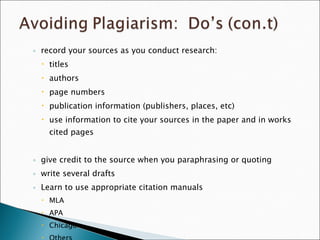
record your sources as you conduct research: titles authors page numbers publication information (publishers, places, etc) use information to cite your sources in the paper and in works cited pages give credit to the source when you paraphrasing or quoting  write several drafts Learn to use appropriate citation manuals MLA APA Chicago Others
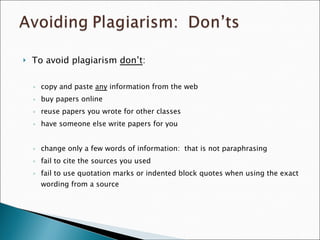
To avoid plagiarism  don’t : copy and paste  any  information from the web buy papers online reuse papers you wrote for other classes have someone else write papers for you change only a few words of information:  that is not paraphrasing fail to cite the sources you used fail to use quotation marks or indented block quotes when using the exact wording from a source
Joyner Library Reference Department (252) 328-0723 Ask A Librarian Joyner Library Web Site http://www.ecu.edu/lib

Plagiarism: What it is & How to Avoid it

  • 1.
    Presented by: AngelaWhitehurst Distance Education Coordinator J.Y. Joyner Library East Carolina University
  • 2.
    Plagiarism – Theact taking someone else’s words or ideas and using them as your own. Can be intentional or unintentional, but both are serious offenses Plagiarism can occur when a person borrows someone else’s ideas with out giving them proper credit or when a person uses another’s exact words without using quotation marks or indented block quotes and does not credit the source
  • 3.
    Items that canbe plagiarized include: words ideas artwork audio & video computer programs statistical data other creative works
  • 4.
    All of thefollowing are examples of plagiarism: buying papers online reusing papers you wrote for other classes letting someone else write papers for you copying and pasting any information from the web or other digital formats failure to cite sources you used to gather information failure to use quotation marks or indented block quotes when using the exact wording of a source as a quote; or failure to cite the source where you found the quotation only changing a few words of information instead of completely paraphrasing the information
  • 5.
    Plagiarism violates theECU Code of Conduct and is a very serious offense Code of Conduct applies to all enrolled students Consequences include: receiving a failing grade on the assignment receiving a failing grade for a course academic probation expulsion from the university
  • 6.
    To avoid plagiarism do : allow plenty of time for research search, read, and evaluate sources take good notes paraphrase –write the ideas in your own words use quotes sparingly place direct quotations in quotation marks or indented blocks as directed by appropriate style manuals cite the source of all direct quotations
  • 7.
    record your sourcesas you conduct research: titles authors page numbers publication information (publishers, places, etc) use information to cite your sources in the paper and in works cited pages give credit to the source when you paraphrasing or quoting write several drafts Learn to use appropriate citation manuals MLA APA Chicago Others
  • 8.
    To avoid plagiarism don’t : copy and paste any information from the web buy papers online reuse papers you wrote for other classes have someone else write papers for you change only a few words of information: that is not paraphrasing fail to cite the sources you used fail to use quotation marks or indented block quotes when using the exact wording from a source
  • 9.
    Joyner Library ReferenceDepartment (252) 328-0723 Ask A Librarian Joyner Library Web Site http://www.ecu.edu/lib