Identifying primary and
secondary sources in the
sciences
By Jeanne Hoover
What is a Primary Source?

A primary source is original research
conducted by a scientist.


Examples:
Lab notebooks
Lab reports
Scholarly research articles
What is a Secondary Source?
A secondary source seeks out primary sources,
analyzes or reviews them and creates a response to
them.


Examples:
Magazine or news articles
Scholarly review articles
Encyclopedias
Textbooks
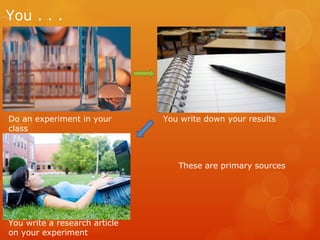
You . . .


Do an experiment in your       You write down your results
class


                                  These are primary sources


You write a research article
on your experiment
As a Result of your published article . . .


A science journalist reads your      A publisher decides to add
article and references it in his     information about your article
article in National Geographic       in a new Biology textbook


                    These are secondary sources
When it gets complicated . . .


 Most of the scholarly research articles that you find in
  journals are either original research (primary sources) or
  review articles (secondary sources). It can be tricky to
  tell them apart.
Similarities Between Original Research
     Articles and Review Articles
   Authors are experts in the field


   Academic journals publish them


   Typically includes the following sections: Abstract,
    introduction, and a reference list


   Geared towards other scientists and college students


   Very technical or advanced in their topic or study
Original Research Article or
        Primary Source Article
 These articles cover one study or experiment that was
  completed by the authors


 The title or topic will be very specific


 Look for the following sections for clues that you’re
  looking at a primary source article
     Methodology Section explaining how the experiment was
      setup
     Results Section which includes the data or results from
      the experiment
Review Articles or Secondary
          Source Articles
 These articles analyze or compare multiple original
  research articles on a topic (aka. a literature review)


 The article gives an overview of a specific topic or
  technique


 These articles may have “review” in the journal or article
  title


 The authors of the article did not do a study or
  experiment


 The article usually has headings related to the topic
Have More Questions? Ask!


Email: askref@ecu.edu
Phone: 252-328-6677
Website: www.ecu.edu/lib

Identifying primary and secondary sources in the sciences

  • 1.
    Identifying primary and secondarysources in the sciences By Jeanne Hoover
  • 2.
    What is aPrimary Source? A primary source is original research conducted by a scientist. Examples: Lab notebooks Lab reports Scholarly research articles
  • 3.
    What is aSecondary Source? A secondary source seeks out primary sources, analyzes or reviews them and creates a response to them. Examples: Magazine or news articles Scholarly review articles Encyclopedias Textbooks
  • 4.
    You . .. Do an experiment in your You write down your results class These are primary sources You write a research article on your experiment
  • 5.
    As a Resultof your published article . . . A science journalist reads your A publisher decides to add article and references it in his information about your article article in National Geographic in a new Biology textbook These are secondary sources
  • 6.
    When it getscomplicated . . .  Most of the scholarly research articles that you find in journals are either original research (primary sources) or review articles (secondary sources). It can be tricky to tell them apart.
  • 7.
    Similarities Between OriginalResearch Articles and Review Articles  Authors are experts in the field  Academic journals publish them  Typically includes the following sections: Abstract, introduction, and a reference list  Geared towards other scientists and college students  Very technical or advanced in their topic or study
  • 8.
    Original Research Articleor Primary Source Article  These articles cover one study or experiment that was completed by the authors  The title or topic will be very specific  Look for the following sections for clues that you’re looking at a primary source article  Methodology Section explaining how the experiment was setup  Results Section which includes the data or results from the experiment
  • 9.
    Review Articles orSecondary Source Articles  These articles analyze or compare multiple original research articles on a topic (aka. a literature review)  The article gives an overview of a specific topic or technique  These articles may have “review” in the journal or article title  The authors of the article did not do a study or experiment  The article usually has headings related to the topic
  • 10.
    Have More Questions?Ask! Email: askref@ecu.edu Phone: 252-328-6677 Website: www.ecu.edu/lib