
Learning to Work or Working to Learn? What Colleges want from placement Liz Warr & Lydia Arnold
What is ‘Learning’? Learning is transforming information into knowledge. Learning is “doing something with information- such as remembering it, understanding it, applying it in a new situation, analysing and evaluating it”.
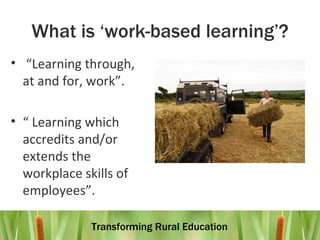
What is ‘work-based learning’? “ Learning through, at and for, work”. “  Learning which accredits and/or extends the workplace skills of employees”.
How does work-based learning correspond to placement  learning? Activity 1 Consider the following terms: Learning to work Learning at work Learning through work Learning from work
How does work-based learning correspond to placement  learning? How important is each : To the student? To the employer? To the tutor?
What about academic level?  Are we looking for different types of  ‘learning’  from FE and HE placement students? Do we differentiate adequately between , for example, National Diploma, Foundation degree and Honours degree students? Do employers know the difference?  Do we tell them what we expect from each?
Overall purpose of Placement Learning Can we define this in a single sentence ….
Purpose of placement learning … ‘ to develop higher level vocational and personal skills in the chosen sector’  ‘  to enhance long-term employability’ ‘ to  develop cognitive  (intellectual)  abilities that are conducive to  successful performance in the work-place’, Any more …….. ?
Activity 2 You are given 6 groups of learning outcomes taken from work based learning modules. Rank the groups in order of importance for FE and/or HE learners and pin them on the relevant ‘bodies’ on the wall – head (most important) to toe (least important). Think about the individual outcomes and rate their importance to placement learners.
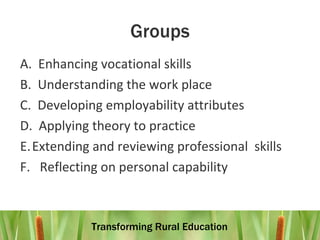
Groups A.  Enhancing vocational skills B.  Understanding the work place C.  Developing employability attributes D.  Applying theory to practice Extending and reviewing professional  skills F.  Reflecting on personal capability
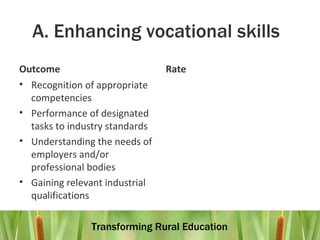
A. Enhancing vocational skills  Outcome Recognition of appropriate competencies Performance of designated tasks to industry standards Understanding the needs of employers and/or professional bodies Gaining relevant industrial qualifications Rate
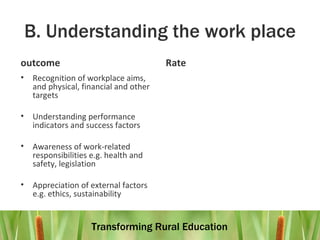
B. Understanding the work place outcome Recognition of workplace aims, and physical, financial and other targets Understanding performance indicators and success factors Awareness of work-related responsibilities e.g. health and safety, legislation Appreciation of external factors e.g. ethics, sustainability Rate
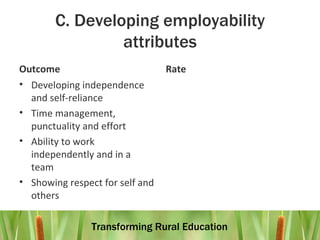
C. Developing employability attributes Outcome Developing independence and self-reliance Time management, punctuality and effort Ability to work independently and in a team Showing respect for self and others Rate
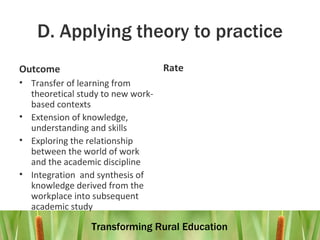
D. Applying theory to practice Outcome Transfer of learning from theoretical study to new work-based contexts Extension of knowledge, understanding and skills Exploring the relationship between the world of work and the academic discipline  Integration  and synthesis of knowledge derived from the workplace into subsequent academic study  Rate
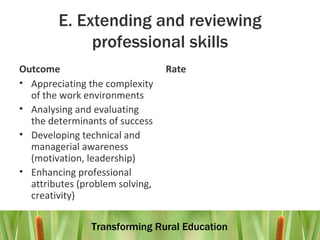
E. Extending and reviewing professional skills Outcome Appreciating the complexity of the work environments Analysing and evaluating the determinants of success Developing technical and managerial awareness  (motivation, leadership) Enhancing professional attributes (problem solving, creativity) Rate
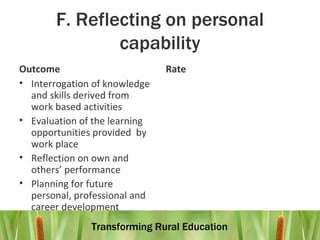
F. Reflecting on personal capability Outcome Interrogation of knowledge and skills derived from  work based activities Evaluation of the learning opportunities provided  by work place Reflection on own and others’ performance Planning for future personal, professional and career development Rate
 
Summary The term ‘Learning to work’ is easy to understand, whereas  the term ‘Working to learn’ is somewhat more complex. Would ‘learning to learn’ be more appropriate?
Learning to learn having an awareness of learning as a process. taking control of the learning process. making the task, individual and context work together for maximum learning. making good learning decisions.  Developing a culture of life-long learning.
Conclusion As colleges, we want to capture the very  powerful learning that undoubtedly takes place on placement for the long term benefit of our students, their future employers and, indeed,  for the future of our rural industries
Liz Warr is curriculum Development Advisor for REEDNet and works remotely from Essex.  [email_address]   Lydia Arnold is Work-based learning developer for the Aspire CETL.  [email_address]   These slides can be downloaded from  www.lydiaarnold.net

Placement and work based learning

  • 1.
    Learning to Workor Working to Learn? What Colleges want from placement Liz Warr & Lydia Arnold
  • 2.
    What is ‘Learning’?Learning is transforming information into knowledge. Learning is “doing something with information- such as remembering it, understanding it, applying it in a new situation, analysing and evaluating it”.
  • 3.
    What is ‘work-basedlearning’? “ Learning through, at and for, work”. “ Learning which accredits and/or extends the workplace skills of employees”.
  • 4.
    How does work-basedlearning correspond to placement learning? Activity 1 Consider the following terms: Learning to work Learning at work Learning through work Learning from work
  • 5.
    How does work-basedlearning correspond to placement learning? How important is each : To the student? To the employer? To the tutor?
  • 6.
    What about academiclevel? Are we looking for different types of ‘learning’ from FE and HE placement students? Do we differentiate adequately between , for example, National Diploma, Foundation degree and Honours degree students? Do employers know the difference? Do we tell them what we expect from each?
  • 7.
    Overall purpose ofPlacement Learning Can we define this in a single sentence ….
  • 8.
    Purpose of placementlearning … ‘ to develop higher level vocational and personal skills in the chosen sector’ ‘ to enhance long-term employability’ ‘ to develop cognitive (intellectual) abilities that are conducive to successful performance in the work-place’, Any more …….. ?
  • 9.
    Activity 2 Youare given 6 groups of learning outcomes taken from work based learning modules. Rank the groups in order of importance for FE and/or HE learners and pin them on the relevant ‘bodies’ on the wall – head (most important) to toe (least important). Think about the individual outcomes and rate their importance to placement learners.
  • 10.
    Groups A. Enhancing vocational skills B. Understanding the work place C. Developing employability attributes D. Applying theory to practice Extending and reviewing professional skills F. Reflecting on personal capability
  • 11.
    A. Enhancing vocationalskills Outcome Recognition of appropriate competencies Performance of designated tasks to industry standards Understanding the needs of employers and/or professional bodies Gaining relevant industrial qualifications Rate
  • 12.
    B. Understanding thework place outcome Recognition of workplace aims, and physical, financial and other targets Understanding performance indicators and success factors Awareness of work-related responsibilities e.g. health and safety, legislation Appreciation of external factors e.g. ethics, sustainability Rate
  • 13.
    C. Developing employabilityattributes Outcome Developing independence and self-reliance Time management, punctuality and effort Ability to work independently and in a team Showing respect for self and others Rate
  • 14.
    D. Applying theoryto practice Outcome Transfer of learning from theoretical study to new work-based contexts Extension of knowledge, understanding and skills Exploring the relationship between the world of work and the academic discipline Integration and synthesis of knowledge derived from the workplace into subsequent academic study Rate
  • 15.
    E. Extending andreviewing professional skills Outcome Appreciating the complexity of the work environments Analysing and evaluating the determinants of success Developing technical and managerial awareness (motivation, leadership) Enhancing professional attributes (problem solving, creativity) Rate
  • 16.
    F. Reflecting onpersonal capability Outcome Interrogation of knowledge and skills derived from work based activities Evaluation of the learning opportunities provided by work place Reflection on own and others’ performance Planning for future personal, professional and career development Rate
  • 17.
  • 18.
    Summary The term‘Learning to work’ is easy to understand, whereas the term ‘Working to learn’ is somewhat more complex. Would ‘learning to learn’ be more appropriate?
  • 19.
    Learning to learnhaving an awareness of learning as a process. taking control of the learning process. making the task, individual and context work together for maximum learning. making good learning decisions. Developing a culture of life-long learning.
  • 20.
    Conclusion As colleges,we want to capture the very powerful learning that undoubtedly takes place on placement for the long term benefit of our students, their future employers and, indeed, for the future of our rural industries
  • 21.
    Liz Warr iscurriculum Development Advisor for REEDNet and works remotely from Essex. [email_address] Lydia Arnold is Work-based learning developer for the Aspire CETL. [email_address] These slides can be downloaded from www.lydiaarnold.net