Grade 3 Mathematics Unit Preview
          Quarter 1: Number Relationships and Computation (Place Value)
Objectives: (Your student will be able to)

   •   Identify the place value and give the value for a digit in a number. For example, in 3,471 the place value of
       the underlined digit is the hundreds place; the value is 400.
   •   Read, write, and compare numbers (using >, <, =, ≠). For example, 312 < (is less than) 340.
        435 > (greater than) 302
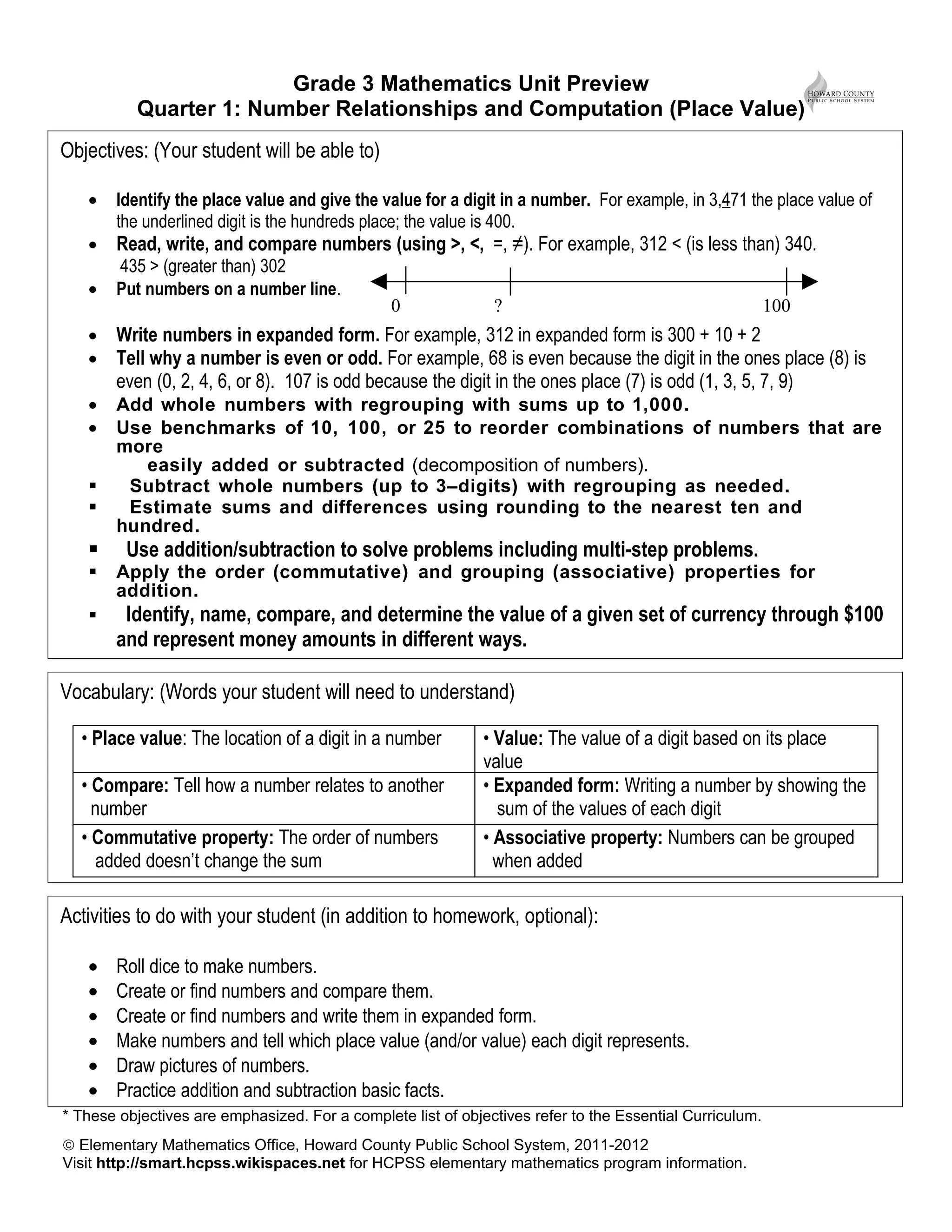
   •   Put numbers on a number line.
                                                0                ?                                  100
   •   Write numbers in expanded form. For example, 312 in expanded form is 300 + 10 + 2
   •   Tell why a number is even or odd. For example, 68 is even because the digit in the ones place (8) is
       even (0, 2, 4, 6, or 8). 107 is odd because the digit in the ones place (7) is odd (1, 3, 5, 7, 9)
   •   Add whole numbers with regrouping with sums up to 1,000.
   •   Use benchmarks of 10, 100, or 25 to reorder combinations of numbers that are
       more
          easily added or subtracted (decomposition of numbers).
       Subtract whole numbers (up to 3–digits) with regrouping as needed.
       Estimate sums and differences using rounding to the nearest ten and
       hundred.
        Use addition/subtraction to solve problems including multi-step problems.
      Apply the order (commutative) and grouping (associative) properties for
       addition.
      Identify, name, compare, and determine the value of a given set of currency through $100
      and represent money amounts in different ways.
   • Solve problems involving money (adding, subtracting, and counting change) with and
Vocabulary: (Words your student will need to understand)

  • Place value: The location of a digit in a number          • Value: The value of a digit based on its place
                                                              value
  • Compare: Tell how a number relates to another             • Expanded form: Writing a number by showing the
    number                                                      sum of the values of each digit
  • Commutative property: The order of numbers                • Associative property: Numbers can be grouped
    added doesn’t change the sum                                when added

Activities to do with your student (in addition to homework, optional):

   •   Roll dice to make numbers.
   •   Create or find numbers and compare them.
   •   Create or find numbers and write them in expanded form.
   •   Make numbers and tell which place value (and/or value) each digit represents.
   •   Draw pictures of numbers.
   •   Practice addition and subtraction basic facts.
* These objectives are emphasized. For a complete list of objectives refer to the Essential Curriculum.
© Elementary Mathematics Office, Howard County Public School System, 2011-2012
Visit http://smart.hcpss.wikispaces.net for HCPSS elementary mathematics program information.

Place Value Preview Sheet

  • 1.
    Grade 3 MathematicsUnit Preview Quarter 1: Number Relationships and Computation (Place Value) Objectives: (Your student will be able to) • Identify the place value and give the value for a digit in a number. For example, in 3,471 the place value of the underlined digit is the hundreds place; the value is 400. • Read, write, and compare numbers (using >, <, =, ≠). For example, 312 < (is less than) 340. 435 > (greater than) 302 • Put numbers on a number line. 0 ? 100 • Write numbers in expanded form. For example, 312 in expanded form is 300 + 10 + 2 • Tell why a number is even or odd. For example, 68 is even because the digit in the ones place (8) is even (0, 2, 4, 6, or 8). 107 is odd because the digit in the ones place (7) is odd (1, 3, 5, 7, 9) • Add whole numbers with regrouping with sums up to 1,000. • Use benchmarks of 10, 100, or 25 to reorder combinations of numbers that are more easily added or subtracted (decomposition of numbers).  Subtract whole numbers (up to 3–digits) with regrouping as needed.  Estimate sums and differences using rounding to the nearest ten and hundred.  Use addition/subtraction to solve problems including multi-step problems.  Apply the order (commutative) and grouping (associative) properties for addition.  Identify, name, compare, and determine the value of a given set of currency through $100 and represent money amounts in different ways. • Solve problems involving money (adding, subtracting, and counting change) with and Vocabulary: (Words your student will need to understand) • Place value: The location of a digit in a number • Value: The value of a digit based on its place value • Compare: Tell how a number relates to another • Expanded form: Writing a number by showing the number sum of the values of each digit • Commutative property: The order of numbers • Associative property: Numbers can be grouped added doesn’t change the sum when added Activities to do with your student (in addition to homework, optional): • Roll dice to make numbers. • Create or find numbers and compare them. • Create or find numbers and write them in expanded form. • Make numbers and tell which place value (and/or value) each digit represents. • Draw pictures of numbers. • Practice addition and subtraction basic facts. * These objectives are emphasized. For a complete list of objectives refer to the Essential Curriculum. © Elementary Mathematics Office, Howard County Public School System, 2011-2012 Visit http://smart.hcpss.wikispaces.net for HCPSS elementary mathematics program information.