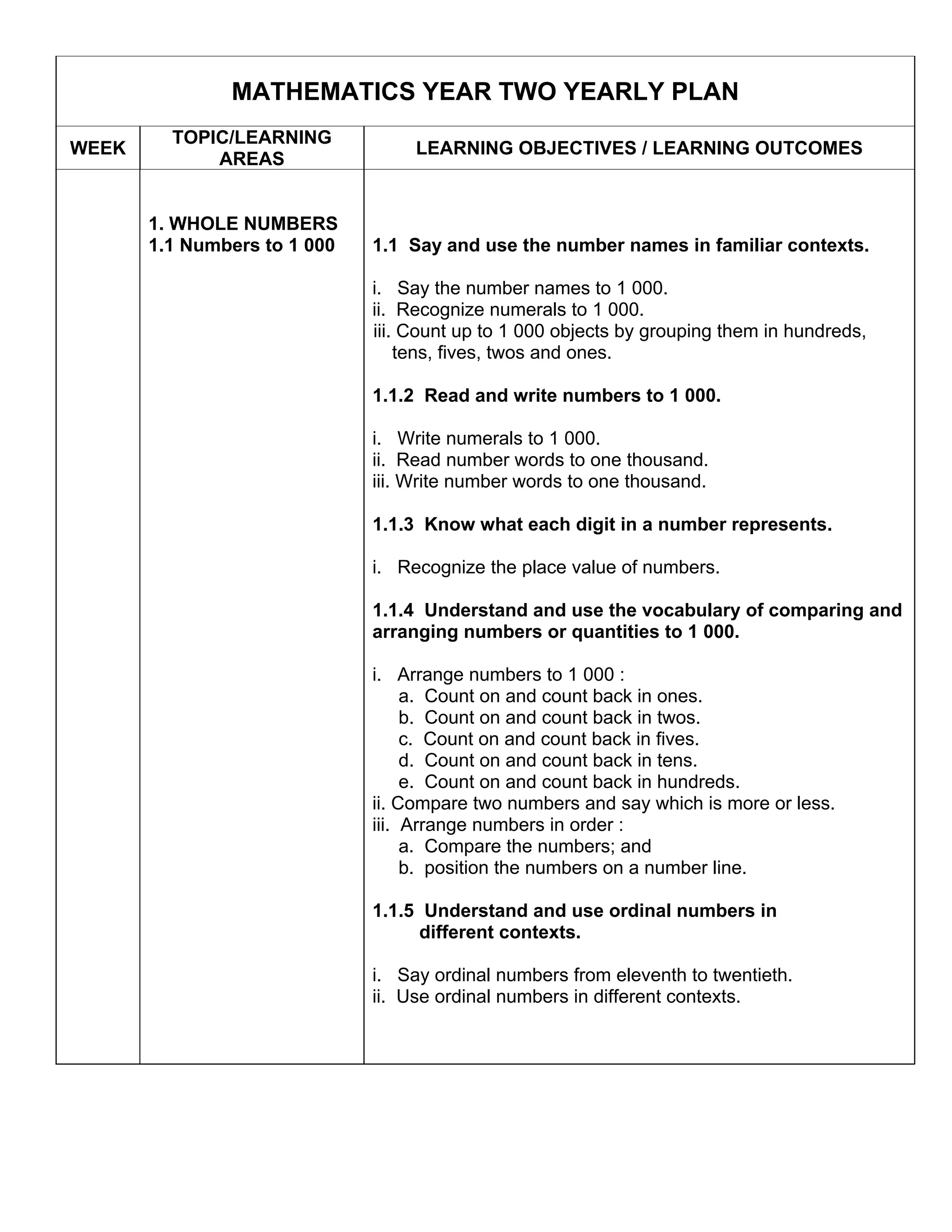
MATHEMATICS YEAR TWO YEARLY PLAN
         TOPIC/LEARNING
WEEK                               LEARNING OBJECTIVES / LEARNING OUTCOMES
             AREAS


       1. WHOLE NUMBERS
       1.1 Numbers to 1 000   1.1 Say and use the number names in familiar contexts.

                              i. Say the number names to 1 000.
                              ii. Recognize numerals to 1 000.
                              iii. Count up to 1 000 objects by grouping them in hundreds,
                                  tens, fives, twos and ones.

                              1.1.2 Read and write numbers to 1 000.

                              i. Write numerals to 1 000.
                              ii. Read number words to one thousand.
                              iii. Write number words to one thousand.

                              1.1.3 Know what each digit in a number represents.

                              i. Recognize the place value of numbers.

                              1.1.4 Understand and use the vocabulary of comparing and
                              arranging numbers or quantities to 1 000.

                              i. Arrange numbers to 1 000 :
                                   a. Count on and count back in ones.
                                   b. Count on and count back in twos.
                                   c. Count on and count back in fives.
                                   d. Count on and count back in tens.
                                   e. Count on and count back in hundreds.
                              ii. Compare two numbers and say which is more or less.
                              iii. Arrange numbers in order :
                                   a. Compare the numbers; and
                                   b. position the numbers on a number line.

                              1.1.5 Understand and use ordinal numbers in
                                    different contexts.

                              i. Say ordinal numbers from eleventh to twentieth.
                              ii. Use ordinal numbers in different contexts.
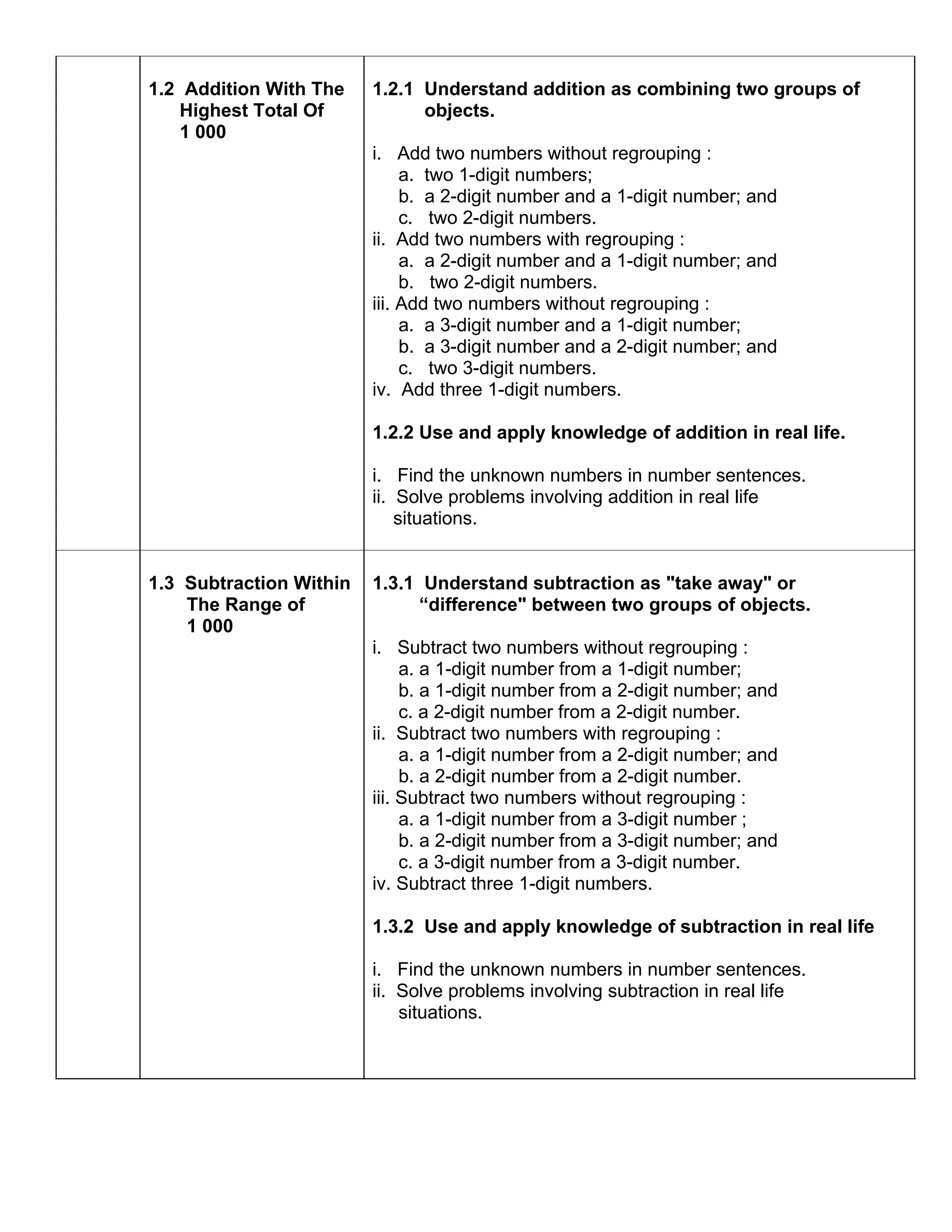
1.2 Addition With The    1.2.1 Understand addition as combining two groups of
    Highest Total Of           objects.
    1 000
                         i. Add two numbers without regrouping :
                              a. two 1-digit numbers;
                              b. a 2-digit number and a 1-digit number; and
                              c. two 2-digit numbers.
                         ii. Add two numbers with regrouping :
                              a. a 2-digit number and a 1-digit number; and
                              b. two 2-digit numbers.
                         iii. Add two numbers without regrouping :
                              a. a 3-digit number and a 1-digit number;
                              b. a 3-digit number and a 2-digit number; and
                              c. two 3-digit numbers.
                         iv. Add three 1-digit numbers.

                         1.2.2 Use and apply knowledge of addition in real life.

                         i. Find the unknown numbers in number sentences.
                         ii. Solve problems involving addition in real life
                             situations.


1.3 Subtraction Within   1.3.1 Understand subtraction as "take away" or
    The Range of               “difference" between two groups of objects.
    1 000
                         i. Subtract two numbers without regrouping :
                              a. a 1-digit number from a 1-digit number;
                              b. a 1-digit number from a 2-digit number; and
                              c. a 2-digit number from a 2-digit number.
                         ii. Subtract two numbers with regrouping :
                              a. a 1-digit number from a 2-digit number; and
                              b. a 2-digit number from a 2-digit number.
                         iii. Subtract two numbers without regrouping :
                              a. a 1-digit number from a 3-digit number ;
                              b. a 2-digit number from a 3-digit number; and
                              c. a 3-digit number from a 3-digit number.
                         iv. Subtract three 1-digit numbers.

                         1.3.2 Use and apply knowledge of subtraction in real life

                         i. Find the unknown numbers in number sentences.
                         ii. Solve problems involving subtraction in real life
                             situations.
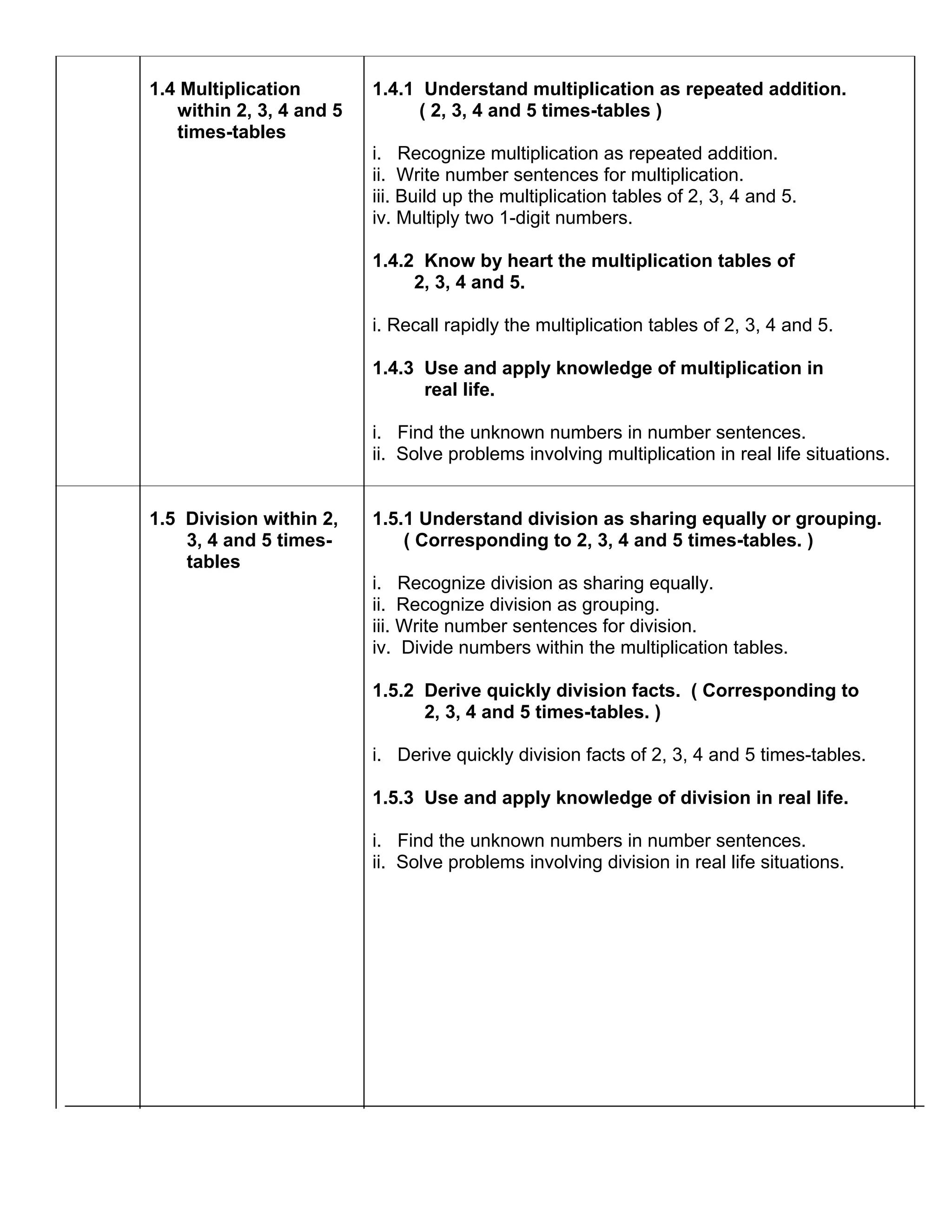
1.4 Multiplication        1.4.1 Understand multiplication as repeated addition.
   within 2, 3, 4 and 5         ( 2, 3, 4 and 5 times-tables )
   times-tables
                          i. Recognize multiplication as repeated addition.
                          ii. Write number sentences for multiplication.
                          iii. Build up the multiplication tables of 2, 3, 4 and 5.
                          iv. Multiply two 1-digit numbers.

                          1.4.2 Know by heart the multiplication tables of
                               2, 3, 4 and 5.

                          i. Recall rapidly the multiplication tables of 2, 3, 4 and 5.

                          1.4.3 Use and apply knowledge of multiplication in
                                real life.

                          i. Find the unknown numbers in number sentences.
                          ii. Solve problems involving multiplication in real life situations.


1.5 Division within 2,    1.5.1 Understand division as sharing equally or grouping.
    3, 4 and 5 times-         ( Corresponding to 2, 3, 4 and 5 times-tables. )
    tables
                          i. Recognize division as sharing equally.
                          ii. Recognize division as grouping.
                          iii. Write number sentences for division.
                          iv. Divide numbers within the multiplication tables.

                          1.5.2 Derive quickly division facts. ( Corresponding to
                                2, 3, 4 and 5 times-tables. )

                          i. Derive quickly division facts of 2, 3, 4 and 5 times-tables.

                          1.5.3 Use and apply knowledge of division in real life.

                          i. Find the unknown numbers in number sentences.
                          ii. Solve problems involving division in real life situations.
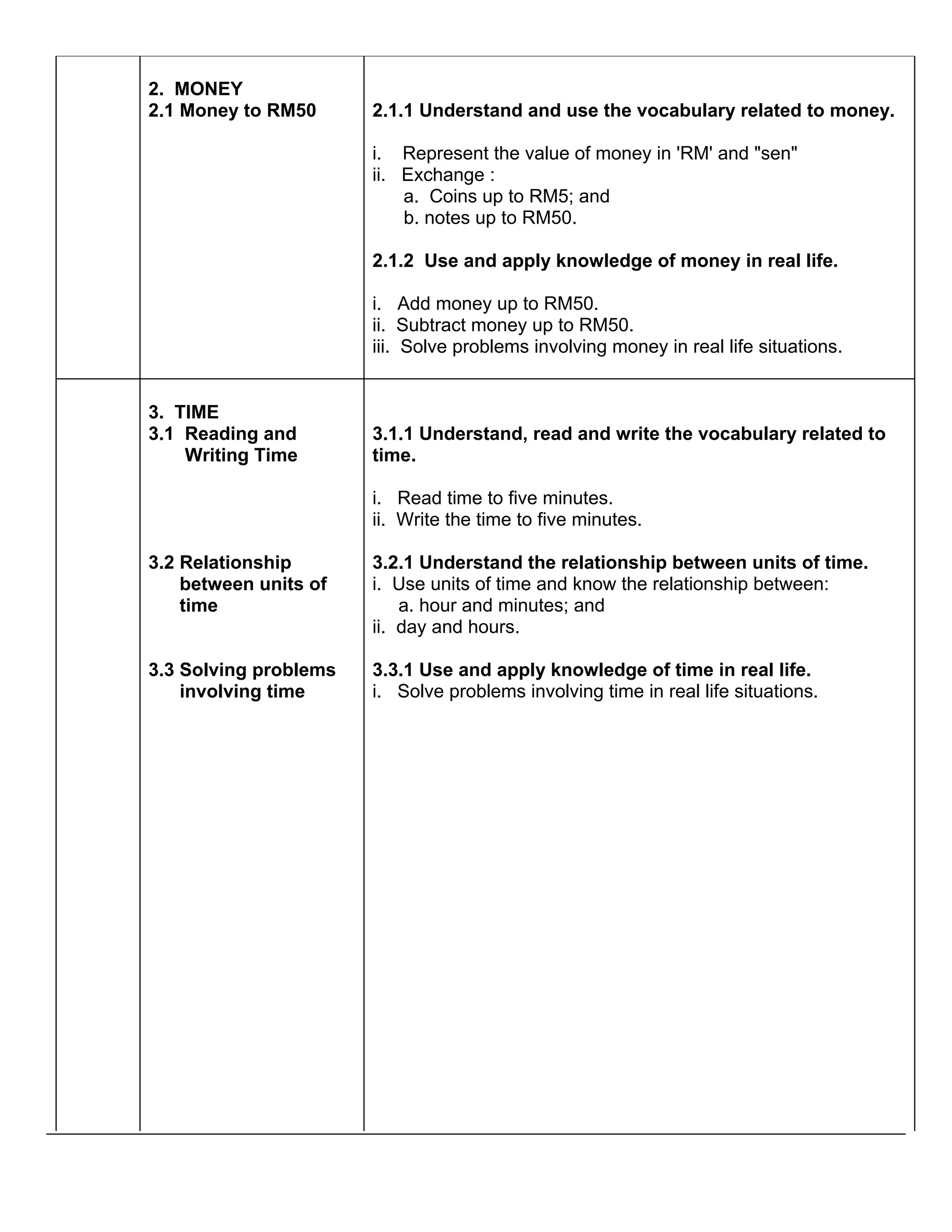
2. MONEY
2.1 Money to RM50      2.1.1 Understand and use the vocabulary related to money.

                       i. Represent the value of money in 'RM' and "sen"
                       ii. Exchange :
                           a. Coins up to RM5; and
                           b. notes up to RM50.

                       2.1.2 Use and apply knowledge of money in real life.

                       i. Add money up to RM50.
                       ii. Subtract money up to RM50.
                       iii. Solve problems involving money in real life situations.


3. TIME
3.1 Reading and        3.1.1 Understand, read and write the vocabulary related to
    Writing Time       time.

                       i. Read time to five minutes.
                       ii. Write the time to five minutes.

3.2 Relationship       3.2.1 Understand the relationship between units of time.
    between units of   i. Use units of time and know the relationship between:
    time                   a. hour and minutes; and
                       ii. day and hours.

3.3 Solving problems   3.3.1 Use and apply knowledge of time in real life.
    involving time     i. Solve problems involving time in real life situations.
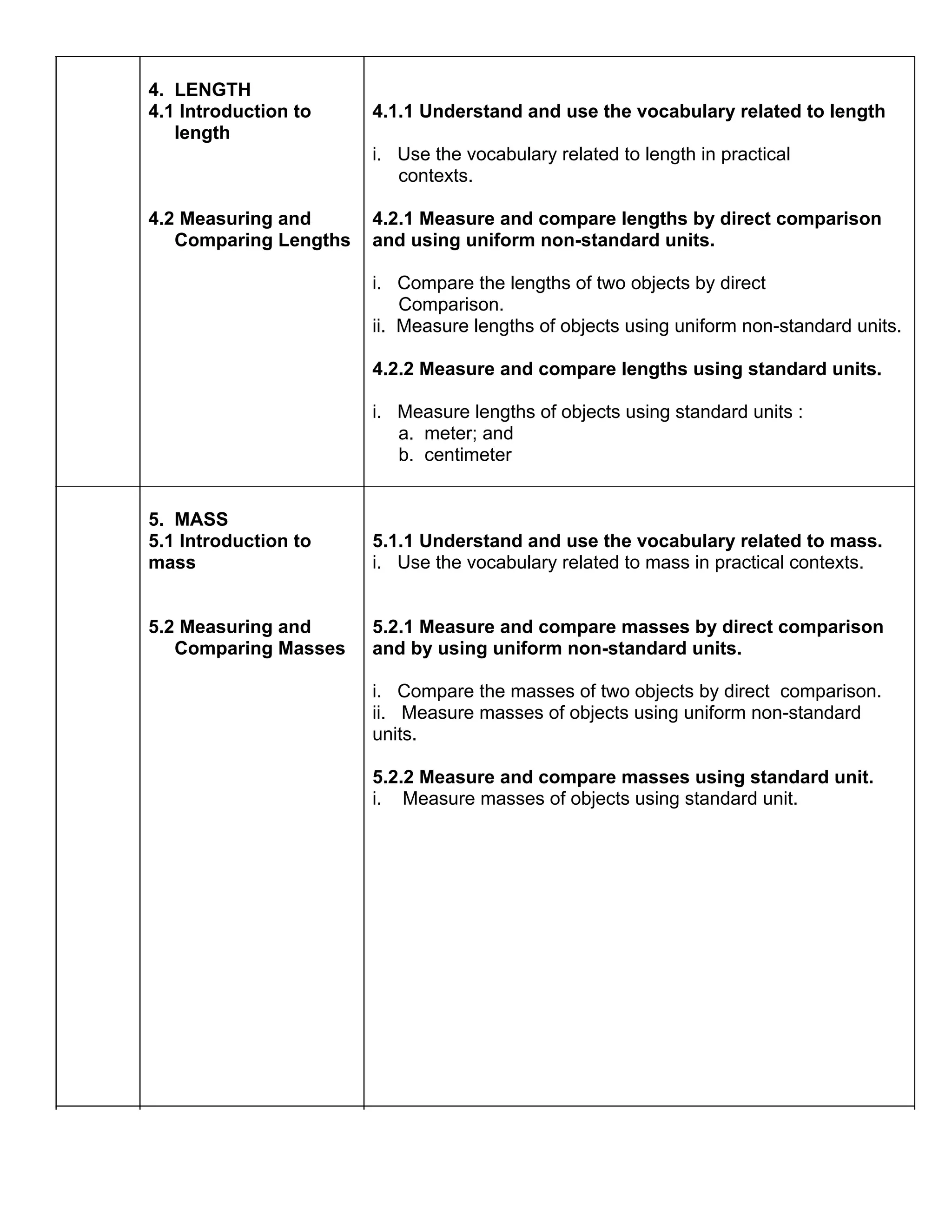
4. LENGTH
4.1 Introduction to    4.1.1 Understand and use the vocabulary related to length
   length
                       i. Use the vocabulary related to length in practical
                          contexts.

4.2 Measuring and      4.2.1 Measure and compare lengths by direct comparison
   Comparing Lengths   and using uniform non-standard units.

                       i. Compare the lengths of two objects by direct
                           Comparison.
                       ii. Measure lengths of objects using uniform non-standard units.

                       4.2.2 Measure and compare lengths using standard units.

                       i. Measure lengths of objects using standard units :
                          a. meter; and
                          b. centimeter


5. MASS
5.1 Introduction to    5.1.1 Understand and use the vocabulary related to mass.
mass                   i. Use the vocabulary related to mass in practical contexts.


5.2 Measuring and      5.2.1 Measure and compare masses by direct comparison
   Comparing Masses    and by using uniform non-standard units.

                       i. Compare the masses of two objects by direct comparison.
                       ii. Measure masses of objects using uniform non-standard
                       units.

                       5.2.2 Measure and compare masses using standard unit.
                       i. Measure masses of objects using standard unit.
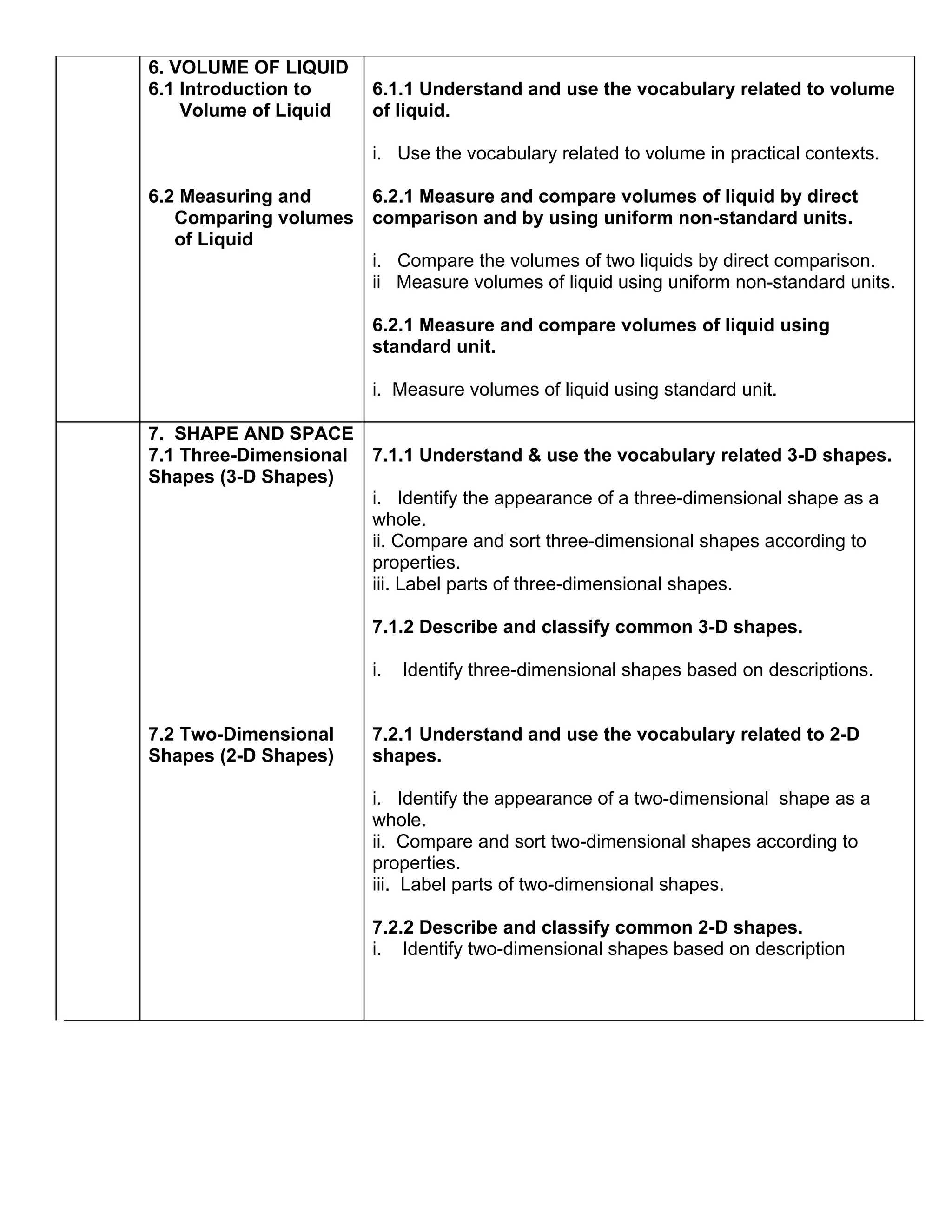
6. VOLUME OF LIQUID
6.1 Introduction to     6.1.1 Understand and use the vocabulary related to volume
    Volume of Liquid    of liquid.

                        i. Use the vocabulary related to volume in practical contexts.

6.2 Measuring and    6.2.1 Measure and compare volumes of liquid by direct
   Comparing volumes comparison and by using uniform non-standard units.
   of Liquid
                     i. Compare the volumes of two liquids by direct comparison.
                     ii Measure volumes of liquid using uniform non-standard units.

                        6.2.1 Measure and compare volumes of liquid using
                        standard unit.

                        i. Measure volumes of liquid using standard unit.

7. SHAPE AND SPACE
7.1 Three-Dimensional 7.1.1 Understand & use the vocabulary related 3-D shapes.
Shapes (3-D Shapes)
                      i. Identify the appearance of a three-dimensional shape as a
                      whole.
                      ii. Compare and sort three-dimensional shapes according to
                      properties.
                      iii. Label parts of three-dimensional shapes.

                        7.1.2 Describe and classify common 3-D shapes.

                        i.   Identify three-dimensional shapes based on descriptions.


7.2 Two-Dimensional     7.2.1 Understand and use the vocabulary related to 2-D
Shapes (2-D Shapes)     shapes.

                        i. Identify the appearance of a two-dimensional shape as a
                        whole.
                        ii. Compare and sort two-dimensional shapes according to
                        properties.
                        iii. Label parts of two-dimensional shapes.

                        7.2.2 Describe and classify common 2-D shapes.
                        i. Identify two-dimensional shapes based on description

M3thn2

  • 1.
    MATHEMATICS YEAR TWOYEARLY PLAN TOPIC/LEARNING WEEK LEARNING OBJECTIVES / LEARNING OUTCOMES AREAS 1. WHOLE NUMBERS 1.1 Numbers to 1 000 1.1 Say and use the number names in familiar contexts. i. Say the number names to 1 000. ii. Recognize numerals to 1 000. iii. Count up to 1 000 objects by grouping them in hundreds, tens, fives, twos and ones. 1.1.2 Read and write numbers to 1 000. i. Write numerals to 1 000. ii. Read number words to one thousand. iii. Write number words to one thousand. 1.1.3 Know what each digit in a number represents. i. Recognize the place value of numbers. 1.1.4 Understand and use the vocabulary of comparing and arranging numbers or quantities to 1 000. i. Arrange numbers to 1 000 : a. Count on and count back in ones. b. Count on and count back in twos. c. Count on and count back in fives. d. Count on and count back in tens. e. Count on and count back in hundreds. ii. Compare two numbers and say which is more or less. iii. Arrange numbers in order : a. Compare the numbers; and b. position the numbers on a number line. 1.1.5 Understand and use ordinal numbers in different contexts. i. Say ordinal numbers from eleventh to twentieth. ii. Use ordinal numbers in different contexts.
  • 2.
    1.2 Addition WithThe 1.2.1 Understand addition as combining two groups of Highest Total Of objects. 1 000 i. Add two numbers without regrouping : a. two 1-digit numbers; b. a 2-digit number and a 1-digit number; and c. two 2-digit numbers. ii. Add two numbers with regrouping : a. a 2-digit number and a 1-digit number; and b. two 2-digit numbers. iii. Add two numbers without regrouping : a. a 3-digit number and a 1-digit number; b. a 3-digit number and a 2-digit number; and c. two 3-digit numbers. iv. Add three 1-digit numbers. 1.2.2 Use and apply knowledge of addition in real life. i. Find the unknown numbers in number sentences. ii. Solve problems involving addition in real life situations. 1.3 Subtraction Within 1.3.1 Understand subtraction as "take away" or The Range of “difference" between two groups of objects. 1 000 i. Subtract two numbers without regrouping : a. a 1-digit number from a 1-digit number; b. a 1-digit number from a 2-digit number; and c. a 2-digit number from a 2-digit number. ii. Subtract two numbers with regrouping : a. a 1-digit number from a 2-digit number; and b. a 2-digit number from a 2-digit number. iii. Subtract two numbers without regrouping : a. a 1-digit number from a 3-digit number ; b. a 2-digit number from a 3-digit number; and c. a 3-digit number from a 3-digit number. iv. Subtract three 1-digit numbers. 1.3.2 Use and apply knowledge of subtraction in real life i. Find the unknown numbers in number sentences. ii. Solve problems involving subtraction in real life situations.
  • 3.
    1.4 Multiplication 1.4.1 Understand multiplication as repeated addition. within 2, 3, 4 and 5 ( 2, 3, 4 and 5 times-tables ) times-tables i. Recognize multiplication as repeated addition. ii. Write number sentences for multiplication. iii. Build up the multiplication tables of 2, 3, 4 and 5. iv. Multiply two 1-digit numbers. 1.4.2 Know by heart the multiplication tables of 2, 3, 4 and 5. i. Recall rapidly the multiplication tables of 2, 3, 4 and 5. 1.4.3 Use and apply knowledge of multiplication in real life. i. Find the unknown numbers in number sentences. ii. Solve problems involving multiplication in real life situations. 1.5 Division within 2, 1.5.1 Understand division as sharing equally or grouping. 3, 4 and 5 times- ( Corresponding to 2, 3, 4 and 5 times-tables. ) tables i. Recognize division as sharing equally. ii. Recognize division as grouping. iii. Write number sentences for division. iv. Divide numbers within the multiplication tables. 1.5.2 Derive quickly division facts. ( Corresponding to 2, 3, 4 and 5 times-tables. ) i. Derive quickly division facts of 2, 3, 4 and 5 times-tables. 1.5.3 Use and apply knowledge of division in real life. i. Find the unknown numbers in number sentences. ii. Solve problems involving division in real life situations.
  • 4.
    2. MONEY 2.1 Moneyto RM50 2.1.1 Understand and use the vocabulary related to money. i. Represent the value of money in 'RM' and "sen" ii. Exchange : a. Coins up to RM5; and b. notes up to RM50. 2.1.2 Use and apply knowledge of money in real life. i. Add money up to RM50. ii. Subtract money up to RM50. iii. Solve problems involving money in real life situations. 3. TIME 3.1 Reading and 3.1.1 Understand, read and write the vocabulary related to Writing Time time. i. Read time to five minutes. ii. Write the time to five minutes. 3.2 Relationship 3.2.1 Understand the relationship between units of time. between units of i. Use units of time and know the relationship between: time a. hour and minutes; and ii. day and hours. 3.3 Solving problems 3.3.1 Use and apply knowledge of time in real life. involving time i. Solve problems involving time in real life situations.
  • 5.
    4. LENGTH 4.1 Introductionto 4.1.1 Understand and use the vocabulary related to length length i. Use the vocabulary related to length in practical contexts. 4.2 Measuring and 4.2.1 Measure and compare lengths by direct comparison Comparing Lengths and using uniform non-standard units. i. Compare the lengths of two objects by direct Comparison. ii. Measure lengths of objects using uniform non-standard units. 4.2.2 Measure and compare lengths using standard units. i. Measure lengths of objects using standard units : a. meter; and b. centimeter 5. MASS 5.1 Introduction to 5.1.1 Understand and use the vocabulary related to mass. mass i. Use the vocabulary related to mass in practical contexts. 5.2 Measuring and 5.2.1 Measure and compare masses by direct comparison Comparing Masses and by using uniform non-standard units. i. Compare the masses of two objects by direct comparison. ii. Measure masses of objects using uniform non-standard units. 5.2.2 Measure and compare masses using standard unit. i. Measure masses of objects using standard unit.
  • 6.
    6. VOLUME OFLIQUID 6.1 Introduction to 6.1.1 Understand and use the vocabulary related to volume Volume of Liquid of liquid. i. Use the vocabulary related to volume in practical contexts. 6.2 Measuring and 6.2.1 Measure and compare volumes of liquid by direct Comparing volumes comparison and by using uniform non-standard units. of Liquid i. Compare the volumes of two liquids by direct comparison. ii Measure volumes of liquid using uniform non-standard units. 6.2.1 Measure and compare volumes of liquid using standard unit. i. Measure volumes of liquid using standard unit. 7. SHAPE AND SPACE 7.1 Three-Dimensional 7.1.1 Understand & use the vocabulary related 3-D shapes. Shapes (3-D Shapes) i. Identify the appearance of a three-dimensional shape as a whole. ii. Compare and sort three-dimensional shapes according to properties. iii. Label parts of three-dimensional shapes. 7.1.2 Describe and classify common 3-D shapes. i. Identify three-dimensional shapes based on descriptions. 7.2 Two-Dimensional 7.2.1 Understand and use the vocabulary related to 2-D Shapes (2-D Shapes) shapes. i. Identify the appearance of a two-dimensional shape as a whole. ii. Compare and sort two-dimensional shapes according to properties. iii. Label parts of two-dimensional shapes. 7.2.2 Describe and classify common 2-D shapes. i. Identify two-dimensional shapes based on description