1950S, 60S,
AND 70S
HISTORY AND CONTEXT
1950S
 Post WW2 and rationing had ended.
 More disposable income.
 The word ‘teenager’ used for the first time.
 Korean War
 McCarthyism and ‘reds under the bed’.
 First credit cards issued.
1950s Fashion
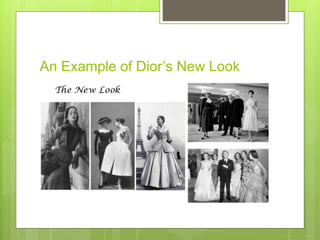
 Christian Dior and the New Look.
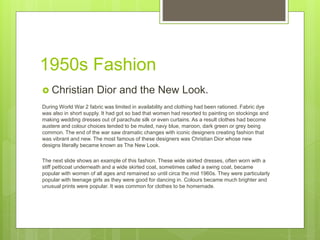
During World War 2 fabric was limited in availability and clothing had been rationed. Fabric dye
was also in short supply. It had got so bad that women had resorted to painting on stockings and
making wedding dresses out of parachute silk or even curtains. As a result clothes had become
austere and colour choices tended to be muted, navy blue, maroon, dark green or grey being
common. The end of the war saw dramatic changes with iconic designers creating fashion that
was vibrant and new. The most famous of these designers was Christian Dior whose new
designs literally became known as The New Look.
The next slide shows an example of this fashion. These wide skirted dresses, often worn with a
stiff petticoat underneath and a wide skirted coat, sometimes called a swing coat, became
popular with women of all ages and remained so until circa the mid 1960s. They were particularly
popular with teenage girls as they were good for dancing in. Colours became much brighter and
unusual prints were popular. It was common for clothes to be homemade.
An Example of Dior’s New Look
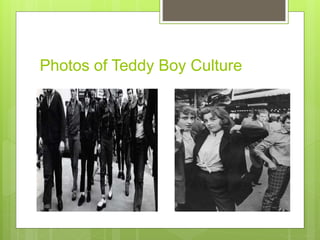
Teddy Boys and Girls
Another example of 1950s fashion was that worn by Teddy Boys
and Girls. This is probably the earliest example of a youth
subculture. Teddy boys emulated Edwardian style in their
clothing. Drainpipe trousers and a jacket known as ‘The drape’,
often with a velvet collar, were popular. Hair was slicked back or
worn in a quiff.
Teddy Girls also wore drape jackets, often with a pencil skirt,
brooch, and a clutch bag.
The next slide shows pictures of Teddy Boys and Teddy Girls.
Photos of Teddy Boy Culture
1960s Overview
 Moon landing
 Vietnam
 Berlin Wall constructed
 President Kennedy shot
 Civil Rights Movement
 Cash dispensers, cassette tapes, and the
internet invented.
 Television in people’s homes.
1960s Fashion
The 1960s saw some huge changes in fashion. The New Look persisted
until around the mid 60s when designers such as Mary Quant became
popular. Big skirts were replaced with shift dresses and mini skirts.
Tights were evented specifically to be worn with skirts. The space race
brought in a fascination with metallic fabrics and futuristic styling. The
Mary Quant look involved bold, bright colours, monochrome, and bold,
bright statement jewellery, often in lucite or plastic. Hair was cut in a
bob, makeup concentrated on the eyes, lots of eyeliner and false
eyelashes. This look particularly suited thin, gamine models such as
Twiggy.
A contrast to this look occurred in the late 60s when the hippie look
developed. The mini skirt and shift dress became maxi dresses. Hair
became longer, for women and men, and prints became wilder. A
notable designer at this point was Emilo Pucci.
1970s Overview
 Watergate and Nixon’s resignation
 Death of Elvis Presley
 Sony Walkman invented
 Margret Thatcher elected for the first time.
 Britain joins the European Union.
 First test tube baby born
 Bloody Sunday.
1970s fashion
Hippy culture continued to be popular for quite a while and then disco became
popular with lurex, wide lapels and flares. This was followed by glam rock, Bowie’s
songs ‘Rebel Rebel’ and ‘Queen Bitch’ describe elements of this look:
‘Got your mother in a whirl
She’s not sure if you’re a boy or a girl’
‘She’s so swishy in her satin and tat
Her frock coat and bibberty bobberty hat’
Later on in the era punk was invented, spiky hair, safety pins, ripped clothing,
leather and occasionally some things that looked like bin bags! Vivienne Westwood
was a popular designer from the punk era.
Music from 50s, 60s, 70s
https://youtu.be/Qadw2rFiaJc
Eddie Cochran ‘C’monEverybody’ (1958)
https://youtu.be/vdSqLfuRN18
Zaegar and Evans ‘In the Year 2525’ (1969)
https://youtu.be/78Xa3G0SZ3E
Bowie ‘Rebel Rebel; (1978)

Pipmoran19502spptx

  • 1.
  • 2.
    1950S  Post WW2and rationing had ended.  More disposable income.  The word ‘teenager’ used for the first time.  Korean War  McCarthyism and ‘reds under the bed’.  First credit cards issued.
  • 3.
    1950s Fashion  ChristianDior and the New Look. During World War 2 fabric was limited in availability and clothing had been rationed. Fabric dye was also in short supply. It had got so bad that women had resorted to painting on stockings and making wedding dresses out of parachute silk or even curtains. As a result clothes had become austere and colour choices tended to be muted, navy blue, maroon, dark green or grey being common. The end of the war saw dramatic changes with iconic designers creating fashion that was vibrant and new. The most famous of these designers was Christian Dior whose new designs literally became known as The New Look. The next slide shows an example of this fashion. These wide skirted dresses, often worn with a stiff petticoat underneath and a wide skirted coat, sometimes called a swing coat, became popular with women of all ages and remained so until circa the mid 1960s. They were particularly popular with teenage girls as they were good for dancing in. Colours became much brighter and unusual prints were popular. It was common for clothes to be homemade.
  • 4.
    An Example ofDior’s New Look
  • 5.
    Teddy Boys andGirls Another example of 1950s fashion was that worn by Teddy Boys and Girls. This is probably the earliest example of a youth subculture. Teddy boys emulated Edwardian style in their clothing. Drainpipe trousers and a jacket known as ‘The drape’, often with a velvet collar, were popular. Hair was slicked back or worn in a quiff. Teddy Girls also wore drape jackets, often with a pencil skirt, brooch, and a clutch bag. The next slide shows pictures of Teddy Boys and Teddy Girls.
  • 6.
    Photos of TeddyBoy Culture
  • 7.
    1960s Overview  Moonlanding  Vietnam  Berlin Wall constructed  President Kennedy shot  Civil Rights Movement  Cash dispensers, cassette tapes, and the internet invented.  Television in people’s homes.
  • 8.
    1960s Fashion The 1960ssaw some huge changes in fashion. The New Look persisted until around the mid 60s when designers such as Mary Quant became popular. Big skirts were replaced with shift dresses and mini skirts. Tights were evented specifically to be worn with skirts. The space race brought in a fascination with metallic fabrics and futuristic styling. The Mary Quant look involved bold, bright colours, monochrome, and bold, bright statement jewellery, often in lucite or plastic. Hair was cut in a bob, makeup concentrated on the eyes, lots of eyeliner and false eyelashes. This look particularly suited thin, gamine models such as Twiggy. A contrast to this look occurred in the late 60s when the hippie look developed. The mini skirt and shift dress became maxi dresses. Hair became longer, for women and men, and prints became wilder. A notable designer at this point was Emilo Pucci.
  • 9.
    1970s Overview  Watergateand Nixon’s resignation  Death of Elvis Presley  Sony Walkman invented  Margret Thatcher elected for the first time.  Britain joins the European Union.  First test tube baby born  Bloody Sunday.
  • 10.
    1970s fashion Hippy culturecontinued to be popular for quite a while and then disco became popular with lurex, wide lapels and flares. This was followed by glam rock, Bowie’s songs ‘Rebel Rebel’ and ‘Queen Bitch’ describe elements of this look: ‘Got your mother in a whirl She’s not sure if you’re a boy or a girl’ ‘She’s so swishy in her satin and tat Her frock coat and bibberty bobberty hat’ Later on in the era punk was invented, spiky hair, safety pins, ripped clothing, leather and occasionally some things that looked like bin bags! Vivienne Westwood was a popular designer from the punk era.
  • 11.
    Music from 50s,60s, 70s https://youtu.be/Qadw2rFiaJc Eddie Cochran ‘C’monEverybody’ (1958) https://youtu.be/vdSqLfuRN18 Zaegar and Evans ‘In the Year 2525’ (1969) https://youtu.be/78Xa3G0SZ3E Bowie ‘Rebel Rebel; (1978)