LA MODE
20TH CENTURY
1940 -> 2000
the 20th century of French is the century of fashion. It sees the
greatest fashion designers: Lanvin, Chanel or Yves Saint-Laurent…
They work only for rare wealthy clients.
La “femme Lanvin” in November
1915. Founded in 1889, Lanvin is now
the oldest Parisian couture house in
operation.
Gabrielle Chanel en 1928. Avant-garde
et independence, Chanel's style
launches the emblematic “boy” style
of the 30’.
Fashion for All
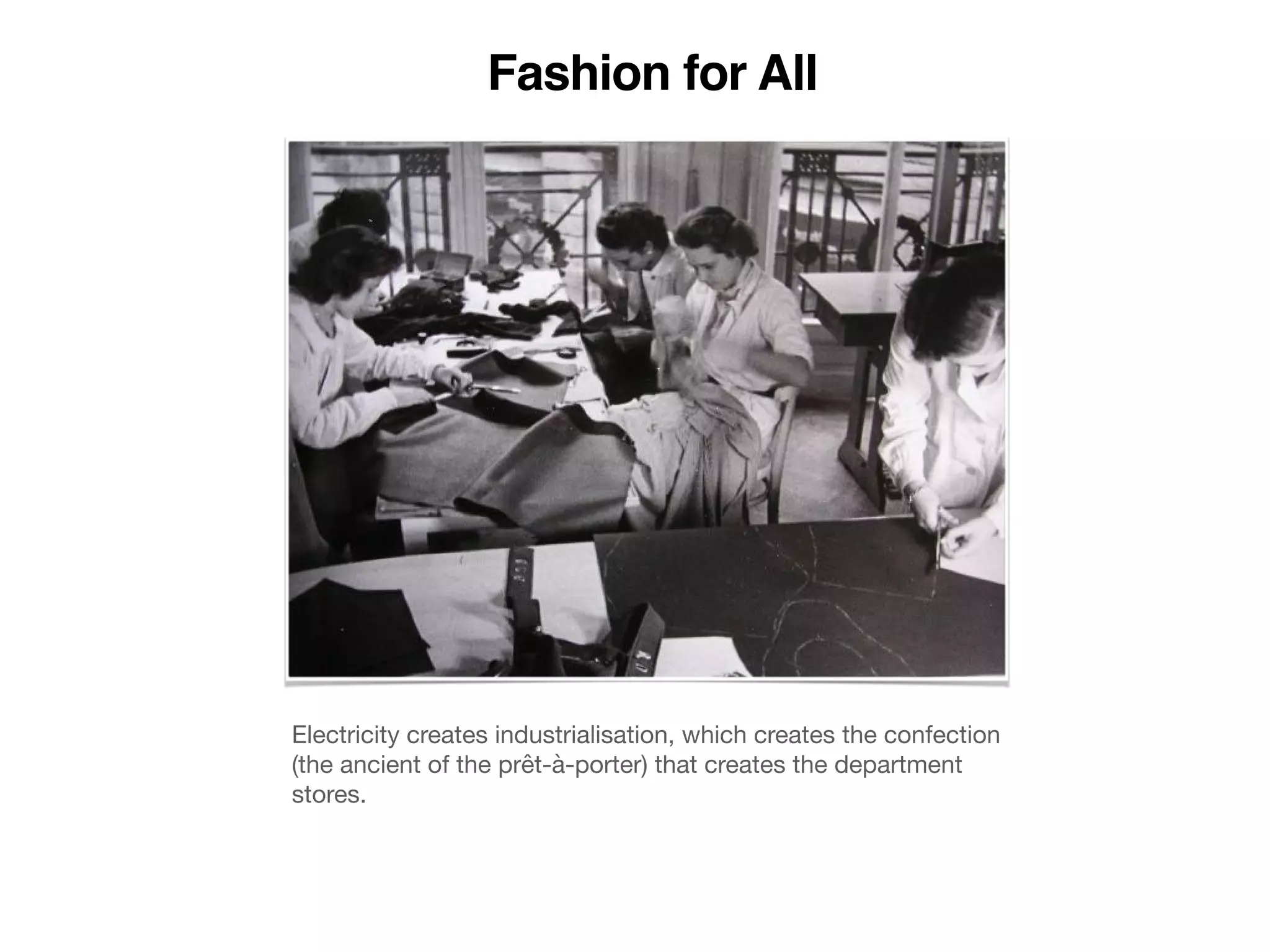
Electricity creates industrialisation, which creates the confection
(the ancient of the prêt-à-porter) that creates the department
stores.
1939 -> 1945
The decade opens up to the horror of the
Second World War.

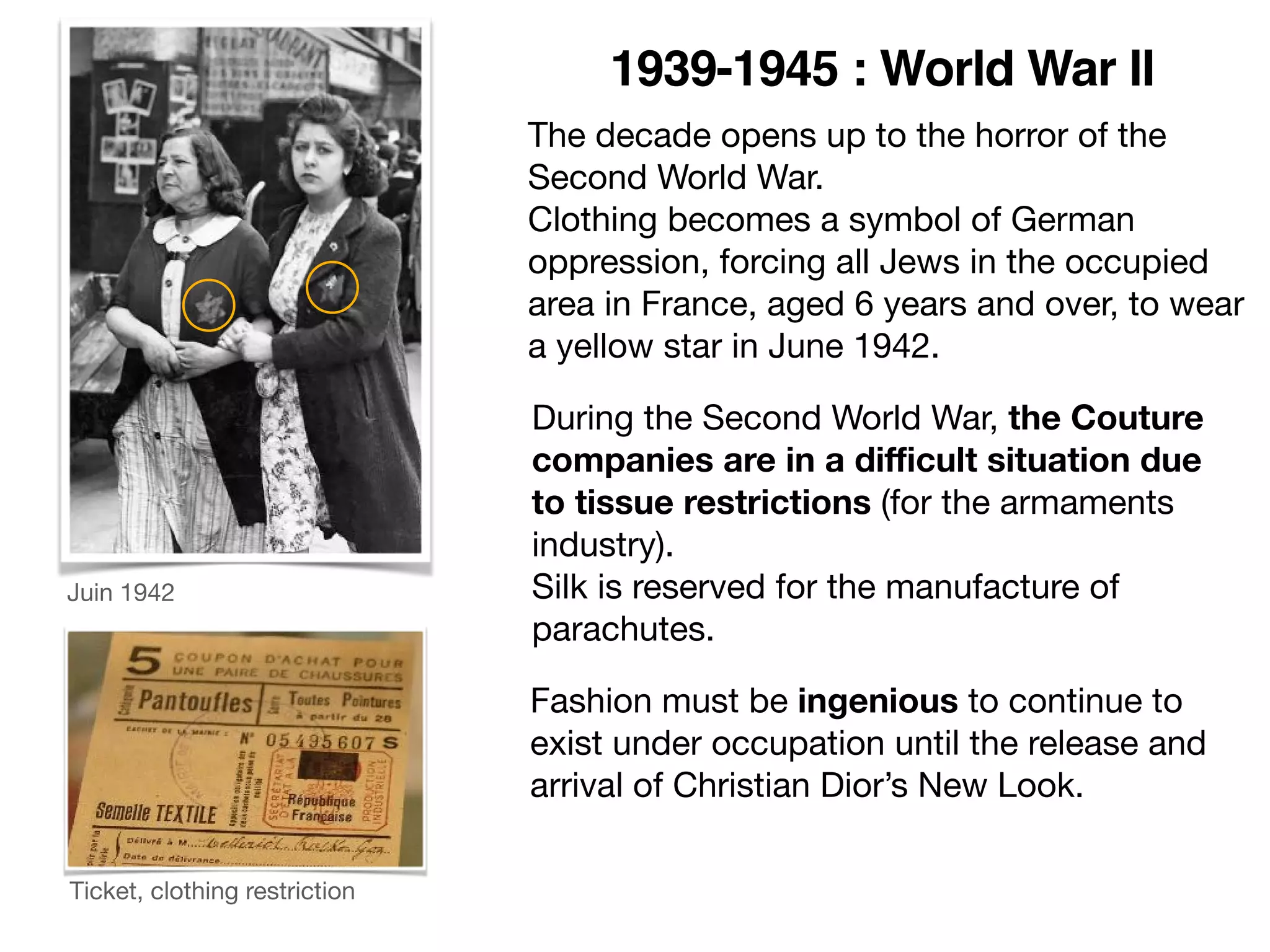
Clothing becomes a symbol of German
oppression, forcing all Jews in the occupied
area in France, aged 6 years and over, to wear
a yellow star in June 1942.
Juin 1942
1939-1945 : World War II
During the Second World War, the Couture
companies are in a difficult situation due
to tissue restrictions (for the armaments
industry).

Silk is reserved for the manufacture of
parachutes.
Fashion must be ingenious to continue to
exist under occupation until the release and
arrival of Christian Dior’s New Look.
Ticket, clothing restriction
Fashion is controlled very strictly: the
skirt length goes back under the knee,
which will mark the advent of the pencil
shape skirt : la jupe crayon.
1939-1945 : LE SYSTÈME D*
“Liquid tight” made from coffee
or tea. The line was drawn1941.
The curtains turn into a dress
and the women dye their legs
with tea to imitate the silk
stockings.
* System D is a shorthand term that refers back to the French word
débrouillard, (one who is) skilled or resourceful at handling any
difficulty. System D refers to a manner of responding to challenges
that requires one to have the ability to think fast, to adapt, and to
improvise when getting the job done.
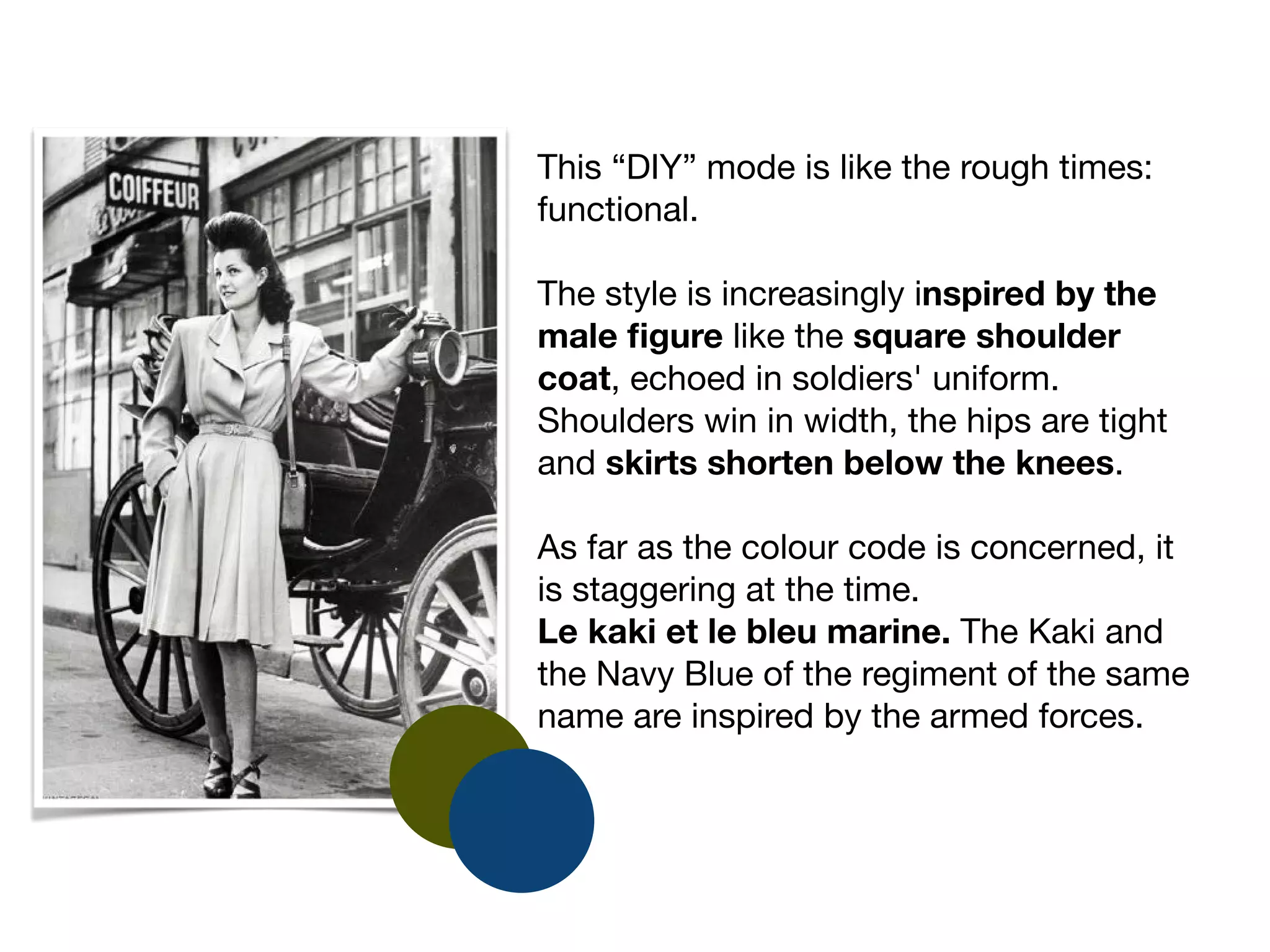
This “DIY” mode is like the rough times:
functional.

The style is increasingly inspired by the
male figure like the square shoulder
coat, echoed in soldiers' uniform.

Shoulders win in width, the hips are tight
and skirts shorten below the knees.

As far as the colour code is concerned, it
is staggering at the time.

Le kaki et le bleu marine. The Kaki and
the Navy Blue of the regiment of the same
name are inspired by the armed forces.
The emblematic dress
code from 1939 to 1945
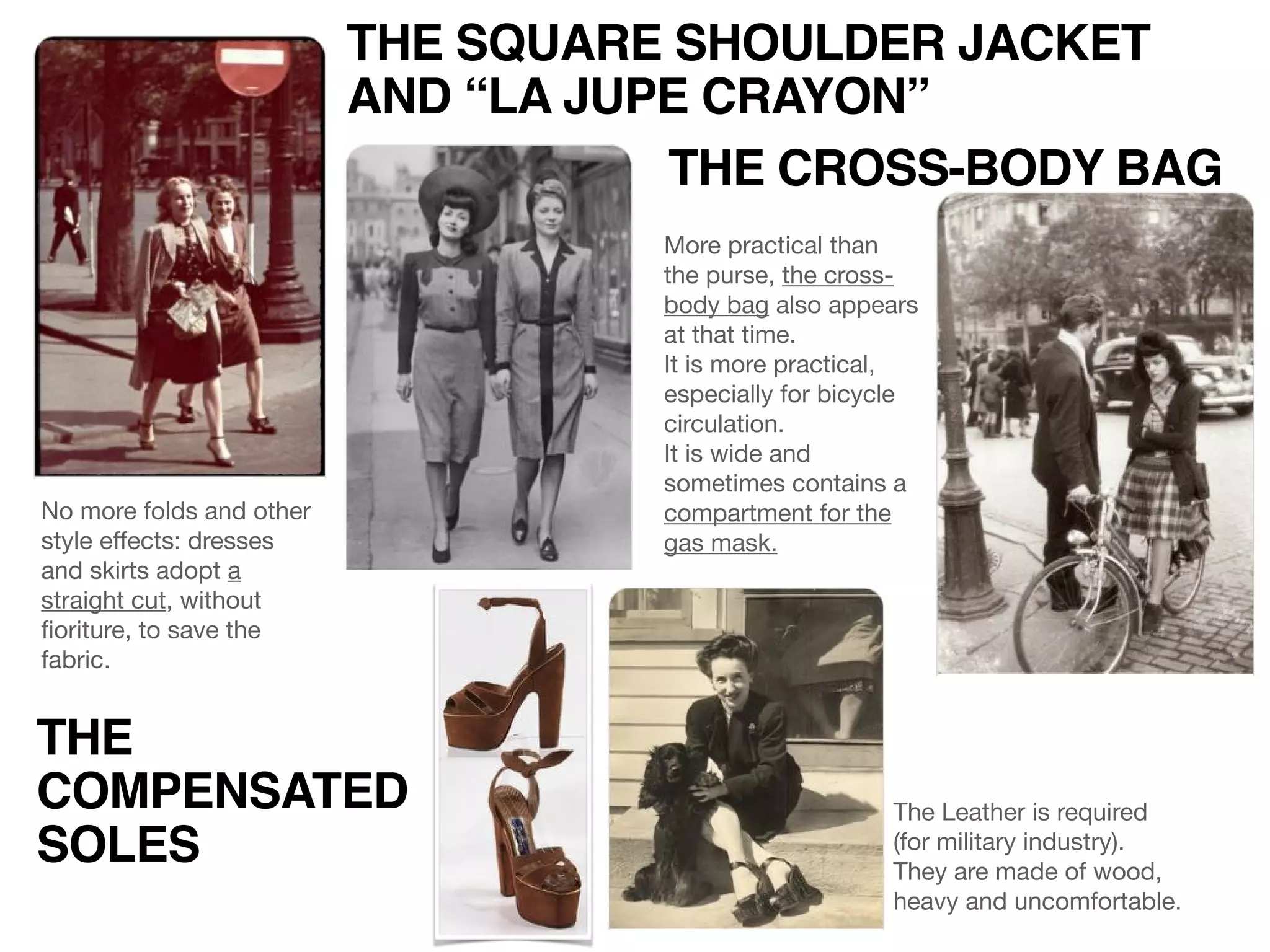
THE SQUARE SHOULDER JACKET
AND “LA JUPE CRAYON”
No more folds and other
style effects: dresses
and skirts adopt a
straight cut, without
fioriture, to save the
fabric.
THE CROSS-BODY BAG
More practical than
the purse, the cross-
body bag also appears
at that time.

It is more practical,
especially for bicycle
circulation.

It is wide and
sometimes contains a
compartment for the
gas mask.
THE
COMPENSATED
SOLES
The Leather is required

(for military industry).

They are made of wood,
heavy and uncomfortable.
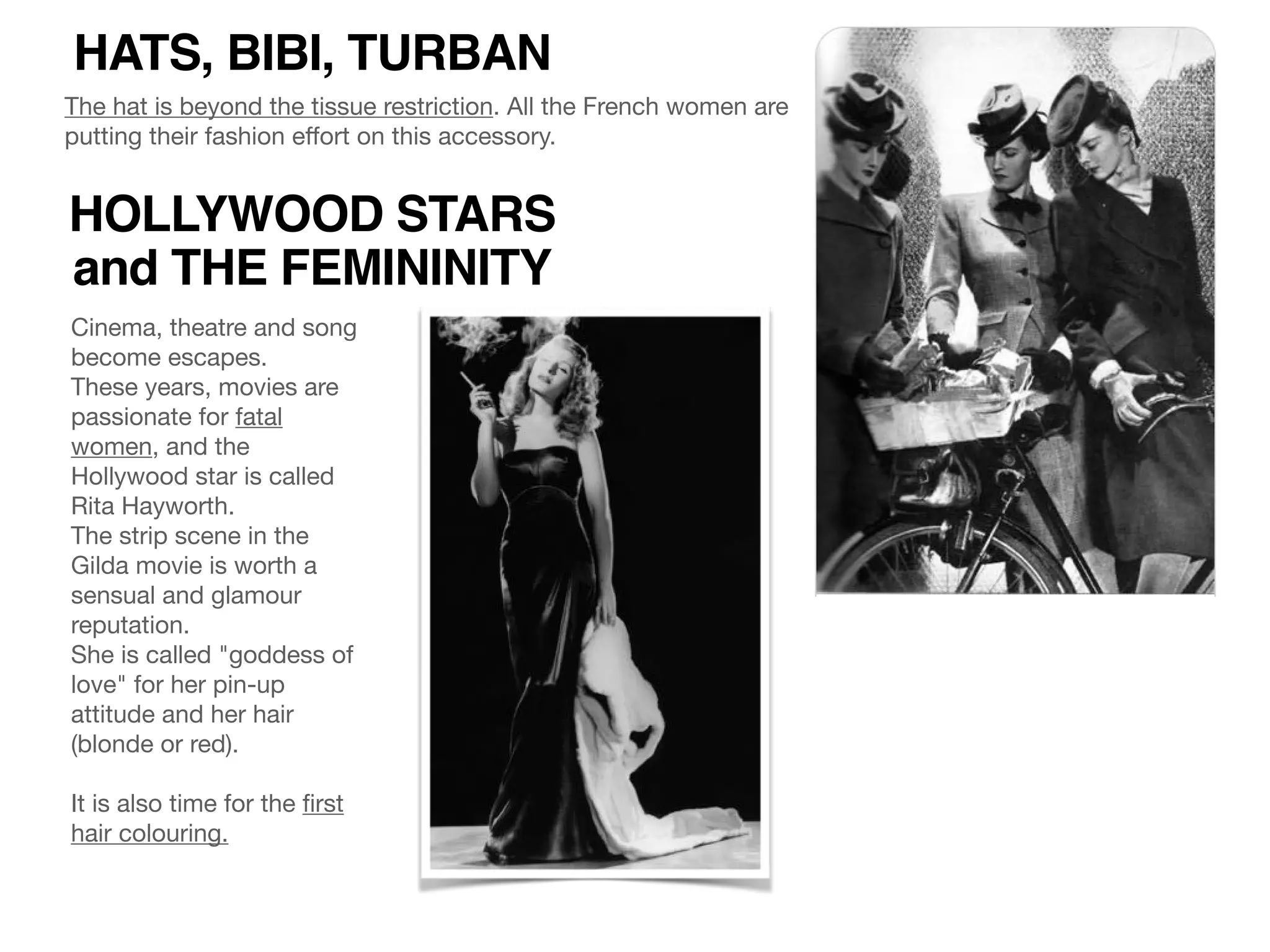
HATS, BIBI, TURBAN
The hat is beyond the tissue restriction. All the French women are
putting their fashion effort on this accessory.
HOLLYWOOD STARS
and THE FEMININITY
Cinema, theatre and song
become escapes.

These years, movies are
passionate for fatal
women, and the
Hollywood star is called
Rita Hayworth.

The strip scene in the
Gilda movie is worth a
sensual and glamour
reputation.

She is called "goddess of
love" for her pin-up
attitude and her hair
(blonde or red).

It is also time for the first
hair colouring.
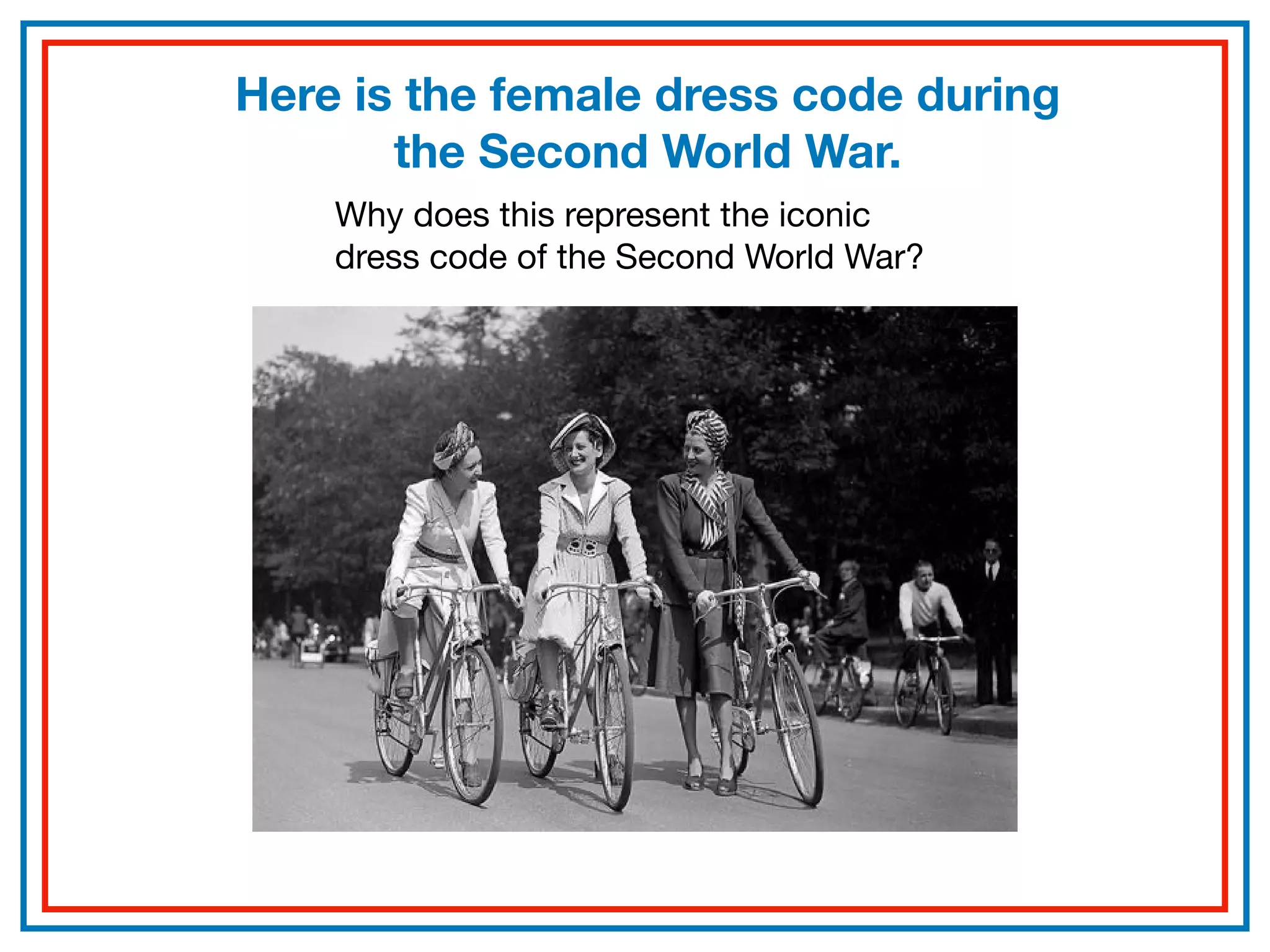
Here is the female dress code during
the Second World War.
Why does this represent the iconic
dress code of the Second World War?
Post-war
ONCE UPON A TIME...
OBVIOUS FEMININITY IN THE 1950’S
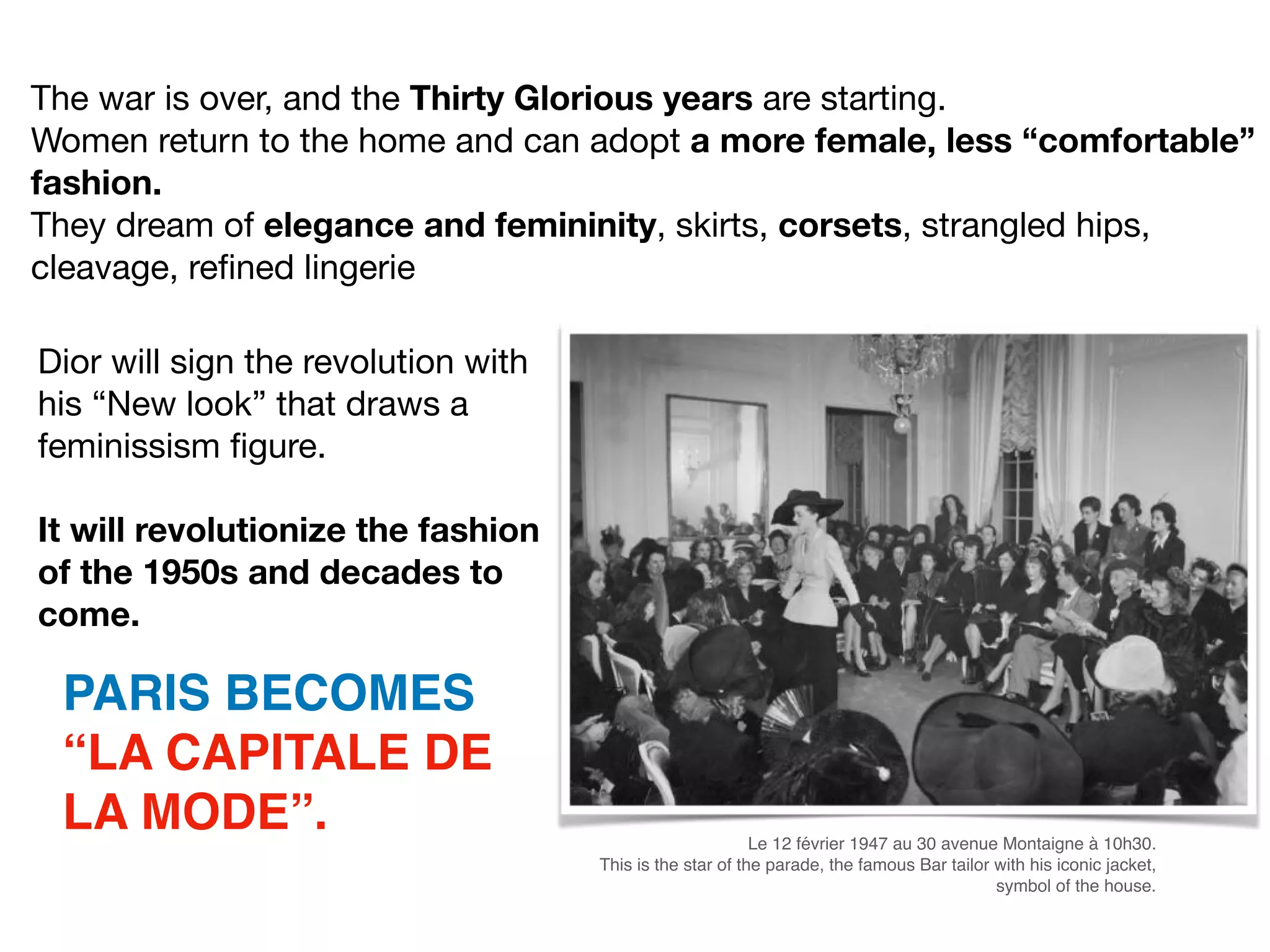
Dior will sign the revolution with
his “New look” that draws a
feminissism figure. 

It will revolutionize the fashion
of the 1950s and decades to
come.
PARIS BECOMES
“LA CAPITALE DE
LA MODE”. Le 12 février 1947 au 30 avenue Montaigne à 10h30.
This is the star of the parade, the famous Bar tailor with his iconic jacket,
symbol of the house.
The war is over, and the Thirty Glorious years are starting.

Women return to the home and can adopt a more female, less “comfortable”
fashion.
They dream of elegance and femininity, skirts, corsets, strangled hips,
cleavage, refined lingerie
The fashion has never been so bold, making
the director of Harper’s Bazaar Carmel Snow
told: “It’s a new look”.
The chest stands, shoulders are
rounder, The waist is tight, the hips
are wider, the breast is proud and
the skirt is longer..
Dior just reinvented the
woman's allure.
1947
THE NEW LOOK BY DIOR
Here is the female dress code after the
Second World War.
Why does this represent the iconic
wardrobe of the post war era ?
The 50’s
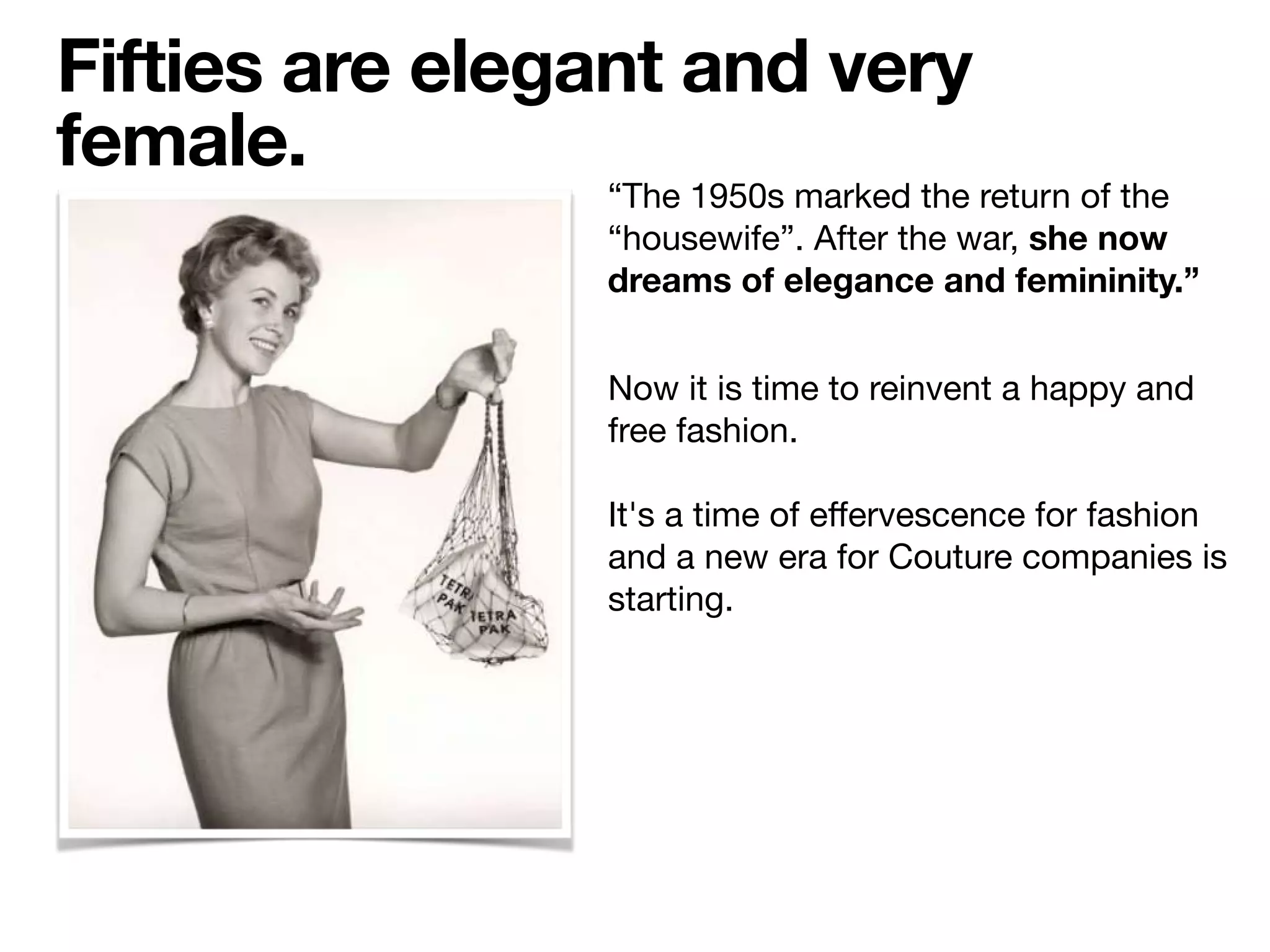
“The 1950s marked the return of the
“housewife”. After the war, she now
dreams of elegance and femininity.”
Fifties are elegant and very
female.
Now it is time to reinvent a happy and
free fashion.

It's a time of effervescence for fashion
and a new era for Couture companies is
starting.
1. Pierre Balmain et l’actrice Ruth Ford en 19472. Grace Kelly en 1954
It is the golden age of the Couture that renders Paris its status as a
world fashion capital. The whole planet is looking at Christian Dior, Hubert
de Givenchy, Cristóbal Balenciaga and Pierre Balmain. 

They are at the top of the 1950s fashion. They dress Hollywood icons:
Grace Kelly, Audrey Hepburn, Marilyn Monroe, Lauren Bacall…
Two headlights are facing each other in the heart of the women.
Chanel’s tight tailor The very evaded Dior Corolle dress.
Technological advances in the
period give rise to new
materials: polyester,
polyamide and acrylic are
now being worked.

This new leads to the creation
of ready-to-wear lines.
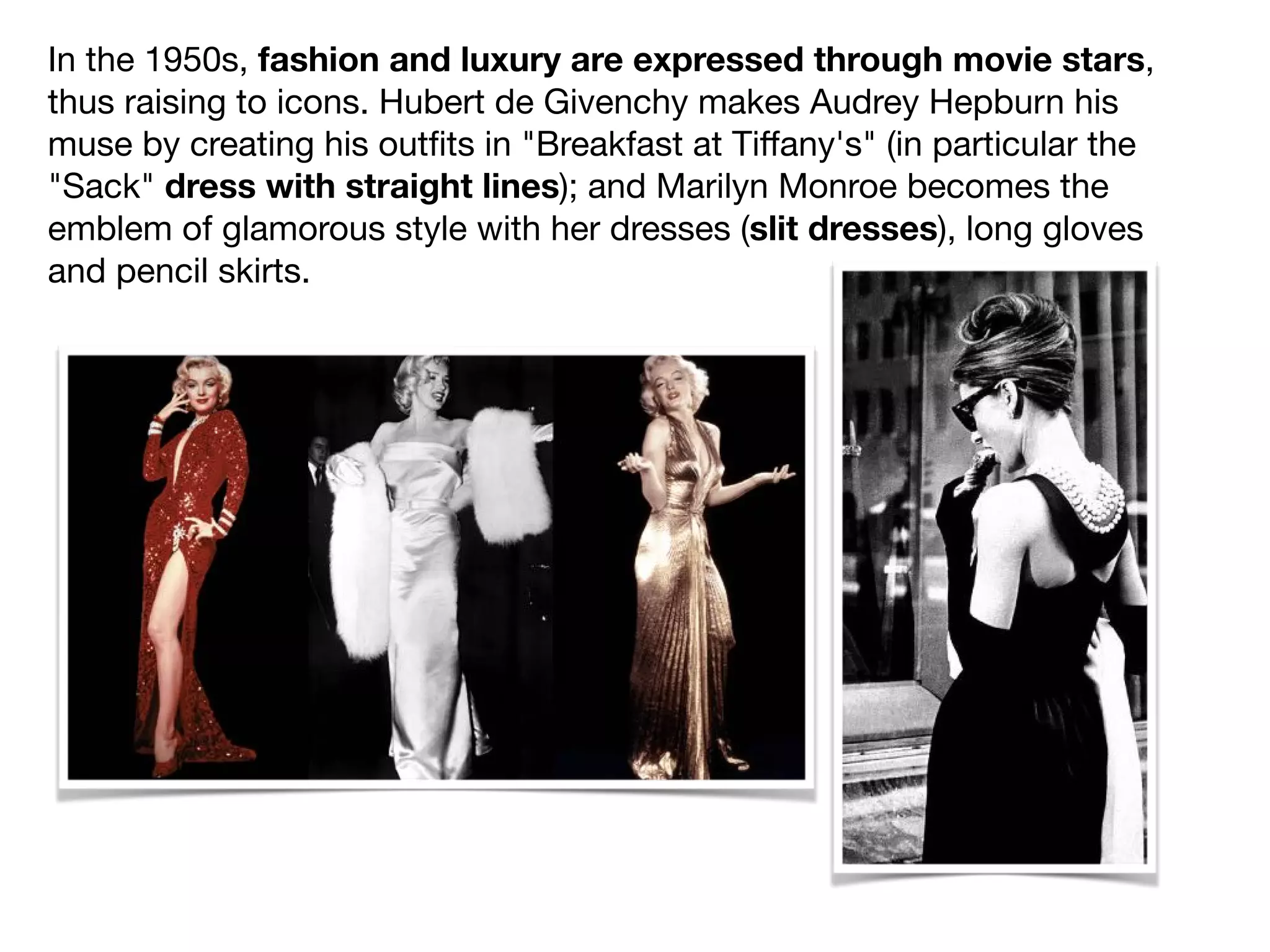
In the 1950s, fashion and luxury are expressed through movie stars,
thus raising to icons. Hubert de Givenchy makes Audrey Hepburn his
muse by creating his outfits in "Breakfast at Tiffany's" (in particular the
"Sack" dress with straight lines); and Marilyn Monroe becomes the
emblem of glamorous style with her dresses (slit dresses), long gloves
and pencil skirts.
Le col claudine : Audrey Hepburn appears the first in a
red blouse in Claudine collar!
The emblematic dress
code of the 50’s
This figure half child-half woman caused by this round-collar is worth the support of her entire
generation, which also starts to imitate Colette’s famous heroin in "Claudine at school".
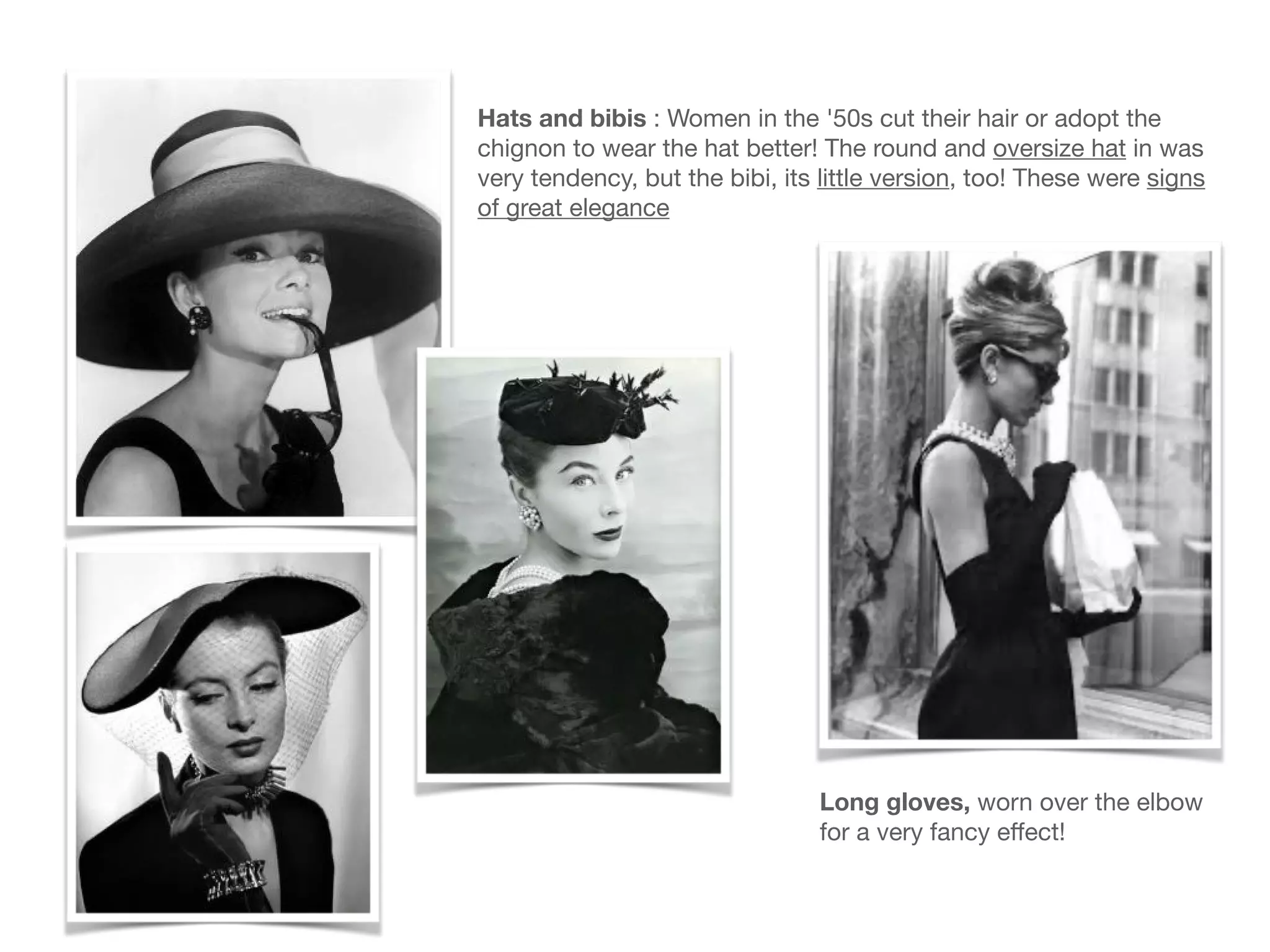
Long gloves, worn over the elbow
for a very fancy effect!
Hats and bibis : Women in the '50s cut their hair or adopt the
chignon to wear the hat better! The round and oversize hat in was
very tendency, but the bibi, its little version, too! These were signs
of great elegance
The 1950s also see the advent of pigeon bras and panty girdle that make it
possible to reach the shapes so coveted by the New-Look spirit.
The bicolor shoes and needle heel, launched by the Raymond Massaro Bottier for Coco Chanel in 1957.

According to Coco Chanel, the beige color was intended to extend the leg, and the black tip to shorten the
foot, for aesthetic purposes!
Here is the female dress code during
the 50’s.
Why does this represent the
iconic wardrobe of the decade ?
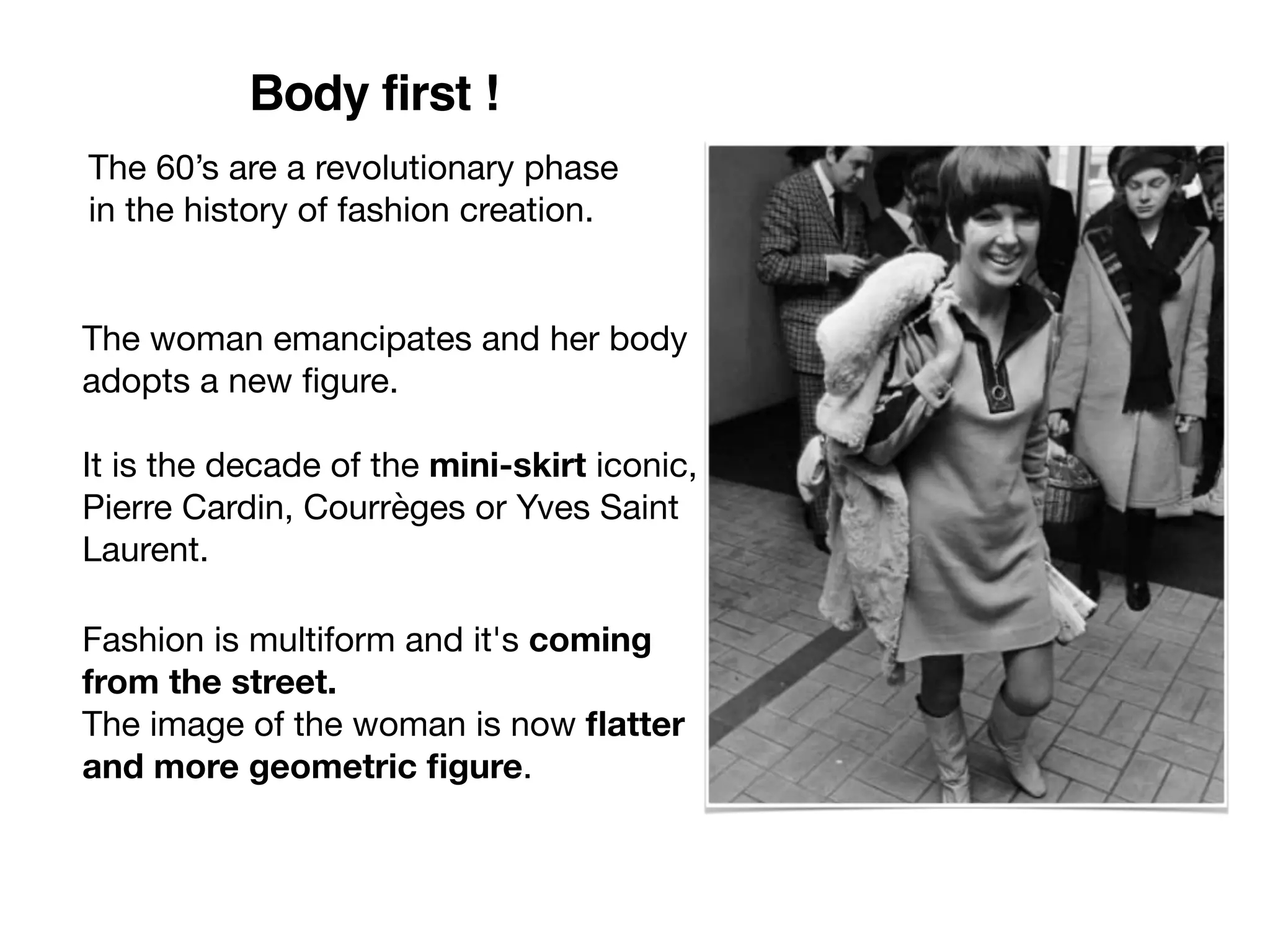
Mary Quant is significantly
shortening her dresses and skirt.
She starts to introduce the mini-
skirt that will become one of the
biggest phenomena in the Sixties.
But a new wind blows in fashion…
The 60’s
The woman emancipates and her body
adopts a new figure. 

It is the decade of the mini-skirt iconic,
Pierre Cardin, Courrèges or Yves Saint
Laurent.
Fashion is multiform and it's coming
from the street.
The image of the woman is now flatter
and more geometric figure.
Body first !
The 60’s are a revolutionary phase
in the history of fashion creation.
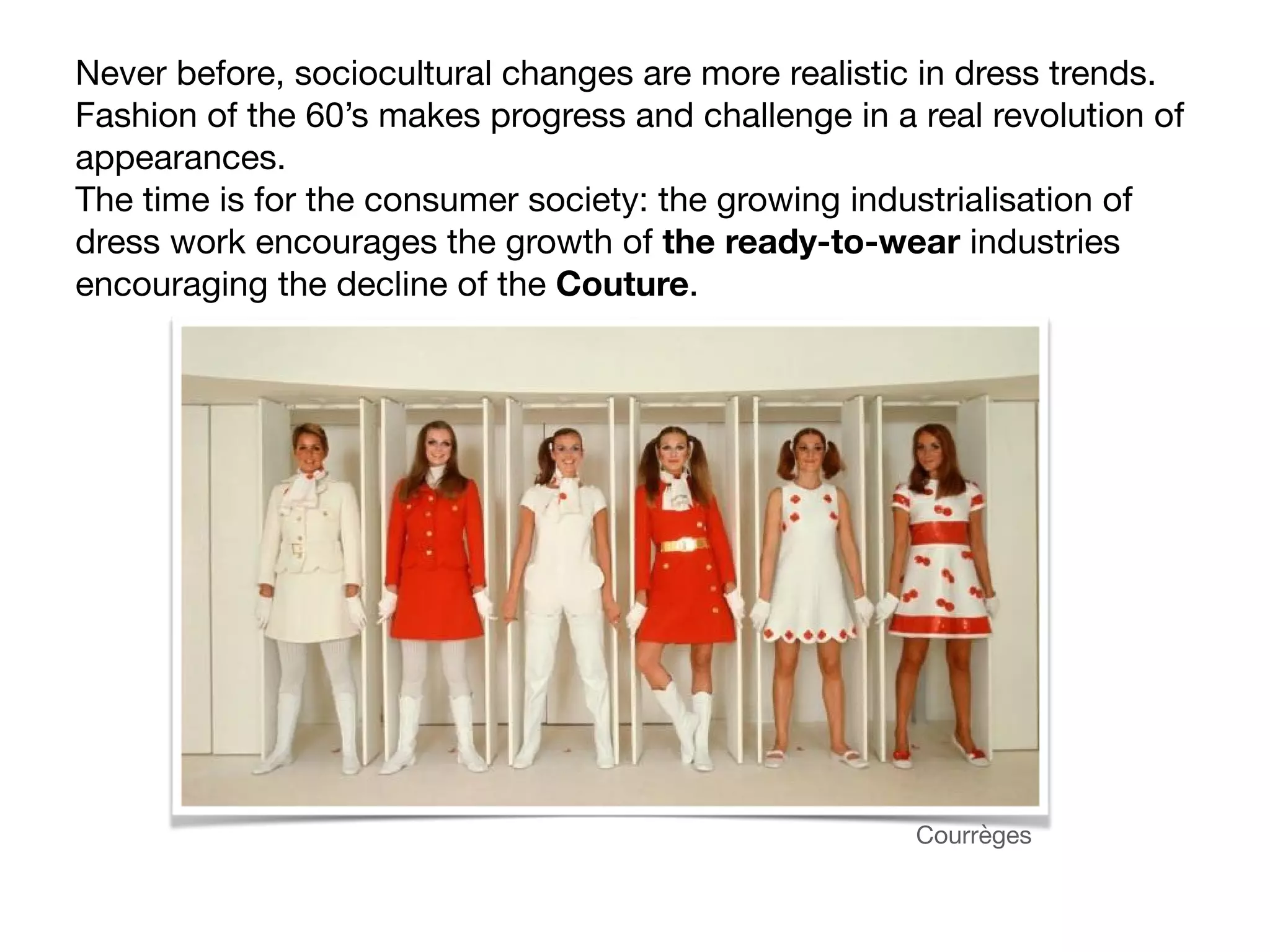
Never before, sociocultural changes are more realistic in dress trends.
Fashion of the 60’s makes progress and challenge in a real revolution of
appearances.

The time is for the consumer society: the growing industrialisation of
dress work encourages the growth of the ready-to-wear industries
encouraging the decline of the Couture.
Courrèges
In the youth of the baby boom, a new dress culture, which is based on
the Anglo-Saxon model is rising.

Music and groups impose their membership in a well-defined style :
«yéyés », « black leather jackets», « mods », « rockers » are a symbol of a
counterculture that is more than ever in appearances.
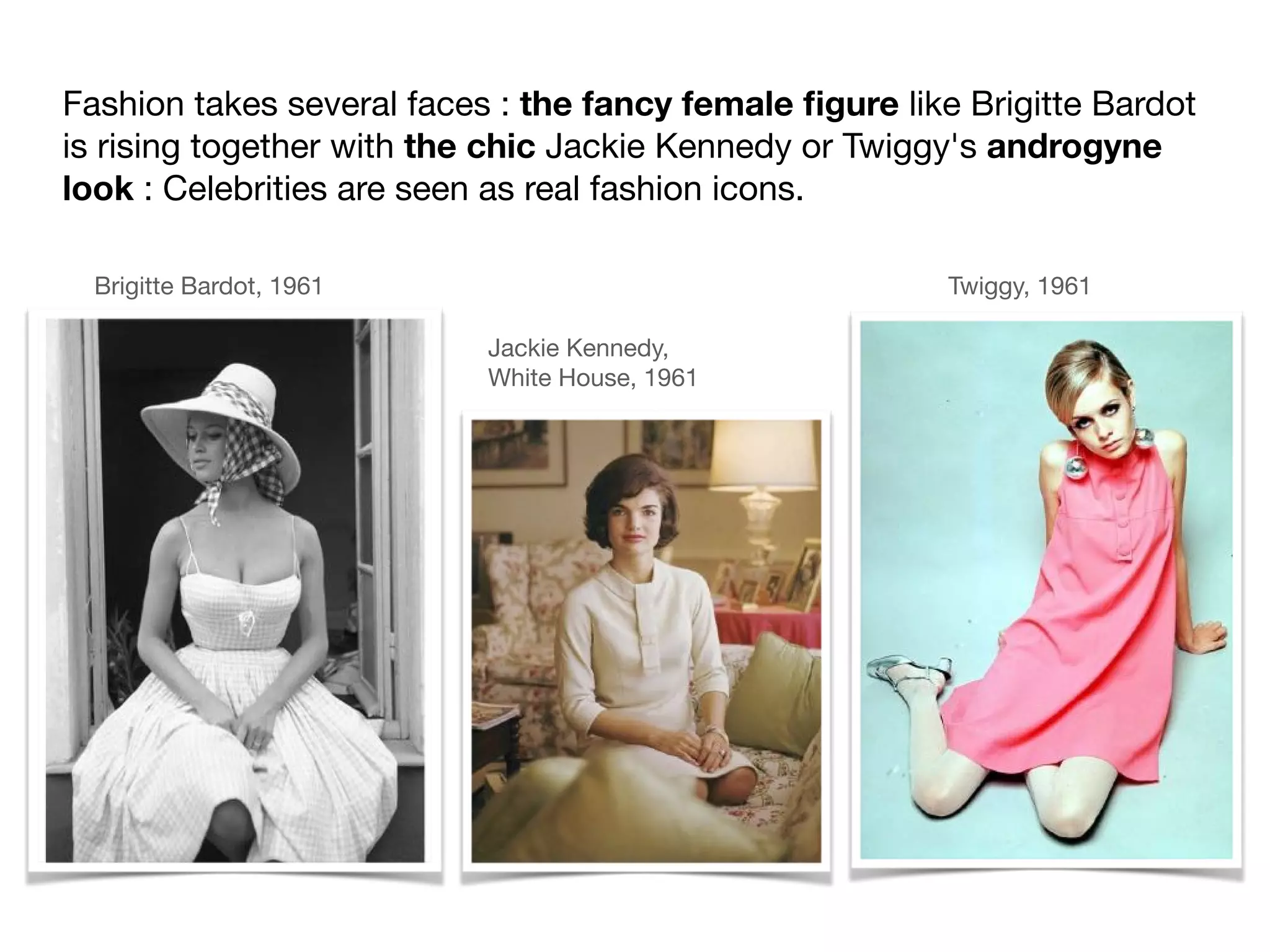
Fashion takes several faces : the fancy female figure like Brigitte Bardot
is rising together with the chic Jackie Kennedy or Twiggy's androgyne
look : Celebrities are seen as real fashion icons. 
Brigitte Bardot, 1961
Jackie Kennedy,

White House, 1961
Twiggy, 1961
The pants that are now more than ever becoming unisex.

Yves Saint Laurent brings the trench and the tuxedo for men into
the female wardrobe.
Trench by Yves Saint Laurent 1969
Tuxedo by Yves Saint Laurent

1969
“Carotte” trousers
New trends are moving into the heart of French women
like the mini-skirt, seen at André Courrèges fashion
shows and inspired by the British Mary Quant.
The flat boots
In the 60's, it is the conquest of space.
André Courrèges with its architectural collection called
Space Age, makes the geometric pattern the
moment’s print.

These forms, as well as silver color, will have a strong
influence on Paco Rabanne and Pierre Cardin.
Two creators, Pierre Cardin and Paco Rabanne, will contribute to
dialogue between the fashion world and the show world.
Paco Rabanne signs the
Barbarella movie suits with
Jane Fonda in 1968.
Paco Rabanne provides the dresses
of Casino Royal movie.
Pierre Cardin is gonna create the
Beatles costumes.

Paco Rabanne collections are often
made of plastic and metal.
Paco Rabanne
and Françoise
Hardy.
THE
TROUSERS
They become the witness
part of women’s dress
release.
TRENCH COAT
The trench became
popular and was brought
by civilians in the 1960’s
by Yves Saint Laurent.
THE 3 HOLES
DRESS
The creators Courèges and
Pierre Cardin made it one of their
flagship pieces. Wear with
ballerina, oversized sunglasses
and a scarf, Jackie O made an
iconic model.
The emblematic dress code
MONDRIAN DRESS
January 1966
Mondrian dress

by Yves Saint
Laurent.
In 1966, Mondrian dress, inspired by Piet Mondrian abstract art, comes out of Yves Saint Laurent’s
workshops. The prototype is created by Azzedine Alaia and the shoes are drawn by Roger Vivier. 

The feeling is complete, the fashion world remains flabbergasted in front of this sleeveless wool,
right cut and modernist prints, which stops just above the knees.
SAHARA JACKET
Betty Catroux, Yves Saint
Laurent and Loulou de la
Falaise
From military inspiration, the Sahara jacket is distinguished
by its half-long length, the lace on the breast, and its wide
pockets. A flagship play made by Yves Saint Laurent in
1967.
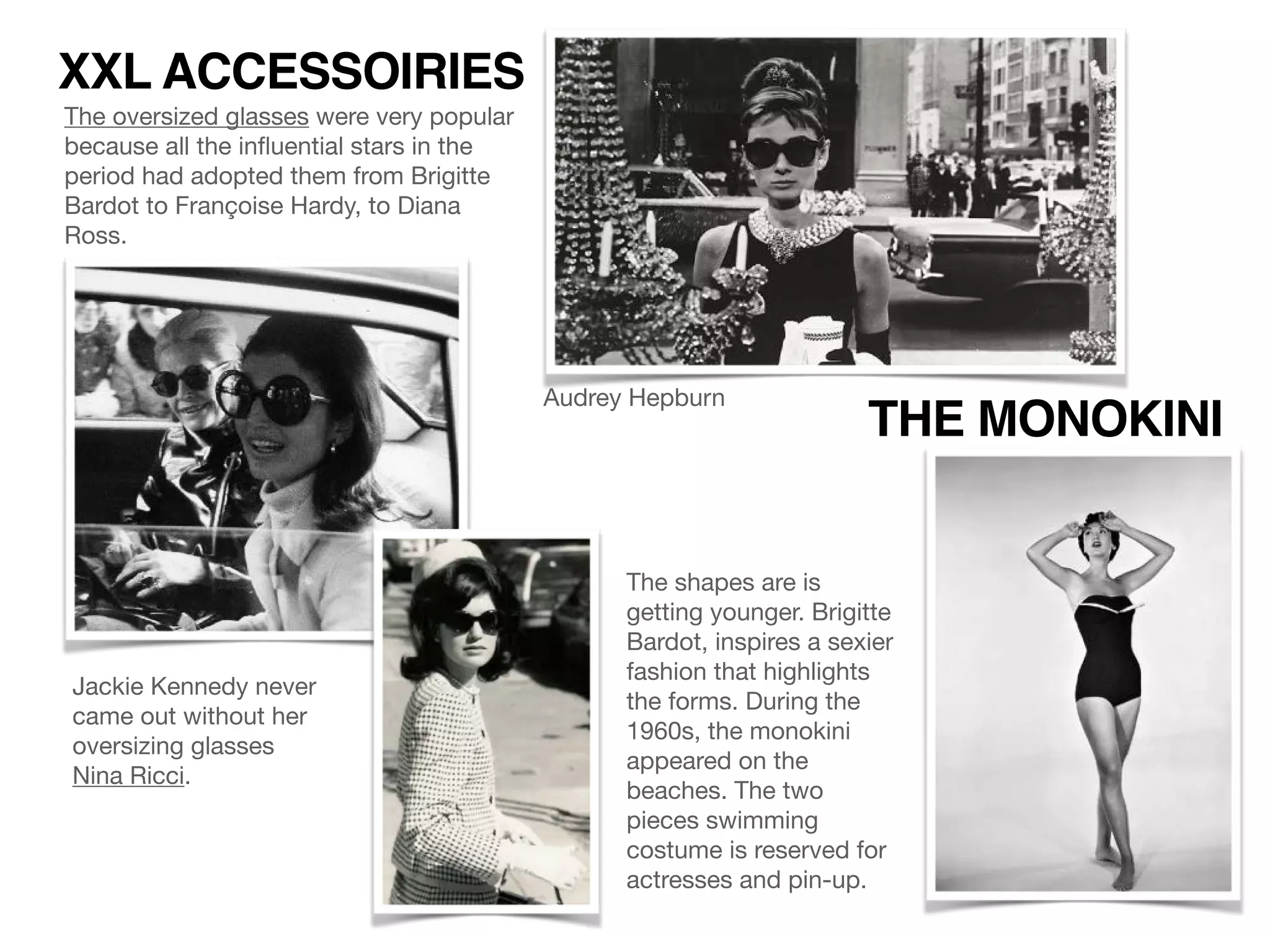
The oversized glasses were very popular
because all the influential stars in the
period had adopted them from Brigitte
Bardot to Françoise Hardy, to Diana
Ross.
XXL ACCESSOIRIES
Jackie Kennedy never
came out without her
oversizing glasses
Nina Ricci.
Audrey Hepburn
THE MONOKINI
The shapes are is
getting younger. Brigitte
Bardot, inspires a sexier
fashion that highlights
the forms. During the
1960s, the monokini
appeared on the
beaches. The two
pieces swimming
costume is reserved for
actresses and pin-up.
Here is the female dress code during
the 60’s.
Why does this represent the
iconic wardrobe of the decade ?
The 70’s
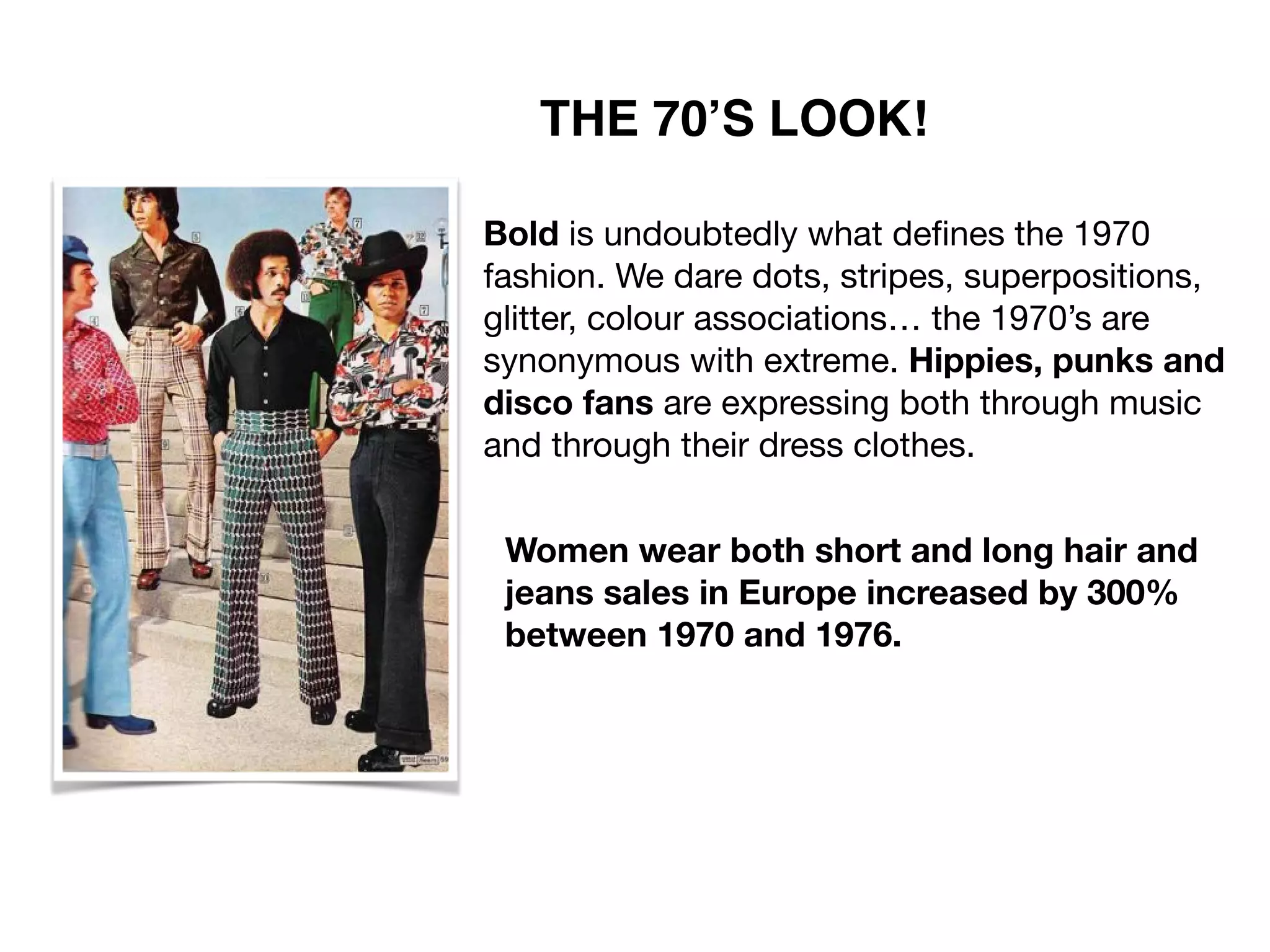
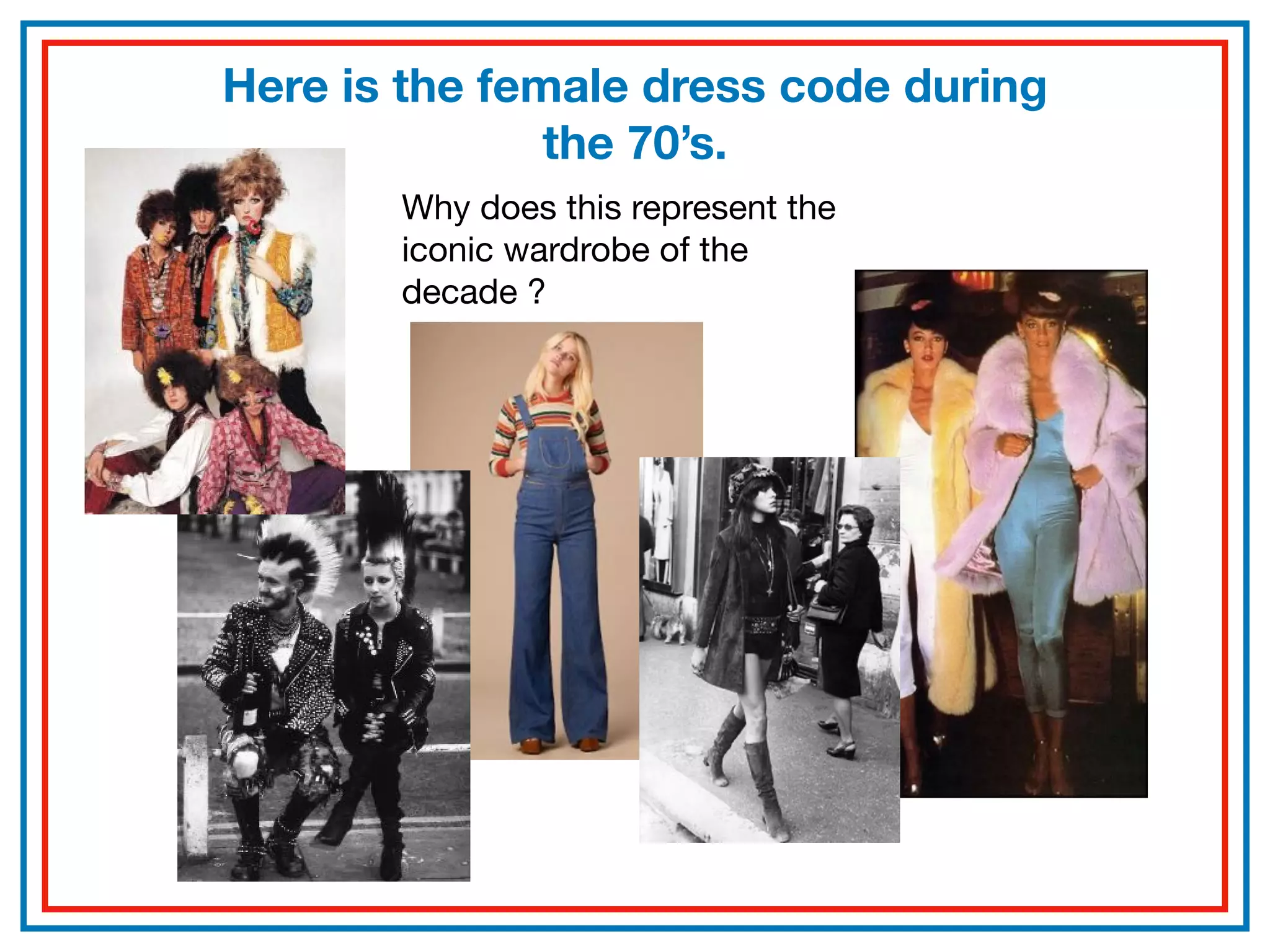
THE 70’S LOOK!
Bold is undoubtedly what defines the 1970
fashion. We dare dots, stripes, superpositions,
glitter, colour associations… the 1970’s are
synonymous with extreme. Hippies, punks and
disco fans are expressing both through music
and through their dress clothes.
Women wear both short and long hair and
jeans sales in Europe increased by 300%
between 1970 and 1976.
The Hippie wave gives birth to floral
prints on shirts, on dresses and skirts.
Major trend in the “Flower Power” and
"Peace and Love" eras.

It translates into clothes such as eph’s
paws trousers, oversized blouses and
accessories such as scarves or
flowers in hair
MUSIC AS A WEALTHY DRESS CODE
In the '70s, you have to be original. On the
outfits, this will has resulted in a colour
explosion (such as electric blue and orange),
and materials (such as glitter).

The style becomes unisex:

women claim to be men with pants and
blazers, while men opt for long hair.
Disco music puts glitter on the light as demonstrated by the ABBA group, the gold color, but also the
very strong colors such as yellow, red or apple green. It’s also the time for the famous pie server
collar…
Saturday Night Fever - 1977
But the punk movement begins in 1976, with
the English band The Sex Pistols and the
American The Ramones. 

The tartan is all-out, the blue-jeans holed under
a kilt and the necessary accessories: nanny
pins, nail bracelet and the Dr Martens boots.
Malcolm mcLaren Siouxsie Sioux wears
bracelets, Nancy Spungen,
pulls out the nails, and Sid
Vicious frequently wears a
chain around the neck, the two
ends are sealed by a lock
In the 1970s, creators replace the fashion
designers: Issey Miyake et Karl Lagerfeld know their
first Parisian successes, Kenzo et Jean-Charles de
Castelbajac put it on color while Chantal Thomass is
drawing sexy underwear collections.
Kenzo 1976
Chantal Thomass 1976
Jerry Hall and the Zèbre sweater 

by Castelbajac
Karl Lagerfeld with models at Maison
Chloe, 1972 Stock Photo - Alamy. Karl
Lagarfeld was famous for the long and fluid
skirts and shirts. Hi collaboration with Chloé
lasts for 20 years.
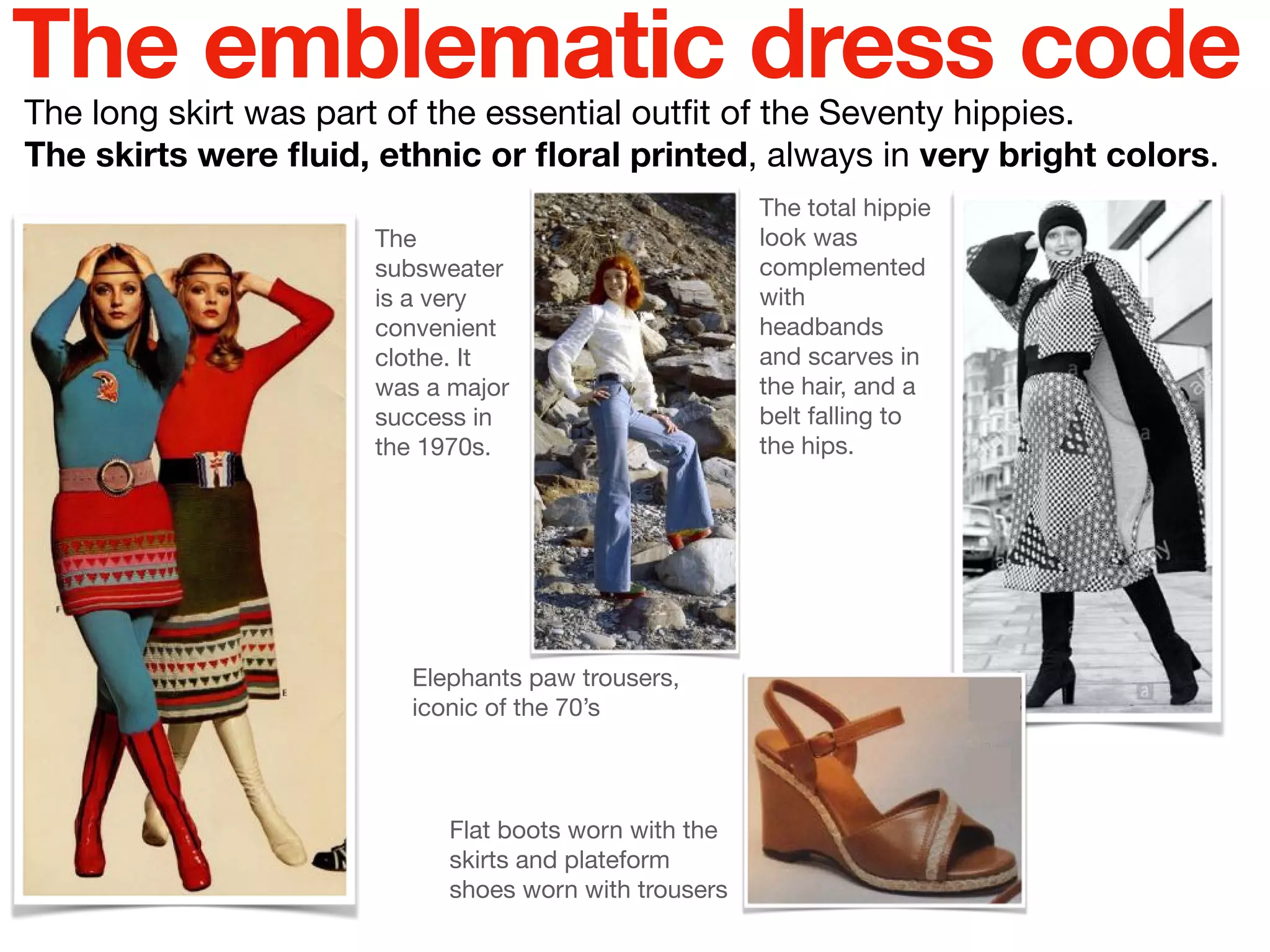
The long skirt was part of the essential outfit of the Seventy hippies.

The skirts were fluid, ethnic or floral printed, always in very bright colors.
The total hippie
look was
complemented
with
headbands
and scarves in
the hair, and a
belt falling to
the hips.
The emblematic dress code
The
subsweater
is a very
convenient
clothe. It
was a major
success in
the 1970s.
Flat boots worn with the
skirts and plateform
shoes worn with trousers
Elephants paw trousers,
iconic of the 70’s
Here is the female dress code during
the 70’s.
Why does this represent the
iconic wardrobe of the
decade ?
Les années 80
French designers of the ‘80s combined
cottons, silks and new fabrics with silver or
gold lamé, lace or tulle to create the
glamorous attitude.
EXCENTRICITY AND CARELESSNESS
Bold colours and
opulent fabrics.
SPORTY LOOKS
'80s is the decade of the fitness queen,
Jane Fonda. The actress became the
first celebrity to imagine and participate
in a gymnastics video.

She started the fashion of the leg
warmers and the lycra.
The emblematic dress code
LE LOOK GLAM-PUNK
Scrunchies, leather leggings and
affirmative tutus... When she arrived on
the pop stage in 1983, Madonna freaks.

Everyone falls over the aura of the queen
of pop. Her unique style and her stylistic
experiences make it an unusual fashion
icon.
Madonna, Recherche Susan désespérément.
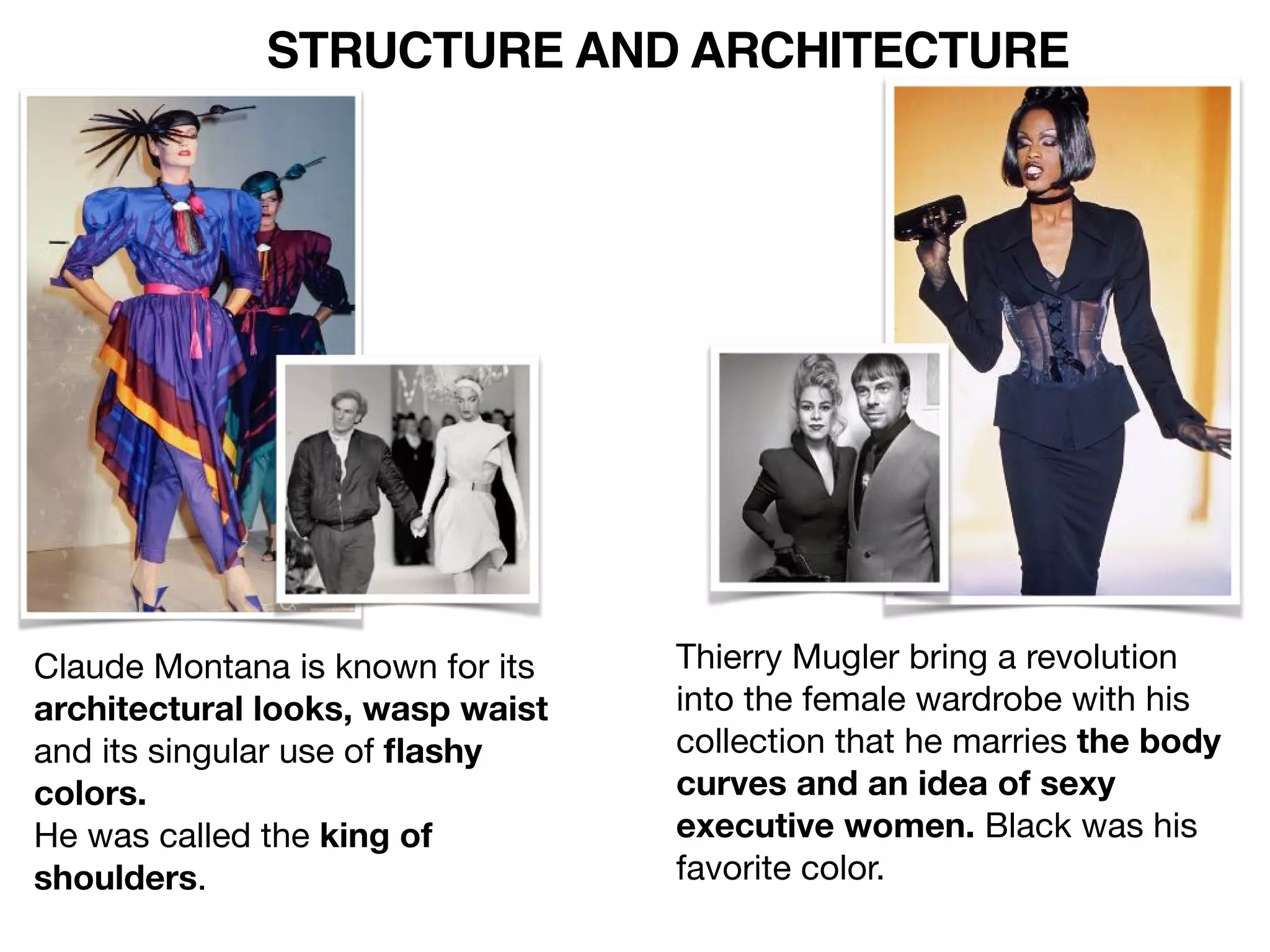
STRUCTURE AND ARCHITECTURE
Thierry Mugler bring a revolution
into the female wardrobe with his
collection that he marries the body
curves and an idea of sexy
executive women. Black was his
favorite color.
Claude Montana is known for its
architectural looks, wasp waist
and its singular use of flashy
colors.
He was called the king of
shoulders.
Here is the female dress code during
the 80’s.
Why does this represent
the iconic wardrobe of the
decade ?
The 90’s
1990 ALL TRENDS OUT:
We recycle the basic of the previous decades by accessorising them.
Fashion is mainly between minimalist, grunge and bling-bling from
Italian brands such as Versace or Gucci with a pinch of porno chic…
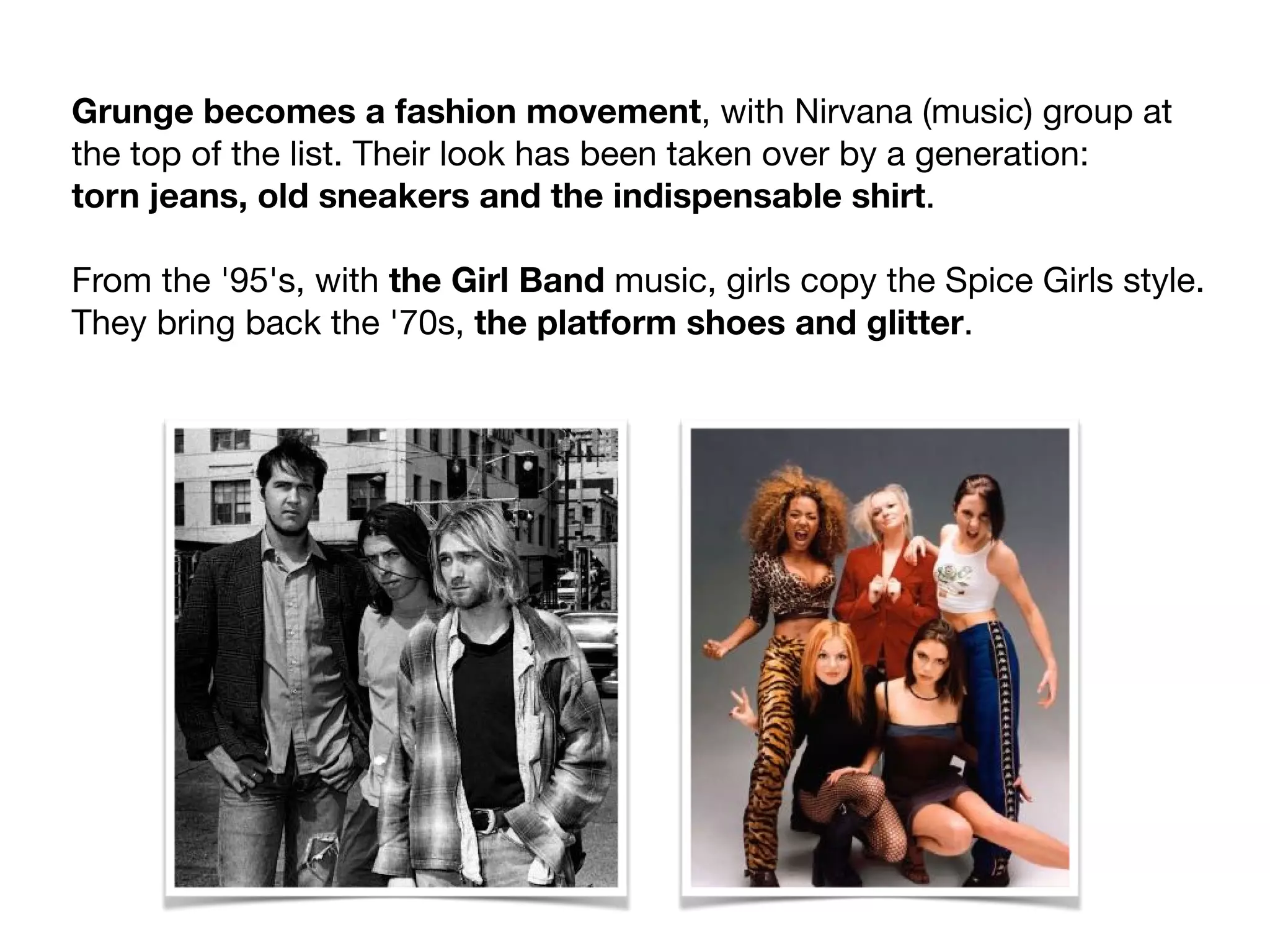
Grunge becomes a fashion movement, with Nirvana (music) group at
the top of the list. Their look has been taken over by a generation:

torn jeans, old sneakers and the indispensable shirt.

From the '95's, with the Girl Band music, girls copy the Spice Girls style.
They bring back the '70s, the platform shoes and glitter.
The 1990s see the development of luxury groups
leading with them “the mercato” of fashion creators:

John Galliano for Dior, Jean Paul Gaultier et
Alexander McQueen for Givenchy.

Martin Margiela
Jean Paul Gaultier
It’s also the trend of a minimalist fashion.
MADONNA’S ICONIC CONE BRA
Madonna always surprised by her rebel
and provocative style. Her scene suits
are bold as her conical corset, created
by Jean Paul Gaultier specifically for
his Blonde Ambition tour, which will
unleash the criticism.
The emblematic dress code
Jean Paul Gaultier and his famous 

“marinière” and Madonna - 1990

BestImage
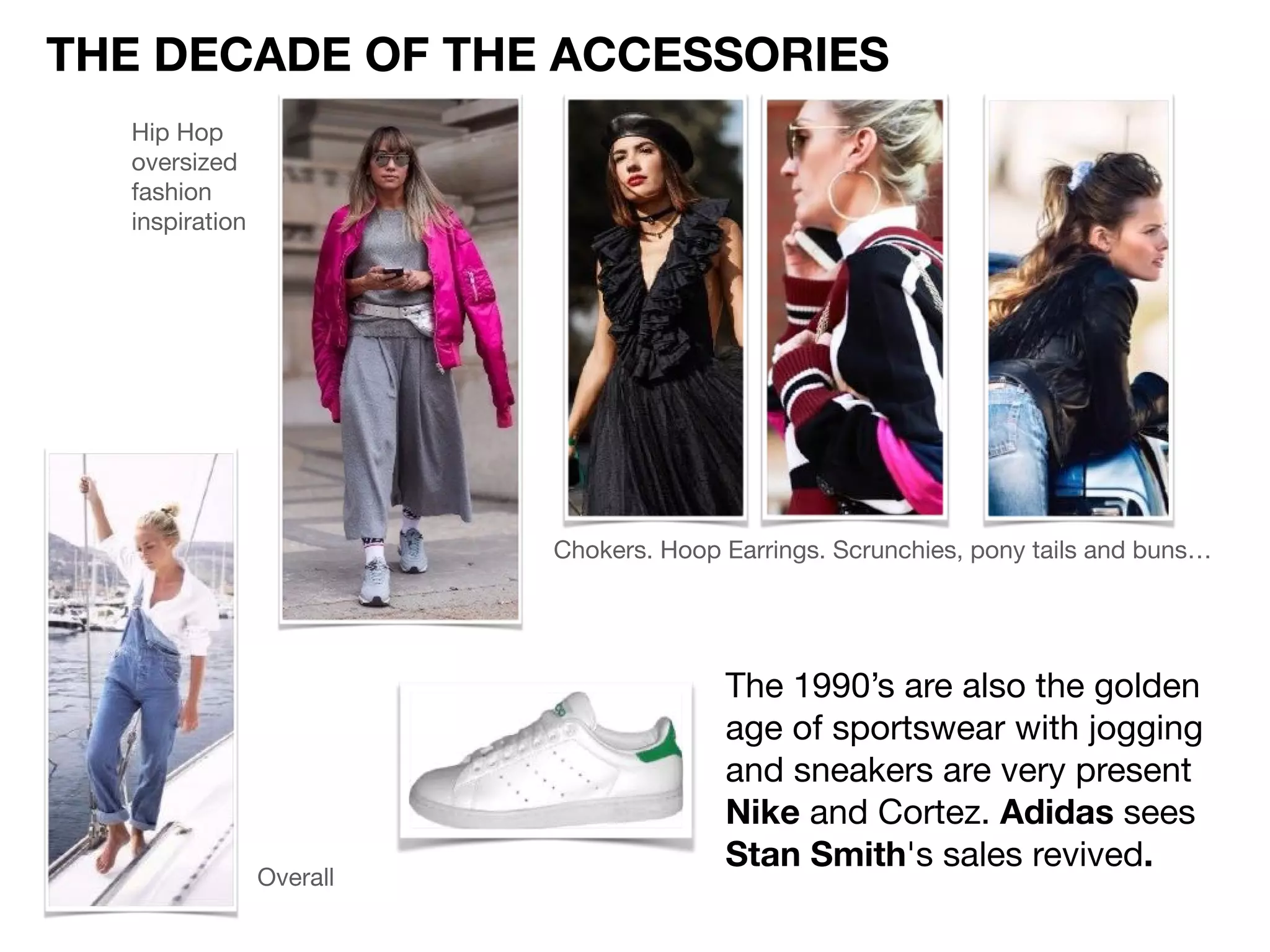
The 1990’s are also the golden
age of sportswear with jogging
and sneakers are very present

Nike and Cortez. Adidas sees
Stan Smith's sales revived.
THE DECADE OF THE ACCESSORIES
Chokers. Hoop Earrings. Scrunchies, pony tails and buns…

Overall
Hip Hop
oversized
fashion
inspiration
Here is the female dress code during
the 90’s.
Why does this represent the
iconic wardrobe of the decade ?
The 2000’s
La mode des années 2000
Mocked, sometimes denied :
the style of the 2000 is still a
fashion trauma that keeps
talking, paradoxically inspiring
contemporary creators visibly
determined to rehabilitate it.
It's the air of the low-waist,
cropped-top and belly
piercing…
In the 2000 years, two trends appear:

On the one hand, the appearance of clothing becomes less important
than the brand, expression of consumer purchasing power and the image or
life philosophy that he identifies.
The need for profitability and return on investment
increased the number of collections per year,
accelerated the rolling of new products, while doing
and defusing modes in very short times.
On the other hand, there was a
discontinuation of fashion and
consumption, with the "No Logo"
phenomenon.
(Reference to Naomi Klein's book).

This desire to resist diktats and
appearances was illustrated in the refusal
to wear marks with ostentatious logos.
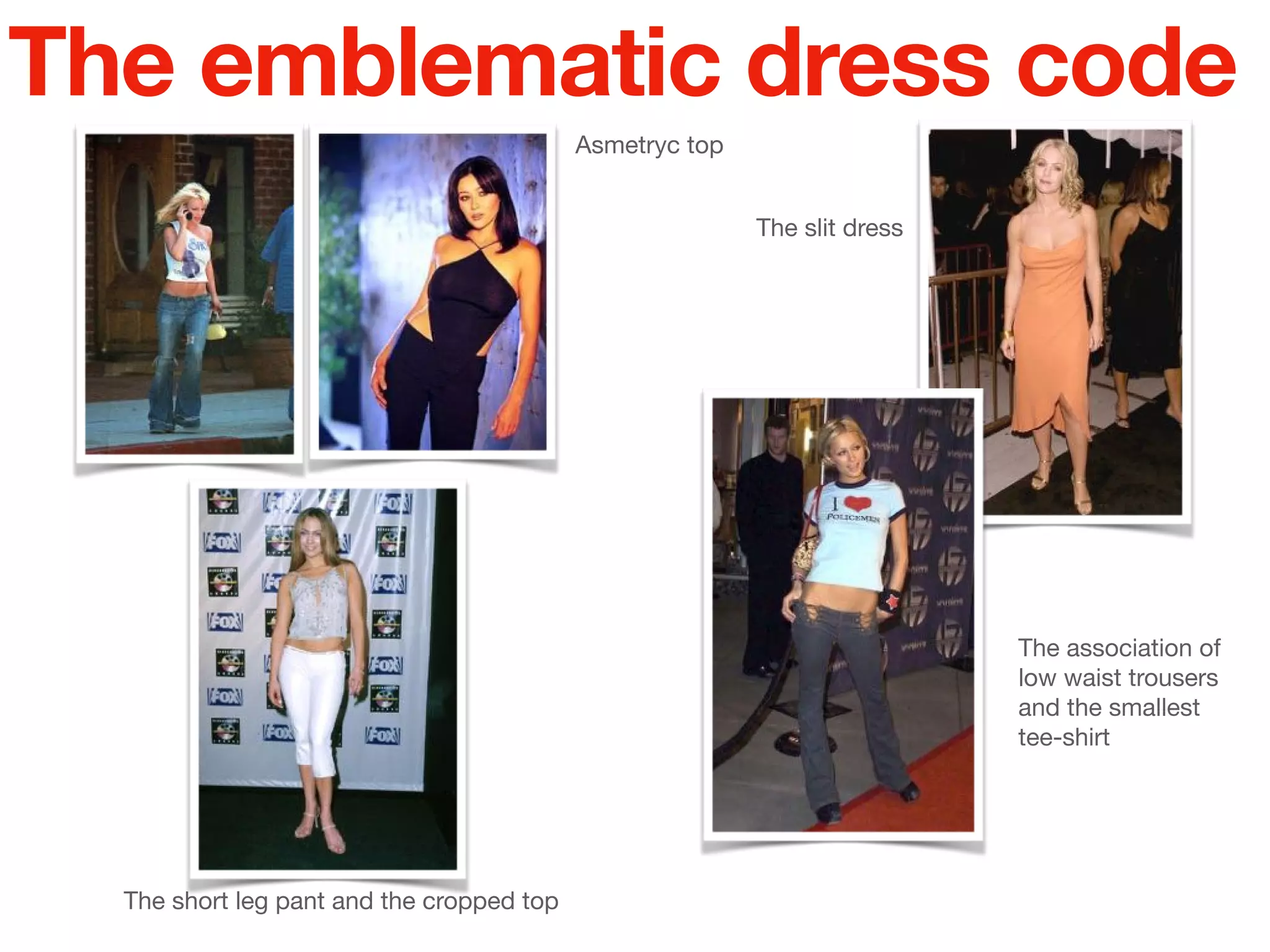
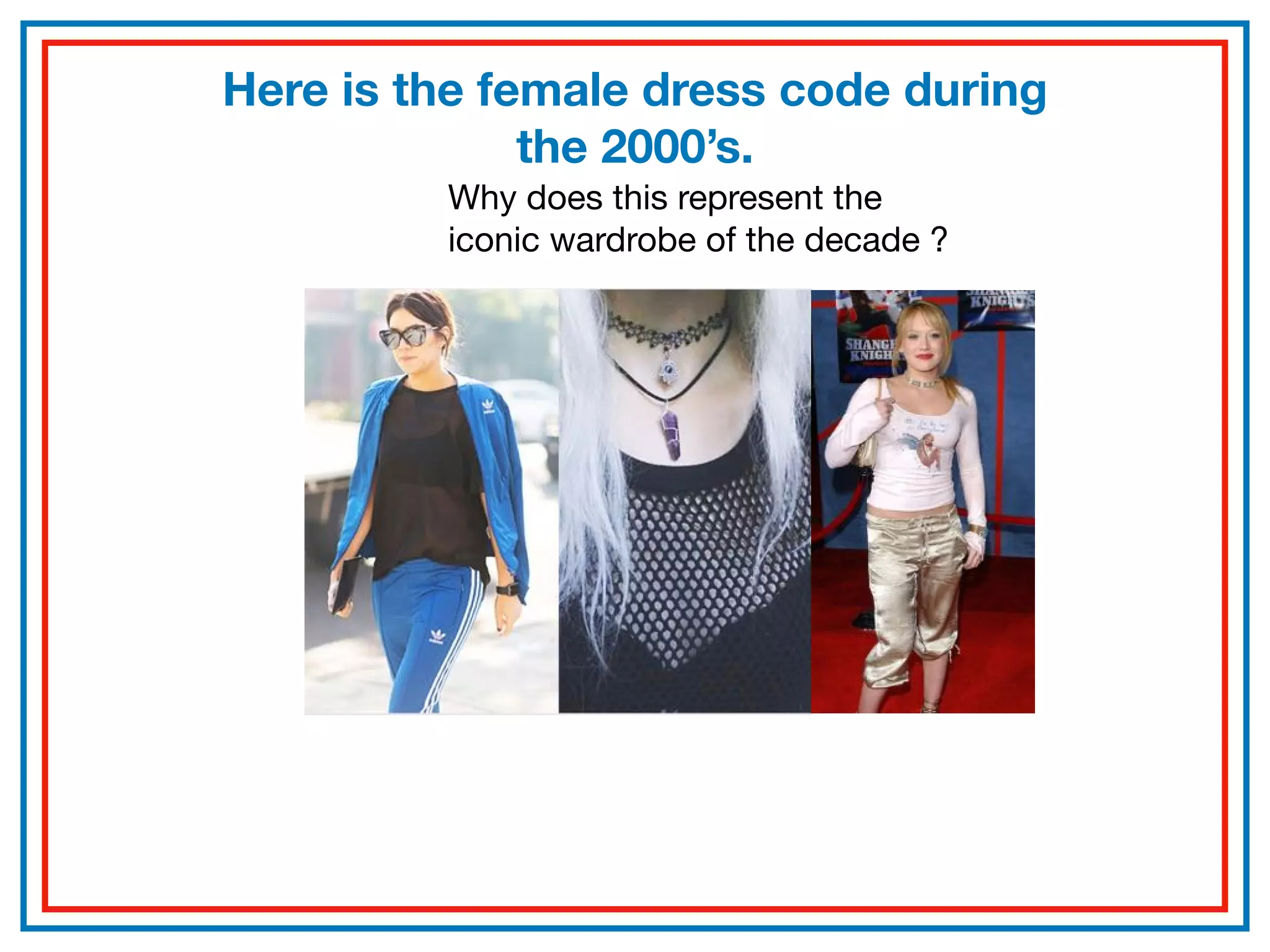
Asmetryc top
The short leg pant and the cropped top
The emblematic dress code
The association of
low waist trousers
and the smallest
tee-shirt
The slit dress
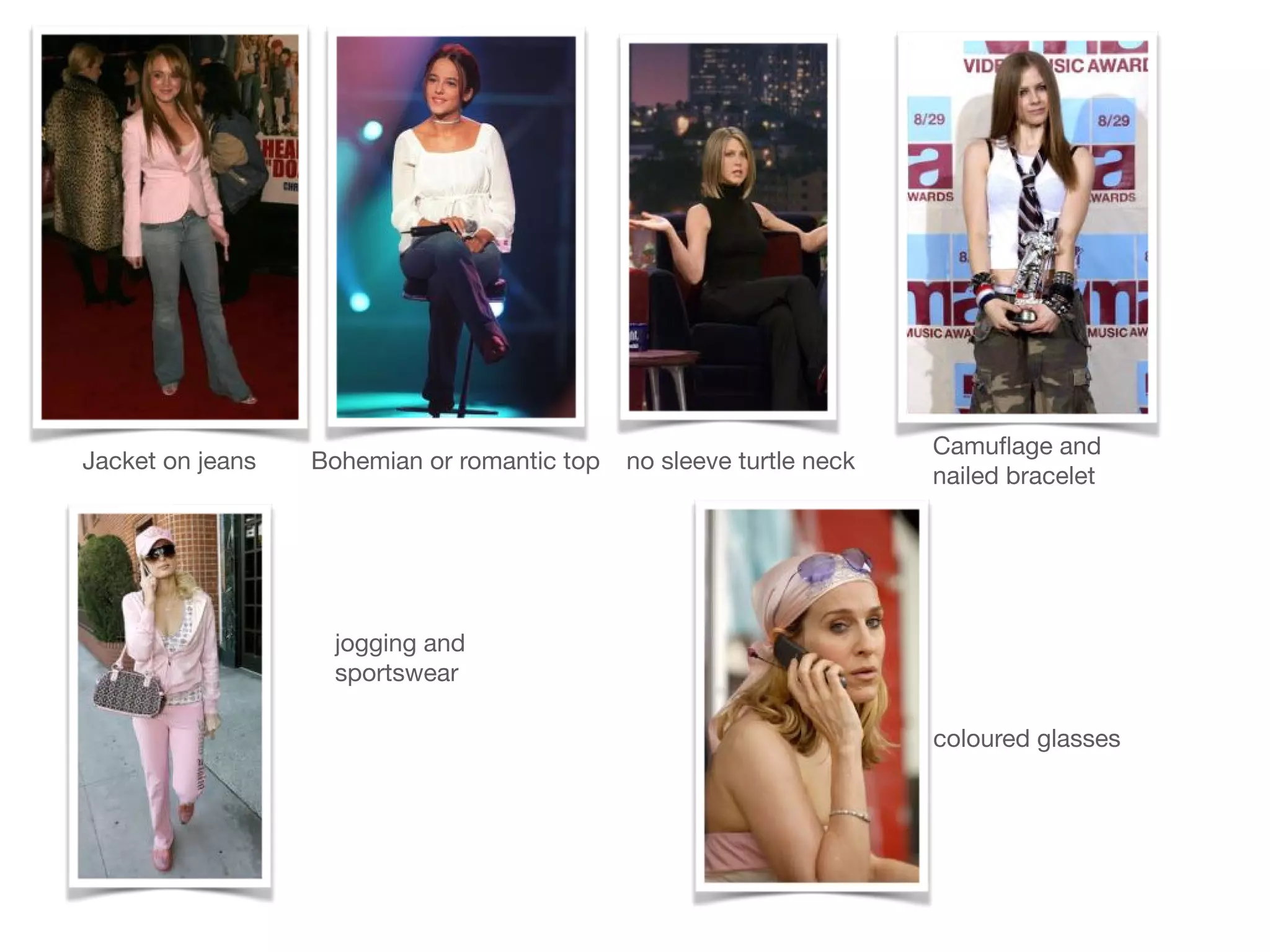
Jacket on jeans Bohemian or romantic top
Camuflage and
nailed bracelet
jogging and
sportswear
coloured glasses
no sleeve turtle neck
Here is the female dress code during
the 2000’s.
Why does this represent the
iconic wardrobe of the decade ?
2010’s and now
Between the dazzling speed and the slow fashion, the years 2010 have been
able to emancipate dominant aesthetic carcans. Streetward, unpleasant
taste, standardised genderless dressing room: trends surprise, provoke and
reveal an industry in the middle of a shifting.
It’s the time for a cool, casual luxury.
Formal dressing like the urban wardrobe is more pragmatic, assuming our
desire for comfort to the detriment of a tyrannical and so-called “chic”.
Fashion is coming from the street, it also surfs on its heritage by giving
new visibility to vintage shops.
We play with the logos and, above all, we have fun.
Fashion changes rapidly and offers micro-trends, but it is also
more ethical and is concerned about the planet.
The fashion pollutes, so we're doing new with old.
What is the symbol of French icon
in fashion?
Thank you.

Atelier Mode

  • 1.
  • 2.
    the 20th centuryof French is the century of fashion. It sees the greatest fashion designers: Lanvin, Chanel or Yves Saint-Laurent… They work only for rare wealthy clients. La “femme Lanvin” in November 1915. Founded in 1889, Lanvin is now the oldest Parisian couture house in operation. Gabrielle Chanel en 1928. Avant-garde et independence, Chanel's style launches the emblematic “boy” style of the 30’.
  • 3.
    Fashion for All Electricitycreates industrialisation, which creates the confection (the ancient of the prêt-à-porter) that creates the department stores.
  • 4.
  • 5.
    The decade opensup to the horror of the Second World War. Clothing becomes a symbol of German oppression, forcing all Jews in the occupied area in France, aged 6 years and over, to wear a yellow star in June 1942. Juin 1942 1939-1945 : World War II During the Second World War, the Couture companies are in a difficult situation due to tissue restrictions (for the armaments industry). Silk is reserved for the manufacture of parachutes. Fashion must be ingenious to continue to exist under occupation until the release and arrival of Christian Dior’s New Look. Ticket, clothing restriction
  • 6.
    Fashion is controlledvery strictly: the skirt length goes back under the knee, which will mark the advent of the pencil shape skirt : la jupe crayon. 1939-1945 : LE SYSTÈME D* “Liquid tight” made from coffee or tea. The line was drawn1941. The curtains turn into a dress and the women dye their legs with tea to imitate the silk stockings. * System D is a shorthand term that refers back to the French word débrouillard, (one who is) skilled or resourceful at handling any difficulty. System D refers to a manner of responding to challenges that requires one to have the ability to think fast, to adapt, and to improvise when getting the job done.
  • 7.
    This “DIY” modeis like the rough times: functional. The style is increasingly inspired by the male figure like the square shoulder coat, echoed in soldiers' uniform. Shoulders win in width, the hips are tight and skirts shorten below the knees. As far as the colour code is concerned, it is staggering at the time. Le kaki et le bleu marine. The Kaki and the Navy Blue of the regiment of the same name are inspired by the armed forces.
  • 8.
    The emblematic dress codefrom 1939 to 1945
  • 9.
    THE SQUARE SHOULDERJACKET AND “LA JUPE CRAYON” No more folds and other style effects: dresses and skirts adopt a straight cut, without fioriture, to save the fabric. THE CROSS-BODY BAG More practical than the purse, the cross- body bag also appears at that time. It is more practical, especially for bicycle circulation. It is wide and sometimes contains a compartment for the gas mask. THE COMPENSATED SOLES The Leather is required (for military industry). They are made of wood, heavy and uncomfortable.
  • 10.
    HATS, BIBI, TURBAN Thehat is beyond the tissue restriction. All the French women are putting their fashion effort on this accessory. HOLLYWOOD STARS and THE FEMININITY Cinema, theatre and song become escapes. These years, movies are passionate for fatal women, and the Hollywood star is called Rita Hayworth. The strip scene in the Gilda movie is worth a sensual and glamour reputation. She is called "goddess of love" for her pin-up attitude and her hair (blonde or red). It is also time for the first hair colouring.
  • 11.
    Here is thefemale dress code during the Second World War. Why does this represent the iconic dress code of the Second World War?
  • 12.
    Post-war ONCE UPON ATIME... OBVIOUS FEMININITY IN THE 1950’S
  • 13.
    Dior will signthe revolution with his “New look” that draws a feminissism figure. It will revolutionize the fashion of the 1950s and decades to come. PARIS BECOMES “LA CAPITALE DE LA MODE”. Le 12 février 1947 au 30 avenue Montaigne à 10h30. This is the star of the parade, the famous Bar tailor with his iconic jacket, symbol of the house. The war is over, and the Thirty Glorious years are starting. Women return to the home and can adopt a more female, less “comfortable” fashion. They dream of elegance and femininity, skirts, corsets, strangled hips, cleavage, refined lingerie
  • 14.
    The fashion hasnever been so bold, making the director of Harper’s Bazaar Carmel Snow told: “It’s a new look”. The chest stands, shoulders are rounder, The waist is tight, the hips are wider, the breast is proud and the skirt is longer.. Dior just reinvented the woman's allure. 1947 THE NEW LOOK BY DIOR
  • 15.
    Here is thefemale dress code after the Second World War. Why does this represent the iconic wardrobe of the post war era ?
  • 16.
  • 17.
    “The 1950s markedthe return of the “housewife”. After the war, she now dreams of elegance and femininity.” Fifties are elegant and very female. Now it is time to reinvent a happy and free fashion. It's a time of effervescence for fashion and a new era for Couture companies is starting.
  • 18.
    1. Pierre Balmainet l’actrice Ruth Ford en 19472. Grace Kelly en 1954 It is the golden age of the Couture that renders Paris its status as a world fashion capital. The whole planet is looking at Christian Dior, Hubert de Givenchy, Cristóbal Balenciaga and Pierre Balmain. They are at the top of the 1950s fashion. They dress Hollywood icons: Grace Kelly, Audrey Hepburn, Marilyn Monroe, Lauren Bacall…
  • 19.
    Two headlights arefacing each other in the heart of the women. Chanel’s tight tailor The very evaded Dior Corolle dress.
  • 20.
    Technological advances inthe period give rise to new materials: polyester, polyamide and acrylic are now being worked. This new leads to the creation of ready-to-wear lines.
  • 21.
    In the 1950s,fashion and luxury are expressed through movie stars, thus raising to icons. Hubert de Givenchy makes Audrey Hepburn his muse by creating his outfits in "Breakfast at Tiffany's" (in particular the "Sack" dress with straight lines); and Marilyn Monroe becomes the emblem of glamorous style with her dresses (slit dresses), long gloves and pencil skirts.
  • 22.
    Le col claudine: Audrey Hepburn appears the first in a red blouse in Claudine collar! The emblematic dress code of the 50’s This figure half child-half woman caused by this round-collar is worth the support of her entire generation, which also starts to imitate Colette’s famous heroin in "Claudine at school".
  • 23.
    Long gloves, wornover the elbow for a very fancy effect! Hats and bibis : Women in the '50s cut their hair or adopt the chignon to wear the hat better! The round and oversize hat in was very tendency, but the bibi, its little version, too! These were signs of great elegance
  • 24.
    The 1950s alsosee the advent of pigeon bras and panty girdle that make it possible to reach the shapes so coveted by the New-Look spirit. The bicolor shoes and needle heel, launched by the Raymond Massaro Bottier for Coco Chanel in 1957. According to Coco Chanel, the beige color was intended to extend the leg, and the black tip to shorten the foot, for aesthetic purposes!
  • 25.
    Here is thefemale dress code during the 50’s. Why does this represent the iconic wardrobe of the decade ?
  • 26.
    Mary Quant issignificantly shortening her dresses and skirt. She starts to introduce the mini- skirt that will become one of the biggest phenomena in the Sixties. But a new wind blows in fashion…
  • 27.
  • 28.
    The woman emancipatesand her body adopts a new figure. It is the decade of the mini-skirt iconic, Pierre Cardin, Courrèges or Yves Saint Laurent. Fashion is multiform and it's coming from the street. The image of the woman is now flatter and more geometric figure. Body first ! The 60’s are a revolutionary phase in the history of fashion creation.
  • 29.
    Never before, socioculturalchanges are more realistic in dress trends. Fashion of the 60’s makes progress and challenge in a real revolution of appearances. The time is for the consumer society: the growing industrialisation of dress work encourages the growth of the ready-to-wear industries encouraging the decline of the Couture. Courrèges
  • 30.
    In the youthof the baby boom, a new dress culture, which is based on the Anglo-Saxon model is rising. Music and groups impose their membership in a well-defined style : «yéyés », « black leather jackets», « mods », « rockers » are a symbol of a counterculture that is more than ever in appearances.
  • 31.
    Fashion takes severalfaces : the fancy female figure like Brigitte Bardot is rising together with the chic Jackie Kennedy or Twiggy's androgyne look : Celebrities are seen as real fashion icons.  Brigitte Bardot, 1961 Jackie Kennedy, White House, 1961 Twiggy, 1961
  • 32.
    The pants thatare now more than ever becoming unisex. Yves Saint Laurent brings the trench and the tuxedo for men into the female wardrobe. Trench by Yves Saint Laurent 1969 Tuxedo by Yves Saint Laurent 1969 “Carotte” trousers
  • 33.
    New trends aremoving into the heart of French women like the mini-skirt, seen at André Courrèges fashion shows and inspired by the British Mary Quant. The flat boots In the 60's, it is the conquest of space. André Courrèges with its architectural collection called Space Age, makes the geometric pattern the moment’s print. These forms, as well as silver color, will have a strong influence on Paco Rabanne and Pierre Cardin.
  • 34.
    Two creators, PierreCardin and Paco Rabanne, will contribute to dialogue between the fashion world and the show world. Paco Rabanne signs the Barbarella movie suits with Jane Fonda in 1968. Paco Rabanne provides the dresses of Casino Royal movie. Pierre Cardin is gonna create the Beatles costumes. Paco Rabanne collections are often made of plastic and metal. Paco Rabanne and Françoise Hardy.
  • 35.
    THE TROUSERS They become thewitness part of women’s dress release. TRENCH COAT The trench became popular and was brought by civilians in the 1960’s by Yves Saint Laurent. THE 3 HOLES DRESS The creators Courèges and Pierre Cardin made it one of their flagship pieces. Wear with ballerina, oversized sunglasses and a scarf, Jackie O made an iconic model. The emblematic dress code
  • 36.
    MONDRIAN DRESS January 1966 Mondriandress by Yves Saint Laurent. In 1966, Mondrian dress, inspired by Piet Mondrian abstract art, comes out of Yves Saint Laurent’s workshops. The prototype is created by Azzedine Alaia and the shoes are drawn by Roger Vivier. The feeling is complete, the fashion world remains flabbergasted in front of this sleeveless wool, right cut and modernist prints, which stops just above the knees. SAHARA JACKET Betty Catroux, Yves Saint Laurent and Loulou de la Falaise From military inspiration, the Sahara jacket is distinguished by its half-long length, the lace on the breast, and its wide pockets. A flagship play made by Yves Saint Laurent in 1967.
  • 37.
    The oversized glasseswere very popular because all the influential stars in the period had adopted them from Brigitte Bardot to Françoise Hardy, to Diana Ross. XXL ACCESSOIRIES Jackie Kennedy never came out without her oversizing glasses Nina Ricci. Audrey Hepburn THE MONOKINI The shapes are is getting younger. Brigitte Bardot, inspires a sexier fashion that highlights the forms. During the 1960s, the monokini appeared on the beaches. The two pieces swimming costume is reserved for actresses and pin-up.
  • 38.
    Here is thefemale dress code during the 60’s. Why does this represent the iconic wardrobe of the decade ?
  • 39.
  • 40.
    THE 70’S LOOK! Boldis undoubtedly what defines the 1970 fashion. We dare dots, stripes, superpositions, glitter, colour associations… the 1970’s are synonymous with extreme. Hippies, punks and disco fans are expressing both through music and through their dress clothes. Women wear both short and long hair and jeans sales in Europe increased by 300% between 1970 and 1976.
  • 41.
    The Hippie wavegives birth to floral prints on shirts, on dresses and skirts. Major trend in the “Flower Power” and "Peace and Love" eras. It translates into clothes such as eph’s paws trousers, oversized blouses and accessories such as scarves or flowers in hair
  • 42.
    MUSIC AS AWEALTHY DRESS CODE In the '70s, you have to be original. On the outfits, this will has resulted in a colour explosion (such as electric blue and orange), and materials (such as glitter). The style becomes unisex: women claim to be men with pants and blazers, while men opt for long hair. Disco music puts glitter on the light as demonstrated by the ABBA group, the gold color, but also the very strong colors such as yellow, red or apple green. It’s also the time for the famous pie server collar… Saturday Night Fever - 1977
  • 43.
    But the punkmovement begins in 1976, with the English band The Sex Pistols and the American The Ramones. The tartan is all-out, the blue-jeans holed under a kilt and the necessary accessories: nanny pins, nail bracelet and the Dr Martens boots. Malcolm mcLaren Siouxsie Sioux wears bracelets, Nancy Spungen, pulls out the nails, and Sid Vicious frequently wears a chain around the neck, the two ends are sealed by a lock
  • 44.
    In the 1970s,creators replace the fashion designers: Issey Miyake et Karl Lagerfeld know their first Parisian successes, Kenzo et Jean-Charles de Castelbajac put it on color while Chantal Thomass is drawing sexy underwear collections. Kenzo 1976 Chantal Thomass 1976 Jerry Hall and the Zèbre sweater by Castelbajac Karl Lagerfeld with models at Maison Chloe, 1972 Stock Photo - Alamy. Karl Lagarfeld was famous for the long and fluid skirts and shirts. Hi collaboration with Chloé lasts for 20 years.
  • 45.
    The long skirtwas part of the essential outfit of the Seventy hippies. The skirts were fluid, ethnic or floral printed, always in very bright colors. The total hippie look was complemented with headbands and scarves in the hair, and a belt falling to the hips. The emblematic dress code The subsweater is a very convenient clothe. It was a major success in the 1970s. Flat boots worn with the skirts and plateform shoes worn with trousers Elephants paw trousers, iconic of the 70’s
  • 46.
    Here is thefemale dress code during the 70’s. Why does this represent the iconic wardrobe of the decade ?
  • 47.
  • 48.
    French designers ofthe ‘80s combined cottons, silks and new fabrics with silver or gold lamé, lace or tulle to create the glamorous attitude. EXCENTRICITY AND CARELESSNESS Bold colours and opulent fabrics.
  • 49.
    SPORTY LOOKS '80s isthe decade of the fitness queen, Jane Fonda. The actress became the first celebrity to imagine and participate in a gymnastics video. She started the fashion of the leg warmers and the lycra. The emblematic dress code
  • 50.
    LE LOOK GLAM-PUNK Scrunchies,leather leggings and affirmative tutus... When she arrived on the pop stage in 1983, Madonna freaks. Everyone falls over the aura of the queen of pop. Her unique style and her stylistic experiences make it an unusual fashion icon. Madonna, Recherche Susan désespérément.
  • 51.
    STRUCTURE AND ARCHITECTURE ThierryMugler bring a revolution into the female wardrobe with his collection that he marries the body curves and an idea of sexy executive women. Black was his favorite color. Claude Montana is known for its architectural looks, wasp waist and its singular use of flashy colors. He was called the king of shoulders.
  • 52.
    Here is thefemale dress code during the 80’s. Why does this represent the iconic wardrobe of the decade ?
  • 53.
  • 54.
    1990 ALL TRENDSOUT: We recycle the basic of the previous decades by accessorising them. Fashion is mainly between minimalist, grunge and bling-bling from Italian brands such as Versace or Gucci with a pinch of porno chic…
  • 55.
    Grunge becomes afashion movement, with Nirvana (music) group at the top of the list. Their look has been taken over by a generation: torn jeans, old sneakers and the indispensable shirt. From the '95's, with the Girl Band music, girls copy the Spice Girls style. They bring back the '70s, the platform shoes and glitter.
  • 56.
    The 1990s seethe development of luxury groups leading with them “the mercato” of fashion creators: John Galliano for Dior, Jean Paul Gaultier et Alexander McQueen for Givenchy. Martin Margiela Jean Paul Gaultier It’s also the trend of a minimalist fashion.
  • 57.
    MADONNA’S ICONIC CONEBRA Madonna always surprised by her rebel and provocative style. Her scene suits are bold as her conical corset, created by Jean Paul Gaultier specifically for his Blonde Ambition tour, which will unleash the criticism. The emblematic dress code Jean Paul Gaultier and his famous “marinière” and Madonna - 1990 BestImage
  • 58.
    The 1990’s arealso the golden age of sportswear with jogging and sneakers are very present Nike and Cortez. Adidas sees Stan Smith's sales revived. THE DECADE OF THE ACCESSORIES Chokers. Hoop Earrings. Scrunchies, pony tails and buns… Overall Hip Hop oversized fashion inspiration
  • 59.
    Here is thefemale dress code during the 90’s. Why does this represent the iconic wardrobe of the decade ?
  • 60.
  • 61.
    La mode desannées 2000 Mocked, sometimes denied : the style of the 2000 is still a fashion trauma that keeps talking, paradoxically inspiring contemporary creators visibly determined to rehabilitate it. It's the air of the low-waist, cropped-top and belly piercing…
  • 62.
    In the 2000years, two trends appear: On the one hand, the appearance of clothing becomes less important than the brand, expression of consumer purchasing power and the image or life philosophy that he identifies. The need for profitability and return on investment increased the number of collections per year, accelerated the rolling of new products, while doing and defusing modes in very short times. On the other hand, there was a discontinuation of fashion and consumption, with the "No Logo" phenomenon. (Reference to Naomi Klein's book). This desire to resist diktats and appearances was illustrated in the refusal to wear marks with ostentatious logos.
  • 63.
    Asmetryc top The shortleg pant and the cropped top The emblematic dress code The association of low waist trousers and the smallest tee-shirt The slit dress
  • 64.
    Jacket on jeansBohemian or romantic top Camuflage and nailed bracelet jogging and sportswear coloured glasses no sleeve turtle neck
  • 65.
    Here is thefemale dress code during the 2000’s. Why does this represent the iconic wardrobe of the decade ?
  • 66.
  • 67.
    Between the dazzlingspeed and the slow fashion, the years 2010 have been able to emancipate dominant aesthetic carcans. Streetward, unpleasant taste, standardised genderless dressing room: trends surprise, provoke and reveal an industry in the middle of a shifting. It’s the time for a cool, casual luxury. Formal dressing like the urban wardrobe is more pragmatic, assuming our desire for comfort to the detriment of a tyrannical and so-called “chic”. Fashion is coming from the street, it also surfs on its heritage by giving new visibility to vintage shops. We play with the logos and, above all, we have fun. Fashion changes rapidly and offers micro-trends, but it is also more ethical and is concerned about the planet. The fashion pollutes, so we're doing new with old.
  • 68.
    What is thesymbol of French icon in fashion?
  • 69.