Oil Pipeline Risks: Issues to consider

        By Louisette Lanteigne
         700 Star Flower Ave.
            Waterloo Ont.
              N2V 2L2

      butterflybluelu@rogers.com
Issue #1: Seisemic Risks & Pipeline Welds
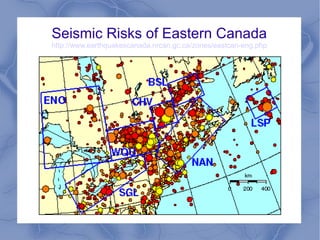
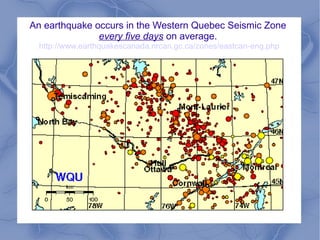
Seismic Risks of Eastern Canada
http://www.earthquakescanada.nrcan.gc.ca/zones/eastcan-eng.php
Earthquakes & Oil Pipes


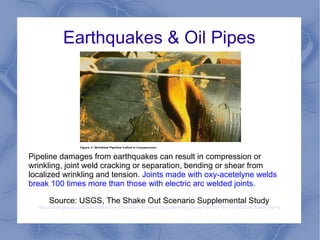
Pipeline damages from earthquakes can result in compression or
wrinkling, joint weld cracking or separation, bending or shear from
localized wrinkling and tension. Joints made with oxy-acetelyne welds
break 100 times more than those with electric arc welded joints .

      Source: USGS, The Shake Out Scenario Supplemental Study
  http://books.google.ca/books/about/The_ShakeOut_Scenario_Supplemental_Study.html?id=7PU1A6N3ZOAC&redir_esc=y
An earthquake occurs in the Western Quebec Seismic Zone
               every five days on average.
  http://www.earthquakescanada.nrcan.gc.ca/zones/eastcan-eng.php
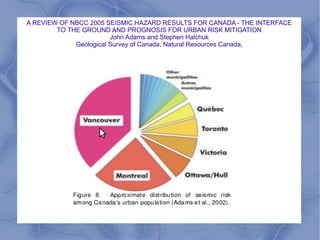
A REVIEW OF NBCC 2005 SEISMIC HAZARD RESULTS FOR CANADA - THE INTERFACE
        TO THE GROUND AND PROGNOSIS FOR URBAN RISK MITIGATION
                        John Adams and Stephen Halchuk
             Geological Survey of Canada, Natural Resources Canada,
Earthquake risks should be identified within
EA applications of pipelines so we can set
reasonable design criteria to mitigate the
risks, particularly with regards to pipeline
welds.
Issue #2: Bacterium & PE tape
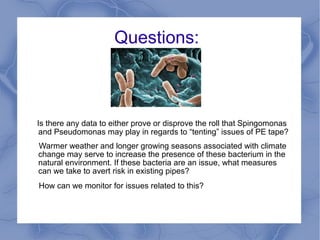
Spingomonas and Pseudomonas Eat Plastic

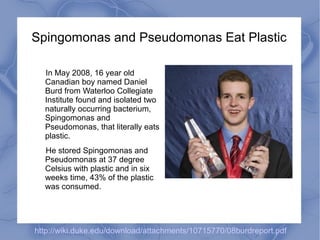
  In May 2008, 16 year old
  Canadian boy named Daniel
  Burd from Waterloo Collegiate
  Institute found and isolated two
  naturally occurring bacterium,
  Spingomonas and
  Pseudomonas, that literally eats
  plastic.
  He stored Spingomonas and
  Pseudomonas at 37 degree
  Celsius with plastic and in six
  weeks time, 43% of the plastic
  was consumed.


http://wiki.duke.edu/download/attachments/10715770/08burdreport.pdf
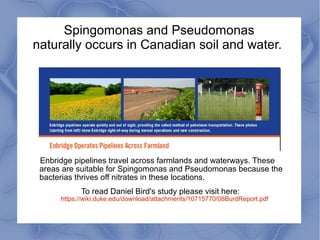
Spingomonas and Pseudomonas
naturally occurs in Canadian soil and water.


 Enbridge pipelines travel across farmlands and waterways. These
 areas are suitable for Spingomonas and Pseudomonas because the
 bacterias thrives off nitrates in these locations.
            To read Daniel Bird's study please visit here:
      https://wiki.duke.edu/download/attachments/10715770/08BurdReport.pdf
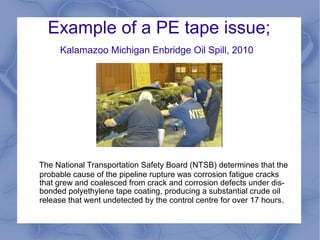
Example of a PE tape issue;
     Kalamazoo Michigan Enbridge Oil Spill, 2010


The National Transportation Safety Board (NTSB) determines that the
probable cause of the pipeline rupture was corrosion fatigue cracks
that grew and coalesced from crack and corrosion defects under dis-
bonded polyethylene tape coating, producing a substantial crude oil
release that went undetected by the control centre for over 17 hours .
Questions:


Is there any data to either prove or disprove the role that
 Spingomonas and Pseudomonas may play in regards to “tenting”
 issues of PE tape?
Warmer weather and longer growing seasons associated with climate
change may serve to increase the presence of these bacterium in the
natural environment. If these bacteria are an issue, what measures
can we take to avert risk in existing pipes?
How can we monitor for issues related to this?
Issue #3: Climate Change:
Plan for hotter, wetter weather
Example: Rain and extream heat expected for the city
                of Toronto by 2040

  Toronto will see almost 40 days per year with a
  humidex over 40˚C (current average is 9 per year).
  Heat waves (3+ days of 32˚C) will occur 5 times a
  year, instead of once every two years.
  We'll see 80% more summer rain in July, 50% more in
  August.
  Extreme rain events will almost triple in size to
  166mm in 24hrs from the current 66 mm.
Source: TORONTO'S FUTURE WEATHER & CLIMATE
      DRIVER STUDY: OUTCOMES REPORT

                  Summary of the SENES
                  Consultants Ltd Study by
                 Toronto Environment Office
                      October 30, 2012

http://www.toronto.ca/legdocs/mmis/2012/pe/bgrd/backgroundfile-51653.pdf
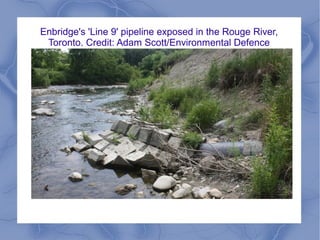
Enbridge's 'Line 9' pipeline exposed in the Rouge River,
 Toronto. Credit: Adam Scott/Environmental Defence
Pipelines and Aquifers: the need to examine
groundwater influences of subsurface geology
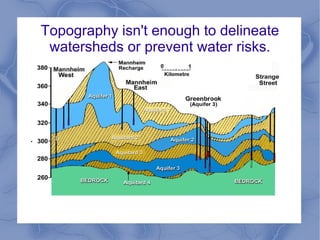
Topography isn't enough to delineate
     watersheds or prevent water risks.


.
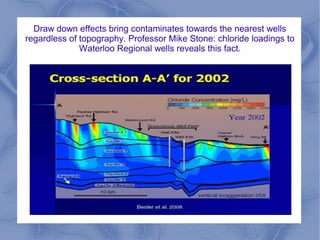
Draw down effects bring contaminates towards the nearest wells
regardless of topography. Professor Mike Stone: chloride loadings to
              Waterloo Regional wells reveals this fact.
Understanding the subsurface geology and localized well
   data in proximity to pipes can help contain spills.

  Mapping subsurface geology is critical data to have in
  order to quickly and reasonably isolate and contain spills.
  It allows us to view which aquifers may be impacted,
  which wells to shut off to immediately stop the draw down
  spread of contaminates shoud a spill occur.
  EA processes could mandate that firms have that data
  prior to final approvals in order to make sure they are
  reasonably capable of swift responses should a spill occur
  along that route.
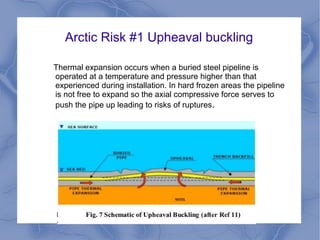
Arctic Risk #1 Upheaval buckling

Thermal expansion occurs when a buried steel pipeline is
operated at a temperature and pressure higher than that
experienced during installation. In hard frozen areas the pipeline
is not free to expand so the axial compressive force serves to
push the pipe up leading to risks of ruptures.
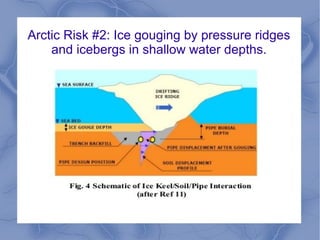
Arctic Risk #2: Ice gouging by pressure ridges
    and icebergs in shallow water depths.
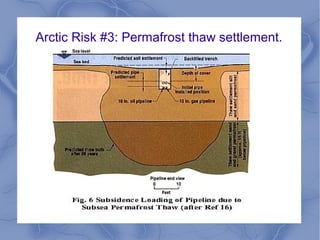
Arctic Risk #3: Permafrost thaw settlement.
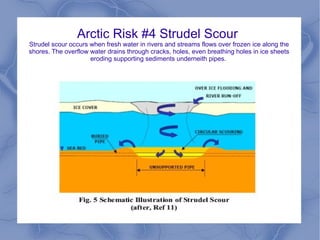
Arctic Risk #4 Strudel Scour
Strudel scour occurs when fresh water in rivers and streams flows over frozen ice along the
shores. The overflow water drains through cracks, holes, even breathing holes in ice sheets
                     eroding supporting sediments underneith pipes.
What is a reasonable depth to avoid these risks?


Based on the literature review of the research on subgouge
deformations, the industry is still in need of direct rule of thumb that
provides safe and economical burial depth for pipelines. From one
hand, pipes must be trenched sufficiently far beneath the influence
zone of soil displaced below ice keel to limit pipe bending to
acceptable limits. On the other hand, designers must not go to an
over-conservative solution and consequently a non-economical
one. Therefore, the desired burial depth is the minimum depth
needed for the survival of the pipeline during its design life time.
Such depth has not been established.

Source: The Technical Challenges of Designing Oil and Gas
Pipelines in the Arctic - Basel Abdalla PhD PE, Paul Jukes PhD,
Ayman Eltaher PhD PE, and Billy Duron
Issue #5: The Public Finds the Spills.

 A newly published draft report by the US department of
 Transportation Pipeline and Hazardous Materials Safety
 Administration reveals that it is up to the public to find oil and gas
 leaks.
 Pipeline leaks, ruptures and spills are “systematically causing more
 and more property damage…in a bad year you can have up to $5
 billion in property damages due to pipeline related accidents.”
 Given the volume of public property damage, pipeline companies
 would be “probably justified” in spending $490,000 a year for every
 400 miles of pipeline but the reality is that “right now companies might
 spend a tenth of that figure."
              Here is a published news article regarding this:
http://oilandgas-investments.com/2012/energy-services/leak-detection-pipeline-industry/
Here is the link to the actual Draft report:
             U.S. Department of Transportation
  Pipeline and Hazardous Materials Safety Administration
Draft Report: Leak Detection Study – DTPH56-11-D- 000001

   Dr. David Shaw, Dr. Martin Phillips, Ron Baker, Eduardo Munoz,
        Hamood Rehman, Carol Gibson, Christine Mayernik

                         September 28, 2012
        https://primis.phmsa.dot.gov/meetings/FilGet.mtg?fil=397


This report clearly shows that we need more money invested in prevention
            and better science to reasonably mitigate the risks!

Pipelinespillsprevention

  • 1.
    Oil Pipeline Risks:Issues to consider By Louisette Lanteigne 700 Star Flower Ave. Waterloo Ont. N2V 2L2 butterflybluelu@rogers.com
  • 2.
    Issue #1: SeisemicRisks & Pipeline Welds
  • 3.
    Seismic Risks ofEastern Canada http://www.earthquakescanada.nrcan.gc.ca/zones/eastcan-eng.php
  • 4.
    Earthquakes & OilPipes Pipeline damages from earthquakes can result in compression or wrinkling, joint weld cracking or separation, bending or shear from localized wrinkling and tension. Joints made with oxy-acetelyne welds break 100 times more than those with electric arc welded joints . Source: USGS, The Shake Out Scenario Supplemental Study http://books.google.ca/books/about/The_ShakeOut_Scenario_Supplemental_Study.html?id=7PU1A6N3ZOAC&redir_esc=y
  • 5.
    An earthquake occursin the Western Quebec Seismic Zone every five days on average. http://www.earthquakescanada.nrcan.gc.ca/zones/eastcan-eng.php
  • 6.
    A REVIEW OFNBCC 2005 SEISMIC HAZARD RESULTS FOR CANADA - THE INTERFACE TO THE GROUND AND PROGNOSIS FOR URBAN RISK MITIGATION John Adams and Stephen Halchuk Geological Survey of Canada, Natural Resources Canada,
  • 7.
    Earthquake risks shouldbe identified within EA applications of pipelines so we can set reasonable design criteria to mitigate the risks, particularly with regards to pipeline welds.
  • 8.
  • 9.
    Spingomonas and PseudomonasEat Plastic In May 2008, 16 year old Canadian boy named Daniel Burd from Waterloo Collegiate Institute found and isolated two naturally occurring bacterium, Spingomonas and Pseudomonas, that literally eats plastic. He stored Spingomonas and Pseudomonas at 37 degree Celsius with plastic and in six weeks time, 43% of the plastic was consumed. http://wiki.duke.edu/download/attachments/10715770/08burdreport.pdf
  • 10.
    Spingomonas and Pseudomonas naturallyoccurs in Canadian soil and water. Enbridge pipelines travel across farmlands and waterways. These areas are suitable for Spingomonas and Pseudomonas because the bacterias thrives off nitrates in these locations. To read Daniel Bird's study please visit here: https://wiki.duke.edu/download/attachments/10715770/08BurdReport.pdf
  • 11.
    Example of aPE tape issue; Kalamazoo Michigan Enbridge Oil Spill, 2010 The National Transportation Safety Board (NTSB) determines that the probable cause of the pipeline rupture was corrosion fatigue cracks that grew and coalesced from crack and corrosion defects under dis- bonded polyethylene tape coating, producing a substantial crude oil release that went undetected by the control centre for over 17 hours .
  • 12.
    Questions: Is there anydata to either prove or disprove the role that Spingomonas and Pseudomonas may play in regards to “tenting” issues of PE tape? Warmer weather and longer growing seasons associated with climate change may serve to increase the presence of these bacterium in the natural environment. If these bacteria are an issue, what measures can we take to avert risk in existing pipes? How can we monitor for issues related to this?
  • 13.
    Issue #3: ClimateChange: Plan for hotter, wetter weather
  • 14.
    Example: Rain andextream heat expected for the city of Toronto by 2040 Toronto will see almost 40 days per year with a humidex over 40˚C (current average is 9 per year). Heat waves (3+ days of 32˚C) will occur 5 times a year, instead of once every two years. We'll see 80% more summer rain in July, 50% more in August. Extreme rain events will almost triple in size to 166mm in 24hrs from the current 66 mm.
  • 15.
    Source: TORONTO'S FUTUREWEATHER & CLIMATE DRIVER STUDY: OUTCOMES REPORT Summary of the SENES Consultants Ltd Study by Toronto Environment Office October 30, 2012 http://www.toronto.ca/legdocs/mmis/2012/pe/bgrd/backgroundfile-51653.pdf
  • 16.
    Enbridge's 'Line 9'pipeline exposed in the Rouge River, Toronto. Credit: Adam Scott/Environmental Defence
  • 17.
    Pipelines and Aquifers:the need to examine groundwater influences of subsurface geology
  • 18.
    Topography isn't enoughto delineate watersheds or prevent water risks. .
  • 19.
    Draw down effectsbring contaminates towards the nearest wells regardless of topography. Professor Mike Stone: chloride loadings to Waterloo Regional wells reveals this fact.
  • 20.
    Understanding the subsurfacegeology and localized well data in proximity to pipes can help contain spills. Mapping subsurface geology is critical data to have in order to quickly and reasonably isolate and contain spills. It allows us to view which aquifers may be impacted, which wells to shut off to immediately stop the draw down spread of contaminates shoud a spill occur. EA processes could mandate that firms have that data prior to final approvals in order to make sure they are reasonably capable of swift responses should a spill occur along that route.
  • 21.
    Arctic Risk #1Upheaval buckling Thermal expansion occurs when a buried steel pipeline is operated at a temperature and pressure higher than that experienced during installation. In hard frozen areas the pipeline is not free to expand so the axial compressive force serves to push the pipe up leading to risks of ruptures.
  • 22.
    Arctic Risk #2:Ice gouging by pressure ridges and icebergs in shallow water depths.
  • 23.
    Arctic Risk #3:Permafrost thaw settlement.
  • 24.
    Arctic Risk #4Strudel Scour Strudel scour occurs when fresh water in rivers and streams flows over frozen ice along the shores. The overflow water drains through cracks, holes, even breathing holes in ice sheets eroding supporting sediments underneith pipes.
  • 25.
    What is areasonable depth to avoid these risks? Based on the literature review of the research on subgouge deformations, the industry is still in need of direct rule of thumb that provides safe and economical burial depth for pipelines. From one hand, pipes must be trenched sufficiently far beneath the influence zone of soil displaced below ice keel to limit pipe bending to acceptable limits. On the other hand, designers must not go to an over-conservative solution and consequently a non-economical one. Therefore, the desired burial depth is the minimum depth needed for the survival of the pipeline during its design life time. Such depth has not been established. Source: The Technical Challenges of Designing Oil and Gas Pipelines in the Arctic - Basel Abdalla PhD PE, Paul Jukes PhD, Ayman Eltaher PhD PE, and Billy Duron
  • 26.
    Issue #5: ThePublic Finds the Spills. A newly published draft report by the US department of Transportation Pipeline and Hazardous Materials Safety Administration reveals that it is up to the public to find oil and gas leaks. Pipeline leaks, ruptures and spills are “systematically causing more and more property damage…in a bad year you can have up to $5 billion in property damages due to pipeline related accidents.” Given the volume of public property damage, pipeline companies would be “probably justified” in spending $490,000 a year for every 400 miles of pipeline but the reality is that “right now companies might spend a tenth of that figure." Here is a published news article regarding this: http://oilandgas-investments.com/2012/energy-services/leak-detection-pipeline-industry/
  • 27.
    Here is thelink to the actual Draft report: U.S. Department of Transportation Pipeline and Hazardous Materials Safety Administration Draft Report: Leak Detection Study – DTPH56-11-D- 000001 Dr. David Shaw, Dr. Martin Phillips, Ron Baker, Eduardo Munoz, Hamood Rehman, Carol Gibson, Christine Mayernik September 28, 2012 https://primis.phmsa.dot.gov/meetings/FilGet.mtg?fil=397 This report clearly shows that we need more money invested in prevention and better science to reasonably mitigate the risks!