

1.COUNTRY PROFILE
2. ARCHITECTURAL STUDY
3. LAW
4. SITE
5. CONCEPT
SINGAPORE
1.
COUNTRY PROFILE
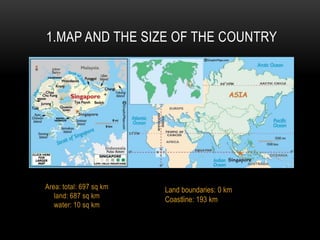
Area: total: 697 sq km
land: 687 sq km
water: 10 sq km
1.MAP AND THE SIZE OF THE COUNTRY
Land boundaries: 0 km
Coastline: 193 km
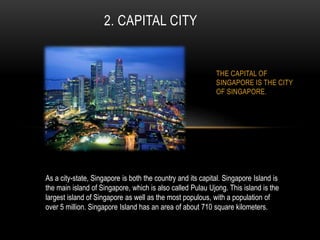
THE CAPITAL OF
SINGAPORE IS THE CITY
OF SINGAPORE.
2. CAPITAL CITY
As a city-state, Singapore is both the country and its capital. Singapore Island is
the main island of Singapore, which is also called Pulau Ujong. This island is the
largest island of Singapore as well as the most populous, with a population of
over 5 million. Singapore Island has an area of about 710 square kilometers.
THE POPULATION OF SINGAPORE IS 5.8 MILLION
3. POPULATION AND ETHNIC
GROUP
Ethnic groups: Chinese 76.8%, Malay 13.9%, Indian 7.9%, other 1.4%
(2000 census)
As of 2011, the population of Singapore is 5.18 million people, of whom 3.25 million
(63%) are citizens while the rest (37%) are permanent residents or foreign workers.
Twenty-three percent of Singaporean citizens were born outside Singapore
i.e. foreign born citizens. There are half a million permanent residents in Singapore
in 2011. The resident population does not take into account the 11 million transient
visitors who visit Singapore annually
MALAY IS THE NATIONAL LANGAUGE OF SINGAPORE
4.OFFICIAL LANGAUGE
The national language of Singapore is Malay for historical reasons but the
official languages are English, Chinese (Mandarin), Malay and Tamil. Each
carries equal weight under our constitution. English is widely used as the
lingua franca amongst the different communities. It is also the language of
administration.
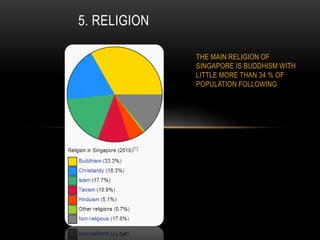
THE MAIN RELIGION OF
SINGAPORE IS BUDDHISM WITH
LITTLE MORE THAN 34 % OF
POPULATION FOLLOWING
5. RELIGION
THE TYPE OF GOVERNANT IN SINGAPORE IS THE
PERLIAMENTARY REPUBLIC
6.SYSTEM OF GOVERNMENT
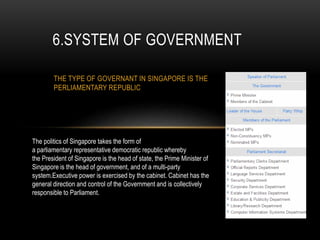
The politics of Singapore takes the form of
a parliamentary representative democratic republic whereby
the President of Singapore is the head of state, the Prime Minister of
Singapore is the head of government, and of a multi-party
system.Executive power is exercised by the cabinet. Cabinet has the
general direction and control of the Government and is collectively
responsible to Parliament.
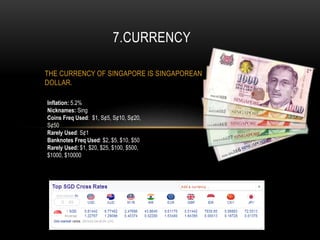
THE CURRENCY OF SINGAPORE IS SINGAPOREAN
DOLLAR.
7.CURRENCY
Inflation: 5.2%
Nicknames: Sing
Coins Freq Used: $1, S¢5, S¢10, S¢20,
S¢50
Rarely Used: S¢1
Banknotes Freq Used: $2, $5, $10, $50
Rarely Used: $1, $20, $25, $100, $500,
$1000, $10000
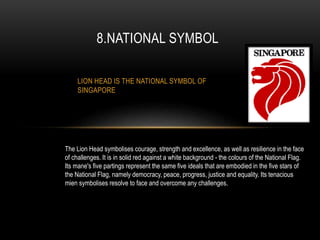
LION HEAD IS THE NATIONAL SYMBOL OF
SINGAPORE
8.NATIONAL SYMBOL
The Lion Head symbolises courage, strength and excellence, as well as resilience in the face
of challenges. It is in solid red against a white background - the colours of the National Flag.
Its mane's five partings represent the same five ideals that are embodied in the five stars of
the National Flag, namely democracy, peace, progress, justice and equality. Its tenacious
mien symbolises resolve to face and overcome any challenges.
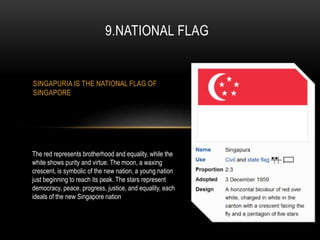
SINGAPURIA IS THE NATIONAL FLAG OF
SINGAPORE
9.NATIONAL FLAG
The red represents brotherhood and equality, while the
white shows purity and virtue. The moon, a waxing
crescent, is symbolic of the new nation, a young nation
just beginning to reach its peak. The stars represent
democracy, peace, progress, justice, and equality, each
ideals of the new Singapore nation
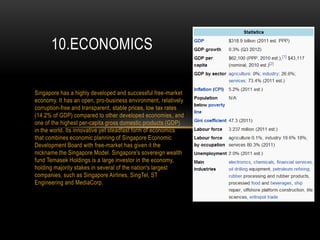
Singapore has a highly developed and successful free-market
economy. It has an open, pro-business environment, relatively
corruption-free and transparent, stable prices, low tax rates
(14.2% of GDP) compared to other developed economies, and
one of the highest per-capita gross domestic products (GDP)
in the world. Its innovative yet steadfast form of economics
that combines economic planning of Singapore Economic
Development Board with free-market has given it the
nickname the Singapore Model. Singapore's sovereign wealth
fund Temasek Holdings is a large investor in the economy,
holding majority stakes in several of the nation's largest
companies, such as Singapore Airlines, SingTel, ST
Engineering and MediaCorp.
10.ECONOMICS
2.
ARCHITECTURE
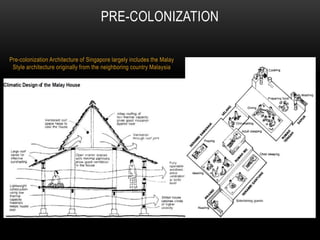
Pre-colonization Architecture of Singapore largely includes the Malay
Style architecture originally from the neighboring country Malaysia
PRE-COLONIZATION
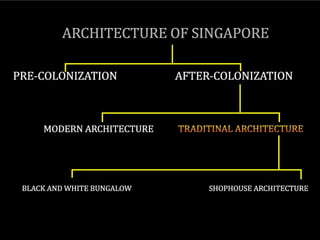
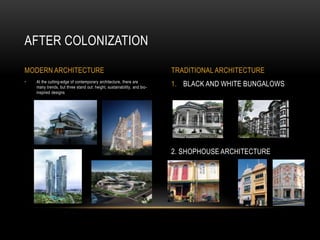
1. BLACK AND WHITE BUNGALOWS
2. SHOPHOUSE ARCHITECTURE
• At the cutting-edge of contemporary architecture, there are
many trends, but three stand out: height, sustainability, and bio-
inspired designs
AFTER COLONIZATION
MODERN ARCHITECTURE TRADITIONAL ARCHITECTURE
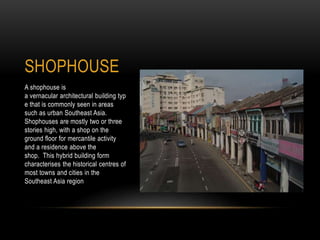
SHOPHOUSE
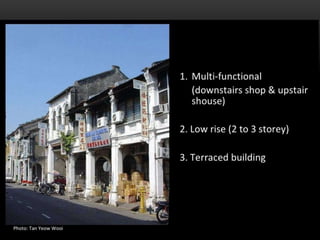
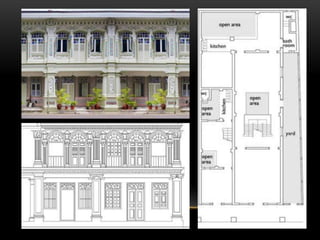
A shophouse is
a vernacular architectural building typ
e that is commonly seen in areas
such as urban Southeast Asia.
Shophouses are mostly two or three
stories high, with a shop on the
ground floor for mercantile activity
and a residence above the
shop. This hybrid building form
characterises the historical centres of
most towns and cities in the
Southeast Asia region
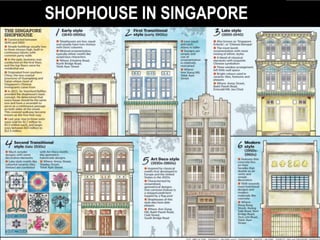
SHOPHOUSE IN SINGAPORE
3.
CONSERVATION
GUIDELINE
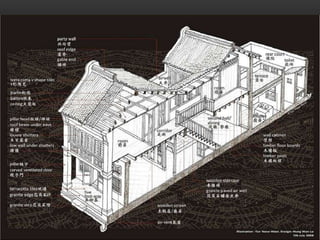
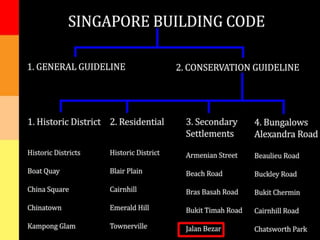
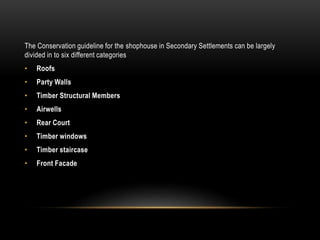
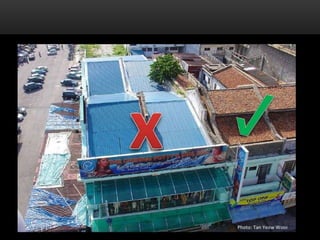
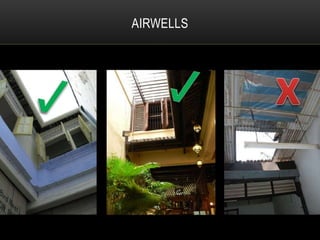
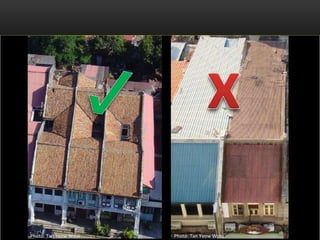
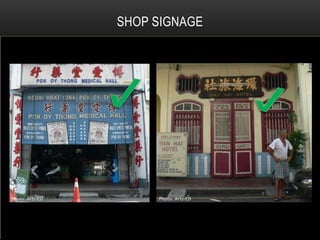
The Conservation guideline for the shophouse in Secondary Settlements can be largely
divided in to six different categories
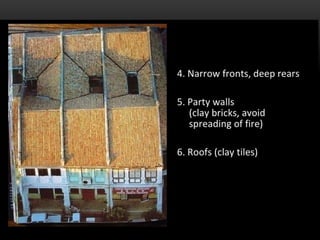
• Roofs
• Party Walls
• Timber Structural Members
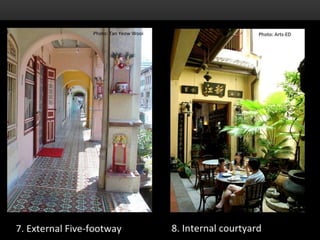
• Airwells
• Rear Court
• Timber windows
• Timber staircase
• Front Facade
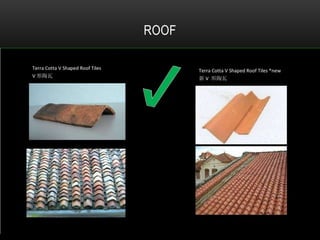
ROOF
AIRWELLS
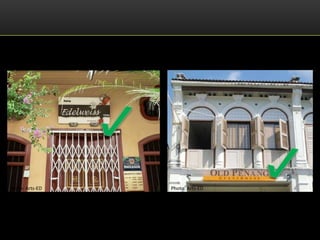
SHOP SIGNAGE
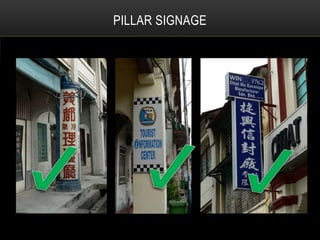
PILLAR SIGNAGE
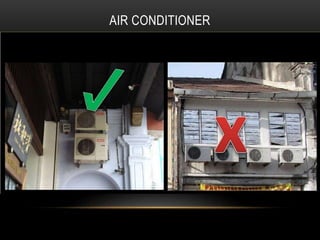
AIR CONDITIONER
4.
SITE
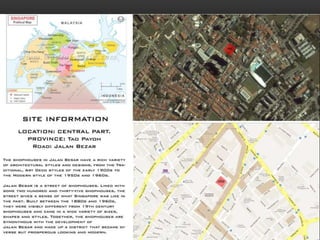
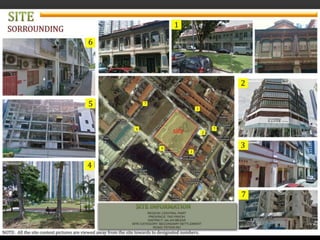
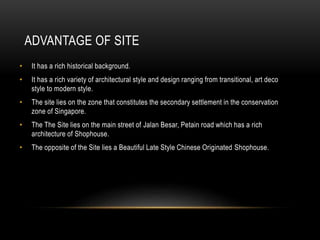
ADVANTAGE OF SITE
• It has a rich historical background.
• It has a rich variety of architectural style and design ranging from transitional, art deco
style to modern style.
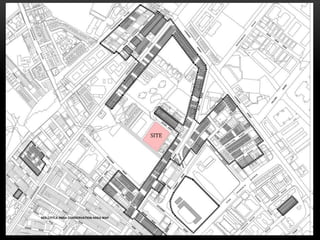
• The site lies on the zone that constitutes the secondary settlement in the conservation
zone of Singapore.
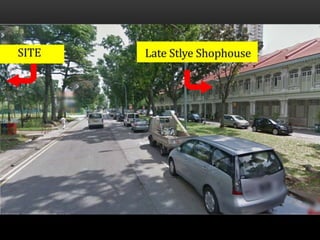
• The The Site lies on the main street of Jalan Besar, Petain road which has a rich
architecture of Shophouse.
• The opposite of the Site lies a Beautiful Late Style Chinese Originated Shophouse.
5.
CONCEPT
THANK YOU

Pin up

  • 2.
    1.COUNTRY PROFILE 2. ARCHITECTURALSTUDY 3. LAW 4. SITE 5. CONCEPT SINGAPORE
  • 3.
  • 4.
    Area: total: 697sq km land: 687 sq km water: 10 sq km 1.MAP AND THE SIZE OF THE COUNTRY Land boundaries: 0 km Coastline: 193 km
  • 5.
    THE CAPITAL OF SINGAPOREIS THE CITY OF SINGAPORE. 2. CAPITAL CITY As a city-state, Singapore is both the country and its capital. Singapore Island is the main island of Singapore, which is also called Pulau Ujong. This island is the largest island of Singapore as well as the most populous, with a population of over 5 million. Singapore Island has an area of about 710 square kilometers.
  • 6.
    THE POPULATION OFSINGAPORE IS 5.8 MILLION 3. POPULATION AND ETHNIC GROUP Ethnic groups: Chinese 76.8%, Malay 13.9%, Indian 7.9%, other 1.4% (2000 census) As of 2011, the population of Singapore is 5.18 million people, of whom 3.25 million (63%) are citizens while the rest (37%) are permanent residents or foreign workers. Twenty-three percent of Singaporean citizens were born outside Singapore i.e. foreign born citizens. There are half a million permanent residents in Singapore in 2011. The resident population does not take into account the 11 million transient visitors who visit Singapore annually
  • 7.
    MALAY IS THENATIONAL LANGAUGE OF SINGAPORE 4.OFFICIAL LANGAUGE The national language of Singapore is Malay for historical reasons but the official languages are English, Chinese (Mandarin), Malay and Tamil. Each carries equal weight under our constitution. English is widely used as the lingua franca amongst the different communities. It is also the language of administration.
  • 8.
    THE MAIN RELIGIONOF SINGAPORE IS BUDDHISM WITH LITTLE MORE THAN 34 % OF POPULATION FOLLOWING 5. RELIGION
  • 9.
    THE TYPE OFGOVERNANT IN SINGAPORE IS THE PERLIAMENTARY REPUBLIC 6.SYSTEM OF GOVERNMENT The politics of Singapore takes the form of a parliamentary representative democratic republic whereby the President of Singapore is the head of state, the Prime Minister of Singapore is the head of government, and of a multi-party system.Executive power is exercised by the cabinet. Cabinet has the general direction and control of the Government and is collectively responsible to Parliament.
  • 10.
    THE CURRENCY OFSINGAPORE IS SINGAPOREAN DOLLAR. 7.CURRENCY Inflation: 5.2% Nicknames: Sing Coins Freq Used: $1, S¢5, S¢10, S¢20, S¢50 Rarely Used: S¢1 Banknotes Freq Used: $2, $5, $10, $50 Rarely Used: $1, $20, $25, $100, $500, $1000, $10000
  • 11.
    LION HEAD ISTHE NATIONAL SYMBOL OF SINGAPORE 8.NATIONAL SYMBOL The Lion Head symbolises courage, strength and excellence, as well as resilience in the face of challenges. It is in solid red against a white background - the colours of the National Flag. Its mane's five partings represent the same five ideals that are embodied in the five stars of the National Flag, namely democracy, peace, progress, justice and equality. Its tenacious mien symbolises resolve to face and overcome any challenges.
  • 12.
    SINGAPURIA IS THENATIONAL FLAG OF SINGAPORE 9.NATIONAL FLAG The red represents brotherhood and equality, while the white shows purity and virtue. The moon, a waxing crescent, is symbolic of the new nation, a young nation just beginning to reach its peak. The stars represent democracy, peace, progress, justice, and equality, each ideals of the new Singapore nation
  • 13.
    Singapore has ahighly developed and successful free-market economy. It has an open, pro-business environment, relatively corruption-free and transparent, stable prices, low tax rates (14.2% of GDP) compared to other developed economies, and one of the highest per-capita gross domestic products (GDP) in the world. Its innovative yet steadfast form of economics that combines economic planning of Singapore Economic Development Board with free-market has given it the nickname the Singapore Model. Singapore's sovereign wealth fund Temasek Holdings is a large investor in the economy, holding majority stakes in several of the nation's largest companies, such as Singapore Airlines, SingTel, ST Engineering and MediaCorp. 10.ECONOMICS
  • 14.
  • 16.
    Pre-colonization Architecture ofSingapore largely includes the Malay Style architecture originally from the neighboring country Malaysia PRE-COLONIZATION
  • 17.
    1. BLACK ANDWHITE BUNGALOWS 2. SHOPHOUSE ARCHITECTURE • At the cutting-edge of contemporary architecture, there are many trends, but three stand out: height, sustainability, and bio- inspired designs AFTER COLONIZATION MODERN ARCHITECTURE TRADITIONAL ARCHITECTURE
  • 18.
    SHOPHOUSE A shophouse is avernacular architectural building typ e that is commonly seen in areas such as urban Southeast Asia. Shophouses are mostly two or three stories high, with a shop on the ground floor for mercantile activity and a residence above the shop. This hybrid building form characterises the historical centres of most towns and cities in the Southeast Asia region
  • 19.
  • 26.
  • 28.
    The Conservation guidelinefor the shophouse in Secondary Settlements can be largely divided in to six different categories • Roofs • Party Walls • Timber Structural Members • Airwells • Rear Court • Timber windows • Timber staircase • Front Facade
  • 29.
  • 31.
  • 33.
  • 35.
  • 36.
  • 37.
  • 40.
    ADVANTAGE OF SITE •It has a rich historical background. • It has a rich variety of architectural style and design ranging from transitional, art deco style to modern style. • The site lies on the zone that constitutes the secondary settlement in the conservation zone of Singapore. • The The Site lies on the main street of Jalan Besar, Petain road which has a rich architecture of Shophouse. • The opposite of the Site lies a Beautiful Late Style Chinese Originated Shophouse.
  • 44.
  • 46.