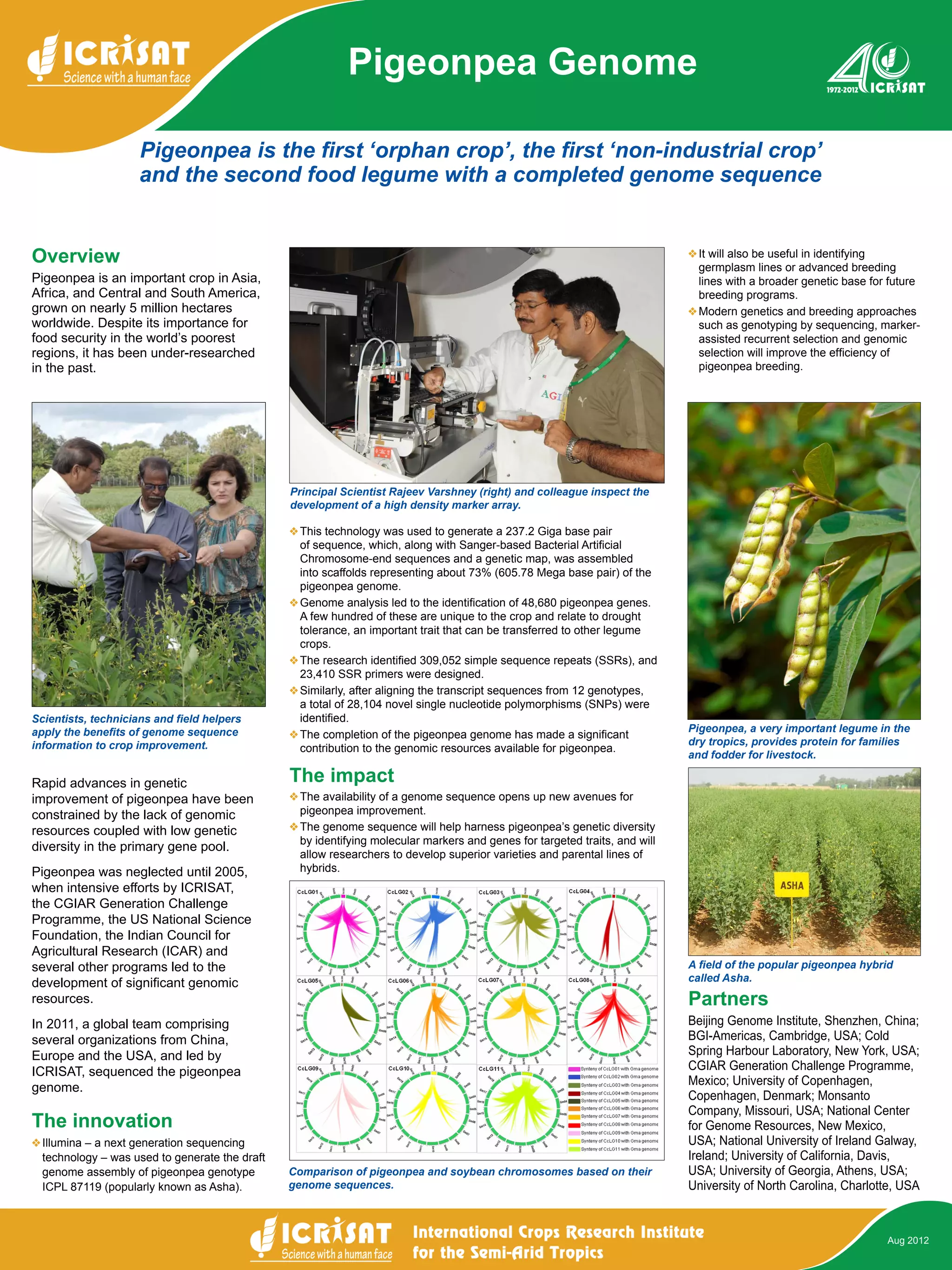
Pigeonpea is the first ‘orphan crop’, the first ‘non-industrial crop’
and the second food legume with a completed genome sequence
Pigeonpea Genome
Aug 2012
Overview
Pigeonpea is an important crop in Asia,
Africa, and Central and South America,
grown on nearly 5 million hectares
worldwide. Despite its importance for
food security in the world’s poorest
regions, it has been under-researched
in the past.
Rapid advances in genetic
improvement of pigeonpea have been
constrained by the lack of genomic
resources coupled with low genetic
diversity in the primary gene pool.
Pigeonpea was neglected until 2005,
when intensive efforts by ICRISAT,
the CGIAR Generation Challenge
Programme, the US National Science
Foundation, the Indian Council for
Agricultural Research (ICAR) and
several other programs led to the
development of significant genomic
resources.
In 2011, a global team comprising
several organizations from China,
Europe and the USA, and led by
ICRISAT, sequenced the pigeonpea
genome.
The innovation
v	Illumina – a next generation sequencing
technology – was used to generate the draft
genome assembly of pigeonpea genotype
ICPL 87119 (popularly known as Asha).
v	This technology was used to generate a 237.2 Giga base pair
of sequence, which, along with Sanger-based Bacterial Artificial
Chromosome-end sequences and a genetic map, was assembled
into scaffolds representing about 73% (605.78 Mega base pair) of the
pigeonpea genome.
v	Genome analysis led to the identification of 48,680 pigeonpea genes.
A few hundred of these are unique to the crop and relate to drought
tolerance, an important trait that can be transferred to other legume
crops.
v	The research identified 309,052 simple sequence repeats (SSRs), and
23,410 SSR primers were designed.
v	Similarly, after aligning the transcript sequences from 12 genotypes,
a total of 28,104 novel single nucleotide polymorphisms (SNPs) were
identified.
v	The completion of the pigeonpea genome has made a significant
contribution to the genomic resources available for pigeonpea.
The impact
v	The availability of a genome sequence opens up new avenues for
pigeonpea improvement.
v	The genome sequence will help harness pigeonpea’s genetic diversity
by identifying molecular markers and genes for targeted traits, and will
allow researchers to develop superior varieties and parental lines of
hybrids.
v	It will also be useful in identifying
germplasm lines or advanced breeding
lines with a broader genetic base for future
breeding programs.
v	Modern genetics and breeding approaches
such as genotyping by sequencing, marker-
assisted recurrent selection and genomic
selection will improve the efficiency of
pigeonpea breeding.
Partners
Beijing Genome Institute, Shenzhen, China;
BGI-Americas, Cambridge, USA; Cold
Spring Harbour Laboratory, New York, USA;
CGIAR Generation Challenge Programme,
Mexico; University of Copenhagen,
Copenhagen, Denmark; Monsanto
Company, Missouri, USA; National Center
for Genome Resources, New Mexico,
USA; National University of Ireland Galway,
Ireland; University of California, Davis,
USA; University of Georgia, Athens, USA;
University of North Carolina, Charlotte, USA
Comparison of pigeonpea and soybean chromosomes based on their
genome sequences.
Pigeonpea, a very important legume in the
dry tropics, provides protein for families
and fodder for livestock.
A field of the popular pigeonpea hybrid
called Asha.
Scientists, technicians and field helpers
apply the benefits of genome sequence
information to crop improvement.
Principal Scientist Rajeev Varshney (right) and colleague inspect the
development of a high density marker array.

Pigeonpea genome

  • 1.
    Pigeonpea is thefirst ‘orphan crop’, the first ‘non-industrial crop’ and the second food legume with a completed genome sequence Pigeonpea Genome Aug 2012 Overview Pigeonpea is an important crop in Asia, Africa, and Central and South America, grown on nearly 5 million hectares worldwide. Despite its importance for food security in the world’s poorest regions, it has been under-researched in the past. Rapid advances in genetic improvement of pigeonpea have been constrained by the lack of genomic resources coupled with low genetic diversity in the primary gene pool. Pigeonpea was neglected until 2005, when intensive efforts by ICRISAT, the CGIAR Generation Challenge Programme, the US National Science Foundation, the Indian Council for Agricultural Research (ICAR) and several other programs led to the development of significant genomic resources. In 2011, a global team comprising several organizations from China, Europe and the USA, and led by ICRISAT, sequenced the pigeonpea genome. The innovation v Illumina – a next generation sequencing technology – was used to generate the draft genome assembly of pigeonpea genotype ICPL 87119 (popularly known as Asha). v This technology was used to generate a 237.2 Giga base pair of sequence, which, along with Sanger-based Bacterial Artificial Chromosome-end sequences and a genetic map, was assembled into scaffolds representing about 73% (605.78 Mega base pair) of the pigeonpea genome. v Genome analysis led to the identification of 48,680 pigeonpea genes. A few hundred of these are unique to the crop and relate to drought tolerance, an important trait that can be transferred to other legume crops. v The research identified 309,052 simple sequence repeats (SSRs), and 23,410 SSR primers were designed. v Similarly, after aligning the transcript sequences from 12 genotypes, a total of 28,104 novel single nucleotide polymorphisms (SNPs) were identified. v The completion of the pigeonpea genome has made a significant contribution to the genomic resources available for pigeonpea. The impact v The availability of a genome sequence opens up new avenues for pigeonpea improvement. v The genome sequence will help harness pigeonpea’s genetic diversity by identifying molecular markers and genes for targeted traits, and will allow researchers to develop superior varieties and parental lines of hybrids. v It will also be useful in identifying germplasm lines or advanced breeding lines with a broader genetic base for future breeding programs. v Modern genetics and breeding approaches such as genotyping by sequencing, marker- assisted recurrent selection and genomic selection will improve the efficiency of pigeonpea breeding. Partners Beijing Genome Institute, Shenzhen, China; BGI-Americas, Cambridge, USA; Cold Spring Harbour Laboratory, New York, USA; CGIAR Generation Challenge Programme, Mexico; University of Copenhagen, Copenhagen, Denmark; Monsanto Company, Missouri, USA; National Center for Genome Resources, New Mexico, USA; National University of Ireland Galway, Ireland; University of California, Davis, USA; University of Georgia, Athens, USA; University of North Carolina, Charlotte, USA Comparison of pigeonpea and soybean chromosomes based on their genome sequences. Pigeonpea, a very important legume in the dry tropics, provides protein for families and fodder for livestock. A field of the popular pigeonpea hybrid called Asha. Scientists, technicians and field helpers apply the benefits of genome sequence information to crop improvement. Principal Scientist Rajeev Varshney (right) and colleague inspect the development of a high density marker array.