Pic Projects And Applications Using C A
Projectbased Approach 3rd Ed David W Smith Auth

download
https://ebookbell.com/product/pic-projects-and-applications-
using-c-a-projectbased-approach-3rd-ed-david-w-smith-auth-4434370
Explore and download more ebooks at ebookbell.com
Here are some recommended products that we believe you will be
interested in. You can click the link to download.
Pic Microcontrollers 50 Projects For Beginners And Experts Bert Van
Dam
https://ebookbell.com/product/pic-microcontrollers-50-projects-for-
beginners-and-experts-bert-van-dam-2289226
Pic Basic Projects 30 Projects Using Pic Basic And Pic Basic Pro Dogan
Ibrahim
https://ebookbell.com/product/pic-basic-projects-30-projects-using-
pic-basic-and-pic-basic-pro-dogan-ibrahim-977640
Microcontroller Systems Engineering 45 Projects For Pic Avr And Arm
Bert Van Dam
https://ebookbell.com/product/microcontroller-systems-
engineering-45-projects-for-pic-avr-and-arm-bert-van-dam-2097978
Programming Arduino Projects With The Pic Microcontroller A Lineby
Line Code Analysis And Complete Reference Guide For Embedded
Programming In C 1st Edition Hubert Henry Ward
https://ebookbell.com/product/programming-arduino-projects-with-the-
pic-microcontroller-a-lineby-line-code-analysis-and-complete-
reference-guide-for-embedded-programming-in-c-1st-edition-hubert-
henry-ward-34873434
Programming Arduino Projects With The Pic Microcontroller A Linebyline
Code Analysis And Complete Reference Guide For Embedded Programming In
C Hubert Henry Ward
https://ebookbell.com/product/programming-arduino-projects-with-the-
pic-microcontroller-a-linebyline-code-analysis-and-complete-reference-
guide-for-embedded-programming-in-c-hubert-henry-ward-34877482
Pic Microcontroller Project Book For Pic Basic And Pic Basic Pro
Compliers 2nd Edition John Iovine
https://ebookbell.com/product/pic-microcontroller-project-book-for-
pic-basic-and-pic-basic-pro-compliers-2nd-edition-john-iovine-1617194
Pic Projects For Nonprogrammers John Iovine Auth
https://ebookbell.com/product/pic-projects-for-nonprogrammers-john-
iovine-auth-4342102
Pic Microcontroller Projects In C Basic To Advanced 2nd Edition Dogan
Ibrahim
https://ebookbell.com/product/pic-microcontroller-projects-in-c-basic-
to-advanced-2nd-edition-dogan-ibrahim-33554944
Pic Microcontroller Projects In C 2nd Edition Ibrahim Dogan
https://ebookbell.com/product/pic-microcontroller-projects-in-c-2nd-
edition-ibrahim-dogan-11825810
PIC Projects and
Applications using C
PIC Projects and
Applications using C
A Project-based Approach
Third edition
David W. Smith
AMSTERDAM • BOSTON • HEIDELBERG • LONDON
NEW YORK • OXFORD • PARIS • SAN DIEGO
SAN FRANCISCO • SINGAPORE • SYDNEY • TOKYO
Newnes is an imprint of Elsevier
The Boulevard, Langford Lane, Kidlington, Oxford OX5 1GB, UK
225 Wyman Street, Waltham, MA 02451, USA
First edition 2002
Second edition 2006
Third edition 2013
Copyright © 2013 Elsevier Ltd. All rights reserved
No part of this publication may be reproduced or transmitted in any form or by
any means, electronic or mechanical, including photocopying, recording, or any
information storage and retrieval system, without permission in writing from the
publisher. Details on how to seek permission, further information about the Publisher’s
permissions policies and our arrangement with organizations such as the Copyright
Clearance Center and the Copyright Licensing Agency, can be found at our website:
www.elsevier.com/permissions.
This book and the individual contributions contained in it are protected under
copyright by the Publisher (other than as may be noted herein).
Notice
Knowledge and best practice in this field are constantly changing. As new research
and experience broaden our understanding, changes in research methods, professional
practices, or medical treatment may become necessary.
Practitioners and researchers must always rely on their own experience and
knowledge in evaluating and using any information, methods, compounds, or
experiments described herein. In using such information or methods they should be
mindful of their own safety and the safety of others, including parties for whom they
have a professional responsibility.
To the fullest extent of the law, neither the Publisher nor the authors, contributors, or
editors, assume any liability for any injury and/or damage to persons or property as a
matter of products liability, negligence or otherwise, or from any use or operation of
any methods, products, instructions, or ideas contained in the material herein.
British Library Cataloguing-in-Publication Data
A catalogue record for this book is available from the British Library
Library of Congress Cataloging-in-Publication Data
A catalog record for this book is available from the Library of Congress
ISBN: 978-0-08-097151-3
For information on all Newnes publications
visit our website at www.books.elsevier.com
13 14 15 16  10 9 8 7 6 5 4 3 2 1
Printed in the United States of America
ix
Preface
The aim of this book is to enable the reader to program the 18F series of
PIC Microcontrollers in the C language using Microchip’s MPLAB C18 com-
piler. The program examples demonstrate the power of the C language, yet the
reader does not have to be a C programmer in order to benefit from this tech-
nology as the C language is added and explained as required.
The chapters show numerous applications starting with switching out-
puts on, then using digital inputs such as switches and keypads. This book
continues with making measurements from analogue inputs, writing to alpha
numeric displays, using timers and interrupts, and transmitting data via radio
links.
There is a section on fault finding using the MPLAB simulator and in-
circuit debugger. So that faults can be located easier.
All of the chapters show applications on how to use the program examples.
The programs are complete and are clearly explained.
My aim has been to show the reader how to use the Microcontroller to
develop programs for projects. I have tried to keep the technical detail down to
a minimum and have not gone into a deeper understanding of how the micro-
controller is working inside. An understanding of the electronics inside the
microcontroller is not necessary to enable the reader to program it.
The reader is encouraged to build the programs, see how they work, and
then modify the code to enable a clearer understanding of the principles
involved; a development kit is available to do this. My own students have been
ingenious in developing faults in code and I have used their efforts, hopefully,
to produce an easy-to-understand guide to programming the PIC micro in C.
The programs listed in this book and the details of the development kit
are available from the book’s companion website: http://booksite.elsevier.
com/9780080971513.
DW Smith BSc., MSc.
Lecturer in Electronics, Manchester Metropolitan University
April 2013
1
PIC Projects and Applications using C.
© 2013 David W. Smith. Published by Elsevier Ltd. All rights reserved.
2013
Introduction to the
Microcontroller and C
Chapter 1
A microcontroller is an integrated circuit that has a number of memory
locations embedded inside it which are used to store instructions that are to be
executed. These locations are called registers, and instructions are written to
these registers to enable the microcontroller to perform an operation.
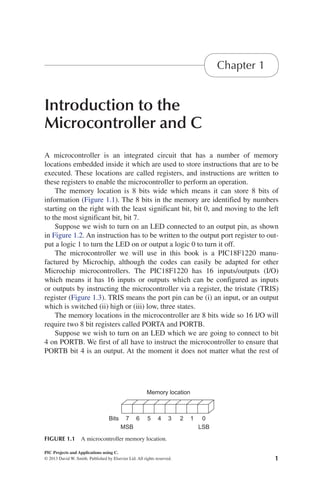
The memory location is 8 bits wide which means it can store 8 bits of
information (Figure 1.1). The 8 bits in the memory are identified by numbers
starting on the right with the least significant bit, bit 0, and moving to the left
to the most significant bit, bit 7.
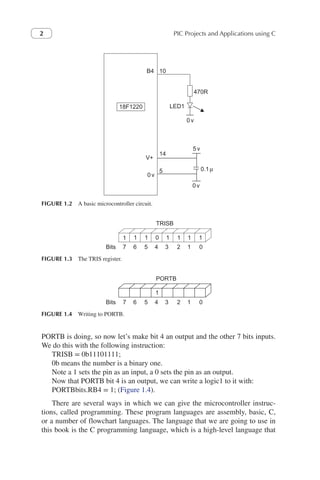
Suppose we wish to turn on an LED connected to an output pin, as shown
in Figure 1.2. An instruction has to be written to the output port register to out-
put a logic 1 to turn the LED on or output a logic 0 to turn it off.
The microcontroller we will use in this book is a PIC18F1220 manu-
factured by Microchip, although the codes can easily be adapted for other
Microchip microcontrollers. The PIC18F1220 has 16 inputs/outputs (I/O)
which means it has 16 inputs or outputs which can be configured as inputs
or outputs by instructing the microcontroller via a register, the tristate (TRIS)
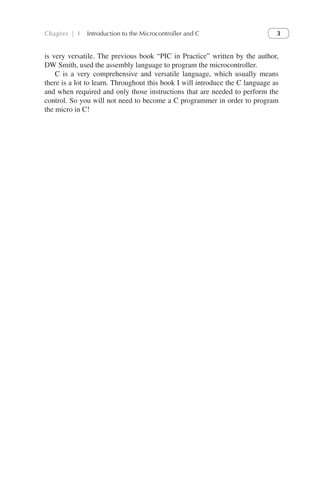
register (Figure 1.3). TRIS means the port pin can be (i) an input, or an output
which is switched (ii) high or (iii) low, three states.
The memory locations in the microcontroller are 8 bits wide so 16 I/O will
require two 8 bit registers called PORTA and PORTB.
Suppose we wish to turn on an LED which we are going to connect to bit
4 on PORTB. We first of all have to instruct the microcontroller to ensure that
PORTB bit 4 is an output. At the moment it does not matter what the rest of
Bits
MSB LSB
Memory location
7 6 5 4 3 2 1 0
FIGURE 1.1 A microcontroller memory location.
PIC Projects and Applications using C
2
PORTB is doing, so now let’s make bit 4 an output and the other 7 bits inputs.
We do this with the following instruction:
TRISB = 0b11101111;
0b means the number is a binary one.
Note a 1 sets the pin as an input, a 0 sets the pin as an output.
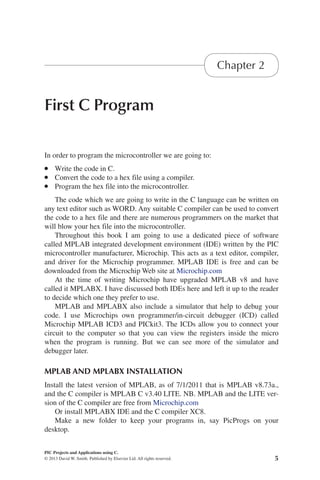
Now that PORTB bit 4 is an output, we can write a logic1 to it with:
PORTBbits.RB4 = 1; (Figure 1.4).
There are several ways in which we can give the microcontroller instruc-
tions, called programming. These program languages are assembly, basic, C,
or a number of flowchart languages. The language that we are going to use in
this book is the C programming language, which is a high-level language that
B4 10
LED1
470R
0v
0 v
0v
V+
5 v
14
5 0.1 µ
18F1220
FIGURE 1.2 A basic microcontroller circuit.
1
TRISB
1 1 0 1 1 1 1
7
Bits 6 5 4 3 2 1 0
FIGURE 1.3 The TRIS register.
1
PORTB
7
Bits 6 5 4 3 2 1 0
FIGURE 1.4 Writing to PORTB.
Chapter | 1 Introduction to the Microcontroller and C 3
is very versatile. The previous book “PIC in Practice” written by the author,
DW Smith, used the assembly language to program the microcontroller.
C is a very comprehensive and versatile language, which usually means
there is a lot to learn. Throughout this book I will introduce the C language as
and when required and only those instructions that are needed to perform the
control. So you will not need to become a C programmer in order to program
the micro in C!
5
PIC Projects and Applications using C.
© 2013 David W. Smith. Published by Elsevier Ltd. All rights reserved.
2013
First C Program
Chapter 2
In order to program the microcontroller we are going to:
l Write the code in C.
l Convert the code to a hex file using a compiler.
l Program the hex file into the microcontroller.
The code which we are going to write in the C language can be written on
any text editor such as WORD. Any suitable C compiler can be used to convert
the code to a hex file and there are numerous programmers on the market that
will blow your hex file into the microcontroller.
Throughout this book I am going to use a dedicated piece of software
called MPLAB integrated development environment (IDE) written by the PIC
microcontroller manufacturer, Microchip. This acts as a text editor, compiler,
and driver for the Microchip programmer. MPLAB IDE is free and can be
downloaded from the Microchip Web site at Microchip.com
At the time of writing Microchip have upgraded MPLAB v8 and have
called it MPLABX. I have discussed both IDEs here and left it up to the reader
to decide which one they prefer to use.
MPLAB and MPLABX also include a simulator that help to debug your
code. I use Microchips own programmer/in-circuit debugger (ICD) called
Microchip MPLAB ICD3 and PICkit3. The ICDs allow you to connect your
circuit to the computer so that you can view the registers inside the micro
when the program is running. But we can see more of the simulator and
debugger later.
MPLAB AND MPLABX INSTALLATION
Install the latest version of MPLAB, as of 7/1/2011 that is MPLAB v8.73a.,
and the C compiler is MPLAB C v3.40 LITE. NB. MPLAB and the LITE ver-
sion of the C compiler are free from Microchip.com
Or install MPLABX IDE and the C compiler XC8.
Make a new folder to keep your programs in, say PicProgs on your
desktop.
PIC Projects and Applications using C
6
For our first program we are going to flash an LED on and off at 1s inter-
vals on the output pin, PORTB,4.
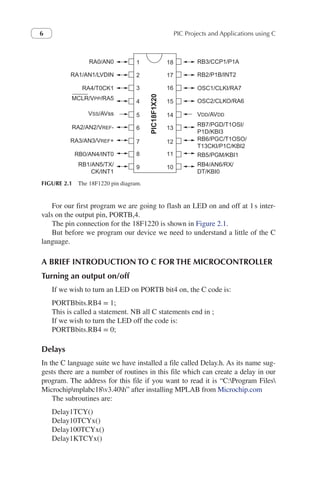
The pin connection for the 18F1220 is shown in Figure 2.1.
But before we program our device we need to understand a little of the C
language.
A BRIEF INTRODUCTION TO C FOR THE MICROCONTROLLER
Turning an output on/off
If we wish to turn an LED on PORTB bit4 on, the C code is:
PORTBbits.RB4 = 1;
This is called a statement. NB all C statements end in ;
If we wish to turn the LED off the code is:
PORTBbits.RB4 = 0;
Delays
In the C language suite we have installed a file called Delay.h. As its name sug-
gests there are a number of routines in this file which can create a delay in our
program. The address for this file if you want to read it is “C:Program Files
Microchipmplabc18v3.40h” after installing MPLAB from Microchip.com
The subroutines are:
Delay1TCY()
Delay10TCYx()
Delay100TCYx()
Delay1KTCYx()
RA0/AN0
RA1/AN1/LVDIN
RA4/T0CK1
RA2/AN2/VREF-
RA3/AN3/VREF+
RB0/AN4/INT0
RB1/AN5/TX/
CK/INT1
MCLR/VPP/RA5
VSS/AVss
RB3/CCP1/P1A
RB2/P1B/INT2
OSC1/CLKI/RA7
RB7/PGD/T1OSI/
P1D/KBI3
RB6/PGC/T1OSO/
T13CKI/P1C/KBI2
RB5/PGM/KBI1
RB4/AN6/RX/
DT/KBI0
OSC2/CLKO/RA6
VDD/AVDD
1
2
3
4
5
6
7
8
9
18
PIC18F1X20
17
16
15
14
13
12
11
10
FIGURE 2.1 The 18F1220 pin diagram.
Chapter | 2 First C Program 7
Delay10KTCYx()
If you wish to call a subroutine in C you just state its name, i.e.,
Delay1KTCYx();
These delays are multiples of timing cycles, i.e., 1, 10, 100, 1000, and
10,000.
A timing cycle is the time taken to execute an instruction and it is the basis
of the timing in the microcontroller system. The timing comes from the oscil-
lator which can be an external clock source, an external crystal, or an internal
oscillator. For now we are going to use the internal oscillator set at 31.25kHz.
The timing cycle runs at one-fourth of this frequency, i.e., at 7.8125kHz.
This means the period of the timing cycle is 0.128ms.
So the Delay100TCYx() subroutine will have a time of 100×0.128ms
= 12.8ms.
In order to achieve a delay of 1s we would need 78 of these 12.8ms.
78 × 12.8ms = 0.9984s, not quite 1s but near enough for this application.
To do this the C code is:
Delay100TCYx(78);
Note the number of times the subroutine is executed is written in the
brackets (78) in this case. NB. 255 is the maximum value that can be entered.
Loops
In order to make the program execute some code a number of times or indefi-
nitely, we use a loop.
The WHILE LOOP as it is called looks like this:
while ( )
{
}
The code to be executed is written between the brackets { } while the con-
dition for executing the code is written between the brackets ( )
Suppose we wish to turn an alarm on if the temperature goes above 60°C,
the code would look like:
while (Temperature>60)
{
PORTBbits.RB0 = 1; // turn on PORTB bit0
}
If we wish to execute a piece of code indefinitely such as flashing our LED
on PORTB bit 4 on and off continuously, the loop is:
while (1)
{
PORTBbits.RB4 = 1;      // turn on PORTB bit4
PIC Projects and Applications using C
8
Delay100TCYx(78);    	 // wait 1s
PORTBbits.RB4 = 0;    	 // turn off PORTB bit4
Delay100TCYx(78);   	 // wait 1s
}
The function while (1) means while 1 is true! But 1 is always 1, so the loop is
always executing. Note the function while (1) does not end with a ;
The // code means ignore what follows on the line; it is for our reference
not for the compiler.
A useful while loop involves just 1 line of code, i.e.,
while (PORTBbits.RB4==1);
This means continue the loop (just 1 line) until PORTBbits.RB4==1 is
no longer true, i.e., wait until PORTBbits.RB4==0 before moving on in the
program.
Note: == means is equal to,=means equals. One is a question and the other
a statement.
Entering Numbers in the Program
Numbers can be entered in the program as hexadecimal, binary or decimal.
A hexadecimal number 7F is written as 0 × 7F.
A binary number 1111 0101 is written as 0b11110101.
A decimal number 45 is just written as 45.
We are now ready to write our C program.
NOTE
In the remainder of this book we will be writing C files and putting them
into projects. You can choose to do this with MPLAB or MPLABX.
WRITING THE CODE USING MPLAB IDE
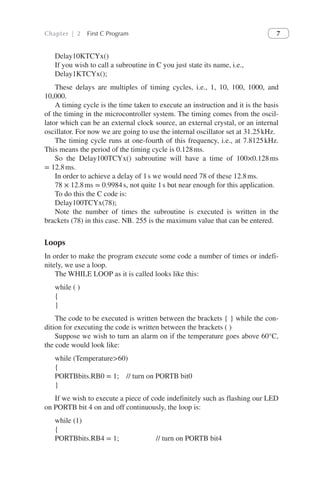
Run MPLAB and the screen shown in Figure 2.2 will open.
For our first program we are going to flash an LED on and off at 1s inter-
vals on the output pin, PORTB,4. We will call this, flash.c
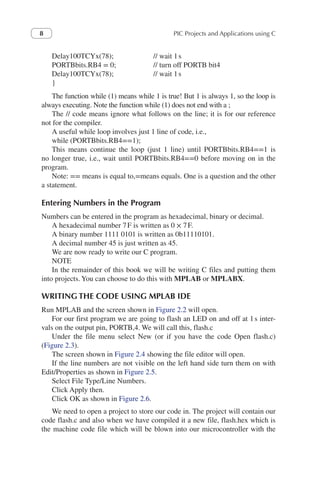
Under the file menu select New (or if you have the code Open flash.c)
(Figure 2.3).
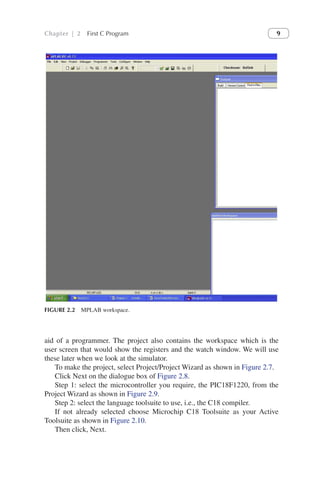
The screen shown in Figure 2.4 showing the file editor will open.
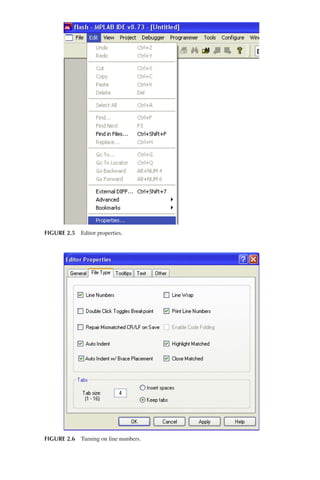
If the line numbers are not visible on the left hand side turn them on with
Edit/Properties as shown in Figure 2.5.
Select File Type/Line Numbers.
Click Apply then.
Click OK as shown in Figure 2.6.
We need to open a project to store our code in. The project will contain our
code flash.c and also when we have compiled it a new file, flash.hex which is
the machine code file which will be blown into our microcontroller with the
Chapter | 2 First C Program 9
aid of a programmer. The project also contains the workspace which is the
user screen that would show the registers and the watch window. We will use
these later when we look at the simulator.
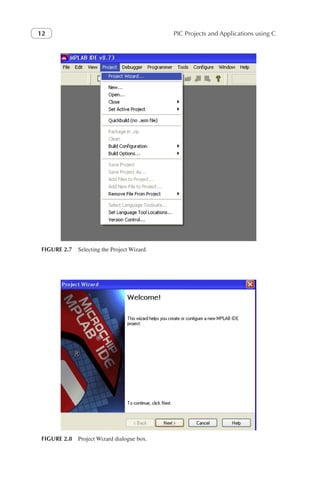
To make the project, select Project/Project Wizard as shown in Figure 2.7.
Click Next on the dialogue box of Figure 2.8.
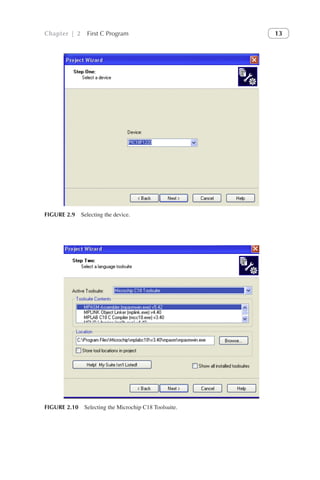
Step 1: select the microcontroller you require, the PIC18F1220, from the
Project Wizard as shown in Figure 2.9.
Step 2: select the language toolsuite to use, i.e., the C18 compiler.
If not already selected choose Microchip C18 Toolsuite as your Active
Toolsuite as shown in Figure 2.10.
Then click, Next.
FIGURE 2.2 MPLAB workspace.
PIC Projects and Applications using C
10
FIGURE 2.3 Creating the file flash.c.
FIGURE 2.4 File editor screen.
FIGURE 2.5 Editor properties.
FIGURE 2.6 Turning on line numbers.
PIC Projects and Applications using C
12
FIGURE 2.7 Selecting the Project Wizard.
FIGURE 2.8 Project Wizard dialogue box.
Chapter | 2 First C Program 13
FIGURE 2.9 Selecting the device.
FIGURE 2.10 Selecting the Microchip C18 Toolsuite.
PIC Projects and Applications using C
14
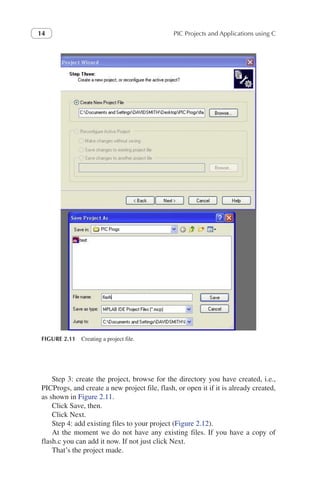
Step 3: create the project, browse for the directory you have created, i.e.,
PICProgs, and create a new project file, flash, or open it if it is already created,
as shown in Figure 2.11.
Click Save, then.
Click Next.
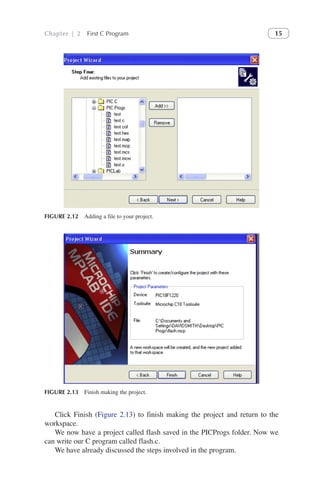
Step 4: add existing files to your project (Figure 2.12).
At the moment we do not have any existing files. If you have a copy of
flash.c you can add it now. If not just click Next.
That’s the project made.
FIGURE 2.11 Creating a project file.
Chapter | 2 First C Program 15
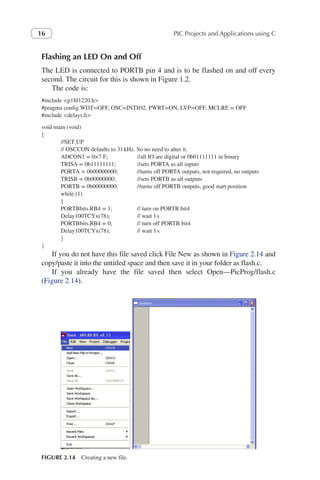
Click Finish (Figure 2.13) to finish making the project and return to the
workspace.
We now have a project called flash saved in the PICProgs folder. Now we
can write our C program called flash.c.
We have already discussed the steps involved in the program.
FIGURE 2.12 Adding a file to your project.
FIGURE 2.13 Finish making the project.
PIC Projects and Applications using C
16
Flashing an LED On and Off
The LED is connected to PORTB pin 4 and is to be flashed on and off every
second. The circuit for this is shown in Figure 1.2.
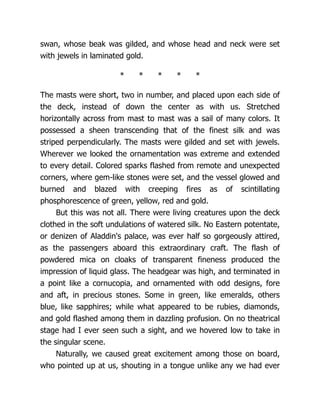
The code is:
#include <p18f1220.h>
#pragma config WDT=OFF, OSC=INTIO2, PWRT=ON, LVP=OFF, MCLRE = OFF
#include <delays.h>
void main (void)
{
//SET UP
// OSCCON defaults to 31kHz. So no need to alter it.
ADCON1 = 0×7 F; //all IO are digital or 0b01111111 in binary
TRISA = 0b11111111; 	 //sets PORTA as all inputs
PORTA = 0b00000000; 	 //turns off PORTA outputs, not required, no outputs
TRISB = 0b00000000; 	 //sets PORTB as all outputs
PORTB = 0b00000000; 	 //turns off PORTB outputs, good start position
while (1)
{
PORTBbits.RB4 = 1; 	 // turn on PORTB bit4
Delay100TCYx(78); 	 // wait 1s
PORTBbits.RB4 = 0; 	 // turn off PORTB bit4
Delay100TCYx(78); 	 // wait 1s
}
}
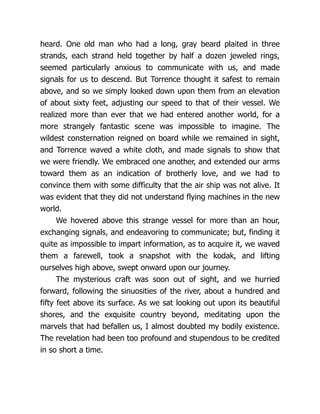
If you do not have this file saved click File New as shown in Figure 2.14 and
copy/paste it into the untitled space and then save it in your folder as flash.c.
If you already have the file saved then select Open—PicProg/flash.c
(Figure 2.14).
FIGURE 2.14 Creating a new file.
Another Random Document on
Scribd Without Any Related Topics
swan, whose beak was gilded, and whose head and neck were set
with jewels in laminated gold.
* * * * *
The masts were short, two in number, and placed upon each side of
the deck, instead of down the center as with us. Stretched
horizontally across from mast to mast was a sail of many colors. It
possessed a sheen transcending that of the finest silk and was
striped perpendicularly. The masts were gilded and set with jewels.
Wherever we looked the ornamentation was extreme and extended
to every detail. Colored sparks flashed from remote and unexpected
corners, where gem-like stones were set, and the vessel glowed and
burned and blazed with creeping fires as of scintillating
phosphorescence of green, yellow, red and gold.
But this was not all. There were living creatures upon the deck
clothed in the soft undulations of watered silk. No Eastern potentate,
or denizen of Aladdin's palace, was ever half so gorgeously attired,
as the passengers aboard this extraordinary craft. The flash of
powdered mica on cloaks of transparent fineness produced the
impression of liquid glass. The headgear was high, and terminated in
a point like a cornucopia, and ornamented with odd designs, fore
and aft, in precious stones. Some in green, like emeralds, others
blue, like sapphires; while what appeared to be rubies, diamonds,
and gold flashed among them in dazzling profusion. On no theatrical
stage had I ever seen such a sight, and we hovered low to take in
the singular scene.
Naturally, we caused great excitement among those on board,
who pointed up at us, shouting in a tongue unlike any we had ever
heard. One old man who had a long, gray beard plaited in three
strands, each strand held together by half a dozen jeweled rings,
seemed particularly anxious to communicate with us, and made
signals for us to descend. But Torrence thought it safest to remain
above, and so we simply looked down upon them from an elevation
of about sixty feet, adjusting our speed to that of their vessel. We
realized more than ever that we had entered another world, for a
more strangely fantastic scene was impossible to imagine. The
wildest consternation reigned on board while we remained in sight,
and Torrence waved a white cloth, and made signals to show that
we were friendly. We embraced one another, and extended our arms
toward them as an indication of brotherly love, and we had to
convince them with some difficulty that the air ship was not alive. It
was evident that they did not understand flying machines in the new
world.
We hovered above this strange vessel for more than an hour,
exchanging signals, and endeavoring to communicate; but, finding it
quite as impossible to impart information, as to acquire it, we waved
them a farewell, took a snapshot with the kodak, and lifting
ourselves high above, swept onward upon our journey.
The mysterious craft was soon out of sight, and we hurried
forward, following the sinuosities of the river, about a hundred and
fifty feet above its surface. As we sat looking out upon its beautiful
shores, and the exquisite country beyond, meditating upon the
marvels that had befallen us, I almost doubted my bodily existence.
The revelation had been too profound and stupendous to be credited
in so short a time.
"Is this thing real, or is it a vision of death?" I inquired, turning
on my brother suddenly.
"I am not surprised at your asking," he replied; "I have been
afraid to tell you the truth of our discovery before, although I have
known it and believed in it for years. Merrick's story only confirmed
me in my own views."
"And have you never felt a doubt as to the result of the
enterprise?"
"Scarcely; the arguments were too strong in favor of the hollow
globe for me to have any serious misgiving. But long before I spoke
to you I was absolutely convinced. By the distance we had traveled.
By the genial climate. By the strange light. By the crescent cloud. By
the absence of recurring cold, and by the accumulated knowledge
already mentioned. My dear boy, I fully appreciate what a shock this
must be to you—even greater than it is to me, and for the reason
that I have studied the question and believed in it half my life. For
fifteen years I have been convinced that if I could ever find a way
across the Palæocrystic Sea I should be able to sail without difficulty
into the interior of the earth. There is really nothing more
stupendous in this acquisition to our knowledge than was that of the
spherical globe to the ancients. When a race of people has been
bred for thousands of years to believe that the world they inhabit is
flat, it must seem wildly absurd to be suddenly confronted with a
theory which advances the possibility of their being able to walk
upon the under side of it. Think of such a statement being made to
sensible men!"
"And how do you account for the fact that these people have
never found their way into the outer world?" I asked.
"For the same reason that we have never found our way into
theirs," replied Torrence. "The difficulties of crossing the ice belt are
very nearly insurmountable; and yet that they are not quite so we
have seen in the case of Jan von Broekhuysen and his two
companions. Neither is it by any means certain that dwellers of this
inner region have never reached us. Remember the wild men
discovered off Cape Tchelyieskin. Where did they come from?
Beyond this there are isolated cases of communities that point to
unknown regions in the far north, as well as the far south, as their
hailing place. These have traditions of having once inhabited a land
of more genial climate, and affording better conditions for the
human race than ours, and moreover, a land where day was eternal!
True, it may not be once in thousands of years that the ice barrier
has been threaded, but what is more to the point, it is probable that
those who have crossed it did not know it. The change is so gradual,
the mind so fixed in its normal conception of the earth's character,
that only a few eccentric, or peculiarly educated persons, among the
very few who may have accomplished the feat, ever suspected it.
There was a time in the world's history when one might have
circumnavigated the earth without a suspicion that he had done so."
We now took our meals invariably on deck, not wishing to miss
any of the strange and beautiful scenery constantly passing. On one
occasion, while preparing some food in the galley, I was struck by
what appeared to be a secret panel in the wall. Asking Torrence
about it, he said:
"Push it up one inch, and then down two. Then if you press it
gently inward it will slide open of itself."
I did so, and found that the aperture contained ten small canvas
bags, in each of which, as Torrence told me, were a thousand
English sovereigns.
"And what on earth have you brought this amount of coin here
for?" I inquired in amazement.
Torrence simply said:
"Because I thought we might need it before we got home again.
Gold talks, you know, and we may be able to communicate with
these people through its medium. Gold is current throughout our
world, and I wanted to see if it were good here. If it is valuable we
may not expect to find any very abnormal deposits; if not, look out
for a bonanza, provided the air ship holds together, so that we can
carry it out with us. I have my theory about it."
"And what is that?" I asked.
"Why simply that our little stock of sovereigns won't buy bread
enough for a square meal!" he answered.
XVII.
This circumstance reminded me of Torrence's financiering and the
discovery of pearls upon the beach. It seemed trivial to concern
ourselves about gold when precious stones were to be had with so
slight an effort, and I asked why he should care to carry any of the
yellow metal away with him.
"Merely to convince the outer world of its existence, and to
confirm a theory I have always held," he replied. "To my mind there
can be no reasonable doubt that we shall find deposits here
exceeding anything our people have ever dreamed of!"
"And why?"
"Because gold is heavy," he answered.
"Nonsense. Do you mean to say that the center of gravity is not
quite as far below our feet here, as on the outer crust?"
"Probably not. When our globe was in process of forming, two
great forces moulded it—the centrifugal and centripetal. These
produce various vibratory conditions in different masses, resulting in
gravity or affinity upon one hand, and repulsion upon the other.
Bodies having the greatest specific gravity grouped themselves
about the inner surface, forming an arch, being thrown off in a
gaseous state from the center. But from the very reason of their
gravity were unable to descend any great distance into the crust;
and therefore the heaviest substances should be found upon the
inner or under side of the earth's canopy."
"I fail to see it," I answered. "Why should not a heavy weight
sink deeper than a light one?"
"It doubtless would on our side of the world," he replied, "but
here the conditions are different, and for this reason. The great
mass of earth above our heads is drawing us upward, as the mass
below is drawing us downward. Not, to be sure, to the same degree,
or we should not be able to walk on the ground. I believe that all
things here are lighter than with us. You and I probably weigh
several pounds less than we would in the United States or England.
Gold, too, is doubtless lighter, for it is lifted up, as well as pulled
down; whereas upon the outer surface of the earth it is drawn only
one way. I may be mistaken, but I expect to find it in large
quantities."
"Why, then, did you bring so much with you?" I inquired.
"Simply because I didn't know what might happen. If we find it,
well and good; if not, the interest on fifty thousand dollars won't be
any too much for a couple of men to live on, in the event of our
being stranded here and unable to return."
All this time we were passing over a country where water,
timber, and pasturage abounded, and where the grass was
variegated with large patches of brilliant flowers of unknown
varieties. But if the flora differed from that of our own land the fauna
was no less remarkable. We saw herds of diminutive deer, feeding in
the open country. Birds abounded, and some with a strange
plumage, in which the pink of roses predominated. The topknots on
certain of these looked as if a rose had blossomed there; add to this
a body and tail of red and green trailing feathers, it appeared as if a
flower spray was floating through the air. We caused the greatest
consternation among these creatures wherever we went, and the
four-legged beasts would at first run on catching sight of us, and
then, overcome with curiosity, huddle together and look up, with
cries of amazement and terror.
But we were approaching a remarkable sight. In the distance
was a fleet of boats, similar to the one we had passed, and beyond
them, looming in the denser background we saw a magnificent city
of white and gold. We brought our glasses to bear upon this strange
vision of the new earth. As we approached, the fleet presented a
vision of splendor impossible to describe. Whereas before a single
vessel had so impressed us, we were now confronted with a vista of
hundreds, which stretched away down the wide avenue of this
unknown river as far as the eye could reach. Flashing sails in a
thousand strange designs of form and color. Decks loaded with men,
women, and children, in such fantastic and magnificent apparel that
we were startled and bewildered at the sight. On nearing this
extraordinary scene, we hovered above, and caused the wildest
excitement. Trumpets were blown at us. Bells were lifted on poles
and jangled. Chimes were sounded that came floating down the
water from ship to ship as if each vessel had its own special note,
and then were answered back again, receding in the distance, until
they faded on the air. In all the sounds there was a singular
harmony, a softness of tone strangely gratifying. We moved slowly
down the line—above the mastheads, above the music—for I cannot
call it noise—to exclamations of joy and wonder. Here was a
revelation awful to contemplate. Had we been living just above these
people, in such close proximity for the unnumbered ages of man's
creation, and never even guessed of their existence? But why was it
any more remarkable than that they had not discovered, or even
thought of us? A double world indeed; a shell, a bubble, a hollow
ball; and yet neither had given a thought to the other's existence.
We hovered above this scene for hours, trying to communicate
with the people, and examining their surroundings; and then, having
learned but little, hastened on to the distant city.
* * * * *
Another singular feature of our new world was the fact that there
were no shadows. I do not mean that there were no shady places,
but a shadow, in our sense, with clear cut edges did not exist. And
indeed it was impossible that it should, the sun itself being nowhere
visible from the inner side of the globe, the light entering from the
poles, and being disseminated throughout the interior, as after
sunset with us. The facilities for this distribution are vastly superior
to anything we know, both from the electrified air, and a certain
humidity, which seizes the rays of the great luminary, and equalizes
and softens them most agreeably.
As we neared the great white city it grew upon us in splendor.
Minarets and towers, arcades and domes, hanging gardens, tiers of
arches rising one above another, majestic colonnades leading to
palaces of regal magnificence, delighted and bewildered us.
Although white was the predominating color, every conceivable hue
and tint was used in ornamentation. Green domes with golden
devices. Lapis lazuli columns. Malachite archways communicating
with gardens where flowers of a thousand tints mingled in the spray
of colored waters, whose trembling waves of iridescent mist would
alternately hide and reveal them; where birds sang, and throngs of
gayly attired people loitered. These were mere glimpses through the
arches; but the parks, the great public spaces of the city where
thousands of citizens met for pleasure and recreation, these were a
vision of glory which word painting cannot approximate; for dreams
of paradise were they, beyond the power of man to conceive. Here
the very atmosphere was alive with song birds, whose plumage
sparkled like jewels. We were entranced. The sights, the perfumes,
and the sounds made the brain reel in its effort to absorb them.
When the sense of vision would weary with the shifting pageant
beneath, the nerves would be soothed with strange perfumes,
whose origin was unseen, but whose effect was marvelous, creating
an inexplicable sense of rest and quiet. When this power of
enjoyment had reached an apparent climax, it would be relieved by
such music as only the voices of the dream-world can equal. Was
the place heaven? I do not know; but can only affirm that it was too
utterly marvelous, too glorious for language.
As we moved slowly above the glittering streets, listening to the
musical voices of those below, and watching the excited gestures of
the populace, electrified at the sight of us, we marked the varied
monuments of beauty, and saw that all were heavily decorated with
gold and flashing with precious stones. Not only was this the case,
but there existed a grace of outline and proportion nowhere to be
found in our world of to-day. Beyond this was a majesty in height
and size, eclipsing the creative genius of the most famous architects
of history. The ancient Egyptian colonnades must slightly have
resembled some of those we saw, judging from the drawings we
have of them, but even these were crude, heavy, and cheerless by
contrast. The city was indeed a vision of glory and magnificence,
whose streets, if not paved with gold, were ornamented with it, and
gems beside. I can never give the reader even the faintest
conception of what we saw, nor can I recall to my own mind the
fullness of the vision. Over all was thrown that rosy haze we had
sometimes seen before, and which added distance and dreaminess
to the picture.
We hovered over a park near the center of the city, and brought
the air ship to a stand, while holding a consultation as to whether
we should descend, and risk our lives among the inhabitants, who
seemed so anxious to have us among them. Golden trumpets
emitted notes of singular sweetness, and seemed to invite us to
come down. Words, signals, and banners all spoke of the same
hospitable thought, and we deliberated long and earnestly.
"I am willing to risk it!" said Torrence.
I acceded to the proposition, and slowly we began to lower
ourselves into the midst of these unknown denizens of the inner
world.
On perceiving our intention pandemonium reigned below.
Trumpets sounded a harsher note than before. Bells jangled, and
shrieks of applause rent the air. Crowds flocked into the space
beneath, making it unsafe for a landing, as we were particularly
desirous that no one should be hurt. We motioned the people away,
but they surged to and fro, directly under the air ship, regardless of
their lives, and with apparently no more intelligence than animals.
This, of course, was the rabble, which the better portion of the
populace tried to control, but without effect. Indeed it is not to be
wondered that so marvelous a sight should have made them lose
their heads.
Coming to a halt again about fifty feet above the ground we
leaned over the rail, shouting to the crowd to disperse, not daring to
touch the earth for fear of injuring some unseen person beneath,
and with the further apprehension, lest in their frenzy of excitement
they should climb upon our decks and overpower us. We were
manifestly looked upon as visitors from another world. Some pointed
above, others to the north and south as if to inquire whether we had
come over the regions of eternal ice. We could neither make
ourselves heard nor understood in the jargon of voices, and
hesitated whether to descend further or not. While poised above
their heads, Torrence threw a handful of gold sovereigns into the
crowd. They were picked up with avidity, and passed from hand to
hand as souvenirs.
"Just as I thought," said Torrence; "the coins are not valued on
account of the metal, but merely as mementoes."
It was evident that St. George and the dragon, and the head of
the ruling monarch of England were regarded with peculiar interest.
"Yes," I replied, "it is clear that gold is of no such value with
them as with us."
They continued to solicit our descent by unmistakable signs,
and we concluded to drop a little lower. Immediately a shower of
gold coins, much larger than ours, was hurled up at us, and fell
rattling over the deck, whence many fell to the ground again,
although we secured quite a number. The pieces were stamped with
strange devices, few being similar in design. There were dragons,
sea serpents, leviathans, and other beasts of mythological fame. The
people seemed to say:
"Have you any animals like these in your world?" at which we
held up our own pieces and nodded. It was difficult to exchange the
simplest idea with them.
Gathering up a few of these coins we offered to throw them
back, and did indeed return a few, dropping them into the crowd;
but when it was discovered that they were only their own no interest
was shown in them, many falling to the ground unnoticed.
Presently a plaited rope, like the finest silk, was thrown across
our stern, catching on one of the knobs of the rail. A man who
looked like an athlete was quickly climbing up it, and half a dozen
others followed his lead. The rope broke and they all fell to the
ground in a heap. Seeing the danger which might ensue if we went
any lower, we decided to leave this strange city behind without
landing, and then amid the shouts and lamentations of the populace
took our upward and onward course once more.
I was not without regret that we waved farewell to this first
great imprint of the most wonderful civilization ever inspected by a
man of our earth, and one perhaps never to be seen by him again.
The city was a witness to a higher order of society than we had
expected to find; at least I must speak for myself, for Torrence had
committed himself to nothing. Not alone were the indications of
wealth beyond compare with anything known in our own world, but
withal, it was clear that the artistic and not the barbaric instinct had
been appealed to. As we passed on through the environs,
monuments of great size and beauty were constantly met. Gardens
full of sculpture, strange flowers, and unfamiliar trees were seen.
Temples, whose lofty summits were surmounted with amazing
figures of nondescript beasts, eccentric dragons, and wonderful
creatures with spreading wings, and all wrought in dazzling
combinations of gold and varicolored marbles hove in sight. As yet
we had seen no horses or domestic animals, unless the deer could
be counted as such, and I remarked upon their absence to Torrence.
"The horse is a later development," he said, "and I am also
inclined to think the dog is.
"And what do you mean by that?" I asked; "you speak as if
these people had a prior existence to our own!"
"They had," he answered, with an air of conviction that amused
me, considering his short acquaintance with them.
"One might almost imagine," I continued, "that you were
familiar with their history."
"Not in the least; only I believe men first existed inside, and
afterward outside of our planet."
He was sweeping the adjacent country with his glass, while my
eyes were still fixed in a regretful gaze at the last magnificent portal
of the city, now rapidly fading from our sight. I can conceive of
nothing grander of its kind than this arch. Full of bas-reliefs, deep-
cut intaglios, and surmounted with a gigantic god-like figure in gold,
with a flowing robe ablaze with precious stones, it was a sight to
hold one spellbound. The head was bent slightly back, the arms
stretched heavenward, as if calling down a blessing upon our heads,
or perhaps the wrath of the Powers above for having left so abruptly.
When it had faded into the hazy atmosphere I turned to Torrence
with a touch of superstition and asked what he meant. He did not
answer immediately, but called my attention to the fertility of the
soil. The great beauty of the country, the marvelous climate, and
health-giving qualities of the air.
Indeed, these things had been impressed upon me from the
beginning, and as we advanced into the interior their perfections
seemed to increase. The hillsides were covered with verdure, and
throughout the great parks fruit abounded in such variety and
beauty that we were tempted to descend and gather it more largely
than we could have used. Twice we dipped earthward and threw on
board several bushels of pink, green, and yellow things, which, in
addition to their extraordinary taste, had the quality of being cold as
ice. There was no appearance that any of these were cultivated, nor
was there any indication that the ground had ever been disturbed
with a plow. All was spontaneous, beautiful, and perfect. The fields—
great open plains—grew at intervals a grain which was always
ripening and falling, judging by its look. It formed itself into a head
which could be gathered and eaten at once without further labor or
preparation. This we tested, after observing that both men and
animals partook of it. Everything was produced so abundantly and
brought to such a high state of perfection by nature, that no room
was left for man's improvement of it.
* * * * *
Distant outlines were softened by the mellowness of the air, and the
clear-cut effects of the outer world were wanting. In no place did
our range of vision exceed twenty miles.
* * * * *
Billowy hills were grouped beneath us, where the vine and fruit tree
flourished, and where streams of crystal water flowed.
Herds of wild goats of a pinkish hue were passed, but they ran
away so rapidly between the hillocks that it was difficult to get a
good view of them.
* * * * *
Human habitations were far between. There were no roads; neither
were there fences. All was pastoral, primitive, and restful. From the
fact that the houses were but partially under roof, we concluded that
rain did not fall, moisture being supplied directly through the
atmosphere in the form of impalpable humidity, without
condensation from above. In this way the disintegration by the
washing of the soil, so common in our rain storms was entirely
obviated. The conditions of life seemed wonderfully happy, and it
looked as if man had only to breathe the life-giving air and eat the
incomparable fruit and grain provided so abundantly to continue an
existence of the utmost blessedness.
Turning to my brother I asked why he believed that the interior
of our planet was peopled before the exterior. He looked at me
queerly for a minute and then asked if I had ever heard an old fable
about the Garden of Eden, from whence men, for certain reasons
had been expelled. I told him that I was familiar with the story, but
could not allow him to capture the whole inside of the earth for an
Eden.
"And yet," he answered, "there is much to support such a
theory. Mind I am not stipulating for garbled accounts of creation
handed down from an ignorant age; but there are often some grains
of truth in a mass of absurdities. Let us say that in here was the
Garden of Eden. Now those who were compelled to leave it, or who
did leave it, from whatever cause, naturally looked back to it as the
hailing place of their race, and taught that fact to their children. The
conditions of life upon the outer world are difficult, compared with
those we find here. The story of their lost home would grow in
beauty as it descended from generation to generation; and I verily
believe that at one period in the earth's history there was a family
driven forth which preserved its records, and that this fact has given
rise to the Persian and Scriptural accounts of Adam and his family
and the garden they left behind them."
"And how do you suppose they crossed the ice?" I inquired.
"I don't know," he answered; "how did Jan von Broekhuysen
cross it? And do you know we have also discovered the gate of the
garden, where the angel stood with a flaming sword?"
I started.
"What on earth are you talking about?" I exclaimed.
"Mount Horror and Mount Gurthrie! If ever there was a great
natural gateway between two worlds it is there. I am sure one is an
extinct volcano, and while it may not have been active in thousands
or millions of years, it was once; and its awful eruptions of fire were
doubtless the flaming sword of the angel!"
It was impossible to help being impressed with Torrence's ideas,
because they were generally fresh, and often right.
"There is another point I wish to make," he added, as we
hovered close above a field of purple berries, "it is this. Several of
our most ancient civilizations have been sun worshipers. Look at the
superb temple of the Syrians at Baalbec! Look at the Phoenicians,
the ancient Greeks, the Peruvians! Now, why was the sun
worshiped? Because it had not been always known. Because it was a
new figure in the heavens, of marvelous powers, among which was
that of locomotion, hitherto only applied to living organisms.
Because it carried directly with it the power of light and heat, and
because darkness followed when it went away; darkness being a
condition previously unknown. Had the sun always been present in
the heavens of the ancients, it would have been too commonplace,
too familiar an object to have been deified. But it was new, strange,
and apparently endowed with life and intelligence, and that is why it
was worshiped. Gurthrie, there can be no doubt about it, we are in
the Garden of Eden!"
"Possibly!" I answered; "but you must remember that we are in
a new world, nearly as large as our own, and we must expect to find
every variety of climate, and many different conditions, as with us."
"True," said Torrence; "I by no means believe that the Garden of
Eden was an entire world. There are doubtless many strange things
awaiting us."
We descended into the bosom of the purple field, and made a
hearty meal of the berries.
* * * * *
XVIII.
* * * * *
An hour after leaving the city a range of ragged mountains loomed
up ahead. We stood on deck watching its beautiful coloring and
outline until the foothills were reached, when we reduced our speed.
Nearing a purple cliff, streaked with crimson, we halted, and then
rose slowly to a grassy ledge, where we landed. The mountains were
not lofty, but presented a rugged aspect by reason of a series of
rocky precipices, like steps, upon the top of each of which was a
narrow belt of green, where the fertility of the ground was
evidenced by a prolific growth of grass and fruits in wonderful
profusion and variety. The grapes we found here deserve another
name, by reason of their superiority; and the fruits which greeted us
on every side beguiled us into lingering for hours to enjoy the
piquancy and delicacy of their flavor. Indeed we felt the poverty of
the human system in our inability to do more than taste the
countless varieties which loaded these hills upon every hand. There
were fruits to quench the thirst of every degree of lusciousness and
acidity, and there were others which partook of the nature of solid
food. Others again had a singular effect upon the spirits, lifting us
into a state of exaltation, as though due to the presence of alcohol.
But I am talking of things that must be experienced to be realized.
Language fails to describe them.
Resting on this beautiful escarpment we looked out over a
dreamy landscape, and then settled ourselves down for a nap. It
was our intention when rested to look for gold in the peculiar tinted
rocks below. Being tired we were soon fast asleep, and were
surprised on waking to find that several hours had elapsed. We were
greatly refreshed, and started out at once to prospect for the yellow
metal with a couple of hammers.
Finding a natural pathway we began scrambling down the rocks,
clinging to the bushes and long grasses that grew in the crannies,
and chipping occasionally at the craggy protuberances around us.
Torrence was ahead, while I was close behind him. I don't think it
could have been ten minutes when I heard him call out:
"Color!"
Before I had time to let myself down to his level he held up a
great chunk of reddish stone filled with yellow nuggets, as large as
my fist. I had never beheld such a sight, and on reaching his
standing, was electrified at the vision that greeted my eyes. This
was not quartz mining; it was simply bending one's back and picking
up wealth faster than a bank teller could deal it out over a counter.
We chipped away as hard as possible for a few minutes, and then
stopped to consider what we should do with the metal. It was
evident that in an hour's time the accumulation would exceed our
capacity for removal. It was clear enough how the inhabitants could
afford to use gold in such wild profusion. Indeed the metal could not
be so valuable here as the peat on an Irish bog or coal at a
Pennsylvania pit. We were discouraged at our inability to turn the
world wrong side out, or that we had not a railway at our command.
But what must we do? Our early education made it impossible to
leave the place without taking with us all we could carry, and so we
resumed our efforts, determined to do our best. We pounded and
hammered for an hour. Nuggets were in sight that were of greater
value than all our stock of sovereigns. The mines of Solomon were
trifling by contrast, and we stopped occasionally to survey the field
and stare at each other in amazement. It was evident that whatever
we succeeded in removing must be carried in the ore, as we had no
machinery to separate it; and had this been of an ordinary kind, it
would have been a serious consideration, but the gold was nearly as
plentiful as the rock itself. All we could hope to do was simply to
loosen the quartz with our hammers and knock out the kernels,
which left us a really very insignificant residuum of rock to transport.
It was not necessary to dip into the ledge or to go below the most
superficial outcroppings, as more pure gold was to be had upon the
surface than we could ever hope to remove.
"We can easily get out a million of money with our hammers,"
said Torrence, "and it would be folly to trouble ourselves with any
but the richest and easiest handled."
We now saw the necessity of returning to the air ship for sacks
to remove the treasure, and it became at once apparent that it
would be impossible to haul it up the precipice. This led to a
consultation. The ledge immediately below was rough and shelving,
and unfit for a landing, but the vessel must be anchored there in
order to receive her cargo. The place where we were standing was
barely wide enough for a footing.
"I have it," said Torrence; "we must bring her to a standstill
underneath without landing."
It was the only thing we could do, and although the face of the
cliff was an awkward halting ground, we must manage it. And so we
returned for ropes and gunny-bags, and a boathook, which we
thought would be useful.
In less than half an hour all was ready, and while I lowered the
precious cargo down to Torrence, who stood ready to receive it, and
pull it out from the face of the cliff with his hook to a position where
it could be lowered into the vessel, the air ship stood balanced in
mid-air about forty feet beneath where I was working. Bag after bag
was swung aboard and stowed away, until Torrence called out that it
would be unwise to load with any more. I then let myself down and
scrambled aboard, when we rose gently again to our former level,
where we landed for another rest.
"Is she as buoyant as ever?" I asked him, meaning the ship.
"Quite!" he answered; "and we must surely have several
millions in gold quartz aboard of her."
When we had rested for an hour we got up to go, but Torrence
said he had an impression of having seen a nugget of such
extraordinary size that he should not like to leave without making an
effort to get it, being anxious to carry it home for exhibition. And so
we decided to crawl down the cliff once more. We found the nugget,
but it was difficult to loosen from the mass, so that we tugged and
worked away for quite a while, and were about to give it up, when
on straightening my back for a rest I looked out over the plain and
saw a sight that startled me.
Far down among the foothills a great living mass was moving
toward us. I called to my brother, and we both stood watching it in
wonder. We had left our glasses above, but it was not many minutes
before we decided that it was a crowd of natives coming our way;
possibly they had followed the line of our flight from the city, hoping
to overtake us in the mountains, believing that we would halt there.
We could form no idea of their number, though evidently it was
large.
"It's the rabble of that city!" exclaimed Torrence. "They've been
overcome with curiosity, and no doubt think to capture us among
these hills. It would be interesting to see what they want, but the
vessel will be the safest place for us. There's no telling what
superstition and curiosity may lead to. Even without hostile
intention, such a crowd might easily overpower and destroy us in a
good-humored effort to investigate!"
And so we began at once to climb the cliff again, discarding our
nugget in the cause of self preservation. But the ascent was difficult.
We missed the trail and wandered off in the wrong direction. Twice
we stopped to examine the ground, but the natural pathway by
which we had descended was undiscoverable, and there appeared
no other route. We beat the bushes, lifting the dense growth right
and left, but what had been so plain before, was quite hidden now.
There was no time to be lost, for already a murmur arose on the air
—a babel of voices from the valley—and it was evident the crowd
was scrambling up the first rugged declivities beneath.
"We must get back to the air ship," said Torrence, "even if we
have to go up the face of the precipice!"
"It is impossible!" I exclaimed; "we shall risk our lives, and may
be dashed to pieces before reaching the top!"
It had all been simple enough before by the other route, and
with the aid of the bushes to lower ourselves by, but now the only
growth we could find grew on ledges that projected outward, and
the roots had so shallow a hold that we dared not risk our weight
upon them. Those we tried gave way immediately. The natural
pathway was lost, and we could not stop to rediscover it.
"It's that or nothing!" cried Torrence, pulling off his boots and
stuffing them into his belt. He then with a literal toe-and-finger
scramble commenced a climb of what must have been nearly fifty
feet up a perpendicular wall. My head swam, but there was no time
to think, and so, following his example, I found myself immediately
beneath him, in the same act.
The sound of trampling feet, falling stones, and the roar of
voices now approached with sickening rapidity. What if they should
reach the air ship first, by some safer and better route known to
them only? What if they should destroy it, and leave us lost and
alone in this strange world, with our only means of returning gone?
The thought of such a possibility was more terrible than that of
death; for even if these people were friendly, we could never
become one of them. A Chinaman or a Thibetan, or even some
undiscovered race in Central Africa would be allied to us by every tie
of life beneath a kindred sky, the same sun and moon, the same
stars and clouds throughout the ages; but here was another world,
compared with which nothing in our own could ever be looked upon
as foreign.
But Torrence climbed slowly and steadily, and I kept my grip
beneath him, not daring to look below, or speak a word. I was
overpowered with the agonizing fear that each step might be his
last, or, that reaching a spot where, unable to proceed for want of a
foothold, he would be compelled to retreat. And all this time the
crowd was gaining on us at a sickening rate. I could now hear the
individual voices of those clambering up behind. How near they were
I could not think. We dared not touch the shrubs that grew in the
crannies about us, for the soil was mellow and they broke away in
our hands. There was nothing to do but cling to the rock with tooth
and nail, and trust to luck. Suddenly the jangle of bells rang out on
the air; why had we not heard them before? Surely it was an
ominous sound—possibly the token of victory. But Torrence stuck to
the wall and I was close behind him. The vanguard of the crowd had
already commenced climbing the cliff below us, and I could almost
feel their breath upon my neck.
"Be quick!" I called to Torrence, speaking for the first time. But
he turned upon me a face pale with horror and said:
"I can go no further!"
It was what I was dreading. The cliff above was smooth and
slaty, offering not the slightest projection for a foothold. And there
we hung in mid-air, listening to the rabble pouring on behind. Death
seemed inevitable, for we had nearly reached the top, and could not
have survived a fall to the jagged rocks below, to say nothing of
dropping into the teeth of the enemy.
How long we hung thus it is impossible to say, but it seemed
like an eternity, and I remember looking at Torrence's boots tucked
in each side of his belt and observing that the one upon the right
was not as well secured as the other, and wondering if he would lose
it. Then an angel's hand seemed suddenly let down from heaven, as
I saw for the first time the limb of a tree, which hung over the cliff in
line with my brother's head. He had not seen it, so intently were his
eyes fixed upon the rock, but I now called out loudly for him to
grasp it. Even this was no easy task, the bough being several feet
above his head, and it required all the nerve he possessed to jump
into the air from his precarious foothold and seize it.
I trembled, and every nerve in my body quivered as he leaped
upward. I sickened, and felt the earth give way beneath me, but at
the same instant I saw that he had caught the limb with one hand
and was swinging clear of the rock. Would he be able to draw
himself up? Yes, there he was struggling along the bough with both
legs and arms, and in another instant the top was reached. It was
now an easy matter to bend the limb down for me. But the men
were close upon us.
"Run for your life!" cried Torrence; and although exhausted, we
ran as we had never run before, with shouts of "Kyah! Kyah!"
resounding in our ears. I stumbled; I fell; but picked myself up
again, and rushed ahead with "Kyah! Te Kyah!" creeping closer and
closer behind me. I did not dare to look, but felt as if an army were
rushing upon us with every creature in it shouting "Kyah! Te Kyah!"
The panting of the men grew louder; still I felt that we might cope
with the vanguard, if we gained the air ship first, although conscious
that the race would be a severe one. Moreover, in those few seconds
of intervening time I calculated every chance, and weighed to a
nicety how much of our advantage would be lost in boarding the
vessel, hauling in the ladder, and getting under weigh. The ship had
always responded promptly to the touch of the button, but now I
was full of the gravest misgivings, knowing that the slightest hitch
would undo us. A horrible sinking seized me when I saw a large
body of men approaching from the opposite direction, and observed
that the leaders were nearly as close to the vessel as we were. They
had climbed the cliff from the other side, and were now rushing
through the timber frantically. I redoubled my efforts. The air ship
looked as if it were a mile away, judging from the difficulty of
crossing the intervening space, but I knew it was not thirty yards.
Another instant I had a vision of Torrence bounding over the side
and disappearing within, and how it was done I scarcely know, but I
was tumbling down beside him, and then came the swing of the
great hull beneath me and I knew that we were safe.
As soon as we had the strength we pulled in the ladder and
closed the taffrail, and then looked down upon the enemy. They had
gathered in great force, and we estimated there were more than a
hundred.
It was impossible to guess what they wanted, but there was
that which bespoke a deeper emotion than mere curiosity. Had we
violated any statute of their municipality in sailing unsolicited above
their palace walls? We were sure we had committed no other
offence. It was a strange picture they made, assembled upon that
mountain ledge, in such brilliant clothing and magnificent jewels,
and the pow-wowing and jabbering that ensued was delirious. They
constantly pointed up at us, evidently anxious to communicate,
though ignorant of how to do so. We were suspended about fifty
feet above their heads, but concluded to come a little nearer the
ground, at which they gave unmistakable signs of pleasure, and
motioned us to descend all the way. This, of course, we would not
do, but made every effort to understand what was desired. Gradually
it began to dawn upon us that they were anxious for our return to
the city; the signals were pleading and imperative for our immediate
departure, and could not be misinterpreted, though it was
impossible to guess why we were wanted there.
"It can do no harm to return," said Torrence. "It cannot be more
than twenty-five or thirty miles. We can run back in an hour or less
and find out what is the matter."
I agreed with him, and when we signalled our intention, they
were wild with delight. One thing more they begged; it was that we
allow one of their number to go with us. So far as we could judge
this request was simply that we might have one capable of
explaining their demands. After a consultation we decided that the
man, if carefully watched, could not possibly harm us or the ship,
and we consented, if a way could be found to take him on board
without landing. With this end in view we came within about twenty
feet of the ground and dropped a line overboard, signalling that if he
wished to come he must climb the rope. This seemed satisfactory,
and the most gorgeous specimen in the crowd approached for the
honor. Above the waist he wore but little clothing, but about his neck
was a triple necklace of dazzling stones of such unmistakable
genuineness and splendor that, had it been in our world, its value
would have been inestimable.
His hair was long and black, and jeweled rings were knotted
into it at intervals. Upon his wrists were bracelets of a metal I had
never seen, and around his girth was a belt of aluminum. We
imagined the fellow's name was "Tuzu" from the sound by which the
others addressed him, although this may have meant something
else, but knowing no better, we spoke of him in that way. Tuzu
climbed the rope with the agility of an athlete, and swung himself
aboard in splendid style. Torrence motioned where he was to stand
at the bow, and he did as he was bid. We then headed the air ship
for the city.
As we floated out over the cliff a great shout of applause rent
the air, and the crowd began scrambling down after us. Tuzu stood
motionless, holding fast to the rail. He was too much impressed to
heed the demonstrations of his less fortunate comrades, who were
obliged to find their way back afoot, a journey of at least six hours.
We decided to impress the man with our power, and so the
machine was made to rise and fall alternately in stupendous curves
of flight, and with the wildest velocity. The motion was unnerving,
and yet Tuzu never flinched, but stood quietly facing the city, holding
fast to the forward rail. His position was a trying one, and as his
black hair flew upward in some of the downward swoops he made a
striking figurehead.
When the great golden monument over the city gate hove in
sight, we slacked our speed, and going forward, offered the man our
hands. Evidently he did not understand the meaning of the
salutation, but after a moment's hesitation, examined them with
curiosity.
"Tuzu, I am proud to know you!" we said; "whatever your lingo
and religion, human nature is the same outside the world as in it.
Shake!"
The man did not smile; he only looked with increasing wonder,
and we regarded him with growing admiration.
As we drifted into clearer range of the city's portal we were
more impressed than ever with the splendor of the figure
surmounting it. With arms outstretched to heaven, it seemed
appealing for the descent of some blessing upon its people. The
statue alone must have been more than a hundred feet high, while
the arch supporting it was doubtless four or five times as much. It
was a creation far exceeding any similar design of our own world,
and one which can never be forgotten. We stopped before this
monster with feelings akin to awe.
"What is it, Tuzu? What do your people want?" we signalled,
while suspended at an elevation less than half-way up this noble
arch.
He pointed to the monument, and assumed an attitude of
reverence. Then throwing back his head and lifting his arms,
imitated the figure. He then looked at us, and with unmistakable
signs entreated our doing likewise. Was it some ritualistic ceremony
with which all foreigners were expected to conform? Although
puzzling, we did as we were asked, each in turn, and a look of
pleasure came over the fellow's face. We repeated the performance,
always careful to imitate the attitude of the model, feeling sure it
was the right thing. Meanwhile another crowd had come pouring
through the gate, a happy, interested crowd, which shouted with
delight each time we repeated the ceremony. Suddenly Torrence,
turning to me, said:
"I have it! I know what it means!"
He then went on to explain.
"Simple enough; these people take us for gods come from the
sky, and in part they are right. Chock full of superstition, they want
our blessing before we return to the unknown. This colossal figure is
a statue of one of their deities, perhaps their only deity. Being gods,
they give us credit for knowing what it is, and want us to bless the
town and the people. Tuzu and his gang were sent to urge our
return, and now that we have come they are satisfied. I am quite
sure that this is the explanation."
It seemed as if he were right, for although the inhabitants
repeated their request that we descend, they were now willing to let
us go in peace, having bestowed our peace upon them. We declined
their invitation, but signalled our hope of returning at a later day. We
could no longer doubt the kindness of their feelings, but having an
unexplored world ahead, were anxious to hurry on, and so waved
them a second farewell.
* * * * *
XIX.
Before turning our backs for the last time upon this splendid
monument of an unknown civilization, an incident occurred which is
worthy of record.
As Tuzu was about to descend the gangplank—a stout, manila
rope provided for that purpose—Torrence asked leave to examine
the magnificent necklace he wore. The fellow appeared pleased, and
when my brother, who is an excellent judge of precious stones,
expressed his conviction that they were gems of rare merit, he
insisted upon our accepting them, together with other decorations.
This, of course, we would not do, but the man threw the jewels at
our feet, and could not be persuaded to touch them again. The
metallic ornaments upon his wrists and the girdle he would not part
with. It was evident that the stones were not valued as with us, and
that the blessing we had bestowed upon the city was considered
sufficient remuneration for them. Tuzu then looked over the rail and
said something to the citizens below, and in a minute a shower of
jeweled ornaments began pouring in upon us, in the wildest
profusion. The deck became covered with precious stones of such
magnificence that their aggregate value could hardly be estimated. I
would not like to say what amount of wealth was thus heaped upon
us, as the most conservative estimate would sound wild and
extravagant, but it was something fabulous. The air was thick with
bracelets, neckbands, anklets, belts, earrings. They fell upon the
vessel in heaps, in piles; they caught upon every projection, until the
trembling of the air ship in rising shook some of them loose, and we
began to ascend beyond their reach. This shower of wealth had
probably not lasted more than ten minutes, but during that time we
accumulated inestimable treasure, and stones of every color and
size. It was a dazzling sight, but when I reflected that these were
not a tithe of the wealth of the city, my brain fairly swam at the
thought.
"After all," said Torrence, "it is simply the inversion of values; for
what could be more beautiful than some of our Rhinestones, or even
than some of our colored glass? No emerald is really as beautiful as
a true Rhine crystal, but it is more rare, hence its value. The
conditions here favor the formations that are most discouraged with
us; why this should be is very evident, on the theory of inverted
molecular action. The grinding and cooling of the earth's crust
resulted in certain products upon the outer surface, and in others
upon the inner. I have always believed we should find exactly this
state of things here, and should really have been surprised if the
results of creation had been similar in kind and quantity upon both
surfaces. No doubt with little effort we could find diamond mines
that would entirely destroy their value with us."
"Shall we get Tuzu to show us where they are?" I replied,
feeling as if the gardens of Hesperides must be within our reach.
"I think not," he answered reflectively. "We have already more
treasure than we can conveniently carry. I would rather spend the
time in a superficial inspection of our new dominion than in digging
wealth out of a hole which cannot be transported. If we should ever
return it will be time enough to look up the mines, but where their
product is so easily obtained as from these people, it seems hardly
worth while to work for. However, if you wish it, we will go on a
mining tour, and stake our claims, though I am sure no one will ever
dispute them."
I agreed with him that we would better pursue our journey, as
vast distances were to be traversed ere we could form the most
indifferent conception of what awaited us in the continents, oceans,
civilizations and cities. As yet we had only seen one little corner. We
must make our way as rapidly as possible, and be content, for the
present, with a bird's-eye view. And so, having retreated to a short
distance from the gate, we lowered Tuzu to the ground.
When fairly upon our way again we sacked up about fifteen
bushels of jewels, which in addition to the gold, made us very short
of room. Indeed, our saloon was so crowded that we went stumbling
about over bags of treasure, like the miser of Benadin.
Torrence now put on high speed and we swept over the country
at the rate of forty miles an hour. We soon passed the noisy crowd
returning to the city, with jangling bells and flowing mane, and they
sent up a shout as we flew over their heads that spoke of good
humor and general satisfaction. We had lost some valuable time, but
were in a fair way to make it up, and looked forward to the great
unknown with a keener interest than ever.
"How far do you propose to penetrate into the new world?" I
inquired, as we sat on deck smoking our cigars through the rushing
air.
"All the way," he answered.
"You must remember it will take us as long to return as it does
to go," I replied.
"Return!" he exclaimed with surprise; "surely you don't expect
to return."
"Rather! Do you intend to live here always?"
"Not at all," said Torrence; "I expect to go out through the
opening at the South Pole!"
This was a new idea to me; but suddenly a thought struck me
with horror.
"Do you not know it will be the depth of winter, and dark as
Erebus when we get there?" I exclaimed.
"I admit that it will be both dark and cold," he replied, "although
not quite the depth of winter, if we maintain anything approaching
our present rate of speed. You must remember we shall have left the
shortest day—June 21st—behind us."
"At best it will be but a matter of a few weeks, and I still claim
that it will be the depth of winter."
"Practically," said Torrence, "it will."
He spoke with as much indifference as if he were merely going
to walk down the street.
"We shall be frozen corpses if you attempt such a thing, and I
must beg you to give up an idea so thoroughly impracticable."
"It is not impracticable, Gurt," he answered seriously; "do you
not know that we are prepared for all kinds of weather? We can shut
up the cabin and heat it to any temperature desired. Do not be
alarmed; everything shall go well. While here we ought to see as
much as possible. We shall sail through the darkness in a warm and
brightly lighted cabin, and if I mistake not, there are sights in the
antarctic regions which will amply repay our visit. Remember that no
human being has ever penetrated their awful solitudes, and that
none is ever likely to do so unless equipped as we are!"
There was something horrible in the thought of plunging into
those regions of ice and darkness, but I could see the force of his
argument. However, the great bulk of the interior was yet to be
traversed, and there would be plenty of time to think of those terrors
before we reached them.
The purple hills proved to be a country of minerals, grass, and
timber, was broken and picturesque, and abounding in lakes, parks,
and diminutive rivers. The habitations wore few and scattered, the
houses but half under roof. Occasionally we sighted a village,
brilliant in coloring, and strangely rich in architecture, and the
inhabitants would invariably stare up at us and shout. There were
greens and crimsons and flashes of gold among the rocks, and
lumps of iridescence that looked like clusters of gems of marvelous
size and beauty; but we had not time to examine them. We were
sure, however, from all we saw that gold was among their least
valued metals, and that those natural products most highly prized
with us were here regarded as drugs.
We hastened through this mountain country, not because we
did not appreciate its beauty, but from a desire to get a rapid bird's-
eye view of the new earth, and reach again our old home.
A rolling country was now beneath, which we speeded over at
the rate of a mile a minute, not wishing to waste time upon
extended areas that could be comprehended at a glance. Here we
saw herds of cattle carrying four horns and tailless. Probably there
were no flies to annoy them, and tails would have been useless.
There were also more of those diminutive sheep of a pinkish hue,
and wool like silk that trailed upon the ground. One and all they
scampered away upon catching sight of us, but we quickly passed
beyond their range of vision.
* * * * *
Welcome to our website – the perfect destination for book lovers and
knowledge seekers. We believe that every book holds a new world,
offering opportunities for learning, discovery, and personal growth.
That’s why we are dedicated to bringing you a diverse collection of
books, ranging from classic literature and specialized publications to
self-development guides and children's books.
More than just a book-buying platform, we strive to be a bridge
connecting you with timeless cultural and intellectual values. With an
elegant, user-friendly interface and a smart search system, you can
quickly find the books that best suit your interests. Additionally,
our special promotions and home delivery services help you save time
and fully enjoy the joy of reading.
Join us on a journey of knowledge exploration, passion nurturing, and
personal growth every day!
ebookbell.com

Pic Projects And Applications Using C A Projectbased Approach 3rd Ed David W Smith Auth

  • 1.
    Pic Projects AndApplications Using C A Projectbased Approach 3rd Ed David W Smith Auth download https://ebookbell.com/product/pic-projects-and-applications- using-c-a-projectbased-approach-3rd-ed-david-w-smith-auth-4434370 Explore and download more ebooks at ebookbell.com
  • 2.
    Here are somerecommended products that we believe you will be interested in. You can click the link to download. Pic Microcontrollers 50 Projects For Beginners And Experts Bert Van Dam https://ebookbell.com/product/pic-microcontrollers-50-projects-for- beginners-and-experts-bert-van-dam-2289226 Pic Basic Projects 30 Projects Using Pic Basic And Pic Basic Pro Dogan Ibrahim https://ebookbell.com/product/pic-basic-projects-30-projects-using- pic-basic-and-pic-basic-pro-dogan-ibrahim-977640 Microcontroller Systems Engineering 45 Projects For Pic Avr And Arm Bert Van Dam https://ebookbell.com/product/microcontroller-systems- engineering-45-projects-for-pic-avr-and-arm-bert-van-dam-2097978 Programming Arduino Projects With The Pic Microcontroller A Lineby Line Code Analysis And Complete Reference Guide For Embedded Programming In C 1st Edition Hubert Henry Ward https://ebookbell.com/product/programming-arduino-projects-with-the- pic-microcontroller-a-lineby-line-code-analysis-and-complete- reference-guide-for-embedded-programming-in-c-1st-edition-hubert- henry-ward-34873434
  • 3.
    Programming Arduino ProjectsWith The Pic Microcontroller A Linebyline Code Analysis And Complete Reference Guide For Embedded Programming In C Hubert Henry Ward https://ebookbell.com/product/programming-arduino-projects-with-the- pic-microcontroller-a-linebyline-code-analysis-and-complete-reference- guide-for-embedded-programming-in-c-hubert-henry-ward-34877482 Pic Microcontroller Project Book For Pic Basic And Pic Basic Pro Compliers 2nd Edition John Iovine https://ebookbell.com/product/pic-microcontroller-project-book-for- pic-basic-and-pic-basic-pro-compliers-2nd-edition-john-iovine-1617194 Pic Projects For Nonprogrammers John Iovine Auth https://ebookbell.com/product/pic-projects-for-nonprogrammers-john- iovine-auth-4342102 Pic Microcontroller Projects In C Basic To Advanced 2nd Edition Dogan Ibrahim https://ebookbell.com/product/pic-microcontroller-projects-in-c-basic- to-advanced-2nd-edition-dogan-ibrahim-33554944 Pic Microcontroller Projects In C 2nd Edition Ibrahim Dogan https://ebookbell.com/product/pic-microcontroller-projects-in-c-2nd- edition-ibrahim-dogan-11825810
  • 5.
  • 6.
    PIC Projects and Applicationsusing C A Project-based Approach Third edition David W. Smith AMSTERDAM • BOSTON • HEIDELBERG • LONDON NEW YORK • OXFORD • PARIS • SAN DIEGO SAN FRANCISCO • SINGAPORE • SYDNEY • TOKYO Newnes is an imprint of Elsevier
  • 7.
    Newnes is animprint of Elsevier The Boulevard, Langford Lane, Kidlington, Oxford OX5 1GB, UK 225 Wyman Street, Waltham, MA 02451, USA First edition 2002 Second edition 2006 Third edition 2013 Copyright © 2013 Elsevier Ltd. All rights reserved No part of this publication may be reproduced or transmitted in any form or by any means, electronic or mechanical, including photocopying, recording, or any information storage and retrieval system, without permission in writing from the publisher. Details on how to seek permission, further information about the Publisher’s permissions policies and our arrangement with organizations such as the Copyright Clearance Center and the Copyright Licensing Agency, can be found at our website: www.elsevier.com/permissions. This book and the individual contributions contained in it are protected under copyright by the Publisher (other than as may be noted herein). Notice Knowledge and best practice in this field are constantly changing. As new research and experience broaden our understanding, changes in research methods, professional practices, or medical treatment may become necessary. Practitioners and researchers must always rely on their own experience and knowledge in evaluating and using any information, methods, compounds, or experiments described herein. In using such information or methods they should be mindful of their own safety and the safety of others, including parties for whom they have a professional responsibility. To the fullest extent of the law, neither the Publisher nor the authors, contributors, or editors, assume any liability for any injury and/or damage to persons or property as a matter of products liability, negligence or otherwise, or from any use or operation of any methods, products, instructions, or ideas contained in the material herein. British Library Cataloguing-in-Publication Data A catalogue record for this book is available from the British Library Library of Congress Cataloging-in-Publication Data A catalog record for this book is available from the Library of Congress ISBN: 978-0-08-097151-3 For information on all Newnes publications visit our website at www.books.elsevier.com 13 14 15 16  10 9 8 7 6 5 4 3 2 1 Printed in the United States of America
  • 8.
    ix Preface The aim ofthis book is to enable the reader to program the 18F series of PIC Microcontrollers in the C language using Microchip’s MPLAB C18 com- piler. The program examples demonstrate the power of the C language, yet the reader does not have to be a C programmer in order to benefit from this tech- nology as the C language is added and explained as required. The chapters show numerous applications starting with switching out- puts on, then using digital inputs such as switches and keypads. This book continues with making measurements from analogue inputs, writing to alpha numeric displays, using timers and interrupts, and transmitting data via radio links. There is a section on fault finding using the MPLAB simulator and in- circuit debugger. So that faults can be located easier. All of the chapters show applications on how to use the program examples. The programs are complete and are clearly explained. My aim has been to show the reader how to use the Microcontroller to develop programs for projects. I have tried to keep the technical detail down to a minimum and have not gone into a deeper understanding of how the micro- controller is working inside. An understanding of the electronics inside the microcontroller is not necessary to enable the reader to program it. The reader is encouraged to build the programs, see how they work, and then modify the code to enable a clearer understanding of the principles involved; a development kit is available to do this. My own students have been ingenious in developing faults in code and I have used their efforts, hopefully, to produce an easy-to-understand guide to programming the PIC micro in C. The programs listed in this book and the details of the development kit are available from the book’s companion website: http://booksite.elsevier. com/9780080971513. DW Smith BSc., MSc. Lecturer in Electronics, Manchester Metropolitan University April 2013
  • 9.
    1 PIC Projects andApplications using C. © 2013 David W. Smith. Published by Elsevier Ltd. All rights reserved. 2013 Introduction to the Microcontroller and C Chapter 1 A microcontroller is an integrated circuit that has a number of memory locations embedded inside it which are used to store instructions that are to be executed. These locations are called registers, and instructions are written to these registers to enable the microcontroller to perform an operation. The memory location is 8 bits wide which means it can store 8 bits of information (Figure 1.1). The 8 bits in the memory are identified by numbers starting on the right with the least significant bit, bit 0, and moving to the left to the most significant bit, bit 7. Suppose we wish to turn on an LED connected to an output pin, as shown in Figure 1.2. An instruction has to be written to the output port register to out- put a logic 1 to turn the LED on or output a logic 0 to turn it off. The microcontroller we will use in this book is a PIC18F1220 manu- factured by Microchip, although the codes can easily be adapted for other Microchip microcontrollers. The PIC18F1220 has 16 inputs/outputs (I/O) which means it has 16 inputs or outputs which can be configured as inputs or outputs by instructing the microcontroller via a register, the tristate (TRIS) register (Figure 1.3). TRIS means the port pin can be (i) an input, or an output which is switched (ii) high or (iii) low, three states. The memory locations in the microcontroller are 8 bits wide so 16 I/O will require two 8 bit registers called PORTA and PORTB. Suppose we wish to turn on an LED which we are going to connect to bit 4 on PORTB. We first of all have to instruct the microcontroller to ensure that PORTB bit 4 is an output. At the moment it does not matter what the rest of Bits MSB LSB Memory location 7 6 5 4 3 2 1 0 FIGURE 1.1 A microcontroller memory location.
  • 10.
    PIC Projects andApplications using C 2 PORTB is doing, so now let’s make bit 4 an output and the other 7 bits inputs. We do this with the following instruction: TRISB = 0b11101111; 0b means the number is a binary one. Note a 1 sets the pin as an input, a 0 sets the pin as an output. Now that PORTB bit 4 is an output, we can write a logic1 to it with: PORTBbits.RB4 = 1; (Figure 1.4). There are several ways in which we can give the microcontroller instruc- tions, called programming. These program languages are assembly, basic, C, or a number of flowchart languages. The language that we are going to use in this book is the C programming language, which is a high-level language that B4 10 LED1 470R 0v 0 v 0v V+ 5 v 14 5 0.1 µ 18F1220 FIGURE 1.2 A basic microcontroller circuit. 1 TRISB 1 1 0 1 1 1 1 7 Bits 6 5 4 3 2 1 0 FIGURE 1.3 The TRIS register. 1 PORTB 7 Bits 6 5 4 3 2 1 0 FIGURE 1.4 Writing to PORTB.
  • 11.
    Chapter | 1Introduction to the Microcontroller and C 3 is very versatile. The previous book “PIC in Practice” written by the author, DW Smith, used the assembly language to program the microcontroller. C is a very comprehensive and versatile language, which usually means there is a lot to learn. Throughout this book I will introduce the C language as and when required and only those instructions that are needed to perform the control. So you will not need to become a C programmer in order to program the micro in C!
  • 12.
    5 PIC Projects andApplications using C. © 2013 David W. Smith. Published by Elsevier Ltd. All rights reserved. 2013 First C Program Chapter 2 In order to program the microcontroller we are going to: l Write the code in C. l Convert the code to a hex file using a compiler. l Program the hex file into the microcontroller. The code which we are going to write in the C language can be written on any text editor such as WORD. Any suitable C compiler can be used to convert the code to a hex file and there are numerous programmers on the market that will blow your hex file into the microcontroller. Throughout this book I am going to use a dedicated piece of software called MPLAB integrated development environment (IDE) written by the PIC microcontroller manufacturer, Microchip. This acts as a text editor, compiler, and driver for the Microchip programmer. MPLAB IDE is free and can be downloaded from the Microchip Web site at Microchip.com At the time of writing Microchip have upgraded MPLAB v8 and have called it MPLABX. I have discussed both IDEs here and left it up to the reader to decide which one they prefer to use. MPLAB and MPLABX also include a simulator that help to debug your code. I use Microchips own programmer/in-circuit debugger (ICD) called Microchip MPLAB ICD3 and PICkit3. The ICDs allow you to connect your circuit to the computer so that you can view the registers inside the micro when the program is running. But we can see more of the simulator and debugger later. MPLAB AND MPLABX INSTALLATION Install the latest version of MPLAB, as of 7/1/2011 that is MPLAB v8.73a., and the C compiler is MPLAB C v3.40 LITE. NB. MPLAB and the LITE ver- sion of the C compiler are free from Microchip.com Or install MPLABX IDE and the C compiler XC8. Make a new folder to keep your programs in, say PicProgs on your desktop.
  • 13.
    PIC Projects andApplications using C 6 For our first program we are going to flash an LED on and off at 1s inter- vals on the output pin, PORTB,4. The pin connection for the 18F1220 is shown in Figure 2.1. But before we program our device we need to understand a little of the C language. A BRIEF INTRODUCTION TO C FOR THE MICROCONTROLLER Turning an output on/off If we wish to turn an LED on PORTB bit4 on, the C code is: PORTBbits.RB4 = 1; This is called a statement. NB all C statements end in ; If we wish to turn the LED off the code is: PORTBbits.RB4 = 0; Delays In the C language suite we have installed a file called Delay.h. As its name sug- gests there are a number of routines in this file which can create a delay in our program. The address for this file if you want to read it is “C:Program Files Microchipmplabc18v3.40h” after installing MPLAB from Microchip.com The subroutines are: Delay1TCY() Delay10TCYx() Delay100TCYx() Delay1KTCYx() RA0/AN0 RA1/AN1/LVDIN RA4/T0CK1 RA2/AN2/VREF- RA3/AN3/VREF+ RB0/AN4/INT0 RB1/AN5/TX/ CK/INT1 MCLR/VPP/RA5 VSS/AVss RB3/CCP1/P1A RB2/P1B/INT2 OSC1/CLKI/RA7 RB7/PGD/T1OSI/ P1D/KBI3 RB6/PGC/T1OSO/ T13CKI/P1C/KBI2 RB5/PGM/KBI1 RB4/AN6/RX/ DT/KBI0 OSC2/CLKO/RA6 VDD/AVDD 1 2 3 4 5 6 7 8 9 18 PIC18F1X20 17 16 15 14 13 12 11 10 FIGURE 2.1 The 18F1220 pin diagram.
  • 14.
    Chapter | 2First C Program 7 Delay10KTCYx() If you wish to call a subroutine in C you just state its name, i.e., Delay1KTCYx(); These delays are multiples of timing cycles, i.e., 1, 10, 100, 1000, and 10,000. A timing cycle is the time taken to execute an instruction and it is the basis of the timing in the microcontroller system. The timing comes from the oscil- lator which can be an external clock source, an external crystal, or an internal oscillator. For now we are going to use the internal oscillator set at 31.25kHz. The timing cycle runs at one-fourth of this frequency, i.e., at 7.8125kHz. This means the period of the timing cycle is 0.128ms. So the Delay100TCYx() subroutine will have a time of 100×0.128ms = 12.8ms. In order to achieve a delay of 1s we would need 78 of these 12.8ms. 78 × 12.8ms = 0.9984s, not quite 1s but near enough for this application. To do this the C code is: Delay100TCYx(78); Note the number of times the subroutine is executed is written in the brackets (78) in this case. NB. 255 is the maximum value that can be entered. Loops In order to make the program execute some code a number of times or indefi- nitely, we use a loop. The WHILE LOOP as it is called looks like this: while ( ) { } The code to be executed is written between the brackets { } while the con- dition for executing the code is written between the brackets ( ) Suppose we wish to turn an alarm on if the temperature goes above 60°C, the code would look like: while (Temperature>60) { PORTBbits.RB0 = 1; // turn on PORTB bit0 } If we wish to execute a piece of code indefinitely such as flashing our LED on PORTB bit 4 on and off continuously, the loop is: while (1) { PORTBbits.RB4 = 1;      // turn on PORTB bit4
  • 15.
    PIC Projects andApplications using C 8 Delay100TCYx(78);     // wait 1s PORTBbits.RB4 = 0;     // turn off PORTB bit4 Delay100TCYx(78);    // wait 1s } The function while (1) means while 1 is true! But 1 is always 1, so the loop is always executing. Note the function while (1) does not end with a ; The // code means ignore what follows on the line; it is for our reference not for the compiler. A useful while loop involves just 1 line of code, i.e., while (PORTBbits.RB4==1); This means continue the loop (just 1 line) until PORTBbits.RB4==1 is no longer true, i.e., wait until PORTBbits.RB4==0 before moving on in the program. Note: == means is equal to,=means equals. One is a question and the other a statement. Entering Numbers in the Program Numbers can be entered in the program as hexadecimal, binary or decimal. A hexadecimal number 7F is written as 0 × 7F. A binary number 1111 0101 is written as 0b11110101. A decimal number 45 is just written as 45. We are now ready to write our C program. NOTE In the remainder of this book we will be writing C files and putting them into projects. You can choose to do this with MPLAB or MPLABX. WRITING THE CODE USING MPLAB IDE Run MPLAB and the screen shown in Figure 2.2 will open. For our first program we are going to flash an LED on and off at 1s inter- vals on the output pin, PORTB,4. We will call this, flash.c Under the file menu select New (or if you have the code Open flash.c) (Figure 2.3). The screen shown in Figure 2.4 showing the file editor will open. If the line numbers are not visible on the left hand side turn them on with Edit/Properties as shown in Figure 2.5. Select File Type/Line Numbers. Click Apply then. Click OK as shown in Figure 2.6. We need to open a project to store our code in. The project will contain our code flash.c and also when we have compiled it a new file, flash.hex which is the machine code file which will be blown into our microcontroller with the
  • 16.
    Chapter | 2First C Program 9 aid of a programmer. The project also contains the workspace which is the user screen that would show the registers and the watch window. We will use these later when we look at the simulator. To make the project, select Project/Project Wizard as shown in Figure 2.7. Click Next on the dialogue box of Figure 2.8. Step 1: select the microcontroller you require, the PIC18F1220, from the Project Wizard as shown in Figure 2.9. Step 2: select the language toolsuite to use, i.e., the C18 compiler. If not already selected choose Microchip C18 Toolsuite as your Active Toolsuite as shown in Figure 2.10. Then click, Next. FIGURE 2.2 MPLAB workspace.
  • 17.
    PIC Projects andApplications using C 10 FIGURE 2.3 Creating the file flash.c. FIGURE 2.4 File editor screen.
  • 18.
    FIGURE 2.5 Editorproperties. FIGURE 2.6 Turning on line numbers.
  • 19.
    PIC Projects andApplications using C 12 FIGURE 2.7 Selecting the Project Wizard. FIGURE 2.8 Project Wizard dialogue box.
  • 20.
    Chapter | 2First C Program 13 FIGURE 2.9 Selecting the device. FIGURE 2.10 Selecting the Microchip C18 Toolsuite.
  • 21.
    PIC Projects andApplications using C 14 Step 3: create the project, browse for the directory you have created, i.e., PICProgs, and create a new project file, flash, or open it if it is already created, as shown in Figure 2.11. Click Save, then. Click Next. Step 4: add existing files to your project (Figure 2.12). At the moment we do not have any existing files. If you have a copy of flash.c you can add it now. If not just click Next. That’s the project made. FIGURE 2.11 Creating a project file.
  • 22.
    Chapter | 2First C Program 15 Click Finish (Figure 2.13) to finish making the project and return to the workspace. We now have a project called flash saved in the PICProgs folder. Now we can write our C program called flash.c. We have already discussed the steps involved in the program. FIGURE 2.12 Adding a file to your project. FIGURE 2.13 Finish making the project.
  • 23.
    PIC Projects andApplications using C 16 Flashing an LED On and Off The LED is connected to PORTB pin 4 and is to be flashed on and off every second. The circuit for this is shown in Figure 1.2. The code is: #include <p18f1220.h> #pragma config WDT=OFF, OSC=INTIO2, PWRT=ON, LVP=OFF, MCLRE = OFF #include <delays.h> void main (void) { //SET UP // OSCCON defaults to 31kHz. So no need to alter it. ADCON1 = 0×7 F; //all IO are digital or 0b01111111 in binary TRISA = 0b11111111;  //sets PORTA as all inputs PORTA = 0b00000000;  //turns off PORTA outputs, not required, no outputs TRISB = 0b00000000;  //sets PORTB as all outputs PORTB = 0b00000000;  //turns off PORTB outputs, good start position while (1) { PORTBbits.RB4 = 1;  // turn on PORTB bit4 Delay100TCYx(78);  // wait 1s PORTBbits.RB4 = 0;  // turn off PORTB bit4 Delay100TCYx(78);  // wait 1s } } If you do not have this file saved click File New as shown in Figure 2.14 and copy/paste it into the untitled space and then save it in your folder as flash.c. If you already have the file saved then select Open—PicProg/flash.c (Figure 2.14). FIGURE 2.14 Creating a new file.
  • 24.
    Another Random Documenton Scribd Without Any Related Topics
  • 25.
    swan, whose beakwas gilded, and whose head and neck were set with jewels in laminated gold. * * * * * The masts were short, two in number, and placed upon each side of the deck, instead of down the center as with us. Stretched horizontally across from mast to mast was a sail of many colors. It possessed a sheen transcending that of the finest silk and was striped perpendicularly. The masts were gilded and set with jewels. Wherever we looked the ornamentation was extreme and extended to every detail. Colored sparks flashed from remote and unexpected corners, where gem-like stones were set, and the vessel glowed and burned and blazed with creeping fires as of scintillating phosphorescence of green, yellow, red and gold. But this was not all. There were living creatures upon the deck clothed in the soft undulations of watered silk. No Eastern potentate, or denizen of Aladdin's palace, was ever half so gorgeously attired, as the passengers aboard this extraordinary craft. The flash of powdered mica on cloaks of transparent fineness produced the impression of liquid glass. The headgear was high, and terminated in a point like a cornucopia, and ornamented with odd designs, fore and aft, in precious stones. Some in green, like emeralds, others blue, like sapphires; while what appeared to be rubies, diamonds, and gold flashed among them in dazzling profusion. On no theatrical stage had I ever seen such a sight, and we hovered low to take in the singular scene. Naturally, we caused great excitement among those on board, who pointed up at us, shouting in a tongue unlike any we had ever
  • 26.
    heard. One oldman who had a long, gray beard plaited in three strands, each strand held together by half a dozen jeweled rings, seemed particularly anxious to communicate with us, and made signals for us to descend. But Torrence thought it safest to remain above, and so we simply looked down upon them from an elevation of about sixty feet, adjusting our speed to that of their vessel. We realized more than ever that we had entered another world, for a more strangely fantastic scene was impossible to imagine. The wildest consternation reigned on board while we remained in sight, and Torrence waved a white cloth, and made signals to show that we were friendly. We embraced one another, and extended our arms toward them as an indication of brotherly love, and we had to convince them with some difficulty that the air ship was not alive. It was evident that they did not understand flying machines in the new world. We hovered above this strange vessel for more than an hour, exchanging signals, and endeavoring to communicate; but, finding it quite as impossible to impart information, as to acquire it, we waved them a farewell, took a snapshot with the kodak, and lifting ourselves high above, swept onward upon our journey. The mysterious craft was soon out of sight, and we hurried forward, following the sinuosities of the river, about a hundred and fifty feet above its surface. As we sat looking out upon its beautiful shores, and the exquisite country beyond, meditating upon the marvels that had befallen us, I almost doubted my bodily existence. The revelation had been too profound and stupendous to be credited in so short a time.
  • 27.
    "Is this thingreal, or is it a vision of death?" I inquired, turning on my brother suddenly. "I am not surprised at your asking," he replied; "I have been afraid to tell you the truth of our discovery before, although I have known it and believed in it for years. Merrick's story only confirmed me in my own views." "And have you never felt a doubt as to the result of the enterprise?" "Scarcely; the arguments were too strong in favor of the hollow globe for me to have any serious misgiving. But long before I spoke to you I was absolutely convinced. By the distance we had traveled. By the genial climate. By the strange light. By the crescent cloud. By the absence of recurring cold, and by the accumulated knowledge already mentioned. My dear boy, I fully appreciate what a shock this must be to you—even greater than it is to me, and for the reason that I have studied the question and believed in it half my life. For fifteen years I have been convinced that if I could ever find a way across the Palæocrystic Sea I should be able to sail without difficulty into the interior of the earth. There is really nothing more stupendous in this acquisition to our knowledge than was that of the spherical globe to the ancients. When a race of people has been bred for thousands of years to believe that the world they inhabit is flat, it must seem wildly absurd to be suddenly confronted with a theory which advances the possibility of their being able to walk upon the under side of it. Think of such a statement being made to sensible men!" "And how do you account for the fact that these people have never found their way into the outer world?" I asked.
  • 28.
    "For the samereason that we have never found our way into theirs," replied Torrence. "The difficulties of crossing the ice belt are very nearly insurmountable; and yet that they are not quite so we have seen in the case of Jan von Broekhuysen and his two companions. Neither is it by any means certain that dwellers of this inner region have never reached us. Remember the wild men discovered off Cape Tchelyieskin. Where did they come from? Beyond this there are isolated cases of communities that point to unknown regions in the far north, as well as the far south, as their hailing place. These have traditions of having once inhabited a land of more genial climate, and affording better conditions for the human race than ours, and moreover, a land where day was eternal! True, it may not be once in thousands of years that the ice barrier has been threaded, but what is more to the point, it is probable that those who have crossed it did not know it. The change is so gradual, the mind so fixed in its normal conception of the earth's character, that only a few eccentric, or peculiarly educated persons, among the very few who may have accomplished the feat, ever suspected it. There was a time in the world's history when one might have circumnavigated the earth without a suspicion that he had done so." We now took our meals invariably on deck, not wishing to miss any of the strange and beautiful scenery constantly passing. On one occasion, while preparing some food in the galley, I was struck by what appeared to be a secret panel in the wall. Asking Torrence about it, he said: "Push it up one inch, and then down two. Then if you press it gently inward it will slide open of itself."
  • 29.
    I did so,and found that the aperture contained ten small canvas bags, in each of which, as Torrence told me, were a thousand English sovereigns. "And what on earth have you brought this amount of coin here for?" I inquired in amazement. Torrence simply said: "Because I thought we might need it before we got home again. Gold talks, you know, and we may be able to communicate with these people through its medium. Gold is current throughout our world, and I wanted to see if it were good here. If it is valuable we may not expect to find any very abnormal deposits; if not, look out for a bonanza, provided the air ship holds together, so that we can carry it out with us. I have my theory about it." "And what is that?" I asked. "Why simply that our little stock of sovereigns won't buy bread enough for a square meal!" he answered. XVII. This circumstance reminded me of Torrence's financiering and the discovery of pearls upon the beach. It seemed trivial to concern ourselves about gold when precious stones were to be had with so slight an effort, and I asked why he should care to carry any of the yellow metal away with him. "Merely to convince the outer world of its existence, and to confirm a theory I have always held," he replied. "To my mind there
  • 30.
    can be noreasonable doubt that we shall find deposits here exceeding anything our people have ever dreamed of!" "And why?" "Because gold is heavy," he answered. "Nonsense. Do you mean to say that the center of gravity is not quite as far below our feet here, as on the outer crust?" "Probably not. When our globe was in process of forming, two great forces moulded it—the centrifugal and centripetal. These produce various vibratory conditions in different masses, resulting in gravity or affinity upon one hand, and repulsion upon the other. Bodies having the greatest specific gravity grouped themselves about the inner surface, forming an arch, being thrown off in a gaseous state from the center. But from the very reason of their gravity were unable to descend any great distance into the crust; and therefore the heaviest substances should be found upon the inner or under side of the earth's canopy." "I fail to see it," I answered. "Why should not a heavy weight sink deeper than a light one?" "It doubtless would on our side of the world," he replied, "but here the conditions are different, and for this reason. The great mass of earth above our heads is drawing us upward, as the mass below is drawing us downward. Not, to be sure, to the same degree, or we should not be able to walk on the ground. I believe that all things here are lighter than with us. You and I probably weigh several pounds less than we would in the United States or England. Gold, too, is doubtless lighter, for it is lifted up, as well as pulled down; whereas upon the outer surface of the earth it is drawn only
  • 31.
    one way. Imay be mistaken, but I expect to find it in large quantities." "Why, then, did you bring so much with you?" I inquired. "Simply because I didn't know what might happen. If we find it, well and good; if not, the interest on fifty thousand dollars won't be any too much for a couple of men to live on, in the event of our being stranded here and unable to return." All this time we were passing over a country where water, timber, and pasturage abounded, and where the grass was variegated with large patches of brilliant flowers of unknown varieties. But if the flora differed from that of our own land the fauna was no less remarkable. We saw herds of diminutive deer, feeding in the open country. Birds abounded, and some with a strange plumage, in which the pink of roses predominated. The topknots on certain of these looked as if a rose had blossomed there; add to this a body and tail of red and green trailing feathers, it appeared as if a flower spray was floating through the air. We caused the greatest consternation among these creatures wherever we went, and the four-legged beasts would at first run on catching sight of us, and then, overcome with curiosity, huddle together and look up, with cries of amazement and terror. But we were approaching a remarkable sight. In the distance was a fleet of boats, similar to the one we had passed, and beyond them, looming in the denser background we saw a magnificent city of white and gold. We brought our glasses to bear upon this strange vision of the new earth. As we approached, the fleet presented a vision of splendor impossible to describe. Whereas before a single vessel had so impressed us, we were now confronted with a vista of
  • 32.
    hundreds, which stretchedaway down the wide avenue of this unknown river as far as the eye could reach. Flashing sails in a thousand strange designs of form and color. Decks loaded with men, women, and children, in such fantastic and magnificent apparel that we were startled and bewildered at the sight. On nearing this extraordinary scene, we hovered above, and caused the wildest excitement. Trumpets were blown at us. Bells were lifted on poles and jangled. Chimes were sounded that came floating down the water from ship to ship as if each vessel had its own special note, and then were answered back again, receding in the distance, until they faded on the air. In all the sounds there was a singular harmony, a softness of tone strangely gratifying. We moved slowly down the line—above the mastheads, above the music—for I cannot call it noise—to exclamations of joy and wonder. Here was a revelation awful to contemplate. Had we been living just above these people, in such close proximity for the unnumbered ages of man's creation, and never even guessed of their existence? But why was it any more remarkable than that they had not discovered, or even thought of us? A double world indeed; a shell, a bubble, a hollow ball; and yet neither had given a thought to the other's existence. We hovered above this scene for hours, trying to communicate with the people, and examining their surroundings; and then, having learned but little, hastened on to the distant city. * * * * * Another singular feature of our new world was the fact that there were no shadows. I do not mean that there were no shady places, but a shadow, in our sense, with clear cut edges did not exist. And
  • 33.
    indeed it wasimpossible that it should, the sun itself being nowhere visible from the inner side of the globe, the light entering from the poles, and being disseminated throughout the interior, as after sunset with us. The facilities for this distribution are vastly superior to anything we know, both from the electrified air, and a certain humidity, which seizes the rays of the great luminary, and equalizes and softens them most agreeably. As we neared the great white city it grew upon us in splendor. Minarets and towers, arcades and domes, hanging gardens, tiers of arches rising one above another, majestic colonnades leading to palaces of regal magnificence, delighted and bewildered us. Although white was the predominating color, every conceivable hue and tint was used in ornamentation. Green domes with golden devices. Lapis lazuli columns. Malachite archways communicating with gardens where flowers of a thousand tints mingled in the spray of colored waters, whose trembling waves of iridescent mist would alternately hide and reveal them; where birds sang, and throngs of gayly attired people loitered. These were mere glimpses through the arches; but the parks, the great public spaces of the city where thousands of citizens met for pleasure and recreation, these were a vision of glory which word painting cannot approximate; for dreams of paradise were they, beyond the power of man to conceive. Here the very atmosphere was alive with song birds, whose plumage sparkled like jewels. We were entranced. The sights, the perfumes, and the sounds made the brain reel in its effort to absorb them. When the sense of vision would weary with the shifting pageant beneath, the nerves would be soothed with strange perfumes, whose origin was unseen, but whose effect was marvelous, creating
  • 34.
    an inexplicable senseof rest and quiet. When this power of enjoyment had reached an apparent climax, it would be relieved by such music as only the voices of the dream-world can equal. Was the place heaven? I do not know; but can only affirm that it was too utterly marvelous, too glorious for language. As we moved slowly above the glittering streets, listening to the musical voices of those below, and watching the excited gestures of the populace, electrified at the sight of us, we marked the varied monuments of beauty, and saw that all were heavily decorated with gold and flashing with precious stones. Not only was this the case, but there existed a grace of outline and proportion nowhere to be found in our world of to-day. Beyond this was a majesty in height and size, eclipsing the creative genius of the most famous architects of history. The ancient Egyptian colonnades must slightly have resembled some of those we saw, judging from the drawings we have of them, but even these were crude, heavy, and cheerless by contrast. The city was indeed a vision of glory and magnificence, whose streets, if not paved with gold, were ornamented with it, and gems beside. I can never give the reader even the faintest conception of what we saw, nor can I recall to my own mind the fullness of the vision. Over all was thrown that rosy haze we had sometimes seen before, and which added distance and dreaminess to the picture. We hovered over a park near the center of the city, and brought the air ship to a stand, while holding a consultation as to whether we should descend, and risk our lives among the inhabitants, who seemed so anxious to have us among them. Golden trumpets emitted notes of singular sweetness, and seemed to invite us to
  • 35.
    come down. Words,signals, and banners all spoke of the same hospitable thought, and we deliberated long and earnestly. "I am willing to risk it!" said Torrence. I acceded to the proposition, and slowly we began to lower ourselves into the midst of these unknown denizens of the inner world. On perceiving our intention pandemonium reigned below. Trumpets sounded a harsher note than before. Bells jangled, and shrieks of applause rent the air. Crowds flocked into the space beneath, making it unsafe for a landing, as we were particularly desirous that no one should be hurt. We motioned the people away, but they surged to and fro, directly under the air ship, regardless of their lives, and with apparently no more intelligence than animals. This, of course, was the rabble, which the better portion of the populace tried to control, but without effect. Indeed it is not to be wondered that so marvelous a sight should have made them lose their heads. Coming to a halt again about fifty feet above the ground we leaned over the rail, shouting to the crowd to disperse, not daring to touch the earth for fear of injuring some unseen person beneath, and with the further apprehension, lest in their frenzy of excitement they should climb upon our decks and overpower us. We were manifestly looked upon as visitors from another world. Some pointed above, others to the north and south as if to inquire whether we had come over the regions of eternal ice. We could neither make ourselves heard nor understood in the jargon of voices, and hesitated whether to descend further or not. While poised above their heads, Torrence threw a handful of gold sovereigns into the
  • 36.
    crowd. They werepicked up with avidity, and passed from hand to hand as souvenirs. "Just as I thought," said Torrence; "the coins are not valued on account of the metal, but merely as mementoes." It was evident that St. George and the dragon, and the head of the ruling monarch of England were regarded with peculiar interest. "Yes," I replied, "it is clear that gold is of no such value with them as with us." They continued to solicit our descent by unmistakable signs, and we concluded to drop a little lower. Immediately a shower of gold coins, much larger than ours, was hurled up at us, and fell rattling over the deck, whence many fell to the ground again, although we secured quite a number. The pieces were stamped with strange devices, few being similar in design. There were dragons, sea serpents, leviathans, and other beasts of mythological fame. The people seemed to say: "Have you any animals like these in your world?" at which we held up our own pieces and nodded. It was difficult to exchange the simplest idea with them. Gathering up a few of these coins we offered to throw them back, and did indeed return a few, dropping them into the crowd; but when it was discovered that they were only their own no interest was shown in them, many falling to the ground unnoticed. Presently a plaited rope, like the finest silk, was thrown across our stern, catching on one of the knobs of the rail. A man who looked like an athlete was quickly climbing up it, and half a dozen others followed his lead. The rope broke and they all fell to the ground in a heap. Seeing the danger which might ensue if we went
  • 37.
    any lower, wedecided to leave this strange city behind without landing, and then amid the shouts and lamentations of the populace took our upward and onward course once more. I was not without regret that we waved farewell to this first great imprint of the most wonderful civilization ever inspected by a man of our earth, and one perhaps never to be seen by him again. The city was a witness to a higher order of society than we had expected to find; at least I must speak for myself, for Torrence had committed himself to nothing. Not alone were the indications of wealth beyond compare with anything known in our own world, but withal, it was clear that the artistic and not the barbaric instinct had been appealed to. As we passed on through the environs, monuments of great size and beauty were constantly met. Gardens full of sculpture, strange flowers, and unfamiliar trees were seen. Temples, whose lofty summits were surmounted with amazing figures of nondescript beasts, eccentric dragons, and wonderful creatures with spreading wings, and all wrought in dazzling combinations of gold and varicolored marbles hove in sight. As yet we had seen no horses or domestic animals, unless the deer could be counted as such, and I remarked upon their absence to Torrence. "The horse is a later development," he said, "and I am also inclined to think the dog is. "And what do you mean by that?" I asked; "you speak as if these people had a prior existence to our own!" "They had," he answered, with an air of conviction that amused me, considering his short acquaintance with them. "One might almost imagine," I continued, "that you were familiar with their history."
  • 38.
    "Not in theleast; only I believe men first existed inside, and afterward outside of our planet." He was sweeping the adjacent country with his glass, while my eyes were still fixed in a regretful gaze at the last magnificent portal of the city, now rapidly fading from our sight. I can conceive of nothing grander of its kind than this arch. Full of bas-reliefs, deep- cut intaglios, and surmounted with a gigantic god-like figure in gold, with a flowing robe ablaze with precious stones, it was a sight to hold one spellbound. The head was bent slightly back, the arms stretched heavenward, as if calling down a blessing upon our heads, or perhaps the wrath of the Powers above for having left so abruptly. When it had faded into the hazy atmosphere I turned to Torrence with a touch of superstition and asked what he meant. He did not answer immediately, but called my attention to the fertility of the soil. The great beauty of the country, the marvelous climate, and health-giving qualities of the air. Indeed, these things had been impressed upon me from the beginning, and as we advanced into the interior their perfections seemed to increase. The hillsides were covered with verdure, and throughout the great parks fruit abounded in such variety and beauty that we were tempted to descend and gather it more largely than we could have used. Twice we dipped earthward and threw on board several bushels of pink, green, and yellow things, which, in addition to their extraordinary taste, had the quality of being cold as ice. There was no appearance that any of these were cultivated, nor was there any indication that the ground had ever been disturbed with a plow. All was spontaneous, beautiful, and perfect. The fields— great open plains—grew at intervals a grain which was always
  • 39.
    ripening and falling,judging by its look. It formed itself into a head which could be gathered and eaten at once without further labor or preparation. This we tested, after observing that both men and animals partook of it. Everything was produced so abundantly and brought to such a high state of perfection by nature, that no room was left for man's improvement of it. * * * * * Distant outlines were softened by the mellowness of the air, and the clear-cut effects of the outer world were wanting. In no place did our range of vision exceed twenty miles. * * * * * Billowy hills were grouped beneath us, where the vine and fruit tree flourished, and where streams of crystal water flowed. Herds of wild goats of a pinkish hue were passed, but they ran away so rapidly between the hillocks that it was difficult to get a good view of them. * * * * * Human habitations were far between. There were no roads; neither were there fences. All was pastoral, primitive, and restful. From the fact that the houses were but partially under roof, we concluded that rain did not fall, moisture being supplied directly through the atmosphere in the form of impalpable humidity, without condensation from above. In this way the disintegration by the washing of the soil, so common in our rain storms was entirely
  • 40.
    obviated. The conditionsof life seemed wonderfully happy, and it looked as if man had only to breathe the life-giving air and eat the incomparable fruit and grain provided so abundantly to continue an existence of the utmost blessedness. Turning to my brother I asked why he believed that the interior of our planet was peopled before the exterior. He looked at me queerly for a minute and then asked if I had ever heard an old fable about the Garden of Eden, from whence men, for certain reasons had been expelled. I told him that I was familiar with the story, but could not allow him to capture the whole inside of the earth for an Eden. "And yet," he answered, "there is much to support such a theory. Mind I am not stipulating for garbled accounts of creation handed down from an ignorant age; but there are often some grains of truth in a mass of absurdities. Let us say that in here was the Garden of Eden. Now those who were compelled to leave it, or who did leave it, from whatever cause, naturally looked back to it as the hailing place of their race, and taught that fact to their children. The conditions of life upon the outer world are difficult, compared with those we find here. The story of their lost home would grow in beauty as it descended from generation to generation; and I verily believe that at one period in the earth's history there was a family driven forth which preserved its records, and that this fact has given rise to the Persian and Scriptural accounts of Adam and his family and the garden they left behind them." "And how do you suppose they crossed the ice?" I inquired. "I don't know," he answered; "how did Jan von Broekhuysen cross it? And do you know we have also discovered the gate of the
  • 41.
    garden, where theangel stood with a flaming sword?" I started. "What on earth are you talking about?" I exclaimed. "Mount Horror and Mount Gurthrie! If ever there was a great natural gateway between two worlds it is there. I am sure one is an extinct volcano, and while it may not have been active in thousands or millions of years, it was once; and its awful eruptions of fire were doubtless the flaming sword of the angel!" It was impossible to help being impressed with Torrence's ideas, because they were generally fresh, and often right. "There is another point I wish to make," he added, as we hovered close above a field of purple berries, "it is this. Several of our most ancient civilizations have been sun worshipers. Look at the superb temple of the Syrians at Baalbec! Look at the Phoenicians, the ancient Greeks, the Peruvians! Now, why was the sun worshiped? Because it had not been always known. Because it was a new figure in the heavens, of marvelous powers, among which was that of locomotion, hitherto only applied to living organisms. Because it carried directly with it the power of light and heat, and because darkness followed when it went away; darkness being a condition previously unknown. Had the sun always been present in the heavens of the ancients, it would have been too commonplace, too familiar an object to have been deified. But it was new, strange, and apparently endowed with life and intelligence, and that is why it was worshiped. Gurthrie, there can be no doubt about it, we are in the Garden of Eden!" "Possibly!" I answered; "but you must remember that we are in a new world, nearly as large as our own, and we must expect to find
  • 42.
    every variety ofclimate, and many different conditions, as with us." "True," said Torrence; "I by no means believe that the Garden of Eden was an entire world. There are doubtless many strange things awaiting us." We descended into the bosom of the purple field, and made a hearty meal of the berries. * * * * * XVIII. * * * * * An hour after leaving the city a range of ragged mountains loomed up ahead. We stood on deck watching its beautiful coloring and outline until the foothills were reached, when we reduced our speed. Nearing a purple cliff, streaked with crimson, we halted, and then rose slowly to a grassy ledge, where we landed. The mountains were not lofty, but presented a rugged aspect by reason of a series of rocky precipices, like steps, upon the top of each of which was a narrow belt of green, where the fertility of the ground was evidenced by a prolific growth of grass and fruits in wonderful profusion and variety. The grapes we found here deserve another name, by reason of their superiority; and the fruits which greeted us on every side beguiled us into lingering for hours to enjoy the piquancy and delicacy of their flavor. Indeed we felt the poverty of
  • 43.
    the human systemin our inability to do more than taste the countless varieties which loaded these hills upon every hand. There were fruits to quench the thirst of every degree of lusciousness and acidity, and there were others which partook of the nature of solid food. Others again had a singular effect upon the spirits, lifting us into a state of exaltation, as though due to the presence of alcohol. But I am talking of things that must be experienced to be realized. Language fails to describe them. Resting on this beautiful escarpment we looked out over a dreamy landscape, and then settled ourselves down for a nap. It was our intention when rested to look for gold in the peculiar tinted rocks below. Being tired we were soon fast asleep, and were surprised on waking to find that several hours had elapsed. We were greatly refreshed, and started out at once to prospect for the yellow metal with a couple of hammers. Finding a natural pathway we began scrambling down the rocks, clinging to the bushes and long grasses that grew in the crannies, and chipping occasionally at the craggy protuberances around us. Torrence was ahead, while I was close behind him. I don't think it could have been ten minutes when I heard him call out: "Color!" Before I had time to let myself down to his level he held up a great chunk of reddish stone filled with yellow nuggets, as large as my fist. I had never beheld such a sight, and on reaching his standing, was electrified at the vision that greeted my eyes. This was not quartz mining; it was simply bending one's back and picking up wealth faster than a bank teller could deal it out over a counter. We chipped away as hard as possible for a few minutes, and then
  • 44.
    stopped to considerwhat we should do with the metal. It was evident that in an hour's time the accumulation would exceed our capacity for removal. It was clear enough how the inhabitants could afford to use gold in such wild profusion. Indeed the metal could not be so valuable here as the peat on an Irish bog or coal at a Pennsylvania pit. We were discouraged at our inability to turn the world wrong side out, or that we had not a railway at our command. But what must we do? Our early education made it impossible to leave the place without taking with us all we could carry, and so we resumed our efforts, determined to do our best. We pounded and hammered for an hour. Nuggets were in sight that were of greater value than all our stock of sovereigns. The mines of Solomon were trifling by contrast, and we stopped occasionally to survey the field and stare at each other in amazement. It was evident that whatever we succeeded in removing must be carried in the ore, as we had no machinery to separate it; and had this been of an ordinary kind, it would have been a serious consideration, but the gold was nearly as plentiful as the rock itself. All we could hope to do was simply to loosen the quartz with our hammers and knock out the kernels, which left us a really very insignificant residuum of rock to transport. It was not necessary to dip into the ledge or to go below the most superficial outcroppings, as more pure gold was to be had upon the surface than we could ever hope to remove. "We can easily get out a million of money with our hammers," said Torrence, "and it would be folly to trouble ourselves with any but the richest and easiest handled." We now saw the necessity of returning to the air ship for sacks to remove the treasure, and it became at once apparent that it
  • 45.
    would be impossibleto haul it up the precipice. This led to a consultation. The ledge immediately below was rough and shelving, and unfit for a landing, but the vessel must be anchored there in order to receive her cargo. The place where we were standing was barely wide enough for a footing. "I have it," said Torrence; "we must bring her to a standstill underneath without landing." It was the only thing we could do, and although the face of the cliff was an awkward halting ground, we must manage it. And so we returned for ropes and gunny-bags, and a boathook, which we thought would be useful. In less than half an hour all was ready, and while I lowered the precious cargo down to Torrence, who stood ready to receive it, and pull it out from the face of the cliff with his hook to a position where it could be lowered into the vessel, the air ship stood balanced in mid-air about forty feet beneath where I was working. Bag after bag was swung aboard and stowed away, until Torrence called out that it would be unwise to load with any more. I then let myself down and scrambled aboard, when we rose gently again to our former level, where we landed for another rest. "Is she as buoyant as ever?" I asked him, meaning the ship. "Quite!" he answered; "and we must surely have several millions in gold quartz aboard of her." When we had rested for an hour we got up to go, but Torrence said he had an impression of having seen a nugget of such extraordinary size that he should not like to leave without making an effort to get it, being anxious to carry it home for exhibition. And so we decided to crawl down the cliff once more. We found the nugget,
  • 46.
    but it wasdifficult to loosen from the mass, so that we tugged and worked away for quite a while, and were about to give it up, when on straightening my back for a rest I looked out over the plain and saw a sight that startled me. Far down among the foothills a great living mass was moving toward us. I called to my brother, and we both stood watching it in wonder. We had left our glasses above, but it was not many minutes before we decided that it was a crowd of natives coming our way; possibly they had followed the line of our flight from the city, hoping to overtake us in the mountains, believing that we would halt there. We could form no idea of their number, though evidently it was large. "It's the rabble of that city!" exclaimed Torrence. "They've been overcome with curiosity, and no doubt think to capture us among these hills. It would be interesting to see what they want, but the vessel will be the safest place for us. There's no telling what superstition and curiosity may lead to. Even without hostile intention, such a crowd might easily overpower and destroy us in a good-humored effort to investigate!" And so we began at once to climb the cliff again, discarding our nugget in the cause of self preservation. But the ascent was difficult. We missed the trail and wandered off in the wrong direction. Twice we stopped to examine the ground, but the natural pathway by which we had descended was undiscoverable, and there appeared no other route. We beat the bushes, lifting the dense growth right and left, but what had been so plain before, was quite hidden now. There was no time to be lost, for already a murmur arose on the air
  • 47.
    —a babel ofvoices from the valley—and it was evident the crowd was scrambling up the first rugged declivities beneath. "We must get back to the air ship," said Torrence, "even if we have to go up the face of the precipice!" "It is impossible!" I exclaimed; "we shall risk our lives, and may be dashed to pieces before reaching the top!" It had all been simple enough before by the other route, and with the aid of the bushes to lower ourselves by, but now the only growth we could find grew on ledges that projected outward, and the roots had so shallow a hold that we dared not risk our weight upon them. Those we tried gave way immediately. The natural pathway was lost, and we could not stop to rediscover it. "It's that or nothing!" cried Torrence, pulling off his boots and stuffing them into his belt. He then with a literal toe-and-finger scramble commenced a climb of what must have been nearly fifty feet up a perpendicular wall. My head swam, but there was no time to think, and so, following his example, I found myself immediately beneath him, in the same act. The sound of trampling feet, falling stones, and the roar of voices now approached with sickening rapidity. What if they should reach the air ship first, by some safer and better route known to them only? What if they should destroy it, and leave us lost and alone in this strange world, with our only means of returning gone? The thought of such a possibility was more terrible than that of death; for even if these people were friendly, we could never become one of them. A Chinaman or a Thibetan, or even some undiscovered race in Central Africa would be allied to us by every tie of life beneath a kindred sky, the same sun and moon, the same
  • 48.
    stars and cloudsthroughout the ages; but here was another world, compared with which nothing in our own could ever be looked upon as foreign. But Torrence climbed slowly and steadily, and I kept my grip beneath him, not daring to look below, or speak a word. I was overpowered with the agonizing fear that each step might be his last, or, that reaching a spot where, unable to proceed for want of a foothold, he would be compelled to retreat. And all this time the crowd was gaining on us at a sickening rate. I could now hear the individual voices of those clambering up behind. How near they were I could not think. We dared not touch the shrubs that grew in the crannies about us, for the soil was mellow and they broke away in our hands. There was nothing to do but cling to the rock with tooth and nail, and trust to luck. Suddenly the jangle of bells rang out on the air; why had we not heard them before? Surely it was an ominous sound—possibly the token of victory. But Torrence stuck to the wall and I was close behind him. The vanguard of the crowd had already commenced climbing the cliff below us, and I could almost feel their breath upon my neck. "Be quick!" I called to Torrence, speaking for the first time. But he turned upon me a face pale with horror and said: "I can go no further!" It was what I was dreading. The cliff above was smooth and slaty, offering not the slightest projection for a foothold. And there we hung in mid-air, listening to the rabble pouring on behind. Death seemed inevitable, for we had nearly reached the top, and could not have survived a fall to the jagged rocks below, to say nothing of dropping into the teeth of the enemy.
  • 49.
    How long wehung thus it is impossible to say, but it seemed like an eternity, and I remember looking at Torrence's boots tucked in each side of his belt and observing that the one upon the right was not as well secured as the other, and wondering if he would lose it. Then an angel's hand seemed suddenly let down from heaven, as I saw for the first time the limb of a tree, which hung over the cliff in line with my brother's head. He had not seen it, so intently were his eyes fixed upon the rock, but I now called out loudly for him to grasp it. Even this was no easy task, the bough being several feet above his head, and it required all the nerve he possessed to jump into the air from his precarious foothold and seize it. I trembled, and every nerve in my body quivered as he leaped upward. I sickened, and felt the earth give way beneath me, but at the same instant I saw that he had caught the limb with one hand and was swinging clear of the rock. Would he be able to draw himself up? Yes, there he was struggling along the bough with both legs and arms, and in another instant the top was reached. It was now an easy matter to bend the limb down for me. But the men were close upon us. "Run for your life!" cried Torrence; and although exhausted, we ran as we had never run before, with shouts of "Kyah! Kyah!" resounding in our ears. I stumbled; I fell; but picked myself up again, and rushed ahead with "Kyah! Te Kyah!" creeping closer and closer behind me. I did not dare to look, but felt as if an army were rushing upon us with every creature in it shouting "Kyah! Te Kyah!" The panting of the men grew louder; still I felt that we might cope with the vanguard, if we gained the air ship first, although conscious that the race would be a severe one. Moreover, in those few seconds
  • 50.
    of intervening timeI calculated every chance, and weighed to a nicety how much of our advantage would be lost in boarding the vessel, hauling in the ladder, and getting under weigh. The ship had always responded promptly to the touch of the button, but now I was full of the gravest misgivings, knowing that the slightest hitch would undo us. A horrible sinking seized me when I saw a large body of men approaching from the opposite direction, and observed that the leaders were nearly as close to the vessel as we were. They had climbed the cliff from the other side, and were now rushing through the timber frantically. I redoubled my efforts. The air ship looked as if it were a mile away, judging from the difficulty of crossing the intervening space, but I knew it was not thirty yards. Another instant I had a vision of Torrence bounding over the side and disappearing within, and how it was done I scarcely know, but I was tumbling down beside him, and then came the swing of the great hull beneath me and I knew that we were safe. As soon as we had the strength we pulled in the ladder and closed the taffrail, and then looked down upon the enemy. They had gathered in great force, and we estimated there were more than a hundred. It was impossible to guess what they wanted, but there was that which bespoke a deeper emotion than mere curiosity. Had we violated any statute of their municipality in sailing unsolicited above their palace walls? We were sure we had committed no other offence. It was a strange picture they made, assembled upon that mountain ledge, in such brilliant clothing and magnificent jewels, and the pow-wowing and jabbering that ensued was delirious. They constantly pointed up at us, evidently anxious to communicate,
  • 51.
    though ignorant ofhow to do so. We were suspended about fifty feet above their heads, but concluded to come a little nearer the ground, at which they gave unmistakable signs of pleasure, and motioned us to descend all the way. This, of course, we would not do, but made every effort to understand what was desired. Gradually it began to dawn upon us that they were anxious for our return to the city; the signals were pleading and imperative for our immediate departure, and could not be misinterpreted, though it was impossible to guess why we were wanted there. "It can do no harm to return," said Torrence. "It cannot be more than twenty-five or thirty miles. We can run back in an hour or less and find out what is the matter." I agreed with him, and when we signalled our intention, they were wild with delight. One thing more they begged; it was that we allow one of their number to go with us. So far as we could judge this request was simply that we might have one capable of explaining their demands. After a consultation we decided that the man, if carefully watched, could not possibly harm us or the ship, and we consented, if a way could be found to take him on board without landing. With this end in view we came within about twenty feet of the ground and dropped a line overboard, signalling that if he wished to come he must climb the rope. This seemed satisfactory, and the most gorgeous specimen in the crowd approached for the honor. Above the waist he wore but little clothing, but about his neck was a triple necklace of dazzling stones of such unmistakable genuineness and splendor that, had it been in our world, its value would have been inestimable.
  • 52.
    His hair waslong and black, and jeweled rings were knotted into it at intervals. Upon his wrists were bracelets of a metal I had never seen, and around his girth was a belt of aluminum. We imagined the fellow's name was "Tuzu" from the sound by which the others addressed him, although this may have meant something else, but knowing no better, we spoke of him in that way. Tuzu climbed the rope with the agility of an athlete, and swung himself aboard in splendid style. Torrence motioned where he was to stand at the bow, and he did as he was bid. We then headed the air ship for the city. As we floated out over the cliff a great shout of applause rent the air, and the crowd began scrambling down after us. Tuzu stood motionless, holding fast to the rail. He was too much impressed to heed the demonstrations of his less fortunate comrades, who were obliged to find their way back afoot, a journey of at least six hours. We decided to impress the man with our power, and so the machine was made to rise and fall alternately in stupendous curves of flight, and with the wildest velocity. The motion was unnerving, and yet Tuzu never flinched, but stood quietly facing the city, holding fast to the forward rail. His position was a trying one, and as his black hair flew upward in some of the downward swoops he made a striking figurehead. When the great golden monument over the city gate hove in sight, we slacked our speed, and going forward, offered the man our hands. Evidently he did not understand the meaning of the salutation, but after a moment's hesitation, examined them with curiosity.
  • 53.
    "Tuzu, I amproud to know you!" we said; "whatever your lingo and religion, human nature is the same outside the world as in it. Shake!" The man did not smile; he only looked with increasing wonder, and we regarded him with growing admiration. As we drifted into clearer range of the city's portal we were more impressed than ever with the splendor of the figure surmounting it. With arms outstretched to heaven, it seemed appealing for the descent of some blessing upon its people. The statue alone must have been more than a hundred feet high, while the arch supporting it was doubtless four or five times as much. It was a creation far exceeding any similar design of our own world, and one which can never be forgotten. We stopped before this monster with feelings akin to awe. "What is it, Tuzu? What do your people want?" we signalled, while suspended at an elevation less than half-way up this noble arch. He pointed to the monument, and assumed an attitude of reverence. Then throwing back his head and lifting his arms, imitated the figure. He then looked at us, and with unmistakable signs entreated our doing likewise. Was it some ritualistic ceremony with which all foreigners were expected to conform? Although puzzling, we did as we were asked, each in turn, and a look of pleasure came over the fellow's face. We repeated the performance, always careful to imitate the attitude of the model, feeling sure it was the right thing. Meanwhile another crowd had come pouring through the gate, a happy, interested crowd, which shouted with
  • 54.
    delight each timewe repeated the ceremony. Suddenly Torrence, turning to me, said: "I have it! I know what it means!" He then went on to explain. "Simple enough; these people take us for gods come from the sky, and in part they are right. Chock full of superstition, they want our blessing before we return to the unknown. This colossal figure is a statue of one of their deities, perhaps their only deity. Being gods, they give us credit for knowing what it is, and want us to bless the town and the people. Tuzu and his gang were sent to urge our return, and now that we have come they are satisfied. I am quite sure that this is the explanation." It seemed as if he were right, for although the inhabitants repeated their request that we descend, they were now willing to let us go in peace, having bestowed our peace upon them. We declined their invitation, but signalled our hope of returning at a later day. We could no longer doubt the kindness of their feelings, but having an unexplored world ahead, were anxious to hurry on, and so waved them a second farewell. * * * * * XIX. Before turning our backs for the last time upon this splendid monument of an unknown civilization, an incident occurred which is
  • 55.
    worthy of record. AsTuzu was about to descend the gangplank—a stout, manila rope provided for that purpose—Torrence asked leave to examine the magnificent necklace he wore. The fellow appeared pleased, and when my brother, who is an excellent judge of precious stones, expressed his conviction that they were gems of rare merit, he insisted upon our accepting them, together with other decorations. This, of course, we would not do, but the man threw the jewels at our feet, and could not be persuaded to touch them again. The metallic ornaments upon his wrists and the girdle he would not part with. It was evident that the stones were not valued as with us, and that the blessing we had bestowed upon the city was considered sufficient remuneration for them. Tuzu then looked over the rail and said something to the citizens below, and in a minute a shower of jeweled ornaments began pouring in upon us, in the wildest profusion. The deck became covered with precious stones of such magnificence that their aggregate value could hardly be estimated. I would not like to say what amount of wealth was thus heaped upon us, as the most conservative estimate would sound wild and extravagant, but it was something fabulous. The air was thick with bracelets, neckbands, anklets, belts, earrings. They fell upon the vessel in heaps, in piles; they caught upon every projection, until the trembling of the air ship in rising shook some of them loose, and we began to ascend beyond their reach. This shower of wealth had probably not lasted more than ten minutes, but during that time we accumulated inestimable treasure, and stones of every color and size. It was a dazzling sight, but when I reflected that these were
  • 56.
    not a titheof the wealth of the city, my brain fairly swam at the thought. "After all," said Torrence, "it is simply the inversion of values; for what could be more beautiful than some of our Rhinestones, or even than some of our colored glass? No emerald is really as beautiful as a true Rhine crystal, but it is more rare, hence its value. The conditions here favor the formations that are most discouraged with us; why this should be is very evident, on the theory of inverted molecular action. The grinding and cooling of the earth's crust resulted in certain products upon the outer surface, and in others upon the inner. I have always believed we should find exactly this state of things here, and should really have been surprised if the results of creation had been similar in kind and quantity upon both surfaces. No doubt with little effort we could find diamond mines that would entirely destroy their value with us." "Shall we get Tuzu to show us where they are?" I replied, feeling as if the gardens of Hesperides must be within our reach. "I think not," he answered reflectively. "We have already more treasure than we can conveniently carry. I would rather spend the time in a superficial inspection of our new dominion than in digging wealth out of a hole which cannot be transported. If we should ever return it will be time enough to look up the mines, but where their product is so easily obtained as from these people, it seems hardly worth while to work for. However, if you wish it, we will go on a mining tour, and stake our claims, though I am sure no one will ever dispute them." I agreed with him that we would better pursue our journey, as vast distances were to be traversed ere we could form the most
  • 57.
    indifferent conception ofwhat awaited us in the continents, oceans, civilizations and cities. As yet we had only seen one little corner. We must make our way as rapidly as possible, and be content, for the present, with a bird's-eye view. And so, having retreated to a short distance from the gate, we lowered Tuzu to the ground. When fairly upon our way again we sacked up about fifteen bushels of jewels, which in addition to the gold, made us very short of room. Indeed, our saloon was so crowded that we went stumbling about over bags of treasure, like the miser of Benadin. Torrence now put on high speed and we swept over the country at the rate of forty miles an hour. We soon passed the noisy crowd returning to the city, with jangling bells and flowing mane, and they sent up a shout as we flew over their heads that spoke of good humor and general satisfaction. We had lost some valuable time, but were in a fair way to make it up, and looked forward to the great unknown with a keener interest than ever. "How far do you propose to penetrate into the new world?" I inquired, as we sat on deck smoking our cigars through the rushing air. "All the way," he answered. "You must remember it will take us as long to return as it does to go," I replied. "Return!" he exclaimed with surprise; "surely you don't expect to return." "Rather! Do you intend to live here always?" "Not at all," said Torrence; "I expect to go out through the opening at the South Pole!"
  • 58.
    This was anew idea to me; but suddenly a thought struck me with horror. "Do you not know it will be the depth of winter, and dark as Erebus when we get there?" I exclaimed. "I admit that it will be both dark and cold," he replied, "although not quite the depth of winter, if we maintain anything approaching our present rate of speed. You must remember we shall have left the shortest day—June 21st—behind us." "At best it will be but a matter of a few weeks, and I still claim that it will be the depth of winter." "Practically," said Torrence, "it will." He spoke with as much indifference as if he were merely going to walk down the street. "We shall be frozen corpses if you attempt such a thing, and I must beg you to give up an idea so thoroughly impracticable." "It is not impracticable, Gurt," he answered seriously; "do you not know that we are prepared for all kinds of weather? We can shut up the cabin and heat it to any temperature desired. Do not be alarmed; everything shall go well. While here we ought to see as much as possible. We shall sail through the darkness in a warm and brightly lighted cabin, and if I mistake not, there are sights in the antarctic regions which will amply repay our visit. Remember that no human being has ever penetrated their awful solitudes, and that none is ever likely to do so unless equipped as we are!" There was something horrible in the thought of plunging into those regions of ice and darkness, but I could see the force of his argument. However, the great bulk of the interior was yet to be
  • 59.
    traversed, and therewould be plenty of time to think of those terrors before we reached them. The purple hills proved to be a country of minerals, grass, and timber, was broken and picturesque, and abounding in lakes, parks, and diminutive rivers. The habitations wore few and scattered, the houses but half under roof. Occasionally we sighted a village, brilliant in coloring, and strangely rich in architecture, and the inhabitants would invariably stare up at us and shout. There were greens and crimsons and flashes of gold among the rocks, and lumps of iridescence that looked like clusters of gems of marvelous size and beauty; but we had not time to examine them. We were sure, however, from all we saw that gold was among their least valued metals, and that those natural products most highly prized with us were here regarded as drugs. We hastened through this mountain country, not because we did not appreciate its beauty, but from a desire to get a rapid bird's- eye view of the new earth, and reach again our old home. A rolling country was now beneath, which we speeded over at the rate of a mile a minute, not wishing to waste time upon extended areas that could be comprehended at a glance. Here we saw herds of cattle carrying four horns and tailless. Probably there were no flies to annoy them, and tails would have been useless. There were also more of those diminutive sheep of a pinkish hue, and wool like silk that trailed upon the ground. One and all they scampered away upon catching sight of us, but we quickly passed beyond their range of vision. * * * * *
  • 60.
    Welcome to ourwebsite – the perfect destination for book lovers and knowledge seekers. We believe that every book holds a new world, offering opportunities for learning, discovery, and personal growth. That’s why we are dedicated to bringing you a diverse collection of books, ranging from classic literature and specialized publications to self-development guides and children's books. More than just a book-buying platform, we strive to be a bridge connecting you with timeless cultural and intellectual values. With an elegant, user-friendly interface and a smart search system, you can quickly find the books that best suit your interests. Additionally, our special promotions and home delivery services help you save time and fully enjoy the joy of reading. Join us on a journey of knowledge exploration, passion nurturing, and personal growth every day! ebookbell.com