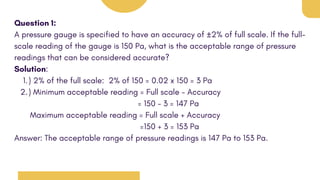
Question 1:
A pressuregauge is specified to have an accuracy of ±2% of full scale. If the full-
scale reading of the gauge is 150 Pa, what is the acceptable range of pressure
readings that can be considered accurate?
Solution:
) 2% of the full scale: 2% of 150 = 0.02 x 150 = 3 Pa
1.
) Minimum acceptable reading = Full scale - Accuracy
2.
= 150 - 3 = 147 Pa
Maximum acceptable reading = Full scale + Accuracy
=150 + 3 = 153 Pa
Answer: The acceptable range of pressure readings is 147 Pa to 153 Pa.
4.
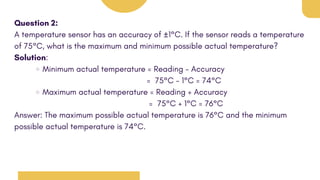
Question 2:
A temperaturesensor has an accuracy of ±1°C. If the sensor reads a temperature
of 75°C, what is the maximum and minimum possible actual temperature?
Solution:
Minimum actual temperature = Reading - Accuracy
= 75°C - 1°C = 74°C
Maximum actual temperature = Reading + Accuracy
= 75°C + 1°C = 76°C
Answer: The maximum possible actual temperature is 76°C and the minimum
possible actual temperature is 74°C.
5.
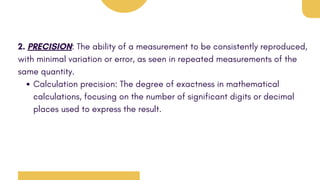
2. PRECISION: Theability of a measurement to be consistently reproduced,
with minimal variation or error, as seen in repeated measurements of the
same quantity.
Calculation precision: The degree of exactness in mathematical
calculations, focusing on the number of significant digits or decimal
places used to express the result.
6.
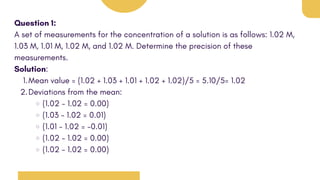
Question 1:
A setof measurements for the concentration of a solution is as follows: 1.02 M,
1.03 M, 1.01 M, 1.02 M, and 1.02 M. Determine the precision of these
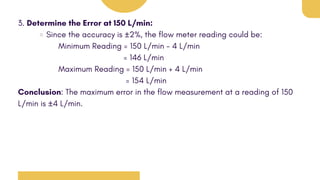
measurements.
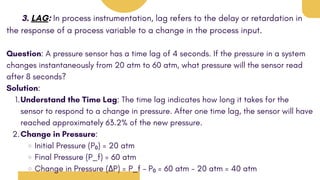
Solution:
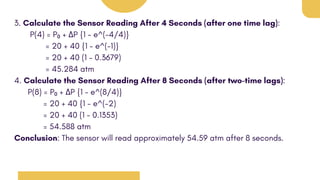
Mean value = (1.02 + 1.03 + 1.01 + 1.02 + 1.02)/5 = 5.10/5= 1.02
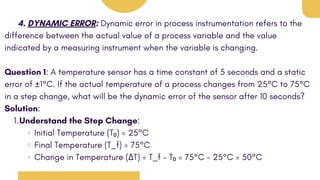
1.
Deviations from the mean:
2.
(1.02 - 1.02 = 0.00)
(1.03 - 1.02 = 0.01)
(1.01 - 1.02 = -0.01)
(1.02 - 1.02 = 0.00)
(1.02 - 1.02 = 0.00)
7.
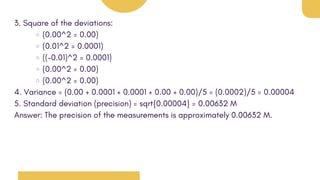
3. Square ofthe deviations:
(0.00^2 = 0.00)
(0.01^2 = 0.0001)
((-0.01)^2 = 0.0001)
(0.00^2 = 0.00)
(0.00^2 = 0.00)
4. Variance = (0.00 + 0.0001 + 0.0001 + 0.00 + 0.00)/5 = (0.0002)/5 = 0.00004
5. Standard deviation (precision) = sqrt{0.00004} = 0.00632 M
Answer: The precision of the measurements is approximately 0.00632 M.
8.
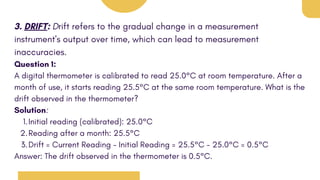
3. DRIFT: Driftrefers to the gradual change in a measurement
instrument's output over time, which can lead to measurement
inaccuracies.
Question 1:
A digital thermometer is calibrated to read 25.0°C at room temperature. After a
month of use, it starts reading 25.5°C at the same room temperature. What is the
drift observed in the thermometer?
Solution:
Initial reading (calibrated): 25.0°C
1.
Reading after a month: 25.5°C
2.
Drift = Current Reading - Initial Reading = 25.5°C - 25.0°C = 0.5°C
3.
Answer: The drift observed in the thermometer is 0.5°C.
9.
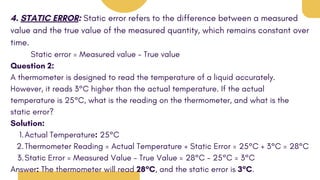
4. STATIC ERROR:Static error refers to the difference between a measured
value and the true value of the measured quantity, which remains constant over
time.
Static error = Measured value - True value
Question 2:
A thermometer is designed to read the temperature of a liquid accurately.
However, it reads 3°C higher than the actual temperature. If the actual
temperature is 25°C, what is the reading on the thermometer, and what is the
static error?
Solution:
Actual Temperature: 25°C
1.
Thermometer Reading = Actual Temperature + Static Error = 25°C + 3°C = 28°C
2.
Static Error = Measured Value - True Value = 28°C - 25°C = 3°C
3.
Answer: The thermometer will read 28°C, and the static error is 3°C.
10.
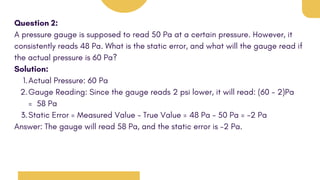
Question 2:
A pressuregauge is supposed to read 50 Pa at a certain pressure. However, it
consistently reads 48 Pa. What is the static error, and what will the gauge read if
the actual pressure is 60 Pa?
Solution:
Actual Pressure: 60 Pa
1.
Gauge Reading: Since the gauge reads 2 psi lower, it will read: (60 - 2)Pa
= 58 Pa
2.
Static Error = Measured Value - True Value = 48 Pa - 50 Pa = -2 Pa
3.
Answer: The gauge will read 58 Pa, and the static error is -2 Pa.
11.
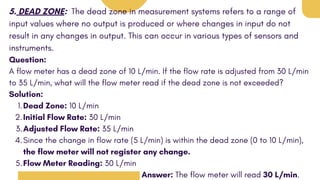
5. DEAD ZONE:The dead zone in measurement systems refers to a range of
input values where no output is produced or where changes in input do not
result in any changes in output. This can occur in various types of sensors and
instruments.
Question:
A flow meter has a dead zone of 10 L/min. If the flow rate is adjusted from 30 L/min
to 35 L/min, what will the flow meter read if the dead zone is not exceeded?
Solution:
Dead Zone: 10 L/min
1.
Initial Flow Rate: 30 L/min
2.
Adjusted Flow Rate: 35 L/min
3.
Since the change in flow rate (5 L/min) is within the dead zone (0 to 10 L/min),
the flow meter will not register any change.
4.
Flow Meter Reading: 30 L/min
5.
Answer: The flow meter will read 30 L/min.
12.
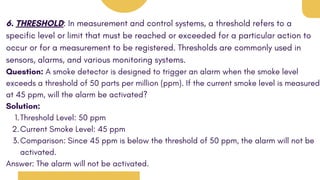
6. THRESHOLD: Inmeasurement and control systems, a threshold refers to a
specific level or limit that must be reached or exceeded for a particular action to
occur or for a measurement to be registered. Thresholds are commonly used in
sensors, alarms, and various monitoring systems.
Question: A smoke detector is designed to trigger an alarm when the smoke level
exceeds a threshold of 50 parts per million (ppm). If the current smoke level is measured
at 45 ppm, will the alarm be activated?
Solution:
Threshold Level: 50 ppm
1.
Current Smoke Level: 45 ppm
2.
Comparison: Since 45 ppm is below the threshold of 50 ppm, the alarm will not be
activated.
3.
Answer: The alarm will not be activated.
13.
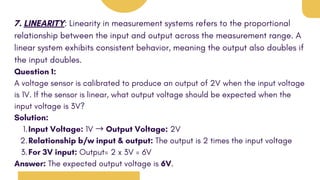
7. LINEARITY: Linearityin measurement systems refers to the proportional
relationship between the input and output across the measurement range. A
linear system exhibits consistent behavior, meaning the output also doubles if
the input doubles.
Question 1:
A voltage sensor is calibrated to produce an output of 2V when the input voltage
is 1V. If the sensor is linear, what output voltage should be expected when the
input voltage is 3V?
Solution:
Input Voltage: 1V → Output Voltage: 2V
1.
Relationship b/w input & output: The output is 2 times the input voltage
2.
For 3V input: Output= 2 x 3V = 6V
3.
Answer: The expected output voltage is 6V.
14.
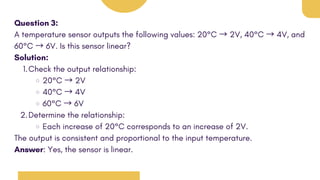
Question 3:
A temperaturesensor outputs the following values: 20°C → 2V, 40°C → 4V, and
60°C → 6V. Is this sensor linear?
Solution:
Check the output relationship:
1.
20°C → 2V
40°C → 4V
60°C → 6V
Determine the relationship:
2.
Each increase of 20°C corresponds to an increase of 2V.
The output is consistent and proportional to the input temperature.
Answer: Yes, the sensor is linear.
15.
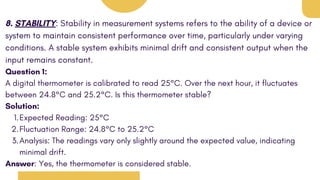
8. STABILITY: Stabilityin measurement systems refers to the ability of a device or
system to maintain consistent performance over time, particularly under varying
conditions. A stable system exhibits minimal drift and consistent output when the
input remains constant.
Question 1:
A digital thermometer is calibrated to read 25°C. Over the next hour, it fluctuates
between 24.8°C and 25.2°C. Is this thermometer stable?
Solution:
Expected Reading: 25°C
1.
Fluctuation Range: 24.8°C to 25.2°C
2.
Analysis: The readings vary only slightly around the expected value, indicating
minimal drift.
3.
Answer: Yes, the thermometer is considered stable.
16.
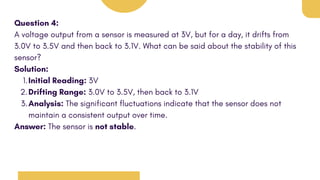
Question 4:
A voltageoutput from a sensor is measured at 3V, but for a day, it drifts from
3.0V to 3.5V and then back to 3.1V. What can be said about the stability of this
sensor?
Solution:
Initial Reading: 3V
1.
Drifting Range: 3.0V to 3.5V, then back to 3.1V
2.
Analysis: The significant fluctuations indicate that the sensor does not
maintain a consistent output over time.
3.
Answer: The sensor is not stable.
17.
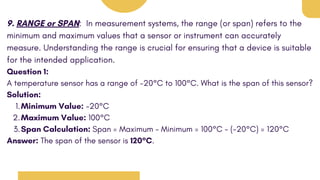
9. RANGE orSPAN: In measurement systems, the range (or span) refers to the
minimum and maximum values that a sensor or instrument can accurately
measure. Understanding the range is crucial for ensuring that a device is suitable
for the intended application.
Question 1:
A temperature sensor has a range of -20°C to 100°C. What is the span of this sensor?
Solution:
Minimum Value: -20°C
1.
Maximum Value: 100°C
2.
Span Calculation: Span = Maximum - Minimum = 100°C - (-20°C) = 120°C
3.
Answer: The span of the sensor is 120°C.
18.
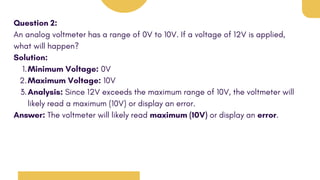
Question 2:
An analogvoltmeter has a range of 0V to 10V. If a voltage of 12V is applied,
what will happen?
Solution:
Minimum Voltage: 0V
1.
Maximum Voltage: 10V
2.
Analysis: Since 12V exceeds the maximum range of 10V, the voltmeter will
likely read a maximum (10V) or display an error.
3.
Answer: The voltmeter will likely read maximum (10V) or display an error.
19.
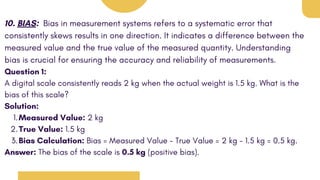
10. BIAS: Biasin measurement systems refers to a systematic error that
consistently skews results in one direction. It indicates a difference between the
measured value and the true value of the measured quantity. Understanding
bias is crucial for ensuring the accuracy and reliability of measurements.
Question 1:
A digital scale consistently reads 2 kg when the actual weight is 1.5 kg. What is the
bias of this scale?
Solution:
Measured Value: 2 kg
1.
True Value: 1.5 kg
2.
Bias Calculation: Bias = Measured Value - True Value = 2 kg - 1.5 kg = 0.5 kg.
3.
Answer: The bias of the scale is 0.5 kg (positive bias).
20.
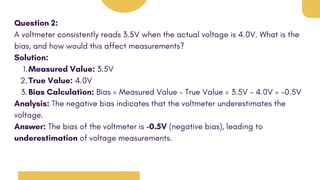
Question 2:
A voltmeterconsistently reads 3.5V when the actual voltage is 4.0V. What is the
bias, and how would this affect measurements?
Solution:
Measured Value: 3.5V
1.
True Value: 4.0V
2.
Bias Calculation: Bias = Measured Value - True Value = 3.5V - 4.0V = -0.5V
3.
Analysis: The negative bias indicates that the voltmeter underestimates the
voltage.
Answer: The bias of the voltmeter is -0.5V (negative bias), leading to
underestimation of voltage measurements.
21.
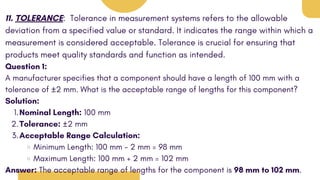
11. TOLERANCE: Tolerancein measurement systems refers to the allowable
deviation from a specified value or standard. It indicates the range within which a
measurement is considered acceptable. Tolerance is crucial for ensuring that
products meet quality standards and function as intended.
Question 1:
A manufacturer specifies that a component should have a length of 100 mm with a
tolerance of ±2 mm. What is the acceptable range of lengths for this component?
Solution:
Nominal Length: 100 mm
1.
Tolerance: ±2 mm
2.
Acceptable Range Calculation:
3.
Minimum Length: 100 mm - 2 mm = 98 mm
Maximum Length: 100 mm + 2 mm = 102 mm
Answer: The acceptable range of lengths for the component is 98 mm to 102 mm.
22.
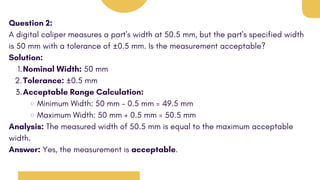
Question 2:
A digitalcaliper measures a part's width at 50.5 mm, but the part's specified width
is 50 mm with a tolerance of ±0.5 mm. Is the measurement acceptable?
Solution:
Nominal Width: 50 mm
1.
Tolerance: ±0.5 mm
2.
Acceptable Range Calculation:
3.
Minimum Width: 50 mm - 0.5 mm = 49.5 mm
Maximum Width: 50 mm + 0.5 mm = 50.5 mm
Analysis: The measured width of 50.5 mm is equal to the maximum acceptable
width.
Answer: Yes, the measurement is acceptable.
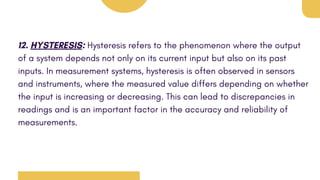
23.
12. HYSTERESIS: Hysteresisrefers to the phenomenon where the output
of a system depends not only on its current input but also on its past
inputs. In measurement systems, hysteresis is often observed in sensors
and instruments, where the measured value differs depending on whether
the input is increasing or decreasing. This can lead to discrepancies in
readings and is an important factor in the accuracy and reliability of
measurements.
24.
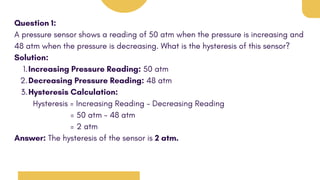
Question 1:
A pressuresensor shows a reading of 50 atm when the pressure is increasing and
48 atm when the pressure is decreasing. What is the hysteresis of this sensor?
Solution:
Increasing Pressure Reading: 50 atm
1.
Decreasing Pressure Reading: 48 atm
2.
Hysteresis Calculation:
3.
Hysteresis = Increasing Reading - Decreasing Reading
= 50 atm - 48 atm
= 2 atm
Answer: The hysteresis of the sensor is 2 atm.
25.
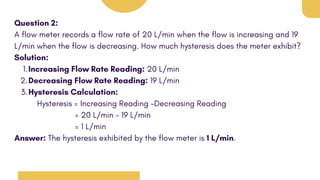
Question 2:
A flowmeter records a flow rate of 20 L/min when the flow is increasing and 19
L/min when the flow is decreasing. How much hysteresis does the meter exhibit?
Solution:
Increasing Flow Rate Reading: 20 L/min
1.
Decreasing Flow Rate Reading: 19 L/min
2.
Hysteresis Calculation:
3.
Hysteresis = Increasing Reading -Decreasing Reading
= 20 L/min - 19 L/min
= 1 L/min
Answer: The hysteresis exhibited by the flow meter is 1 L/min.
26.
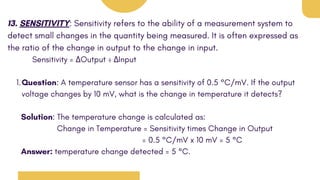
13. SENSITIVITY: Sensitivityrefers to the ability of a measurement system to
detect small changes in the quantity being measured. It is often expressed as
the ratio of the change in output to the change in input.
Sensitivity = ΔOutput ÷ ΔInput
Question: A temperature sensor has a sensitivity of 0.5 °C/mV. If the output
voltage changes by 10 mV, what is the change in temperature it detects?
1.
Solution: The temperature change is calculated as:
Change in Temperature = Sensitivity times Change in Output
= 0.5 °C/mV x 10 mV = 5 °C
Answer: temperature change detected = 5 °C.
27.
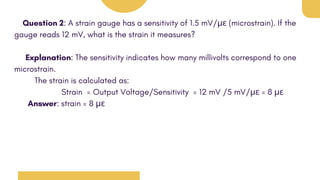
Question 2: Astrain gauge has a sensitivity of 1.5 mV/με (microstrain). If the
gauge reads 12 mV, what is the strain it measures?
Explanation: The sensitivity indicates how many millivolts correspond to one
microstrain.
The strain is calculated as:
Strain = Output Voltage/Sensitivity = 12 mV /5 mV/με = 8 με
Answer: strain = 8 με
28.
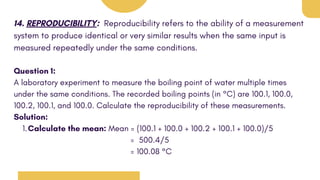
14. REPRODUCIBILITY: Reproducibilityrefers to the ability of a measurement
system to produce identical or very similar results when the same input is
measured repeatedly under the same conditions.
Question 1:
A laboratory experiment to measure the boiling point of water multiple times
under the same conditions. The recorded boiling points (in °C) are 100.1, 100.0,
100.2, 100.1, and 100.0. Calculate the reproducibility of these measurements.
Solution:
Calculate the mean: Mean = (100.1 + 100.0 + 100.2 + 100.1 + 100.0)/5
1.
= 500.4/5
= 100.08 °C
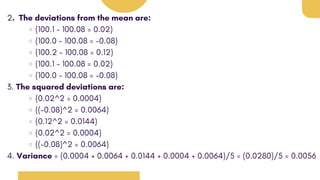
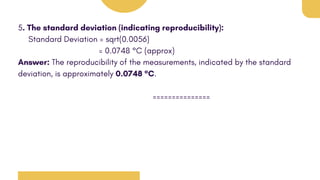
5. The standarddeviation (indicating reproducibility):
Standard Deviation = sqrt(0.0056)
= 0.0748 °C (approx)
Answer: The reproducibility of the measurements, indicated by the standard
deviation, is approximately 0.0748 °C.
===============
31.
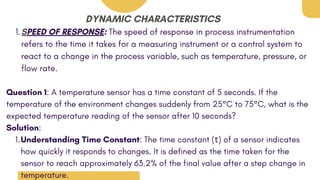
DYNAMIC CHARACTERISTICS
SPEED OFRESPONSE: The speed of response in process instrumentation
refers to the time it takes for a measuring instrument or a control system to
react to a change in the process variable, such as temperature, pressure, or
flow rate.
1.
Question 1: A temperature sensor has a time constant of 5 seconds. If the
temperature of the environment changes suddenly from 25°C to 75°C, what is the
expected temperature reading of the sensor after 10 seconds?
Solution:
Understanding Time Constant: The time constant (τ) of a sensor indicates
how quickly it responds to changes. It is defined as the time taken for the
sensor to reach approximately 63.2% of the final value after a step change in
temperature.
1.
32.
2. Final TemperatureChange:
Initial Temperature (T₀) = 25°C
Final Temperature (T_f) = 75°C
Change in Temperature (ΔT) = T_f - T₀ = 75°C - 25°C = 50°C
3. Temperature Reading After 10 Seconds: The response of the sensor can be
modeled using the first-order response equation:
T(t) = T₀ + (T_f - T₀) [1 - e^(-t/τ)]
Where:
(T(t)) = Temperature reading at time (t)
(T₀) = Initial temperature
(T_f) = Final temperature
(e) = Base of natural logarithm (approximately 2.718)
(t) = Time in seconds
(τ) = Time constant
33.
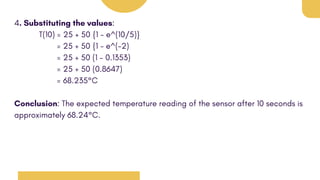
4. Substituting thevalues:
T(10) = 25 + 50 {1 - e^(10/5)}
= 25 + 50 {1 - e^(-2)
= 25 + 50 (1 - 0.1353)
= 25 + 50 (0.8647)
= 68.235°C
Conclusion: The expected temperature reading of the sensor after 10 seconds is
approximately 68.24°C.
34.
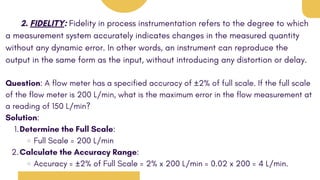
2. FIDELITY: Fidelityin process instrumentation refers to the degree to which
a measurement system accurately indicates changes in the measured quantity
without any dynamic error. In other words, an instrument can reproduce the
output in the same form as the input, without introducing any distortion or delay.
Question: A flow meter has a specified accuracy of ±2% of full scale. If the full scale
of the flow meter is 200 L/min, what is the maximum error in the flow measurement at
a reading of 150 L/min?
Solution:
Determine the Full Scale:
1.
Full Scale = 200 L/min
Calculate the Accuracy Range:
2.
Accuracy = ±2% of Full Scale = 2% x 200 L/min = 0.02 x 200 = 4 L/min.
35.
3. Determine theError at 150 L/min:
Since the accuracy is ±2%, the flow meter reading could be:
Minimum Reading = 150 L/min - 4 L/min
= 146 L/min
Maximum Reading = 150 L/min + 4 L/min
= 154 L/min
Conclusion: The maximum error in the flow measurement at a reading of 150
L/min is ±4 L/min.
36.
3. LAG: Inprocess instrumentation, lag refers to the delay or retardation in
the response of a process variable to a change in the process input.
Question: A pressure sensor has a time lag of 4 seconds. If the pressure in a system
changes instantaneously from 20 atm to 60 atm, what pressure will the sensor read
after 8 seconds?
Solution:
Understand the Time Lag: The time lag indicates how long it takes for the
sensor to respond to a change in pressure. After one time lag, the sensor will have
reached approximately 63.2% of the new pressure.
1.
Change in Pressure:
2.
Initial Pressure (P₀) = 20 atm
Final Pressure (P_f) = 60 atm
Change in Pressure (ΔP) = P_f - P₀ = 60 atm - 20 atm = 40 atm
37.
3. Calculate theSensor Reading After 4 Seconds (after one time lag):
P(4) = P₀ + ΔP {1 - e^(-4/4)}
= 20 + 40 {1 - e^(-1)}
= 20 + 40 (1 - 0.3679)
= 45.284 atm
4. Calculate the Sensor Reading After 8 Seconds (after two-time lags):
P(8) = P₀ + ΔP {1 - e^(8/4)}
= 20 + 40 {1 - e^(-2)
= 20 + 40 (1 - 0.1353)
= 54.588 atm
Conclusion: The sensor will read approximately 54.59 atm after 8 seconds.
38.
4. DYNAMIC ERROR:Dynamic error in process instrumentation refers to the
difference between the actual value of a process variable and the value
indicated by a measuring instrument when the variable is changing.
Question 1: A temperature sensor has a time constant of 5 seconds and a static
error of ±1°C. If the actual temperature of a process changes from 25°C to 75°C
in a step change, what will be the dynamic error of the sensor after 10 seconds?
Solution:
Understand the Step Change:
1.
Initial Temperature (T₀) = 25°C
Final Temperature (T_f) = 75°C
Change in Temperature (ΔT) = T_f - T₀ = 75°C - 25°C = 50°C
39.
2. Calculate theSensor Reading After 10 Seconds: Using the first-order response
equation: T(t) = T₀ + (T_f - T₀) [1 - e^(-t/τ)]
Where (τ) = 5 seconds and (t) = 10 seconds
T(10) = 25 + 50 {1 - e^(-10/5)}
= 25 + 50 {1 - e^{-2)}
= 68.235°C
3. Calculate the Dynamic Error:
Actual Temperature after 10 seconds = 75°C
Sensor Reading after 10 seconds = 68.235°C
Dynamic Error = Actual Temperature - Sensor Reading
= 75°C - 68.235°C
= 6.765°C
Conclusion: The dynamic error of the sensor after 10 seconds is approximately
6.77°C.


![2. Final Temperature Change:
Initial Temperature (T₀) = 25°C
Final Temperature (T_f) = 75°C
Change in Temperature (ΔT) = T_f - T₀ = 75°C - 25°C = 50°C
3. Temperature Reading After 10 Seconds: The response of the sensor can be
modeled using the first-order response equation:
T(t) = T₀ + (T_f - T₀) [1 - e^(-t/τ)]
Where:
(T(t)) = Temperature reading at time (t)
(T₀) = Initial temperature
(T_f) = Final temperature
(e) = Base of natural logarithm (approximately 2.718)
(t) = Time in seconds
(τ) = Time constant](https://image.slidesharecdn.com/pipresentation2-250328194805-654e757b/85/PI-presentation2-pdf-process-instrumentation-32-320.jpg)
![2. Calculate the Sensor Reading After 10 Seconds: Using the first-order response
equation: T(t) = T₀ + (T_f - T₀) [1 - e^(-t/τ)]
Where (τ) = 5 seconds and (t) = 10 seconds
T(10) = 25 + 50 {1 - e^(-10/5)}
= 25 + 50 {1 - e^{-2)}
= 68.235°C
3. Calculate the Dynamic Error:
Actual Temperature after 10 seconds = 75°C
Sensor Reading after 10 seconds = 68.235°C
Dynamic Error = Actual Temperature - Sensor Reading
= 75°C - 68.235°C
= 6.765°C
Conclusion: The dynamic error of the sensor after 10 seconds is approximately
6.77°C.](https://image.slidesharecdn.com/pipresentation2-250328194805-654e757b/85/PI-presentation2-pdf-process-instrumentation-39-320.jpg)