CSE 221: Probabilistic Analysis of Computer Systems
Topics covered:
Course outline and schedule
Introduction
Event Algebra
(Sec. 1.1-1.4)
General information
CSE 221 : Probabilistic Analysis of Computer Systems
Instructor : Swapna S. Gokhale
Phone : 6-2772.
Email : ssg@engr.uconn.edu
Office : ITEB 237
Lecture time : Mon/Fri 11:00 – 12:15 pm
Office hours : By appointment
(I will hang around for a few minutes at the end of
each class).
Web page : http://www.engr.uconn.edu/~ssg/cse221.html
(Lecture notes, homeworks, and general announcements
will be posted on the web page)
TA : Narasimha Shashidhar
Course goals
 Appreciation and motivation for the study of probability
theory.
 Definition of a probability model
 Application of discrete and continuous random variables
 Computation of expectation and moments
 Application of discrete and continuous time Markov chains.
 Estimation of parameters of a distribution.
 Testing hypothesis on distribution parameters
Expected learning outcomes
 Sample space and events:
 Define a sample space (outcomes) of a random experiment and
identify events of interest and independent events on the sample
space.
 Compute conditional and posterior probabilities using Bayes rule.
 Identify and compute probabilities for a sequence of Bernoulli
trials.
 Discrete random variables:
 Define a discrete random variable on a sample space along with
the associated probability mass function.
 Compute the distribution function of a discrete random variable.
 Apply special discrete random variables to real-life problems.
 Compute the probability generating function of a discrete random
variable.
 Compute joint pmf of a vector of discrete random variables.
 Determine if a set of random variables are independent.
Expected learning outcomes (contd..)
 Continuous random variables:
 Define general distribution and density functions.
 Apply special continuous random variables to real problems.
 Define and apply the concepts of reliability, conditional failure
rate, hazard rate and inverse bath-tub curve.
 Expectation and moments:
 Obtain the expectation, moments and transforms of special and
general random variables.
 Stochastic processes:
 Define and classify stochastic processes.
 Derive the metrics for Bernoulli and Poisson processes.
Expected learning outcomes (contd..)
 Discrete time Markov chains:
 Define the state space, state transitions and transition
probability matrix
 Compute the steady state probabilities.
 Analyze the performance and reliability of a software
application based on its architecture.
 Statistical inference:
 Understand the role of statistical inference in applying
probability theory.
 Derive the maximum likelihood estimators for general and
special random variables.
 Test two-sided hypothesis concerning the mean of a random
variable.
Expected learning outcomes (contd..)
 Continuous time Markov chains:
 Define the state space, state transitions and generator matrix.
 Compute the steady state or limiting probabilities.
 Model real world phenomenon as birth-death processes and
compute limiting probabilities.
 Model real world phenomenon as pure birth, and pure death
processes.
 Model and compute system availability.
Textbooks
Required text book:
1. K. S. Trivedi, Probability and Statistics with Reliability, Queuing and
Computer Science Applications, Second Edition, John Wiley.
Course topics
 Introduction (Ch. 1, Sec. 1.1-1.5, 1.7-1.11):
 Sample space and events, Event algebra, Probability axioms,
Combinatorial problems, Independent events, Bayes rule,
Bernoulli trials
 Discrete random variables (Ch. 2, Sec. 2.1-2.4, 2.5.1-2.5.3,
2.5.5,2.5.7,2.7-2.9):
 Definition of a discrete random variable, Probability mass and
distribution functions, Bernoulli, Binomial, Geometric, Modified
Geometric, and Poisson, Uniform pmfs, Probability generating
function, Discrete random vectors, Independent events.
 Continuous random variables (Ch. 3, Sec. 3.1-3.3, 3.4.6,3.4.7):
 Probability density function and cumulative distribution
functions, Exponential and uniform distributions, Reliability and
failure rate, Normal distribution
Course topics (contd..)
 Expectation (Ch. 4, Sec. 4.1-4.4, 4.5.2-4.5.7):
 Expectation of single and multiple random variables, Moments
and transforms
 Stochastic processes (Ch. 6, Sec. 6.1, 6.3 and 6.4)
 Definition and classification of stochastic processes, Bernoulli
and Poisson processes.
 Discrete time Markov chains (Ch. 7, Sec. 7.1-7.3):
 Definition, transition probabilities, steady state concept.
Application of discrete time Markov chains to software
performance and reliability analysis
 Statistical inference (Ch. 10, Sec. 10.1, 10.2.2, 10.3.1):
 Motivation, Maximum likelihood estimates for the parameters
of Bernoulli, Binomial, Geometric, Poisson, Exponential and
Normal distributions, Parameter estimation of Discrete Time
Markov Chains (DTMCs), Hypothesis testing.
Course topics (contd..)
 Continuous time Markov chains (Ch. 8, Sec. 8.1-8.3, 8.4.1):
 Definition, Generator matrix, Computation of steady
state/limiting probabilities, Birth-death process, M/M/1 and
M/M/m queues, Pure birth and pure death process, Availability
analysis.
Course topics and exams calendar
Week #1 (Jan. 21):
1. Jan 25: Logistics, Introduction, Sample Space, Events, Event algebra
Week #2 (Jan. 28):
2. Jan 28: Probability axioms, combinatorial problems
3. Feb. 1: Conditional probability, Independent events, Bayes rule, Bernoulli trials
Week #3 (Feb. 4):
4. Feb. 4: Discrete random variables, Probability mass and Distribution function.
5. Feb. 8: Special discrete distributions
Week #4 (Feb. 11):
6. Feb. 11: Poisson pmf, Uniform pmf, Probability Generating Function
7. Feb. 15: Discrete random vectors, Independent random variables
Week #5 (Feb. 18):
8. Feb. 18: Continuous random variables, Uniform and Normal distributions
9. Feb. 22: Exponential distribution, reliability and failure rate
Course topics and exams calendar (contd..)
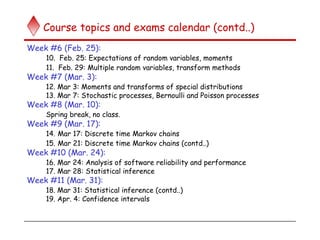
Week #6 (Feb. 25):
10. Feb. 25: Expectations of random variables, moments
11. Feb. 29: Multiple random variables, transform methods
Week #7 (Mar. 3):
12. Mar 3: Moments and transforms of special distributions
13. Mar 7: Stochastic processes, Bernoulli and Poisson processes
Week #8 (Mar. 10):
Spring break, no class.
Week #9 (Mar. 17):
14. Mar 17: Discrete time Markov chains
15. Mar 21: Discrete time Markov chains (contd..)
Week #10 (Mar. 24):
16. Mar 24: Analysis of software reliability and performance
17. Mar 28: Statistical inference
Week #11 (Mar. 31):
18. Mar 31: Statistical inference (contd..)
19. Apr. 4: Confidence intervals
Course topics and exams calendar (contd..)
Week #12 (Apr. 7):
20. Apr. 7: Hypothesis testing
21. Apr. 11: Hypothesis testing (contd..)
Week #13 (Apr. 13):
Apr. 14: No class
22. Apr. 18: Continuous time Markov chains
Week #14: (Apr. 20)
23. Apr. 21: Simple queuing models
24. Apr. 25: Pure death processes, availability models
Week #15: (Apr. 27)
Apr. 27: Make up class
May 2: Final exam handed.
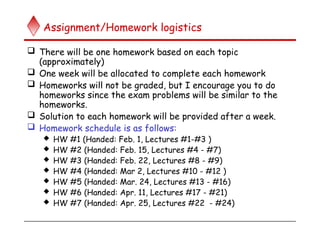
Assignment/Homework logistics
 There will be one homework based on each topic
(approximately)
 One week will be allocated to complete each homework
 Homeworks will not be graded, but I encourage you to do
homeworks since the exam problems will be similar to the
homeworks.
 Solution to each homework will be provided after a week.
 Homework schedule is as follows:
 HW #1 (Handed: Feb. 1, Lectures #1-#3 )
 HW #2 (Handed: Feb. 15, Lectures #4 - #7)
 HW #3 (Handed: Feb. 22, Lectures #8 - #9)
 HW #4 (Handed: Mar 2, Lectures #10 - #12 )
 HW #5 (Handed: Mar. 24, Lectures #13 - #16)
 HW #6 (Handed: Apr. 11, Lectures #17 - #21)
 HW #7 (Handed: Apr. 25, Lectures #22 - #24)
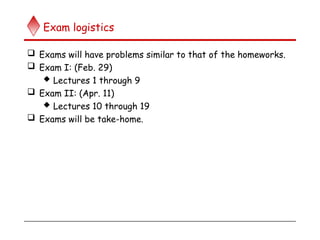
Exam logistics
 Exams will have problems similar to that of the homeworks.
 Exam I: (Feb. 29)
 Lectures 1 through 9
 Exam II: (Apr. 11)
 Lectures 10 through 19
 Exams will be take-home.
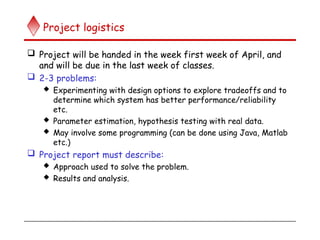
Project logistics
 Project will be handed in the week first week of April, and
and will be due in the last week of classes.
 2-3 problems:
 Experimenting with design options to explore tradeoffs and to
determine which system has better performance/reliability
etc.
 Parameter estimation, hypothesis testing with real data.
 May involve some programming (can be done using Java, Matlab
etc.)
 Project report must describe:
 Approach used to solve the problem.
 Results and analysis.
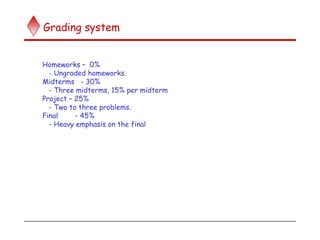
Grading system
Homeworks – 0%
- Ungraded homeworks.
Midterms - 30%
- Three midterms, 15% per midterm
Project – 25%
- Two to three problems.
Final - 45%
- Heavy emphasis on the final
Attendance policy
 Attendance not mandatory.
 Attending classes helps!
 Many examples, derivations (not in the book) in the class
 Problems, examples covered in the class fair game for the
exams.
 Everything not in the lecture notes
Feedback
Please provide informal feedback early and often, before the formal
review process.
Introduction and motivation
 Why study probability theory?
 Answer questions such as:
Probability model
 Examples of random/chance phenomenon:
 What is a probability model?
Sample space
 Definition:
 Example: Status of a computer system
 Example: Status of two components: CPU, Memory
 Example: Outcomes of three coin tosses
Types of sample space
 Based on the number of elements in the sample space:
 Example: Coin toss
 Countably finite/infinite
 Countably infinite
Events
 Definition of an event:
 Example: Sequence of three coin tosses:
 Example: System up.
Events (contd..)
 Universal event
 Null event
 Elementary event
Example
 Sequence of three coin tosses:
 Event E1 – at least two heads
 Complement of event E1 – at most one head (zero or one
head)
 Event E2 – at most two heads
Example (contd..)
 Event E3 – Intersection of events E1 and E2.
 Event E4 – First coin toss is a head
 Event E5 – Union of events E1 and E4
 Mutually exclusive events
Example (contd..)
 Collectively exhaustive events:
 Defining each sample point to be an event

Probabilistic analysis of computer systems

  • 1.
    CSE 221: ProbabilisticAnalysis of Computer Systems Topics covered: Course outline and schedule Introduction Event Algebra (Sec. 1.1-1.4)
  • 2.
    General information CSE 221: Probabilistic Analysis of Computer Systems Instructor : Swapna S. Gokhale Phone : 6-2772. Email : ssg@engr.uconn.edu Office : ITEB 237 Lecture time : Mon/Fri 11:00 – 12:15 pm Office hours : By appointment (I will hang around for a few minutes at the end of each class). Web page : http://www.engr.uconn.edu/~ssg/cse221.html (Lecture notes, homeworks, and general announcements will be posted on the web page) TA : Narasimha Shashidhar
  • 3.
    Course goals  Appreciationand motivation for the study of probability theory.  Definition of a probability model  Application of discrete and continuous random variables  Computation of expectation and moments  Application of discrete and continuous time Markov chains.  Estimation of parameters of a distribution.  Testing hypothesis on distribution parameters
  • 4.
    Expected learning outcomes Sample space and events:  Define a sample space (outcomes) of a random experiment and identify events of interest and independent events on the sample space.  Compute conditional and posterior probabilities using Bayes rule.  Identify and compute probabilities for a sequence of Bernoulli trials.  Discrete random variables:  Define a discrete random variable on a sample space along with the associated probability mass function.  Compute the distribution function of a discrete random variable.  Apply special discrete random variables to real-life problems.  Compute the probability generating function of a discrete random variable.  Compute joint pmf of a vector of discrete random variables.  Determine if a set of random variables are independent.
  • 5.
    Expected learning outcomes(contd..)  Continuous random variables:  Define general distribution and density functions.  Apply special continuous random variables to real problems.  Define and apply the concepts of reliability, conditional failure rate, hazard rate and inverse bath-tub curve.  Expectation and moments:  Obtain the expectation, moments and transforms of special and general random variables.  Stochastic processes:  Define and classify stochastic processes.  Derive the metrics for Bernoulli and Poisson processes.
  • 6.
    Expected learning outcomes(contd..)  Discrete time Markov chains:  Define the state space, state transitions and transition probability matrix  Compute the steady state probabilities.  Analyze the performance and reliability of a software application based on its architecture.  Statistical inference:  Understand the role of statistical inference in applying probability theory.  Derive the maximum likelihood estimators for general and special random variables.  Test two-sided hypothesis concerning the mean of a random variable.
  • 7.
    Expected learning outcomes(contd..)  Continuous time Markov chains:  Define the state space, state transitions and generator matrix.  Compute the steady state or limiting probabilities.  Model real world phenomenon as birth-death processes and compute limiting probabilities.  Model real world phenomenon as pure birth, and pure death processes.  Model and compute system availability.
  • 8.
    Textbooks Required text book: 1.K. S. Trivedi, Probability and Statistics with Reliability, Queuing and Computer Science Applications, Second Edition, John Wiley.
  • 9.
    Course topics  Introduction(Ch. 1, Sec. 1.1-1.5, 1.7-1.11):  Sample space and events, Event algebra, Probability axioms, Combinatorial problems, Independent events, Bayes rule, Bernoulli trials  Discrete random variables (Ch. 2, Sec. 2.1-2.4, 2.5.1-2.5.3, 2.5.5,2.5.7,2.7-2.9):  Definition of a discrete random variable, Probability mass and distribution functions, Bernoulli, Binomial, Geometric, Modified Geometric, and Poisson, Uniform pmfs, Probability generating function, Discrete random vectors, Independent events.  Continuous random variables (Ch. 3, Sec. 3.1-3.3, 3.4.6,3.4.7):  Probability density function and cumulative distribution functions, Exponential and uniform distributions, Reliability and failure rate, Normal distribution
  • 10.
    Course topics (contd..) Expectation (Ch. 4, Sec. 4.1-4.4, 4.5.2-4.5.7):  Expectation of single and multiple random variables, Moments and transforms  Stochastic processes (Ch. 6, Sec. 6.1, 6.3 and 6.4)  Definition and classification of stochastic processes, Bernoulli and Poisson processes.  Discrete time Markov chains (Ch. 7, Sec. 7.1-7.3):  Definition, transition probabilities, steady state concept. Application of discrete time Markov chains to software performance and reliability analysis  Statistical inference (Ch. 10, Sec. 10.1, 10.2.2, 10.3.1):  Motivation, Maximum likelihood estimates for the parameters of Bernoulli, Binomial, Geometric, Poisson, Exponential and Normal distributions, Parameter estimation of Discrete Time Markov Chains (DTMCs), Hypothesis testing.
  • 11.
    Course topics (contd..) Continuous time Markov chains (Ch. 8, Sec. 8.1-8.3, 8.4.1):  Definition, Generator matrix, Computation of steady state/limiting probabilities, Birth-death process, M/M/1 and M/M/m queues, Pure birth and pure death process, Availability analysis.
  • 12.
    Course topics andexams calendar Week #1 (Jan. 21): 1. Jan 25: Logistics, Introduction, Sample Space, Events, Event algebra Week #2 (Jan. 28): 2. Jan 28: Probability axioms, combinatorial problems 3. Feb. 1: Conditional probability, Independent events, Bayes rule, Bernoulli trials Week #3 (Feb. 4): 4. Feb. 4: Discrete random variables, Probability mass and Distribution function. 5. Feb. 8: Special discrete distributions Week #4 (Feb. 11): 6. Feb. 11: Poisson pmf, Uniform pmf, Probability Generating Function 7. Feb. 15: Discrete random vectors, Independent random variables Week #5 (Feb. 18): 8. Feb. 18: Continuous random variables, Uniform and Normal distributions 9. Feb. 22: Exponential distribution, reliability and failure rate
  • 13.
    Course topics andexams calendar (contd..) Week #6 (Feb. 25): 10. Feb. 25: Expectations of random variables, moments 11. Feb. 29: Multiple random variables, transform methods Week #7 (Mar. 3): 12. Mar 3: Moments and transforms of special distributions 13. Mar 7: Stochastic processes, Bernoulli and Poisson processes Week #8 (Mar. 10): Spring break, no class. Week #9 (Mar. 17): 14. Mar 17: Discrete time Markov chains 15. Mar 21: Discrete time Markov chains (contd..) Week #10 (Mar. 24): 16. Mar 24: Analysis of software reliability and performance 17. Mar 28: Statistical inference Week #11 (Mar. 31): 18. Mar 31: Statistical inference (contd..) 19. Apr. 4: Confidence intervals
  • 14.
    Course topics andexams calendar (contd..) Week #12 (Apr. 7): 20. Apr. 7: Hypothesis testing 21. Apr. 11: Hypothesis testing (contd..) Week #13 (Apr. 13): Apr. 14: No class 22. Apr. 18: Continuous time Markov chains Week #14: (Apr. 20) 23. Apr. 21: Simple queuing models 24. Apr. 25: Pure death processes, availability models Week #15: (Apr. 27) Apr. 27: Make up class May 2: Final exam handed.
  • 15.
    Assignment/Homework logistics  Therewill be one homework based on each topic (approximately)  One week will be allocated to complete each homework  Homeworks will not be graded, but I encourage you to do homeworks since the exam problems will be similar to the homeworks.  Solution to each homework will be provided after a week.  Homework schedule is as follows:  HW #1 (Handed: Feb. 1, Lectures #1-#3 )  HW #2 (Handed: Feb. 15, Lectures #4 - #7)  HW #3 (Handed: Feb. 22, Lectures #8 - #9)  HW #4 (Handed: Mar 2, Lectures #10 - #12 )  HW #5 (Handed: Mar. 24, Lectures #13 - #16)  HW #6 (Handed: Apr. 11, Lectures #17 - #21)  HW #7 (Handed: Apr. 25, Lectures #22 - #24)
  • 16.
    Exam logistics  Examswill have problems similar to that of the homeworks.  Exam I: (Feb. 29)  Lectures 1 through 9  Exam II: (Apr. 11)  Lectures 10 through 19  Exams will be take-home.
  • 17.
    Project logistics  Projectwill be handed in the week first week of April, and and will be due in the last week of classes.  2-3 problems:  Experimenting with design options to explore tradeoffs and to determine which system has better performance/reliability etc.  Parameter estimation, hypothesis testing with real data.  May involve some programming (can be done using Java, Matlab etc.)  Project report must describe:  Approach used to solve the problem.  Results and analysis.
  • 18.
    Grading system Homeworks –0% - Ungraded homeworks. Midterms - 30% - Three midterms, 15% per midterm Project – 25% - Two to three problems. Final - 45% - Heavy emphasis on the final
  • 19.
    Attendance policy  Attendancenot mandatory.  Attending classes helps!  Many examples, derivations (not in the book) in the class  Problems, examples covered in the class fair game for the exams.  Everything not in the lecture notes
  • 20.
    Feedback Please provide informalfeedback early and often, before the formal review process.
  • 21.
    Introduction and motivation Why study probability theory?  Answer questions such as:
  • 22.
    Probability model  Examplesof random/chance phenomenon:  What is a probability model?
  • 23.
    Sample space  Definition: Example: Status of a computer system  Example: Status of two components: CPU, Memory  Example: Outcomes of three coin tosses
  • 24.
    Types of samplespace  Based on the number of elements in the sample space:  Example: Coin toss  Countably finite/infinite  Countably infinite
  • 25.
    Events  Definition ofan event:  Example: Sequence of three coin tosses:  Example: System up.
  • 26.
    Events (contd..)  Universalevent  Null event  Elementary event
  • 27.
    Example  Sequence ofthree coin tosses:  Event E1 – at least two heads  Complement of event E1 – at most one head (zero or one head)  Event E2 – at most two heads
  • 28.
    Example (contd..)  EventE3 – Intersection of events E1 and E2.  Event E4 – First coin toss is a head  Event E5 – Union of events E1 and E4  Mutually exclusive events
  • 29.
    Example (contd..)  Collectivelyexhaustive events:  Defining each sample point to be an event