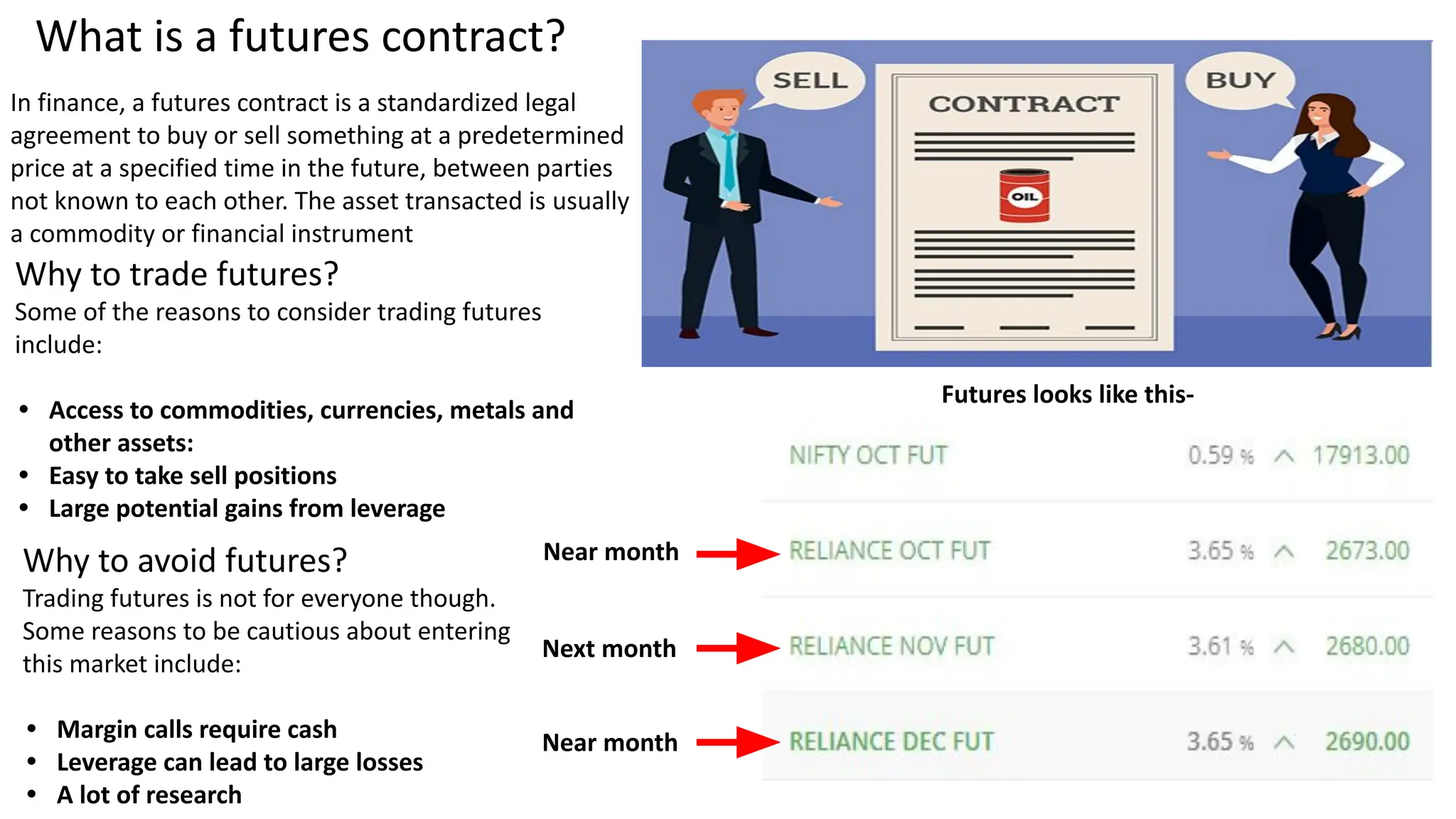
What is afutures contract?
In finance, a futures contract is a standardized legal
agreement to buy or sell something at a predetermined
price at a specified time in the future, between parties
not known to each other. The asset transacted is usually
a commodity or financial instrument
Why to trade futures?
Some of the reasons to consider trading futures
include:
• Access to commodities, currencies, metals and
other assets:
• Easy to take sell positions
• Large potential gains from leverage
Why to avoid futures?
Trading futures is not for everyone though.
Some reasons to be cautious about entering
this market include:
• Margin calls require cash
• Leverage can lead to large losses
• A lot of research
Futures looks like this-
Near month
Next month
Near month
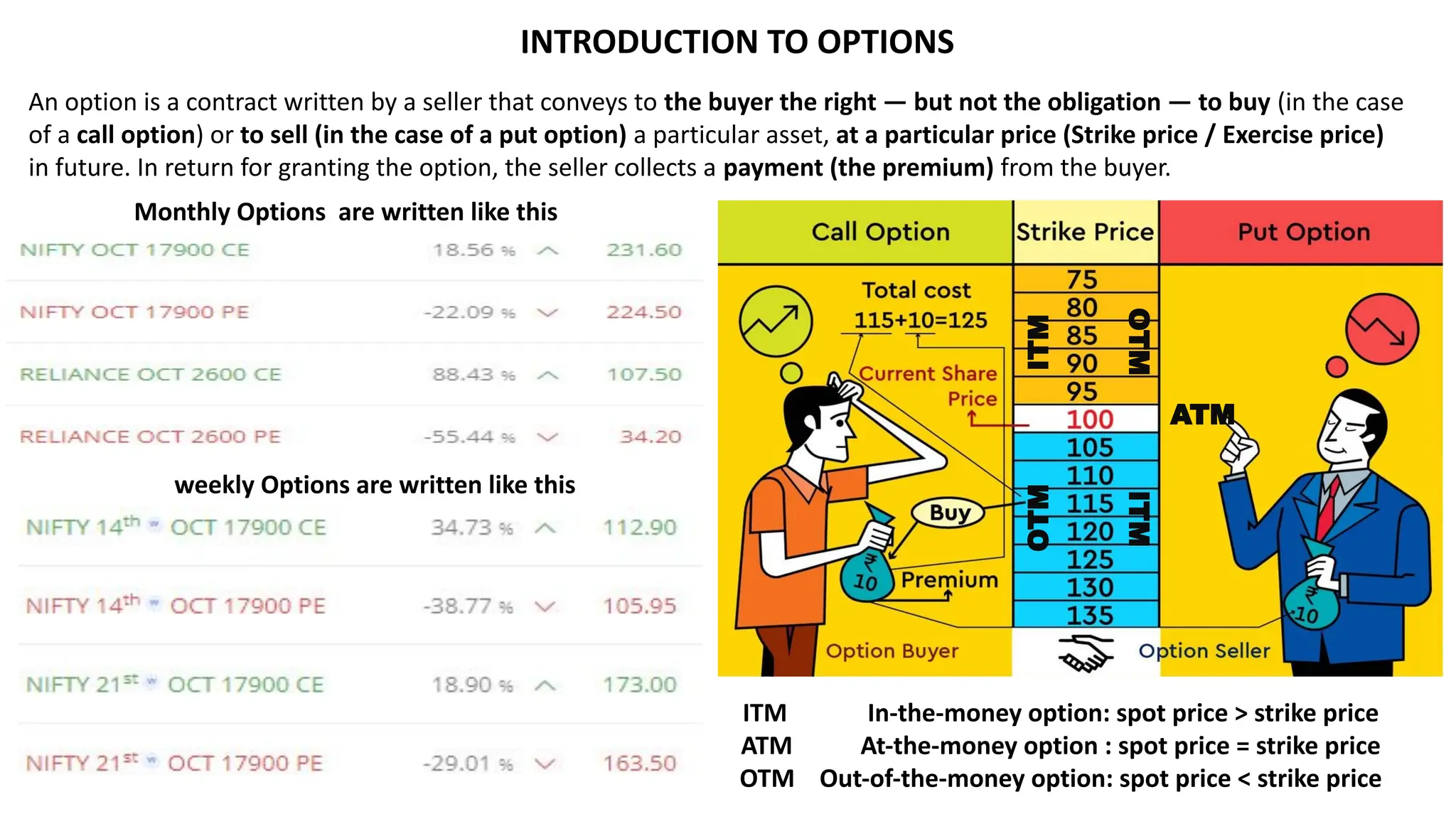
INTRODUCTION TO OPTIONS
Anoption is a contract written by a seller that conveys to the buyer the right — but not the obligation — to buy (in the case
of a call option) or to sell (in the case of a put option) a particular asset, at a particular price (Strike price / Exercise price)
in future. In return for granting the option, the seller collects a payment (the premium) from the buyer.
ITM
ITM
OTM
OTM
ATM
ITM In-the-money option: spot price > strike price
ATM At-the-money option : spot price = strike price
OTM Out-of-the-money option: spot price < strike price
Monthly Options are written like this
weekly Options are written like this
8.
OPTION TERMINOLOGY
❑ Indexoptions: These options have the index as the underlying. In India, they have a European style settlement. Eg. Nifty
options, Mini Nifty options etc.
❑ Stock options: Stock options are options on individual stocks. A stock option contract gives the holder the right to buy or
sell the underlying shares at the specified price. They have an American style settlement.
❑ Buyer of an option: The buyer of an option is the one who by paying the option premium buys the right but not the
obligation to exercise his option on the seller/writer.
❑ Writer / seller of an option: The writer / seller of a call/put option is the one who receives the option premium and is
thereby obliged to sell/buy the asset if the buyer exercises on him.
❑ Call option: A call option gives the holder the right but not the obligation to buy an asset by a certain date for a certain
price.
❑ Put option: A put option gives the holder the right but not the obligation to sell an asset by a certain date for a certain
price.
❑ Option price/premium: Option price is the price which the option buyer pays to the option seller. It is also referred to
as the option premium.
❑ Expiration date: The date specified in the options contract is known as the expiration date, the exercise date, the strike
date or the maturity.
❑ Strike price: The price specified in the options contract is known as the strike price or the exercise price.
❑ Intrinsic value of an option: The option premium can be broken down into two components - intrinsic value and time
value. The intrinsic value of a call is the amount the option is ITM, if it is ITM. If the call is OTM, its intrinsic value is zero.
Putting it another way, the intrinsic value of a call is Max[0, (St — K)].
❑ Time value of an option: The time value of an option is the difference between its premium and its intrinsic value. Both
calls and puts have time value. An option that is OTM or ATM has only time value.
9.
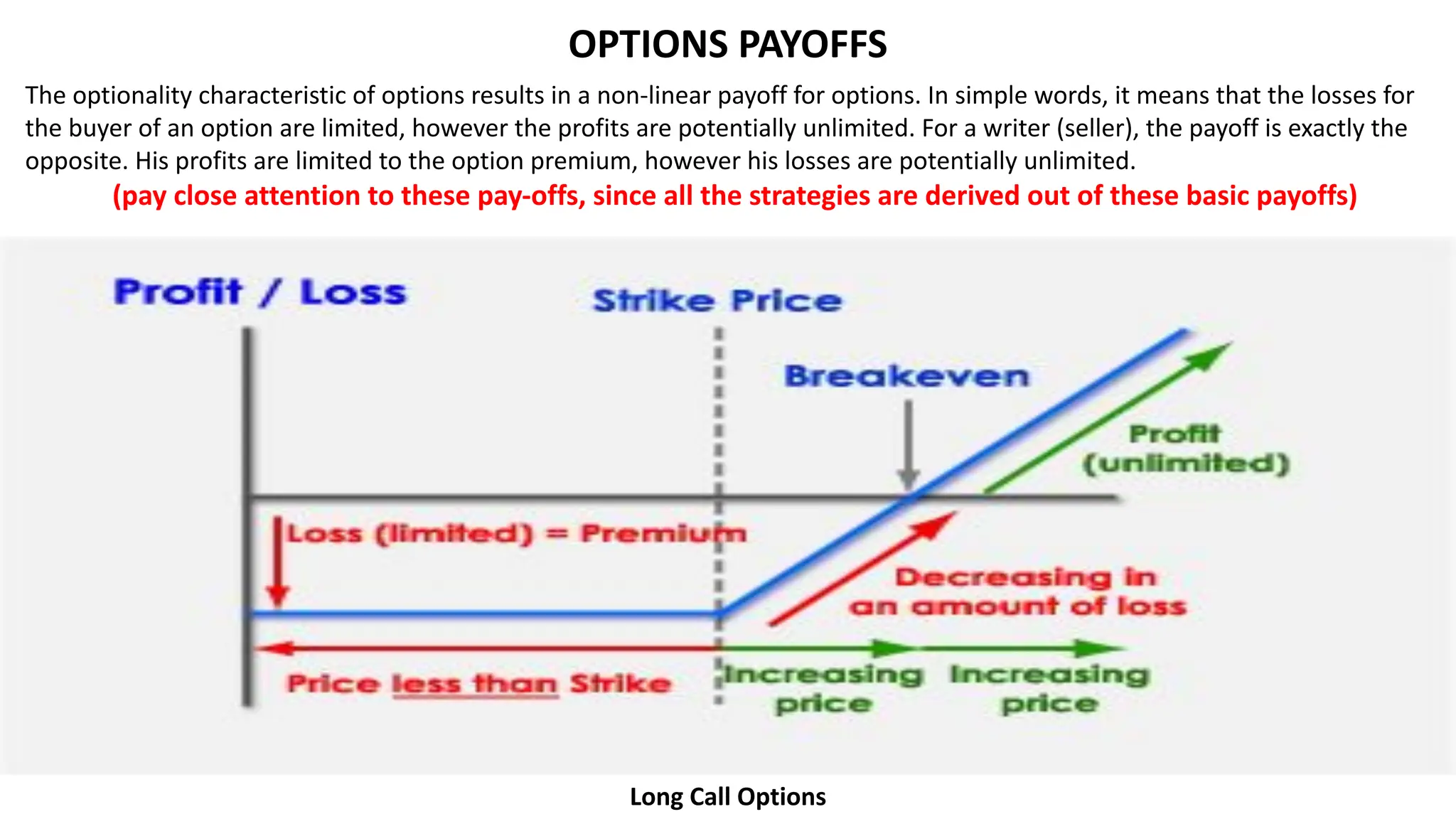
Long Call Options
OPTIONSPAYOFFS
The optionality characteristic of options results in a non-linear payoff for options. In simple words, it means that the losses for
the buyer of an option are limited, however the profits are potentially unlimited. For a writer (seller), the payoff is exactly the
opposite. His profits are limited to the option premium, however his losses are potentially unlimited.
(pay close attention to these pay-offs, since all the strategies are derived out of these basic payoffs)
![OPTION TERMINOLOGY
❑ Index options: These options have the index as the underlying. In India, they have a European style settlement. Eg. Nifty
options, Mini Nifty options etc.
❑ Stock options: Stock options are options on individual stocks. A stock option contract gives the holder the right to buy or
sell the underlying shares at the specified price. They have an American style settlement.
❑ Buyer of an option: The buyer of an option is the one who by paying the option premium buys the right but not the
obligation to exercise his option on the seller/writer.
❑ Writer / seller of an option: The writer / seller of a call/put option is the one who receives the option premium and is
thereby obliged to sell/buy the asset if the buyer exercises on him.
❑ Call option: A call option gives the holder the right but not the obligation to buy an asset by a certain date for a certain
price.
❑ Put option: A put option gives the holder the right but not the obligation to sell an asset by a certain date for a certain
price.
❑ Option price/premium: Option price is the price which the option buyer pays to the option seller. It is also referred to
as the option premium.
❑ Expiration date: The date specified in the options contract is known as the expiration date, the exercise date, the strike
date or the maturity.
❑ Strike price: The price specified in the options contract is known as the strike price or the exercise price.
❑ Intrinsic value of an option: The option premium can be broken down into two components - intrinsic value and time
value. The intrinsic value of a call is the amount the option is ITM, if it is ITM. If the call is OTM, its intrinsic value is zero.
Putting it another way, the intrinsic value of a call is Max[0, (St — K)].
❑ Time value of an option: The time value of an option is the difference between its premium and its intrinsic value. Both
calls and puts have time value. An option that is OTM or ATM has only time value.](https://image.slidesharecdn.com/options-250220062625-d5d75e89/75/Getting-started-in-Futures-Options-by-Omkar-8-2048.jpg)