PROJECTILE MOTION
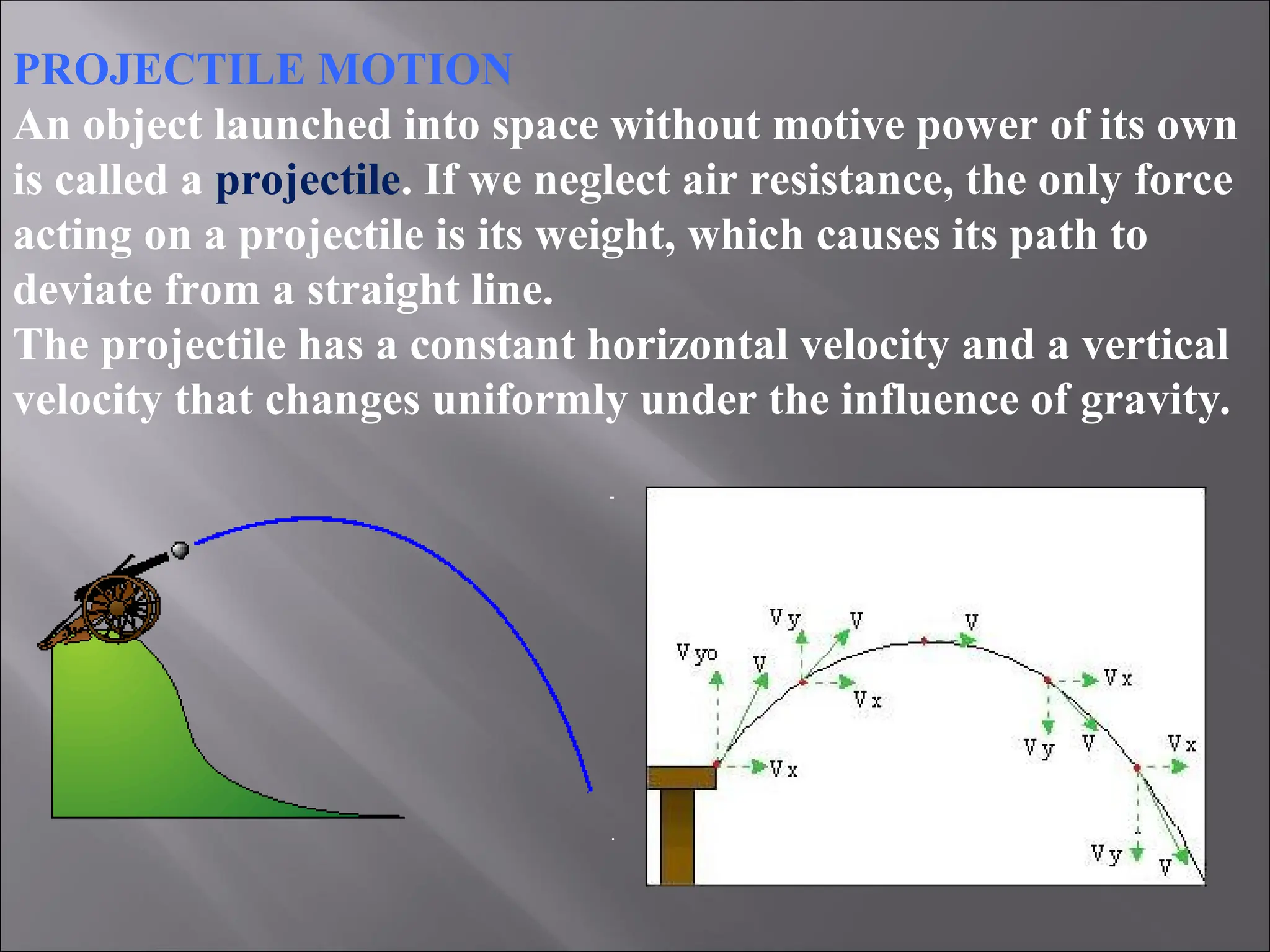
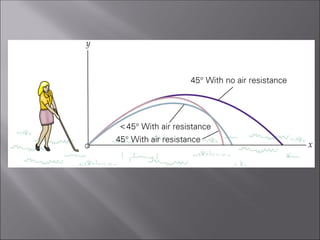
An object launched into space without motive power of its own
is called a projectile. If we neglect air resistance, the only force
acting on a projectile is its weight, which causes its path to
deviate from a straight line.
The projectile has a constant horizontal velocity and a vertical
velocity that changes uniformly under the influence of gravity.
HORIZONTAL PROJECTION
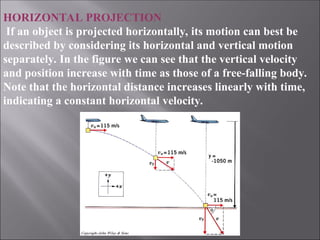
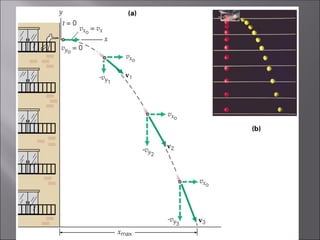
If an object is projected horizontally, its motion can best be
described by considering its horizontal and vertical motion
separately. In the figure we can see that the vertical velocity
and position increase with time as those of a free-falling body.
Note that the horizontal distance increases linearly with time,
indicating a constant horizontal velocity.
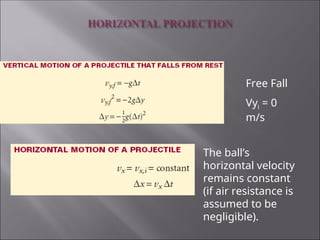
Free Fall
Vyi = 0
m/s
The ball’s
horizontal velocity
remains constant
(if air resistance is
assumed to be
negligible).
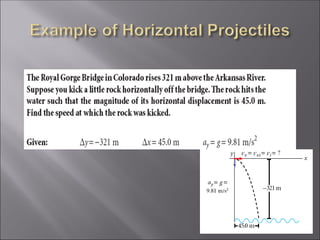
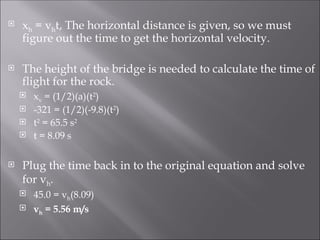
 xh = vht, The horizontal distance is given, so we must
figure out the time to get the horizontal velocity.
 The height of the bridge is needed to calculate the time of
flight for the rock.
 xv = (1/2)(a)(t2
)
 -321 = (1/2)(-9.8)(t2
)
 t2
= 65.5 s2
 t = 8.09 s
 Plug the time back in to the original equation and solve
for vh.
 45.0 = vh(8.09)
 vh = 5.56 m/s
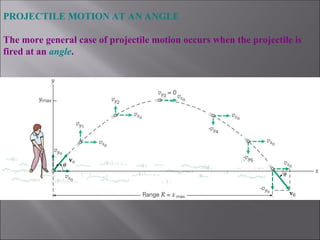
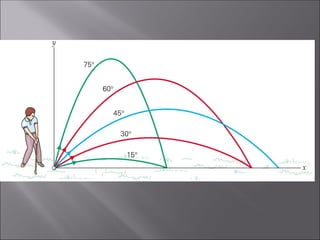
PROJECTILE MOTION AT AN ANGLE
The more general case of projectile motion occurs when the projectile is
fired at an angle.
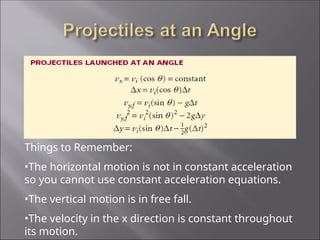
Things to Remember:
•The horizontal motion is not in constant acceleration
so you cannot use constant acceleration equations.
•The vertical motion is in free fall.
•The velocity in the x direction is constant throughout
its motion.
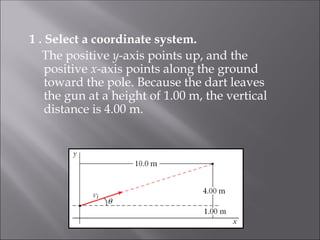
1 . Select a coordinate system.
The positive y-axis points up, and the
positive x-axis points along the ground
toward the pole. Because the dart leaves
the gun at a height of 1.00 m, the vertical
distance is 4.00 m.
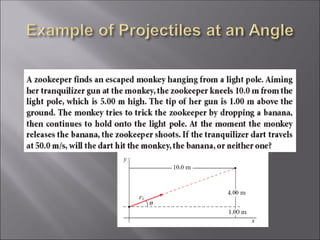
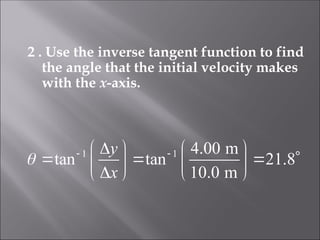
2 . Use the inverse tangent function to find
the angle that the initial velocity makes
with the x-axis.
1 1 4.00 m
tan tan 21.8
10.0 m
y
x
  

   
   
   

   
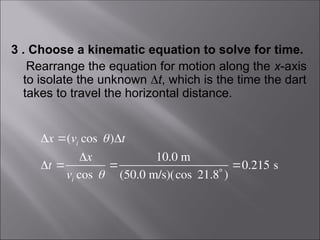
3 . Choose a kinematic equation to solve for time.
Rearrange the equation for motion along the x-axis
to isolate the unknown t, which is the time the dart
takes to travel the horizontal distance.
x (vi cos )t
t 
x
vi cos 

10.0 m
(50.0 m/s)(cos 21.8 )
0.215 s
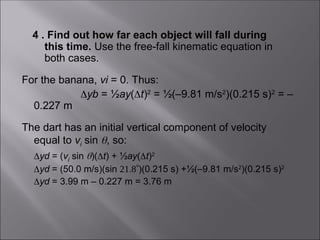
4 . Find out how far each object will fall during
this time. Use the free-fall kinematic equation in
both cases.
For the banana, vi = 0. Thus:
yb = ½ay(t)2
= ½(–9.81 m/s2
)(0.215 s)2
= –
0.227 m
The dart has an initial vertical component of velocity
equal to vi sin , so:
 yd = (vi sin )(t) + ½ay(t)2
 yd = (50.0 m/s)(sin )(0.215 s) +½(–9.81 m/s2
)(0.215 s)2
 yd = 3.99 m – 0.227 m = 3.76 m
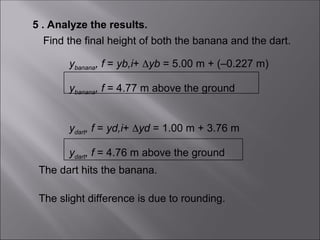
5 . Analyze the results.
Find the final height of both the banana and the dart.
ybanana, f = yb,i+ yb = 5.00 m + (–0.227 m)
ybanana, f = 4.77 m above the ground
The dart hits the banana.
The slight difference is due to rounding.
ydart, f = yd,i+ yd = 1.00 m + 3.76 m
ydart, f = 4.76 m above the ground

4_projectile_motion.ppt.ENGR.RAMSESSAMPANGPUNO

  • 1.
    PROJECTILE MOTION An objectlaunched into space without motive power of its own is called a projectile. If we neglect air resistance, the only force acting on a projectile is its weight, which causes its path to deviate from a straight line. The projectile has a constant horizontal velocity and a vertical velocity that changes uniformly under the influence of gravity.
  • 2.
    HORIZONTAL PROJECTION If anobject is projected horizontally, its motion can best be described by considering its horizontal and vertical motion separately. In the figure we can see that the vertical velocity and position increase with time as those of a free-falling body. Note that the horizontal distance increases linearly with time, indicating a constant horizontal velocity.
  • 4.
    Free Fall Vyi =0 m/s The ball’s horizontal velocity remains constant (if air resistance is assumed to be negligible).
  • 6.
     xh =vht, The horizontal distance is given, so we must figure out the time to get the horizontal velocity.  The height of the bridge is needed to calculate the time of flight for the rock.  xv = (1/2)(a)(t2 )  -321 = (1/2)(-9.8)(t2 )  t2 = 65.5 s2  t = 8.09 s  Plug the time back in to the original equation and solve for vh.  45.0 = vh(8.09)  vh = 5.56 m/s
  • 7.
    PROJECTILE MOTION ATAN ANGLE The more general case of projectile motion occurs when the projectile is fired at an angle.
  • 8.
    Things to Remember: •Thehorizontal motion is not in constant acceleration so you cannot use constant acceleration equations. •The vertical motion is in free fall. •The velocity in the x direction is constant throughout its motion.
  • 12.
    1 . Selecta coordinate system. The positive y-axis points up, and the positive x-axis points along the ground toward the pole. Because the dart leaves the gun at a height of 1.00 m, the vertical distance is 4.00 m.
  • 13.
    2 . Usethe inverse tangent function to find the angle that the initial velocity makes with the x-axis. 1 1 4.00 m tan tan 21.8 10.0 m y x                     
  • 14.
    3 . Choosea kinematic equation to solve for time. Rearrange the equation for motion along the x-axis to isolate the unknown t, which is the time the dart takes to travel the horizontal distance. x (vi cos )t t  x vi cos   10.0 m (50.0 m/s)(cos 21.8 ) 0.215 s
  • 15.
    4 . Findout how far each object will fall during this time. Use the free-fall kinematic equation in both cases. For the banana, vi = 0. Thus: yb = ½ay(t)2 = ½(–9.81 m/s2 )(0.215 s)2 = – 0.227 m The dart has an initial vertical component of velocity equal to vi sin , so:  yd = (vi sin )(t) + ½ay(t)2  yd = (50.0 m/s)(sin )(0.215 s) +½(–9.81 m/s2 )(0.215 s)2  yd = 3.99 m – 0.227 m = 3.76 m
  • 16.
    5 . Analyzethe results. Find the final height of both the banana and the dart. ybanana, f = yb,i+ yb = 5.00 m + (–0.227 m) ybanana, f = 4.77 m above the ground The dart hits the banana. The slight difference is due to rounding. ydart, f = yd,i+ yd = 1.00 m + 3.76 m ydart, f = 4.76 m above the ground