Physics Basics, Part I
Units
Units
Laws of Motion
Laws of Motion
Spring 2006
UCSD: Physics 8; 2006
2
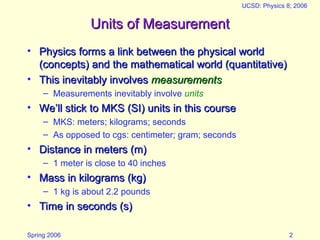
Units of Measurement
• Physics forms a link between the physical world
Physics forms a link between the physical world
(concepts) and the mathematical world (quantitative)
• This inevitably involves
This inevitably involves measurements
measurements
– Measurements inevitably involve units
• We’ll stick to MKS (SI) units in this course
We’ll stick to MKS (SI) units in this course
– MKS: meters; kilograms; seconds
– As opposed to cgs: centimeter; gram; seconds
• Distance in meters (m)
Distance in meters (m)
– 1 meter is close to 40 inches
• Mass in kilograms (kg)
Mass in kilograms (kg)
– 1 kg is about 2.2 pounds
• Time in seconds (s)
Time in seconds (s)
Spring 2006
UCSD: Physics 8; 2006
3
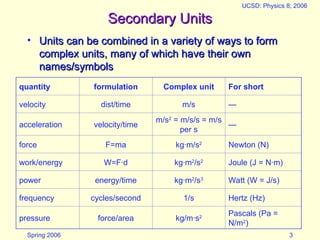
Secondary Units
Secondary Units
• Units can be combined in a variety of ways to form
Units can be combined in a variety of ways to form
complex units, many of which have their own
names/symbols
names/symbols
quantity formulation Complex unit For short
velocity dist/time m/s —
acceleration velocity/time
m/s2
= m/s/s = m/s
per s
—
force F=ma kg·m/s2
Newton (N)
work/energy W=F·d kg·m2
/s2
Joule (J = N·m)
power energy/time kg·m2
/s3
Watt (W = J/s)
frequency cycles/second 1/s Hertz (Hz)
pressure force/area kg/m·s2
Pascals (Pa =
N/m2
)
Spring 2006
UCSD: Physics 8; 2006
4
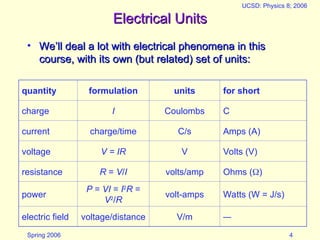
Electrical Units
Electrical Units
• We’ll deal a lot with electrical phenomena in this
We’ll deal a lot with electrical phenomena in this
course, with its own (but related) set of units:
quantity formulation units for short
charge I Coulombs C
current charge/time C/s Amps (A)
voltage V = IR V Volts (V)
resistance R = V/I volts/amp Ohms ()
power
P = VI = I2
R =
V2
/R
volt-amps Watts (W = J/s)
electric field voltage/distance V/m —
Spring 2006
UCSD: Physics 8; 2006
5
Mass and Inertia
Mass and Inertia
• Mass is how hard it is to get something to move
Mass is how hard it is to get something to move
– Intimately related to the idea of inertia
– Effectively how many protons and neutrons in the thing
– Distinct from weight, which relates to gravity
• the same mass weighs different amounts on different planets
• Inertia relates to
Inertia relates to Newton’s first law of motion
Newton’s first law of motion:
:
an object in motion will remain in that state of motion unless
acted on by an outside force
• This applies to being at rest as well as being in a
This applies to being at rest as well as being in a
state of motion
state of motion
– motion relative to what
Spring 2006
UCSD: Physics 8; 2006
6
Newton’s Second Law of Motion
• Okay, what about when there
Okay, what about when there is
is an outside force?
an outside force?
– outside: not coming from within the body; an external agent
– force: something that pushes or pulls
• Then we have Newton’s Second Law of Motion:
Then we have Newton’s Second Law of Motion:
• Great: now we have to talk about acceleration
Great: now we have to talk about acceleration
– the rabbit hole gets deeper
– but first let’s give some examples of force…
F = ma
Spring 2006
UCSD: Physics 8; 2006
7
Examples of Force
Examples of Force
• Examples:
Examples:
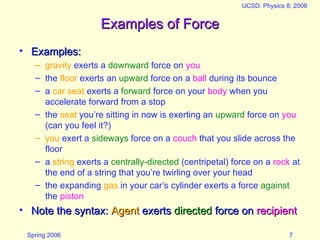
– gravity exerts a downward force on you
– the floor exerts an upward force on a ball during its bounce
– a car seat exerts a forward force on your body when you
accelerate forward from a stop
– the seat you’re sitting in now is exerting an upward force on you
(can you feel it?)
– you exert a sideways force on a couch that you slide across the
floor
– a string exerts a centrally-directed (centripetal) force on a rock at
the end of a string that you’re twirling over your head
– the expanding gas in your car’s cylinder exerts a force against
the piston
• Note the syntax:
Note the syntax: Agent
Agent exerts
exerts directed
directed force on
force on recipient
recipient
Spring 2006
UCSD: Physics 8; 2006
8
Velocity and Acceleration
• Velocity is a
Velocity is a speed
speed and
and associated
associated direction
direction
– 10 m/s toward the north
– 50 m/s straight upward
• Acceleration is
Acceleration is any
any change in velocity
change in velocity
– either in speed OR direction
• Acceleration measured as
Acceleration measured as rate of change
rate of change of velocity
of velocity
– velocity is expressed in meters per second (m/s)
– acceleration is meters per second per second
– expressed as m/s2
(meters per second-squared)
Spring 2006
UCSD: Physics 8; 2006
9
The Force-Acceleration Connection
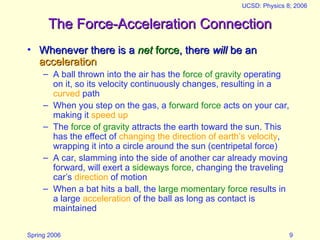
• Whenever there is a
Whenever there is a net
net force
force, there
, there will
will be an
be an
acceleration
acceleration
– A ball thrown into the air has the force of gravity operating
on it, so its velocity continuously changes, resulting in a
curved path
– When you step on the gas, a forward force acts on your car,
making it speed up
– The force of gravity attracts the earth toward the sun. This
has the effect of changing the direction of earth’s velocity,
wrapping it into a circle around the sun (centripetal force)
– A car, slamming into the side of another car already moving
forward, will exert a sideways force, changing the traveling
car’s direction of motion
– When a bat hits a ball, the large momentary force results in
a large acceleration of the ball as long as contact is
maintained
Spring 2006
UCSD: Physics 8; 2006
10
All Forces Great and Small
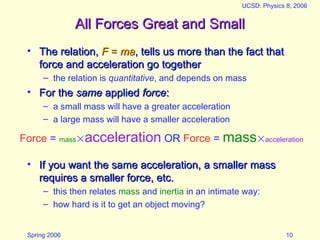
• The relation,
The relation, F
F =
= ma
ma, tells us more than the fact that
, tells us more than the fact that
force and acceleration go together
– the relation is quantitative, and depends on mass
• For the
For the same
same applied
applied force
force:
:
– a small mass will have a greater acceleration
– a large mass will have a smaller acceleration
• If you want the same acceleration, a smaller mass
If you want the same acceleration, a smaller mass
requires a smaller force, etc.
– this then relates mass and inertia in an intimate way:
– how hard is it to get an object moving?
Force = massacceleration OR Force = massacceleration
Spring 2006
UCSD: Physics 8; 2006
11
Hold On a Second…
Hold On a Second…
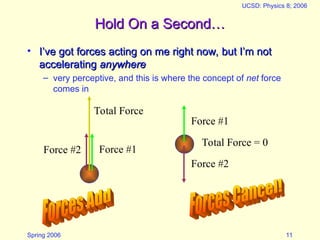
• I’ve got forces acting on me right now, but I’m not
I’ve got forces acting on me right now, but I’m not
accelerating
accelerating anywhere
anywhere
– very perceptive, and this is where the concept of net force
comes in
Force #1
Force #2
Total Force
Force #1
Force #2
Total Force = 0
Spring 2006
UCSD: Physics 8; 2006
12
Examples of Zero Net Force
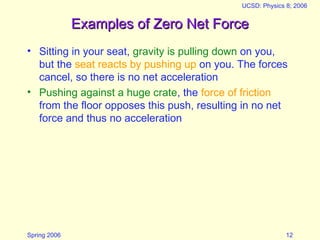
• Sitting in your seat, gravity is pulling down on you,
but the seat reacts by pushing up on you. The forces
cancel, so there is no net acceleration
• Pushing against a huge crate, the force of friction
from the floor opposes this push, resulting in no net
force and thus no acceleration
Spring 2006
UCSD: Physics 8; 2006
13
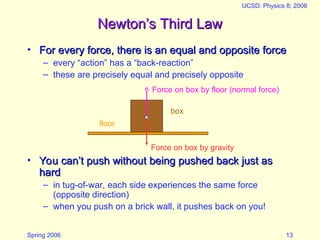
Newton’s Third Law
Newton’s Third Law
• For every force, there is an equal and opposite force
For every force, there is an equal and opposite force
– every “action” has a “back-reaction”
– these are precisely equal and precisely opposite
• You can’t push without being pushed back just as
You can’t push without being pushed back just as
hard
hard
– in tug-of-war, each side experiences the same force
(opposite direction)
– when you push on a brick wall, it pushes back on you!
Force on box by floor (normal force)
Force on box by gravity
box
floor
Spring 2006
UCSD: Physics 8; 2006
14
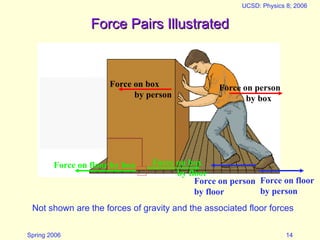
Force Pairs Illustrated
Force on person
by box
Force on floor by box Force on box
by floor
Force on box
by person
Force on person
by floor
Force on floor
by person
Not shown are the forces of gravity and the associated floor forces
Spring 2006
UCSD: Physics 8; 2006
15
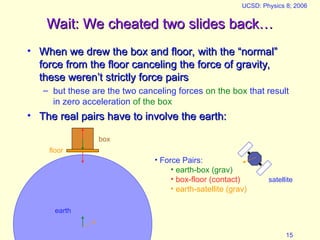
Wait: We cheated two slides back…
• When we drew the box and floor, with the “normal”
When we drew the box and floor, with the “normal”
force from the floor canceling the force of gravity,
these weren’t strictly force pairs
– but these are the two canceling forces on the box that result
in zero acceleration of the box
• The real pairs have to involve the earth:
The real pairs have to involve the earth:
box
floor
earth
satellite
• Force Pairs:
• earth-box (grav)
• box-floor (contact)
• earth-satellite (grav)
Spring 2006
UCSD: Physics 8; 2006
16
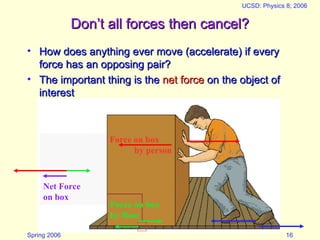
Don’t all forces then cancel?
• How does anything ever move (accelerate) if every
How does anything ever move (accelerate) if every
force has an opposing pair?
• The important thing is the
The important thing is the net force
net force on the object of
on the object of
interest
interest
Force on box
by floor
Force on box
by person
Net Force
on box
Spring 2006
UCSD: Physics 8; 2006
17
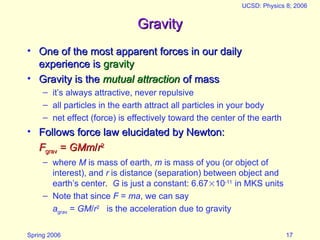
Gravity
Gravity
• One of the most apparent forces in our daily
One of the most apparent forces in our daily
experience is
experience is gravity
gravity
• Gravity is the
Gravity is the mutual attraction
mutual attraction of mass
of mass
– it’s always attractive, never repulsive
– all particles in the earth attract all particles in your body
– net effect (force) is effectively toward the center of the earth
• Follows force law elucidated by Newton:
Follows force law elucidated by Newton:
F
Fgrav
grav =
= GMm
GMm/
/r
r2
2
– where M is mass of earth, m is mass of you (or object of
interest), and r is distance (separation) between object and
earth’s center. G is just a constant: 6.6710-11
in MKS units
– Note that since F = ma, we can say
agrav = GM/r2
is the acceleration due to gravity
Spring 2006
UCSD: Physics 8; 2006
18
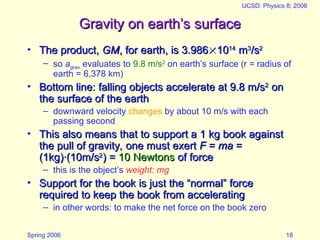
Gravity on earth’s surface
• The product,
The product, GM
GM, for earth, is 3.986
, for earth, is 3.986
10
1014
14
m
m3
3
/s
/s2
2
– so agrav evaluates to 9.8 m/s2
on earth’s surface (r = radius of
earth = 6,378 km)
• Bottom line: falling objects accelerate at 9.8 m/s
Bottom line: falling objects accelerate at 9.8 m/s2
2
on
on
the surface of the earth
– downward velocity changes by about 10 m/s with each
passing second
• This also means that to support a 1 kg book against
This also means that to support a 1 kg book against
the pull of gravity, one must exert
the pull of gravity, one must exert F
F =
= ma
ma =
=
(1kg)·(10m/s
(1kg)·(10m/s2
2
) =
) = 10 Newtons
10 Newtons of force
of force
– this is the object’s weight: mg
• Support for the book is just the “normal” force
Support for the book is just the “normal” force
required to keep the book from accelerating
– in other words: to make the net force on the book zero
Spring 2006
UCSD: Physics 8; 2006
19
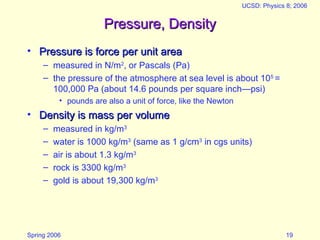
Pressure, Density
Pressure, Density
• Pressure is force per unit area
Pressure is force per unit area
– measured in N/m2
, or Pascals (Pa)
– the pressure of the atmosphere at sea level is about 105
=
100,000 Pa (about 14.6 pounds per square inch—psi)
• pounds are also a unit of force, like the Newton
• Density is mass per volume
Density is mass per volume
– measured in kg/m3
– water is 1000 kg/m3
(same as 1 g/cm3
in cgs units)
– air is about 1.3 kg/m3
– rock is 3300 kg/m3
– gold is about 19,300 kg/m3
Spring 2006
UCSD: Physics 8; 2006
20
Announcements/Assignments
• Next up:
Next up:
– energy in its myriad forms
– a simple model for molecules/lattices
– electrons, charge, current, electric fields
• Assignments:
Assignments:
– Read Chapter 1 of book
• You can skip sections on velocity, position of falling balls, as
well as section on projectile motion (pp. 15–21)
– Read Chapter 2: pp. 54–59, 61–62, 71–72
– Transmitters will start counting for credit Tuesday 4/11
– First HW will be due Thursday 4/13
– First Q/O due Friday, 4/14 by 6PM via WebCT

Physics introduction motion and forces grade 9

  • 1.
    Physics Basics, PartI Physics Basics, Part I Units Units Laws of Motion Laws of Motion
  • 2.
    Spring 2006 UCSD: Physics8; 2006 2 Units of Measurement Units of Measurement • Physics forms a link between the physical world Physics forms a link between the physical world (concepts) and the mathematical world (quantitative) (concepts) and the mathematical world (quantitative) • This inevitably involves This inevitably involves measurements measurements – Measurements inevitably involve units • We’ll stick to MKS (SI) units in this course We’ll stick to MKS (SI) units in this course – MKS: meters; kilograms; seconds – As opposed to cgs: centimeter; gram; seconds • Distance in meters (m) Distance in meters (m) – 1 meter is close to 40 inches • Mass in kilograms (kg) Mass in kilograms (kg) – 1 kg is about 2.2 pounds • Time in seconds (s) Time in seconds (s)
  • 3.
    Spring 2006 UCSD: Physics8; 2006 3 Secondary Units Secondary Units • Units can be combined in a variety of ways to form Units can be combined in a variety of ways to form complex units, many of which have their own complex units, many of which have their own names/symbols names/symbols quantity formulation Complex unit For short velocity dist/time m/s — acceleration velocity/time m/s2 = m/s/s = m/s per s — force F=ma kg·m/s2 Newton (N) work/energy W=F·d kg·m2 /s2 Joule (J = N·m) power energy/time kg·m2 /s3 Watt (W = J/s) frequency cycles/second 1/s Hertz (Hz) pressure force/area kg/m·s2 Pascals (Pa = N/m2 )
  • 4.
    Spring 2006 UCSD: Physics8; 2006 4 Electrical Units Electrical Units • We’ll deal a lot with electrical phenomena in this We’ll deal a lot with electrical phenomena in this course, with its own (but related) set of units: course, with its own (but related) set of units: quantity formulation units for short charge I Coulombs C current charge/time C/s Amps (A) voltage V = IR V Volts (V) resistance R = V/I volts/amp Ohms () power P = VI = I2 R = V2 /R volt-amps Watts (W = J/s) electric field voltage/distance V/m —
  • 5.
    Spring 2006 UCSD: Physics8; 2006 5 Mass and Inertia Mass and Inertia • Mass is how hard it is to get something to move Mass is how hard it is to get something to move – Intimately related to the idea of inertia – Effectively how many protons and neutrons in the thing – Distinct from weight, which relates to gravity • the same mass weighs different amounts on different planets • Inertia relates to Inertia relates to Newton’s first law of motion Newton’s first law of motion: : an object in motion will remain in that state of motion unless acted on by an outside force • This applies to being at rest as well as being in a This applies to being at rest as well as being in a state of motion state of motion – motion relative to what
  • 6.
    Spring 2006 UCSD: Physics8; 2006 6 Newton’s Second Law of Motion Newton’s Second Law of Motion • Okay, what about when there Okay, what about when there is is an outside force? an outside force? – outside: not coming from within the body; an external agent – force: something that pushes or pulls • Then we have Newton’s Second Law of Motion: Then we have Newton’s Second Law of Motion: • Great: now we have to talk about acceleration Great: now we have to talk about acceleration – the rabbit hole gets deeper – but first let’s give some examples of force… F = ma
  • 7.
    Spring 2006 UCSD: Physics8; 2006 7 Examples of Force Examples of Force • Examples: Examples: – gravity exerts a downward force on you – the floor exerts an upward force on a ball during its bounce – a car seat exerts a forward force on your body when you accelerate forward from a stop – the seat you’re sitting in now is exerting an upward force on you (can you feel it?) – you exert a sideways force on a couch that you slide across the floor – a string exerts a centrally-directed (centripetal) force on a rock at the end of a string that you’re twirling over your head – the expanding gas in your car’s cylinder exerts a force against the piston • Note the syntax: Note the syntax: Agent Agent exerts exerts directed directed force on force on recipient recipient
  • 8.
    Spring 2006 UCSD: Physics8; 2006 8 Velocity and Acceleration Velocity and Acceleration • Velocity is a Velocity is a speed speed and and associated associated direction direction – 10 m/s toward the north – 50 m/s straight upward • Acceleration is Acceleration is any any change in velocity change in velocity – either in speed OR direction • Acceleration measured as Acceleration measured as rate of change rate of change of velocity of velocity – velocity is expressed in meters per second (m/s) – acceleration is meters per second per second – expressed as m/s2 (meters per second-squared)
  • 9.
    Spring 2006 UCSD: Physics8; 2006 9 The Force-Acceleration Connection The Force-Acceleration Connection • Whenever there is a Whenever there is a net net force force, there , there will will be an be an acceleration acceleration – A ball thrown into the air has the force of gravity operating on it, so its velocity continuously changes, resulting in a curved path – When you step on the gas, a forward force acts on your car, making it speed up – The force of gravity attracts the earth toward the sun. This has the effect of changing the direction of earth’s velocity, wrapping it into a circle around the sun (centripetal force) – A car, slamming into the side of another car already moving forward, will exert a sideways force, changing the traveling car’s direction of motion – When a bat hits a ball, the large momentary force results in a large acceleration of the ball as long as contact is maintained
  • 10.
    Spring 2006 UCSD: Physics8; 2006 10 All Forces Great and Small All Forces Great and Small • The relation, The relation, F F = = ma ma, tells us more than the fact that , tells us more than the fact that force and acceleration go together force and acceleration go together – the relation is quantitative, and depends on mass • For the For the same same applied applied force force: : – a small mass will have a greater acceleration – a large mass will have a smaller acceleration • If you want the same acceleration, a smaller mass If you want the same acceleration, a smaller mass requires a smaller force, etc. requires a smaller force, etc. – this then relates mass and inertia in an intimate way: – how hard is it to get an object moving? Force = massacceleration OR Force = massacceleration
  • 11.
    Spring 2006 UCSD: Physics8; 2006 11 Hold On a Second… Hold On a Second… • I’ve got forces acting on me right now, but I’m not I’ve got forces acting on me right now, but I’m not accelerating accelerating anywhere anywhere – very perceptive, and this is where the concept of net force comes in Force #1 Force #2 Total Force Force #1 Force #2 Total Force = 0
  • 12.
    Spring 2006 UCSD: Physics8; 2006 12 Examples of Zero Net Force Examples of Zero Net Force • Sitting in your seat, gravity is pulling down on you, but the seat reacts by pushing up on you. The forces cancel, so there is no net acceleration • Pushing against a huge crate, the force of friction from the floor opposes this push, resulting in no net force and thus no acceleration
  • 13.
    Spring 2006 UCSD: Physics8; 2006 13 Newton’s Third Law Newton’s Third Law • For every force, there is an equal and opposite force For every force, there is an equal and opposite force – every “action” has a “back-reaction” – these are precisely equal and precisely opposite • You can’t push without being pushed back just as You can’t push without being pushed back just as hard hard – in tug-of-war, each side experiences the same force (opposite direction) – when you push on a brick wall, it pushes back on you! Force on box by floor (normal force) Force on box by gravity box floor
  • 14.
    Spring 2006 UCSD: Physics8; 2006 14 Force Pairs Illustrated Force Pairs Illustrated Force on person by box Force on floor by box Force on box by floor Force on box by person Force on person by floor Force on floor by person Not shown are the forces of gravity and the associated floor forces
  • 15.
    Spring 2006 UCSD: Physics8; 2006 15 Wait: We cheated two slides back… Wait: We cheated two slides back… • When we drew the box and floor, with the “normal” When we drew the box and floor, with the “normal” force from the floor canceling the force of gravity, force from the floor canceling the force of gravity, these weren’t strictly force pairs these weren’t strictly force pairs – but these are the two canceling forces on the box that result in zero acceleration of the box • The real pairs have to involve the earth: The real pairs have to involve the earth: box floor earth satellite • Force Pairs: • earth-box (grav) • box-floor (contact) • earth-satellite (grav)
  • 16.
    Spring 2006 UCSD: Physics8; 2006 16 Don’t all forces then cancel? Don’t all forces then cancel? • How does anything ever move (accelerate) if every How does anything ever move (accelerate) if every force has an opposing pair? force has an opposing pair? • The important thing is the The important thing is the net force net force on the object of on the object of interest interest Force on box by floor Force on box by person Net Force on box
  • 17.
    Spring 2006 UCSD: Physics8; 2006 17 Gravity Gravity • One of the most apparent forces in our daily One of the most apparent forces in our daily experience is experience is gravity gravity • Gravity is the Gravity is the mutual attraction mutual attraction of mass of mass – it’s always attractive, never repulsive – all particles in the earth attract all particles in your body – net effect (force) is effectively toward the center of the earth • Follows force law elucidated by Newton: Follows force law elucidated by Newton: F Fgrav grav = = GMm GMm/ /r r2 2 – where M is mass of earth, m is mass of you (or object of interest), and r is distance (separation) between object and earth’s center. G is just a constant: 6.6710-11 in MKS units – Note that since F = ma, we can say agrav = GM/r2 is the acceleration due to gravity
  • 18.
    Spring 2006 UCSD: Physics8; 2006 18 Gravity on earth’s surface Gravity on earth’s surface • The product, The product, GM GM, for earth, is 3.986 , for earth, is 3.986 10 1014 14 m m3 3 /s /s2 2 – so agrav evaluates to 9.8 m/s2 on earth’s surface (r = radius of earth = 6,378 km) • Bottom line: falling objects accelerate at 9.8 m/s Bottom line: falling objects accelerate at 9.8 m/s2 2 on on the surface of the earth the surface of the earth – downward velocity changes by about 10 m/s with each passing second • This also means that to support a 1 kg book against This also means that to support a 1 kg book against the pull of gravity, one must exert the pull of gravity, one must exert F F = = ma ma = = (1kg)·(10m/s (1kg)·(10m/s2 2 ) = ) = 10 Newtons 10 Newtons of force of force – this is the object’s weight: mg • Support for the book is just the “normal” force Support for the book is just the “normal” force required to keep the book from accelerating required to keep the book from accelerating – in other words: to make the net force on the book zero
  • 19.
    Spring 2006 UCSD: Physics8; 2006 19 Pressure, Density Pressure, Density • Pressure is force per unit area Pressure is force per unit area – measured in N/m2 , or Pascals (Pa) – the pressure of the atmosphere at sea level is about 105 = 100,000 Pa (about 14.6 pounds per square inch—psi) • pounds are also a unit of force, like the Newton • Density is mass per volume Density is mass per volume – measured in kg/m3 – water is 1000 kg/m3 (same as 1 g/cm3 in cgs units) – air is about 1.3 kg/m3 – rock is 3300 kg/m3 – gold is about 19,300 kg/m3
  • 20.
    Spring 2006 UCSD: Physics8; 2006 20 Announcements/Assignments Announcements/Assignments • Next up: Next up: – energy in its myriad forms – a simple model for molecules/lattices – electrons, charge, current, electric fields • Assignments: Assignments: – Read Chapter 1 of book • You can skip sections on velocity, position of falling balls, as well as section on projectile motion (pp. 15–21) – Read Chapter 2: pp. 54–59, 61–62, 71–72 – Transmitters will start counting for credit Tuesday 4/11 – First HW will be due Thursday 4/13 – First Q/O due Friday, 4/14 by 6PM via WebCT