Physical Science
- The sciences concerned with the study
of inanimate natural objects, including
physics, chemistry, astronomy and earth
science.
•The all embracing term that
constitutes to the study of origin,
properties and characteristics of
earth.
Earth Science
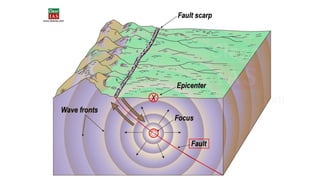
•Earthquake-A sudden ground motion or vibration
produced by a rapid release of stored-up energy.
•Epicenter-The point on the Earth's surface located
directly above the focus of an earthquake.
•Focus-The location where the earthquake begins.
The ground ruptures at this spot, then seismic
waves radiate outward in all directions.
• Fault - is a planar fracture or discontinuity in a volume of
rock, across which there has been significant displacement
as a result of rock-mass movement.
• FAULT PLANE is the plane that represents the fracture
surface of a fault
• FAULT TRACE OR FAULT LINE is a place where the fault can
be seen or mapped on the surface.
•P- waves – these are waves that can
travel through solid and liquid.
•S-waves- These are waves that can only
travel through solid only.
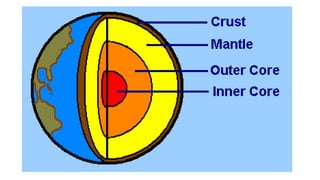
This means the liquid part of the core
blocks the passage of S-waves
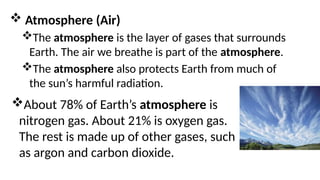
 Atmosphere (Air)
The atmosphere is the layer of gases that surrounds
Earth. The air we breathe is part of the atmosphere.
The atmosphere also protects Earth from much of
the sun’s harmful radiation.
About 78% of Earth’s atmosphere is
nitrogen gas. About 21% is oxygen gas.
The rest is made up of other gases, such
as argon and carbon dioxide.
 Hydrosphere (Water)
All the water on Earth makes up the hydrosphere.
Almost all the water in the hydrosphere is salty.
(97%)
Only 3% is fresh water.
Fresh water is found in streams, lakes, and
rivers. It is also frozen in glaciers and the polar
ice sheets and is found underground in soil and
bedrock.
The Earth’s Subsystems
 Lithosphere (Geosphere-Earth)
The lithosphere includes the crust and upper mantle
which forms the solid outer layers of the Earth.
Some natural processes, such as volcanic
eruptions, bring matter from Earth’s interior to
its surface. Other natural processes move
surface matter into Earth’s interior.
 Biosphere (Life)
The biosphere is made up of all Earth’s living
things.
Organic matter from dead organisms is also part of
the biosphere.
Once this organic matter has decomposed, it
becomes part of the other three spheres.
The biosphere extends from within Earth’s crust to
a few kilometers above Earth’s surface.
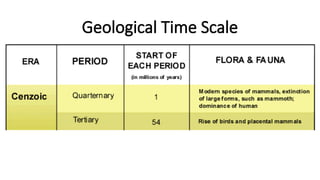
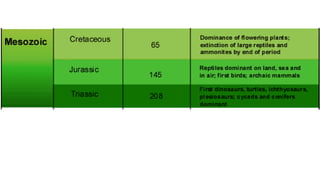
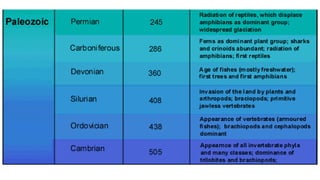
Geological Time Scale
Rocks & Mineral
Mineral Properties: Hardness
•Hardness is the resistance of a mineral to
scratching.
•Hardness is dependent on the strength of a
mineral’s chemical bonds.
•Bond strength is determined by ionic charge,
atom (or ion) size, and packing.
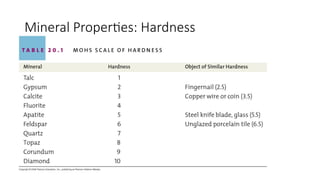
•The Mohs Scale compares the hardness of
different minerals.
Mineral Properties: Hardness
Mineral Properties: Cleavage and Fracture
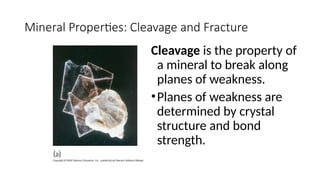
Cleavage is the property of
a mineral to break along
planes of weakness.
•Planes of weakness are
determined by crystal
structure and bond
strength.
Mineral Properties: fracture
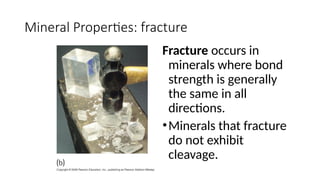
Fracture occurs in
minerals where bond
strength is generally
the same in all
directions.
•Minerals that fracture
do not exhibit
cleavage.
Mineral Properties: Color
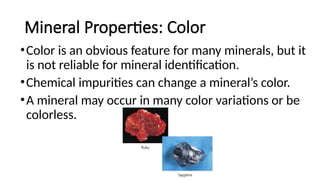
•Color is an obvious feature for many minerals, but it
is not reliable for mineral identification.
•Chemical impurities can change a mineral’s color.
•A mineral may occur in many color variations or be
colorless.
Mineral Properties: Density
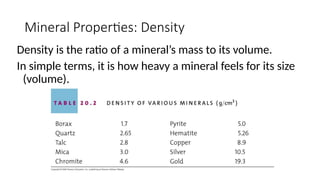
Density is the ratio of a mineral’s mass to its volume.
In simple terms, it is how heavy a mineral feels for its size
(volume).
Classification of Rock-Forming Minerals
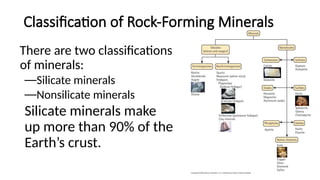
There are two classifications
of minerals:
—Silicate minerals
—Nonsilicate minerals
Silicate minerals make
up more than 90% of the
Earth’s crust.
Classification of Rock-Forming Minerals
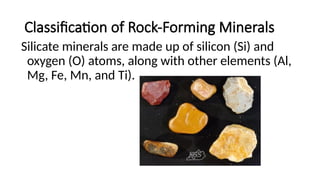
Silicate minerals are made up of silicon (Si) and
oxygen (O) atoms, along with other elements (Al,
Mg, Fe, Mn, and Ti).
Classification of Rock-Forming Minerals
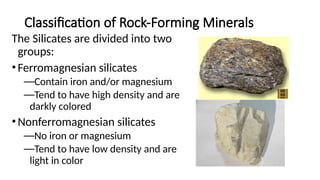
The Silicates are divided into two
groups:
•Ferromagnesian silicates
—Contain iron and/or magnesium
—Tend to have high density and are
darkly colored
•Nonferromagnesian silicates
—No iron or magnesium
—Tend to have low density and are
light in color
Classification of Rock-Forming Minerals
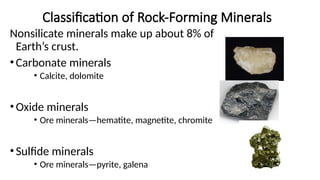
Nonsilicate minerals make up about 8% of
Earth’s crust.
•Carbonate minerals
• Calcite, dolomite
•Oxide minerals
• Ore minerals—hematite, magnetite, chromite
•Sulfide minerals
• Ore minerals—pyrite, galena
Classification of Rock-Forming Minerals
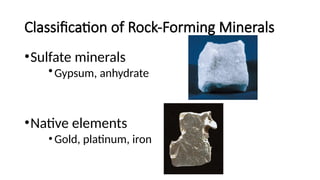
•Sulfate minerals
•Gypsum, anhydrate
•Native elements
•Gold, platinum, iron
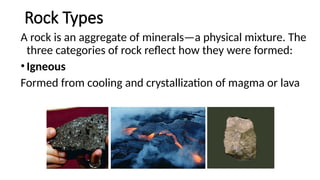
Rock Types
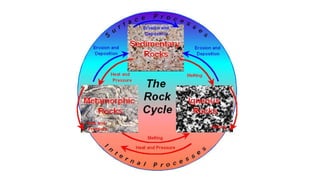
A rock is an aggregate of minerals—a physical mixture. The
three categories of rock reflect how they were formed:
•Igneous
Formed from cooling and crystallization of magma or lava
Rock Types
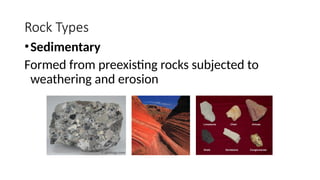
•Sedimentary
Formed from preexisting rocks subjected to
weathering and erosion
Rock Types
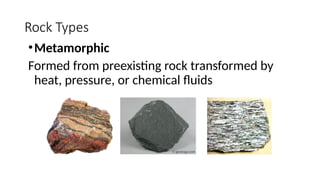
•Metamorphic
Formed from preexisting rock transformed by
heat, pressure, or chemical fluids
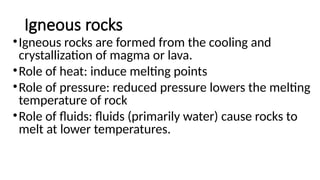
Igneous rocks
•Igneous rocks are formed from the cooling and
crystallization of magma or lava.
•Role of heat: induce melting points
•Role of pressure: reduced pressure lowers the melting
temperature of rock
•Role of fluids: fluids (primarily water) cause rocks to
melt at lower temperatures.
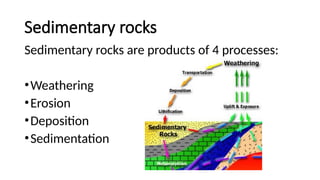
Sedimentary rocks
Sedimentary rocks are products of 4 processes:
•Weathering
•Erosion
•Deposition
•Sedimentation
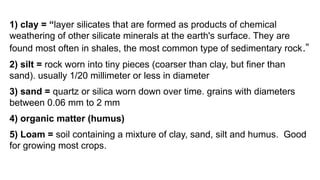
1) clay = “layer silicates that are formed as products of chemical
weathering of other silicate minerals at the earth's surface. They are
found most often in shales, the most common type of sedimentary rock.”
2) silt = rock worn into tiny pieces (coarser than clay, but finer than
sand). usually 1/20 millimeter or less in diameter
3) sand = quartz or silica worn down over time. grains with diameters
between 0.06 mm to 2 mm
4) organic matter (humus)
5) Loam = soil containing a mixture of clay, sand, silt and humus. Good
for growing most crops.
1) Clay -  porosity  permeability,  retention
2) Silt -  porosity,  permeability, retention
3) Sand -  porosity,  permeability,  retention
4) Organic matter -  porosity,  permeability,  retention
Porosity - volume of water that “fits between” the soil particles
Permeability - rate of flow of water through soil
% retention - how much water is “trapped” by soil
Porosity and Permeability are directly related; when one is high, the other is
high as well. % water retention is inversely related to both.

4th part.pptx,,,,ssaghnujnsuhsdjhdnnsjjs

  • 2.
    Physical Science - Thesciences concerned with the study of inanimate natural objects, including physics, chemistry, astronomy and earth science.
  • 3.
    •The all embracingterm that constitutes to the study of origin, properties and characteristics of earth. Earth Science
  • 11.
    •Earthquake-A sudden groundmotion or vibration produced by a rapid release of stored-up energy. •Epicenter-The point on the Earth's surface located directly above the focus of an earthquake. •Focus-The location where the earthquake begins. The ground ruptures at this spot, then seismic waves radiate outward in all directions.
  • 12.
    • Fault -is a planar fracture or discontinuity in a volume of rock, across which there has been significant displacement as a result of rock-mass movement. • FAULT PLANE is the plane that represents the fracture surface of a fault • FAULT TRACE OR FAULT LINE is a place where the fault can be seen or mapped on the surface.
  • 14.
    •P- waves –these are waves that can travel through solid and liquid. •S-waves- These are waves that can only travel through solid only. This means the liquid part of the core blocks the passage of S-waves
  • 15.
     Atmosphere (Air) Theatmosphere is the layer of gases that surrounds Earth. The air we breathe is part of the atmosphere. The atmosphere also protects Earth from much of the sun’s harmful radiation. About 78% of Earth’s atmosphere is nitrogen gas. About 21% is oxygen gas. The rest is made up of other gases, such as argon and carbon dioxide.
  • 16.
     Hydrosphere (Water) Allthe water on Earth makes up the hydrosphere. Almost all the water in the hydrosphere is salty. (97%) Only 3% is fresh water. Fresh water is found in streams, lakes, and rivers. It is also frozen in glaciers and the polar ice sheets and is found underground in soil and bedrock.
  • 17.
    The Earth’s Subsystems Lithosphere (Geosphere-Earth) The lithosphere includes the crust and upper mantle which forms the solid outer layers of the Earth. Some natural processes, such as volcanic eruptions, bring matter from Earth’s interior to its surface. Other natural processes move surface matter into Earth’s interior.
  • 18.
     Biosphere (Life) Thebiosphere is made up of all Earth’s living things. Organic matter from dead organisms is also part of the biosphere. Once this organic matter has decomposed, it becomes part of the other three spheres. The biosphere extends from within Earth’s crust to a few kilometers above Earth’s surface.
  • 19.
  • 22.
  • 23.
    Mineral Properties: Hardness •Hardnessis the resistance of a mineral to scratching. •Hardness is dependent on the strength of a mineral’s chemical bonds. •Bond strength is determined by ionic charge, atom (or ion) size, and packing. •The Mohs Scale compares the hardness of different minerals.
  • 24.
  • 25.
    Mineral Properties: Cleavageand Fracture Cleavage is the property of a mineral to break along planes of weakness. •Planes of weakness are determined by crystal structure and bond strength.
  • 26.
    Mineral Properties: fracture Fractureoccurs in minerals where bond strength is generally the same in all directions. •Minerals that fracture do not exhibit cleavage.
  • 27.
    Mineral Properties: Color •Coloris an obvious feature for many minerals, but it is not reliable for mineral identification. •Chemical impurities can change a mineral’s color. •A mineral may occur in many color variations or be colorless.
  • 28.
    Mineral Properties: Density Densityis the ratio of a mineral’s mass to its volume. In simple terms, it is how heavy a mineral feels for its size (volume).
  • 29.
    Classification of Rock-FormingMinerals There are two classifications of minerals: —Silicate minerals —Nonsilicate minerals Silicate minerals make up more than 90% of the Earth’s crust.
  • 30.
    Classification of Rock-FormingMinerals Silicate minerals are made up of silicon (Si) and oxygen (O) atoms, along with other elements (Al, Mg, Fe, Mn, and Ti).
  • 31.
    Classification of Rock-FormingMinerals The Silicates are divided into two groups: •Ferromagnesian silicates —Contain iron and/or magnesium —Tend to have high density and are darkly colored •Nonferromagnesian silicates —No iron or magnesium —Tend to have low density and are light in color
  • 32.
    Classification of Rock-FormingMinerals Nonsilicate minerals make up about 8% of Earth’s crust. •Carbonate minerals • Calcite, dolomite •Oxide minerals • Ore minerals—hematite, magnetite, chromite •Sulfide minerals • Ore minerals—pyrite, galena
  • 33.
    Classification of Rock-FormingMinerals •Sulfate minerals •Gypsum, anhydrate •Native elements •Gold, platinum, iron
  • 34.
    Rock Types A rockis an aggregate of minerals—a physical mixture. The three categories of rock reflect how they were formed: •Igneous Formed from cooling and crystallization of magma or lava
  • 35.
    Rock Types •Sedimentary Formed frompreexisting rocks subjected to weathering and erosion
  • 36.
    Rock Types •Metamorphic Formed frompreexisting rock transformed by heat, pressure, or chemical fluids
  • 38.
    Igneous rocks •Igneous rocksare formed from the cooling and crystallization of magma or lava. •Role of heat: induce melting points •Role of pressure: reduced pressure lowers the melting temperature of rock •Role of fluids: fluids (primarily water) cause rocks to melt at lower temperatures.
  • 39.
    Sedimentary rocks Sedimentary rocksare products of 4 processes: •Weathering •Erosion •Deposition •Sedimentation
  • 40.
    1) clay =“layer silicates that are formed as products of chemical weathering of other silicate minerals at the earth's surface. They are found most often in shales, the most common type of sedimentary rock.” 2) silt = rock worn into tiny pieces (coarser than clay, but finer than sand). usually 1/20 millimeter or less in diameter 3) sand = quartz or silica worn down over time. grains with diameters between 0.06 mm to 2 mm 4) organic matter (humus) 5) Loam = soil containing a mixture of clay, sand, silt and humus. Good for growing most crops.
  • 41.
    1) Clay - porosity  permeability,  retention 2) Silt -  porosity,  permeability, retention 3) Sand -  porosity,  permeability,  retention 4) Organic matter -  porosity,  permeability,  retention Porosity - volume of water that “fits between” the soil particles Permeability - rate of flow of water through soil % retention - how much water is “trapped” by soil Porosity and Permeability are directly related; when one is high, the other is high as well. % water retention is inversely related to both.