Activity: Cosmic Connection: Jumbled
UNIVERSE
Instruction: Arrange the jumbled words given.
Write your answers in your work notebook.
Objectives:
• Understand the Big bang theory
• Define Stellar Nucleosynthesis
• Analyze how heavier elements are formed
The Formation of Heavier Elements during Star
Formation and Evolution
• Stellar nucleosynthesis is the process by
which elements are formed within stars. The
abundances of these elements change as the
stars evolve.
• Elements heavier than beryllium are formed
through stellar nucleosynthesis.
Evolution of Stars
• Star formation theory- stars form due to the collapse of
the dense regions of a molecular cloud. As the cloud
collapses, the fragments contract to form a stellar core
called protostar. Due to strong gravitational force, the
protostar contracts and its temperature increases. When
the core temperature reaches about 10 million K, nuclear
reactions begin. The reactions release positrons and
neutrinos which increase pressure and stop the contraction.
When the contraction stops, the gravitational equilibrium is
reached, and the protostar has become a main sequence
star.
• In the core of a main sequence star, hydrogen is
fused into helium via the proton-proton chain. When
most of the hydrogen in the core is fused into
helium, fusion stops, and the pressure in the core
decreases. Gravity squeezes the star to a point that
helium and hydrogen burning occur. Helium is
converted to carbon in the core while hydrogen is
converted to helium in the shell surrounding the
core. The star has become a red giant
• When the majority of the helium in the core has
been converted to carbon, then the rate of fusion
decreases. Gravity again squeezes the star. In a
low-mass star (with mass less than twice the
Sun’s mass), there is not enough mass for a
carbon fusion to occur. The star’s fuel is
depleted, and over time, the outer material of the
star is blown off into space. The only thing that
remains is the hot and inert carbon core. The
star becomes a white dwarf.
• However, the fate of a massive star is different. A
massive star has enough mass such that temperature
and pressure increase to a point where carbon fusion
can occur. The star goes through a series of stages
where heavier elements are fused in the core and in
the shells around the core. The element oxygen is
formed from carbon fusion; neon from oxygen fusion;
magnesium from neon fusion: silicon from
magnesium fusion; and iron from silicon fusion. The
star becomes a multiple-shell red giant
• The fusion of elements continues until iron is formed by
silicon fusion. Elements lighter than iron can be fused
because when two of these elements combine, they
produce a nucleus with a mass lower than the sum of
their masses. The missing mass is released as energy.
Therefore, the fusion of elements lighter than iron
releases energy. However, this does not happen to iron
nuclei. Rather than releasing energy, the fusion of two
iron nuclei requires an input of energy. Therefore,
elements lighter than and including iron can be
produced in a massive star, but no elements heavier
than iron are produced.
• When the core can no longer produce energy
to resist gravity, the star is doomed. Gravity
squeezes the core until the star explodes and
releases a large amount of energy. The star
explosion is called a supernova.
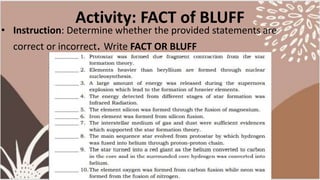
Activity: FACT of BLUFF
• Instruction: Determine whether the provided statements are
correct or incorrect. Write FACT OR BLUFF
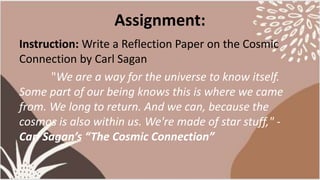
Assignment:
Instruction: Write a Reflection Paper on the Cosmic
Connection by Carl Sagan
"We are a way for the universe to know itself.
Some part of our being knows this is where we came
from. We long to return. And we can, because the
cosmos is also within us. We're made of star stuff," -
Carl Sagan’s “The Cosmic Connection”
Physical Science Lesson 1day1.pptx

Physical Science Lesson 1day1.pptx

  • 3.
    Activity: Cosmic Connection:Jumbled UNIVERSE Instruction: Arrange the jumbled words given. Write your answers in your work notebook.
  • 4.
    Objectives: • Understand theBig bang theory • Define Stellar Nucleosynthesis • Analyze how heavier elements are formed
  • 5.
    The Formation ofHeavier Elements during Star Formation and Evolution • Stellar nucleosynthesis is the process by which elements are formed within stars. The abundances of these elements change as the stars evolve. • Elements heavier than beryllium are formed through stellar nucleosynthesis.
  • 6.
    Evolution of Stars •Star formation theory- stars form due to the collapse of the dense regions of a molecular cloud. As the cloud collapses, the fragments contract to form a stellar core called protostar. Due to strong gravitational force, the protostar contracts and its temperature increases. When the core temperature reaches about 10 million K, nuclear reactions begin. The reactions release positrons and neutrinos which increase pressure and stop the contraction. When the contraction stops, the gravitational equilibrium is reached, and the protostar has become a main sequence star.
  • 7.
    • In thecore of a main sequence star, hydrogen is fused into helium via the proton-proton chain. When most of the hydrogen in the core is fused into helium, fusion stops, and the pressure in the core decreases. Gravity squeezes the star to a point that helium and hydrogen burning occur. Helium is converted to carbon in the core while hydrogen is converted to helium in the shell surrounding the core. The star has become a red giant
  • 8.
    • When themajority of the helium in the core has been converted to carbon, then the rate of fusion decreases. Gravity again squeezes the star. In a low-mass star (with mass less than twice the Sun’s mass), there is not enough mass for a carbon fusion to occur. The star’s fuel is depleted, and over time, the outer material of the star is blown off into space. The only thing that remains is the hot and inert carbon core. The star becomes a white dwarf.
  • 9.
    • However, thefate of a massive star is different. A massive star has enough mass such that temperature and pressure increase to a point where carbon fusion can occur. The star goes through a series of stages where heavier elements are fused in the core and in the shells around the core. The element oxygen is formed from carbon fusion; neon from oxygen fusion; magnesium from neon fusion: silicon from magnesium fusion; and iron from silicon fusion. The star becomes a multiple-shell red giant
  • 10.
    • The fusionof elements continues until iron is formed by silicon fusion. Elements lighter than iron can be fused because when two of these elements combine, they produce a nucleus with a mass lower than the sum of their masses. The missing mass is released as energy. Therefore, the fusion of elements lighter than iron releases energy. However, this does not happen to iron nuclei. Rather than releasing energy, the fusion of two iron nuclei requires an input of energy. Therefore, elements lighter than and including iron can be produced in a massive star, but no elements heavier than iron are produced.
  • 11.
    • When thecore can no longer produce energy to resist gravity, the star is doomed. Gravity squeezes the core until the star explodes and releases a large amount of energy. The star explosion is called a supernova.
  • 12.
    Activity: FACT ofBLUFF • Instruction: Determine whether the provided statements are correct or incorrect. Write FACT OR BLUFF
  • 13.
    Assignment: Instruction: Write aReflection Paper on the Cosmic Connection by Carl Sagan "We are a way for the universe to know itself. Some part of our being knows this is where we came from. We long to return. And we can, because the cosmos is also within us. We're made of star stuff," - Carl Sagan’s “The Cosmic Connection”