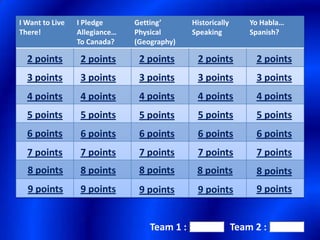
I Want to Live   I Pledge      Getting’       Historically       Yo Habla…
There!           Allegiance…   Physical       Speaking           Spanish?
                 To Canada?    (Geography)

  2 points        2 points      2 points       2 points           2 points
  3 points        3 points      3 points       3 points           3 points
  4 points        4 points      4 points       4 points           4 points
  5 points        5 points      5 points       5 points           5 points
  6 points        6 points      6 points       6 points           6 points
  7 points        7 points      7 points       7 points           7 points
  8 points        8 points      8 points       8 points           8 points
  9 points        9 points      9 points       9 points           9 points


                                   Team 1 :                  Team 2 :
I Want to Live There: 2 Points
The Question Is :
True or False: The primary reason that the
Earth’s population is unevenly distributed is
                 Stop!
that, in order to survive, people must live
               Time’s Up!
near a body of water.

The Answer Is :
False: it is because natural obstacles
Greatly restrict where people live
I Want to Live There: 3 Points
The Question Is :
Were settlers originally attracted to the South
because of the relatively flat landscape? If not,
why were they?  Stop!
            Time’s Up!
The Answer Is :
No, because of the rich soil
I Want to Live There: 4 Points
The Question Is :
The jagged shoreline of the Northeast provides
many excellent ________.
                Stop!
The Answer Is :
            Time’s Up!
Harbors
I Want to Live There: 5 Points
The Question Is :
Who has the higher percentage of people of
European descent: Guatemala or Costa Rica?
                Stop!
The Answer Is :
            Time’s Up!
Costa Rica
I Want to Live There: 6 Points
The Question Is :
About 30 percent of the population in
Suriname, is made up of ________, people of
                Stop!
mixed African and other ancestry.
            Time’s Up!
The Answer Is :
Suriname, mulattoes
I Want to Live There: 7 Points
The Question Is :
What is the largest country in Latin America?

                Stop!
The Answer Is :
Brazil
            Time’s Up!
I Want to Live There: 8 Points
The Question Is :
By encouraging ________, the government of
Brazil hopes that the country will be able to
                 Stop!
benefit economically from the riches of the rain
________ without destroying it.

               Time’s Up!
The Answer Is :
Ecotourism, forest
I Want to Live There: 9 Points
The Question Is :
Compared with Central America, Caribbean
culture is more influenced by what ethnic
group?          Stop!
            Time’s Up!
The Answer Is :
African
The US & Canada: 2 Points
The Question Is :
True or False: The Laurentian Highlands are
located in the United States and Canada.
                Stop!
            Time’s Up!
The Answer Is :
False
The US & Canada: 3 Points
The Question Is :
Which one of these has tundra regions – the
U.S., Canada, or both?
                Stop!
The Answer Time’s Up!
           Is :
Both
The US & Canada: 4 Points
The Question Is :
True or False: Coal, oil, and natural gas are all
nonrenewable resources that are vital to the
                Stop!
energy supply and economy of the US.
            Time’s Up!
The Answer Is :
True
The US & Canada: 5 Points
The Question Is :
Is the United States a NAFTA country?

The Answer Is :Stop!
Yes          Time’s Up!
The US & Canada: 6 Points
The Question Is :
Are forests vital to the energy supply and
economy of the United States?
                Stop!
The Answer Time’s Up!
           Is :
No
The US & Canada: 7 Points
The Question Is :
Both the United States and Canada have
temperate ________ regions.
                Stop!
The Answer Time’s Up!
           Is :
Grassland
The US & Canada: 8 Points
The Question Is :
Why are the peaks of the Rocky Mountains
higher and more jagged than the peaks of
                Stop!
the Appalachian Mountains?
            Time’s Up!
The Answer Is :
The Appalachians have been worn down by
rain, ice, and wind over time
The US & Canada: 9 Points
The Question Is :
The United States relies mostly on ______
______ for energy creation.
                  Stop!
                Time’s Up!
The Answer Is :
Fossil fuels
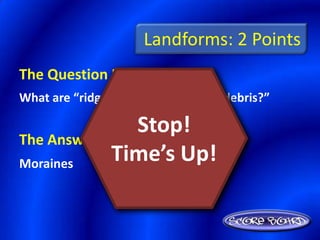
Landforms: 2 Points
The Question Is :
What are “ridgelike piles of rock and debris?”

                Stop!
The Answer Is :
Moraines
             Time’s Up!
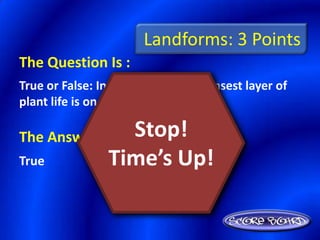
Landforms: 3 Points
The Question Is :
True or False: In rain forests, the densest layer of
plant life is on the forest floor.

The Answer Is :    Stop!
True             Time’s Up!
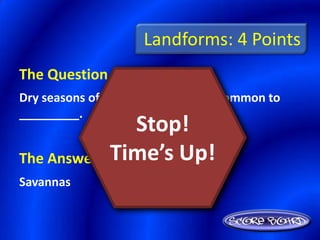
Landforms: 4 Points
The Question Is :
Dry seasons of natural wildfires are common to
_________.
               Stop!
The Answer IsTime’s Up!
             :
Savannas
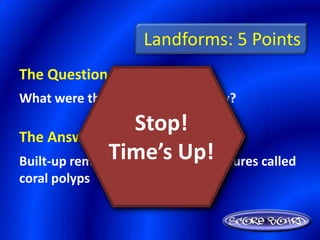
Landforms: 5 Points
The Question Is :
What were the Bahamas created by?

The Answer Is :
                    Stop!
               Time’s Up!
Built-up remains of once-living creatures called
coral polyps
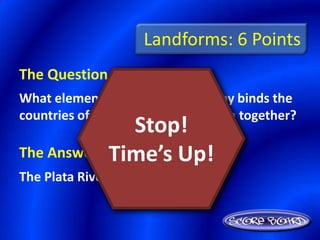
Landforms: 6 Points
The Question Is :
What element of physical geography binds the
countries of southern South America together?
                Stop!
            Time’s Up!
The Answer Is :
The Plata River system
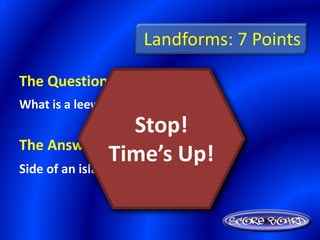
Landforms: 7 Points

The Question Is :
What is a leeward?
                Stop!
The Answer Is :
            Time’s Up!
Side of an island away from the wind
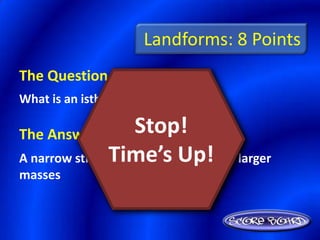
Landforms: 8 Points
The Question Is :
What is an isthmus?

The Answer Is :      Stop!
                Time’s Up!
A narrow strip of land connecting two larger
masses
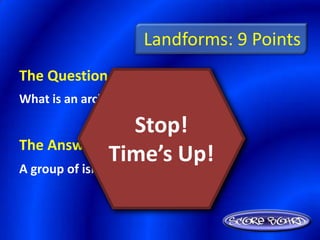
Landforms: 9 Points
The Question Is :
What is an archipelago?

                Stop!
The Answer Is :
            Time’s Up!
A group of islands
Historically Speaking: 2 Points

The Question Is :
True or False: A primary reason for the war of
independence from Spain was the unhappiness of the
                Stop!
criollos at the privileges reserved only for the
peninsulares.
              Time’s Up!
The Answer Is :
True
Historically Speaking: 3 Points

The Question Is :
Warfare between British and French colonists in North
America between 1689 and 1763 ended with what?
                Stop!
            Time’s Up!
The Answer Is :
France surrendered most of its lands to Britain
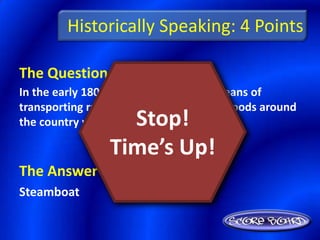
Historically Speaking: 4 Points

The Question Is :
In the early 1800’s, the most efficient means of
transporting raw materials and finished goods around
                   Stop!
the country was the ________.

                 Time’s Up!
The Answer Is :
Steamboat
Historically Speaking: 5 Points

The Question Is :
Is “giving away land in the Amazon region” a policy the
Brazilian government adopted to encourage economic
growth?            Stop!
                 Time’s Up!
The Answer Is :
Yes
Historically Speaking: 6 Points

The Question Is :
What was crucial to the success and development of
Brasilia?
                Stop!
            Time’s Up!
The Answer Is :
A massive road-building project
Historically Speaking: 7 Points

The Question Is :
The growth of Brazil’s middle class is due in large part
to government policies that have what?
                   Stop!
The Answer Is :
               Time’s Up!
Encouraged the growth of industry
Historically Speaking: 8 Points

The Question Is :
Why did little mixing of ethnic groups take place
throughout Central America’s history?
                Stop!
            Time’s Up!
The Answer Is :
Because mountains blocked travel between areas
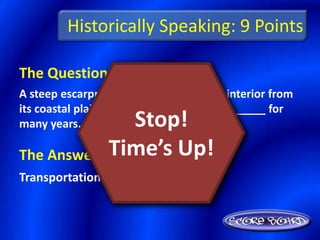
Historically Speaking: 9 Points

The Question Is :
A steep escarpment that divides Brazil’s interior from
its coastal plain formed a barrier to __________ for
many years.     Stop!
            Time’s Up!
The Answer Is :
Transportation
Central & South America: 2 Points
The Question Is :
True or False: Mexico’s heartland region is
dominated by lowlands.
                Stop!
            Time’s Up!
The Answer Is :
False: it is dominated by an elevated plateau.
Central & South America: 3 Points
The Question Is :
What is gasohol and its production has benefited
what country?
                Stop!
The Answer Is :
            Time’s Up!
An alcohol based fuel, Brazil – it has cut its need
to import foreign oil
Central & South America: 4 Points
The Question Is :
Can oil be found in the following section of
Venezuela: Guiana Highlands?
                Stop!
            Time’s Up!
The Answer Is :
No
Central & South America: 5 Points
The Question Is :
The grasslands of Argentina produce most of
Argentina’s _________ and _________.
                Stop!
            Time’s Up!
The Answer Is :
Grains and meats
Central & South America: 6 Points
The Question Is :
In Argentina, the majority of the population is of
_________ ancestry.
                Stop!
The Answer Is :
            Time’s Up!
European
Central & South America: 7 Points
The Question Is :
Brazil’s huge interior plateau drops steeply to the
lowlands beyond to form a(n) ________.
                Stop!
The Answer Is Time’s Up!
              :
Escarpment
Central & South America: 8 Points
The Question Is :
What are the communities that many of Brazil’s
urban poor live in called?
                Stop!
            Time’s Up!
The Answer Is :
Favelas
Central & South America: 9 Points
The Question Is :
Brazilians use _______ ________ to make their
alcohol based fuel called gasohol.
                Stop!
The Answer Is :
             Time’s Up!
Sugar cane

Physical Geography, America, & Canada

  • 2.
    I Want toLive I Pledge Getting’ Historically Yo Habla… There! Allegiance… Physical Speaking Spanish? To Canada? (Geography) 2 points 2 points 2 points 2 points 2 points 3 points 3 points 3 points 3 points 3 points 4 points 4 points 4 points 4 points 4 points 5 points 5 points 5 points 5 points 5 points 6 points 6 points 6 points 6 points 6 points 7 points 7 points 7 points 7 points 7 points 8 points 8 points 8 points 8 points 8 points 9 points 9 points 9 points 9 points 9 points Team 1 : Team 2 :
  • 3.
    I Want toLive There: 2 Points The Question Is : True or False: The primary reason that the Earth’s population is unevenly distributed is Stop! that, in order to survive, people must live Time’s Up! near a body of water. The Answer Is : False: it is because natural obstacles Greatly restrict where people live
  • 4.
    I Want toLive There: 3 Points The Question Is : Were settlers originally attracted to the South because of the relatively flat landscape? If not, why were they? Stop! Time’s Up! The Answer Is : No, because of the rich soil
  • 5.
    I Want toLive There: 4 Points The Question Is : The jagged shoreline of the Northeast provides many excellent ________. Stop! The Answer Is : Time’s Up! Harbors
  • 6.
    I Want toLive There: 5 Points The Question Is : Who has the higher percentage of people of European descent: Guatemala or Costa Rica? Stop! The Answer Is : Time’s Up! Costa Rica
  • 7.
    I Want toLive There: 6 Points The Question Is : About 30 percent of the population in Suriname, is made up of ________, people of Stop! mixed African and other ancestry. Time’s Up! The Answer Is : Suriname, mulattoes
  • 8.
    I Want toLive There: 7 Points The Question Is : What is the largest country in Latin America? Stop! The Answer Is : Brazil Time’s Up!
  • 9.
    I Want toLive There: 8 Points The Question Is : By encouraging ________, the government of Brazil hopes that the country will be able to Stop! benefit economically from the riches of the rain ________ without destroying it. Time’s Up! The Answer Is : Ecotourism, forest

  • 10.

    I Want toLive There: 9 Points The Question Is : Compared with Central America, Caribbean culture is more influenced by what ethnic group? Stop! Time’s Up! The Answer Is : African
  • 11.
    The US &Canada: 2 Points The Question Is : True or False: The Laurentian Highlands are located in the United States and Canada. Stop! Time’s Up! The Answer Is : False
  • 12.
    The US &Canada: 3 Points The Question Is : Which one of these has tundra regions – the U.S., Canada, or both? Stop! The Answer Time’s Up! Is : Both
  • 13.
    The US &Canada: 4 Points The Question Is : True or False: Coal, oil, and natural gas are all nonrenewable resources that are vital to the Stop! energy supply and economy of the US. Time’s Up! The Answer Is : True
  • 14.
    The US &Canada: 5 Points The Question Is : Is the United States a NAFTA country? The Answer Is :Stop! Yes Time’s Up!
  • 15.
    The US &Canada: 6 Points The Question Is : Are forests vital to the energy supply and economy of the United States? Stop! The Answer Time’s Up! Is : No
  • 16.
    The US &Canada: 7 Points The Question Is : Both the United States and Canada have temperate ________ regions. Stop! The Answer Time’s Up! Is : Grassland
  • 17.
    The US &Canada: 8 Points The Question Is : Why are the peaks of the Rocky Mountains higher and more jagged than the peaks of Stop! the Appalachian Mountains? Time’s Up! The Answer Is : The Appalachians have been worn down by rain, ice, and wind over time
  • 18.
    The US &Canada: 9 Points The Question Is : The United States relies mostly on ______ ______ for energy creation. Stop! Time’s Up! The Answer Is : Fossil fuels
  • 19.
    Landforms: 2 Points TheQuestion Is : What are “ridgelike piles of rock and debris?” Stop! The Answer Is : Moraines Time’s Up!
  • 20.
    Landforms: 3 Points TheQuestion Is : True or False: In rain forests, the densest layer of plant life is on the forest floor. The Answer Is : Stop! True Time’s Up!
  • 21.
    Landforms: 4 Points TheQuestion Is : Dry seasons of natural wildfires are common to _________. Stop! The Answer IsTime’s Up! : Savannas
  • 22.
    Landforms: 5 Points TheQuestion Is : What were the Bahamas created by? The Answer Is : Stop! Time’s Up! Built-up remains of once-living creatures called coral polyps
  • 23.
    Landforms: 6 Points TheQuestion Is : What element of physical geography binds the countries of southern South America together? Stop! Time’s Up! The Answer Is : The Plata River system
  • 24.
    Landforms: 7 Points TheQuestion Is : What is a leeward? Stop! The Answer Is : Time’s Up! Side of an island away from the wind
  • 25.
    Landforms: 8 Points TheQuestion Is : What is an isthmus? The Answer Is : Stop! Time’s Up! A narrow strip of land connecting two larger masses
  • 26.
    Landforms: 9 Points TheQuestion Is : What is an archipelago? Stop! The Answer Is : Time’s Up! A group of islands
  • 27.
    Historically Speaking: 2Points The Question Is : True or False: A primary reason for the war of independence from Spain was the unhappiness of the Stop! criollos at the privileges reserved only for the peninsulares. Time’s Up! The Answer Is : True
  • 28.
    Historically Speaking: 3Points The Question Is : Warfare between British and French colonists in North America between 1689 and 1763 ended with what? Stop! Time’s Up! The Answer Is : France surrendered most of its lands to Britain
  • 29.
    Historically Speaking: 4Points The Question Is : In the early 1800’s, the most efficient means of transporting raw materials and finished goods around Stop! the country was the ________. Time’s Up! The Answer Is : Steamboat
  • 30.
    Historically Speaking: 5Points The Question Is : Is “giving away land in the Amazon region” a policy the Brazilian government adopted to encourage economic growth? Stop! Time’s Up! The Answer Is : Yes
  • 31.
    Historically Speaking: 6Points The Question Is : What was crucial to the success and development of Brasilia? Stop! Time’s Up! The Answer Is : A massive road-building project
  • 32.
    Historically Speaking: 7Points The Question Is : The growth of Brazil’s middle class is due in large part to government policies that have what? Stop! The Answer Is : Time’s Up! Encouraged the growth of industry
  • 33.
    Historically Speaking: 8Points The Question Is : Why did little mixing of ethnic groups take place throughout Central America’s history? Stop! Time’s Up! The Answer Is : Because mountains blocked travel between areas
  • 34.
    Historically Speaking: 9Points The Question Is : A steep escarpment that divides Brazil’s interior from its coastal plain formed a barrier to __________ for many years. Stop! Time’s Up! The Answer Is : Transportation
  • 35.
    Central & SouthAmerica: 2 Points The Question Is : True or False: Mexico’s heartland region is dominated by lowlands. Stop! Time’s Up! The Answer Is : False: it is dominated by an elevated plateau.
  • 36.
    Central & SouthAmerica: 3 Points The Question Is : What is gasohol and its production has benefited what country? Stop! The Answer Is : Time’s Up! An alcohol based fuel, Brazil – it has cut its need to import foreign oil
  • 37.
    Central & SouthAmerica: 4 Points The Question Is : Can oil be found in the following section of Venezuela: Guiana Highlands? Stop! Time’s Up! The Answer Is : No
  • 38.
    Central & SouthAmerica: 5 Points The Question Is : The grasslands of Argentina produce most of Argentina’s _________ and _________. Stop! Time’s Up! The Answer Is : Grains and meats
  • 39.
    Central & SouthAmerica: 6 Points The Question Is : In Argentina, the majority of the population is of _________ ancestry. Stop! The Answer Is : Time’s Up! European
  • 40.
    Central & SouthAmerica: 7 Points The Question Is : Brazil’s huge interior plateau drops steeply to the lowlands beyond to form a(n) ________. Stop! The Answer Is Time’s Up! : Escarpment
  • 41.
    Central & SouthAmerica: 8 Points The Question Is : What are the communities that many of Brazil’s urban poor live in called? Stop! Time’s Up! The Answer Is : Favelas
  • 42.
    Central & SouthAmerica: 9 Points The Question Is : Brazilians use _______ ________ to make their alcohol based fuel called gasohol. Stop! The Answer Is : Time’s Up! Sugar cane