Physical Database Design
Lecture:26
Instructor : Irfan Ahmed
Objective
•Basic goal is data processing efficiency
•Transforms logical DB design into
technical specifications for storing and
retrieving data
•Does not include practically
implementing the design however tool
specific decisions are involved
Inputs Required
•Normalized relations
•Definitions of each attribute
•Descriptions of data usage
•Requirements for response time, data
security, backup etc.
•Tool to be used
Decisions Involved
1. Choosing data types
2. Grouping attributes (although
normalized)
3. Deciding file organizations
4. Selecting structures
5. Preparing strategies for efficient access
Data Volume and Usage Analysis
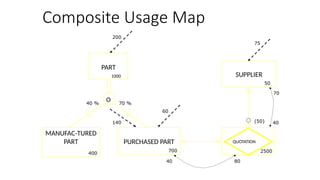
• Statistics about the size and usage of data plays
critical role in data processing efficiency
• Final step of logical DB design or first step in physical
DB design
Data Volume and Usage Analysis
Statistics collected during
analysis phase from the users of
the system
May not be accurate; give the
tentative and relevant figures
Composite Usage Map
PART
1000
MANUFAC-TURED
PART PURCHASED PART
O
QUOTATION
SUPPLIER
2500
40 % 70 %
50
140
200
60
40 80
75
(50) 40
70
700
400
Designing Fields
• Field is smallest unit of application data; corresponds to a
simple attribute
• Involves different decisions about fields
Choosing Data Type
• Data type is defined as set of values along with the operations that
can be performed on them
• Precisely depends on the particular DBMS
Choosing Data Types
• Involves four objectives
• Minimize storage space
• Represent all possible values
• Improve data integrity
• Support all data manipulation
Coding Techniques
• Values of the attributes with small domains can be
replaced by codes
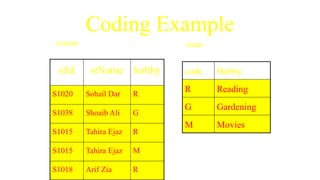
• Codes can be stored in lookup table or can be hard
coded, example
Coding Example
stId stName hobby
S1020 Sohail Dar Reading
S1038 Shoaib Ali Gardening
S1015 Tahira Ejaz Reading
S1015 Tahira Ejaz Movies
S1018 Arif Zia Reading
STUDENT
Coding Example
stId stName hobby
S1020 Sohail Dar R
S1038 Shoaib Ali G
S1015 Tahira Ejaz R
S1015 Tahira Ejaz M
S1018 Arif Zia R
code Hobby
R Reading
G Gardening
M Movies
STUDENT HOBBY
Controlling Data Integrity
• Concerns the possible values that a field can assume
• First such control is enforced by the data type
• Some others are…
Controlling Data Integrity
• Default value
• Range control
• Null values
• Referential integrity
• Handling missing data
THANK YOU!

Physical database design 1.pptx

  • 1.
  • 2.
    Objective •Basic goal isdata processing efficiency •Transforms logical DB design into technical specifications for storing and retrieving data •Does not include practically implementing the design however tool specific decisions are involved
  • 3.
    Inputs Required •Normalized relations •Definitionsof each attribute •Descriptions of data usage •Requirements for response time, data security, backup etc. •Tool to be used
  • 4.
    Decisions Involved 1. Choosingdata types 2. Grouping attributes (although normalized) 3. Deciding file organizations 4. Selecting structures 5. Preparing strategies for efficient access
  • 5.
    Data Volume andUsage Analysis • Statistics about the size and usage of data plays critical role in data processing efficiency • Final step of logical DB design or first step in physical DB design
  • 6.
    Data Volume andUsage Analysis Statistics collected during analysis phase from the users of the system May not be accurate; give the tentative and relevant figures
  • 7.
    Composite Usage Map PART 1000 MANUFAC-TURED PARTPURCHASED PART O QUOTATION SUPPLIER 2500 40 % 70 % 50 140 200 60 40 80 75 (50) 40 70 700 400
  • 8.
    Designing Fields • Fieldis smallest unit of application data; corresponds to a simple attribute • Involves different decisions about fields
  • 9.
    Choosing Data Type •Data type is defined as set of values along with the operations that can be performed on them • Precisely depends on the particular DBMS
  • 10.
    Choosing Data Types •Involves four objectives • Minimize storage space • Represent all possible values • Improve data integrity • Support all data manipulation
  • 11.
    Coding Techniques • Valuesof the attributes with small domains can be replaced by codes • Codes can be stored in lookup table or can be hard coded, example
  • 12.
    Coding Example stId stNamehobby S1020 Sohail Dar Reading S1038 Shoaib Ali Gardening S1015 Tahira Ejaz Reading S1015 Tahira Ejaz Movies S1018 Arif Zia Reading STUDENT
  • 13.
    Coding Example stId stNamehobby S1020 Sohail Dar R S1038 Shoaib Ali G S1015 Tahira Ejaz R S1015 Tahira Ejaz M S1018 Arif Zia R code Hobby R Reading G Gardening M Movies STUDENT HOBBY
  • 14.
    Controlling Data Integrity •Concerns the possible values that a field can assume • First such control is enforced by the data type • Some others are…
  • 15.
    Controlling Data Integrity •Default value • Range control • Null values • Referential integrity • Handling missing data
  • 16.